


I lost R4,200 in under an hour because I was trading the wrong session.

David van der Merwe
신흥시장 트레이더 ·  South Africa
☕ 10 분 소요
배울 내용:
I lost R4,200 in under an hour because I was trading the wrong session. It was a Tuesday morning, SAST, and I was trying to scalp USD/ZAR during the dead zone between the Asian close and the London open. The spread was 8 pips wide, the price moved like molasses, and then it jerked violently on a tiny piece of news, hitting my stop-loss before I could blink. That's the cost of not understanding the rhythm of the market's 24-hour clock. The different forex trading sessions aren't just opening times; they're distinct markets with their own personalities, liquidity, and dangers. For a South African trader, aligning your local SAST clock with these global pulses isn't just smart, it's survival.
Forex never sleeps, but it sure does nap. The market is open 24/5, but it's not a constant stream of action. It's a relay race where the baton of liquidity is passed from one major financial center to the next. Think of it like a wave that builds, peaks, and crashes four times a day. If you're trading when the wave is just a ripple, you'll get eaten by spreads and slippage. If you catch it at the peak, you can ride serious momentum.
For us in South Africa, this is doubly important. Our market, the ZAR, is an exotic. It doesn't have the deep, always-on liquidity of the Euro or Dollar. It comes alive when its trading partners are awake and active. Trying to trade EUR/ZAR when Europe is asleep is a fool's errand. You're trading a ghost. The different forex trading sessions dictate which currency pairs are 'in play' and which are best left alone. I learned this the hard way with that R4,200 loss. Now, I treat the session schedule like my trading bible.

Warning: Trading exotic pairs like USD/ZAR or EUR/ZAR outside of their primary session overlap hours is asking for trouble. You'll face wider spreads (Pepperstone's 5-14 pips on ZAR pairs is normal) and unpredictable, news-driven spikes.
Let's map the global sessions to our South African Standard Time (SAST, GMT+2). Forget GMT for a second; this is your local reality.
The Sydney Session (00:00 – 09:00 SAST)
This is the quiet opener. It kicks off at midnight our time. Honestly, unless you're a night owl trading AUD or NZD pairs, you can mostly ignore this one. Liquidity is thin. It's a time for setting up analysis, not for executing big trades. The price action here often sets a range that gets broken later.
The Tokyo/Asian Session (02:00 – 11:00 SAST)
Now we're getting somewhere. This session adds the Japanese Yen (JPY) and Asian currencies to the mix. The action really picks up around 04:00 SAST. It's known for range-bound trading. Big, sustained trends are rare here; it's more about technical bounces within channels. If you're a fan of scalping strategy in a predictable range, the middle of this session (say, 06:00-09:00 SAST) can be your playground. Just don't expect massive moves.
The London/European Session (10:00 – 19:00 SAST)
This is the main event. The big money flows when London opens. Liquidity skyrockets, spreads on majors like EUR/USD tighten, and real trends begin. For South African traders, this is where our market wakes up. The ZAR pairs become significantly more active as European banks and funds deal with emerging market currencies. The first two hours after the open (10:00-12:00 SAST) are often the most volatile and directional.
The New York Session (16:00 – 01:00 SAST)
London's still open when New York kicks in at 16:00 SAST. This overlap (16:00-19:00 SAST) is the absolute peak of the trading day. Maximum liquidity, maximum volatility. It's where most of the day's volume happens and where major daily trends are often confirmed or reversed. After London closes at 19:00 SAST, New York carries on, but the market slowly winds down into the evening.

Example: My most profitable EUR/USD trade last quarter was during the London-New York overlap. I entered a buy at 1.0725 at 16:30 SAST on a clear breakout, rode the momentum, and took profit at 1.0780 just before 19:00 SAST. The high volume meant my 0.5 pip spread from IC Markets review held firm, and the move was clean.

💡 윈스턴의 팁
The market's personality changes with each session. London is a decisive executive, Tokyo is a careful accountant, and New York is a caffeinated pit trader. Trade the personality, not just the price.
“The different forex trading sessions aren't just opening times; they're distinct markets with their own personalities, liquidity, and dangers.”
This is where the session knowledge pays your rent. The Rand is sensitive. It dances to the tune of commodity prices (gold, platinum), local politics, and global risk sentiment. But it only trades with real volume when its counterparties are at their desks.
Your prime time for USD/ZAR, EUR/ZAR, or GBP/ZAR is unequivocally the London session overlap with South Africa's own business day (10:00-19:00 SAST). This is when European banks are actively pricing and hedging their ZAR exposure. The New York overlap (16:00-19:00) adds another layer of liquidity. I never, ever hold a significant ZAR position outside of these hours unless it's a multi-day swing trading play where I can absorb the wider overnight spreads.
Remember the FSCA's 30:1 use limit? It feels restrictive, but on a volatile pair like USD/ZAR that can move 500 pips in a bad day, it's probably saving you from yourself. Use a position size calculator religiously. A 50-pip stop-loss on USD/ZAR is nothing, and with a typical 5-pip spread, you're already starting 10% of your risk in the hole.

Pro Tip: Watch XAU/USD guide (Gold) during the London session if you're trading ZAR pairs. A strong move in gold often pulls the Rand along with it, as SA is a major producer. It's not a perfect correlation, but it's a useful context clue.
You wouldn't use a fishing net to catch a trout. Don't use a scalping strategy in a session built for ranges.
- Scalping & High-Frequency: You need tight spreads and quick execution. Aim for the London and New York session overlaps. This is when brokers like Exness review or IC Markets with their raw spreads shine. The Asian session can work, but only on the most liquid pairs (EUR/USD, USD/JPY) and you're fighting smaller ranges.
- Day Trading (My Bread and Butter): The London open (10:00 SAST) and the London-New York overlap (16:00-19:00 SAST) are your hunting grounds. This is where you get clear breakouts from the Asian range and sustained momentum. I use the MACD indicator and price action here more than anything else.
- Swing Trading: Sessions matter less for entry, but they matter a ton for execution. Always place your swing trade entries during the London or New York session to get a decent fill. Placing an order on USD/ZAR at 03:00 SAST will get you murdered on the spread. Manage your positions around key session opens/closes, as these are common reversal points.
Here’s a brutal truth I learned: My early attempts at using the RSI indicator for overbought/oversold signals failed miserably in the London session. In a strong trend, RSI can stay pegged at 70 or 30 for hours. I was fading trends that just kept running. Now I use RSI more in the Asian session's ranges and use trend-following tools for London.
“Your prime time for USD/ZAR is the London session overlap with South Africa's own business day. Everything else is just paying spread to your broker.”
You can't be staring at a world clock all day. Automate this.
- Session Indicator on Your Chart: This is non-negotiable. Get an MT4/MT5 indicator that shades the different forex trading sessions on your chart in different colors. Seeing the London session turn green visually reminds you the game has changed.
- Economic Calendar with SAST Timings: Filter your calendar to show only high-impact news for the sessions you trade. If you're a London session trader, know what's coming out at 11:00 SAST (UK data) or 12:00 SAST (EU data).
- Set Alarms: I have a gentle alarm at 09:45 SAST: "London in 15." It's my cue to stop analyzing and start watching the 15-minute chart for the opening range.
- The Wind-Down Rule: After 19:00 SAST (London close), I don't open new positions. I might manage existing ones, but the market character shifts. It's when weird, low-liquidity moves can happen. It's also when I review my trades from the London/New York overlap.
The right platform helps. Most FSCA-regulated brokers offer MT5, which has more built-in timeframe flexibility than MT4. But the real edge comes from tools that help you execute within these windows.
💡 윈스턴의 팁
Your most dangerous trade is the one you place out of boredom between sessions. If the market is sleeping, you should be too. Go for a walk. The charts will still be there when London wakes up.
Let me save you some money by listing my past mistakes.
- Trading the 'Dead Zone': The period from about 21:00 SAST to 02:00 SAST (after New York winds down, before Asia really gets going) is a graveyard. Spreads widen, and any movement is usually meaningless noise. Go to sleep.
- Ignoring the SAST/London Open Lag: Our 10:00 SAST is the official London open, but the big banks are already active by 09:30 SAST. Don't be surprised if a move starts 20-30 minutes early.
- Overtrading the Asian Session: Because it's our morning, there's a temptation to trade it. It's often slow. Forcing trades in low volatility leads to revenge trading later. Use it for analysis, not action.
- Forgetting About Friday Close & Sunday Open: The market closes Friday night New York time (around 01:00 SAST Saturday) and re-opens Sunday night with the Sydney session (00:00 SAST Monday). The Sunday open can have gaps, especially on ZAR pairs if there was local political news over the weekend. Always check the Sunday chart before you start trading Monday morning.
- Not Accounting for Wider Spreads at Session Open/Close: When a session opens or closes, spreads can temporarily widen as liquidity providers adjust. If you have a tight stop-loss, you can get taken out by this spread expansion, not by a real price move. Give your stops a little more breathing room around these times.
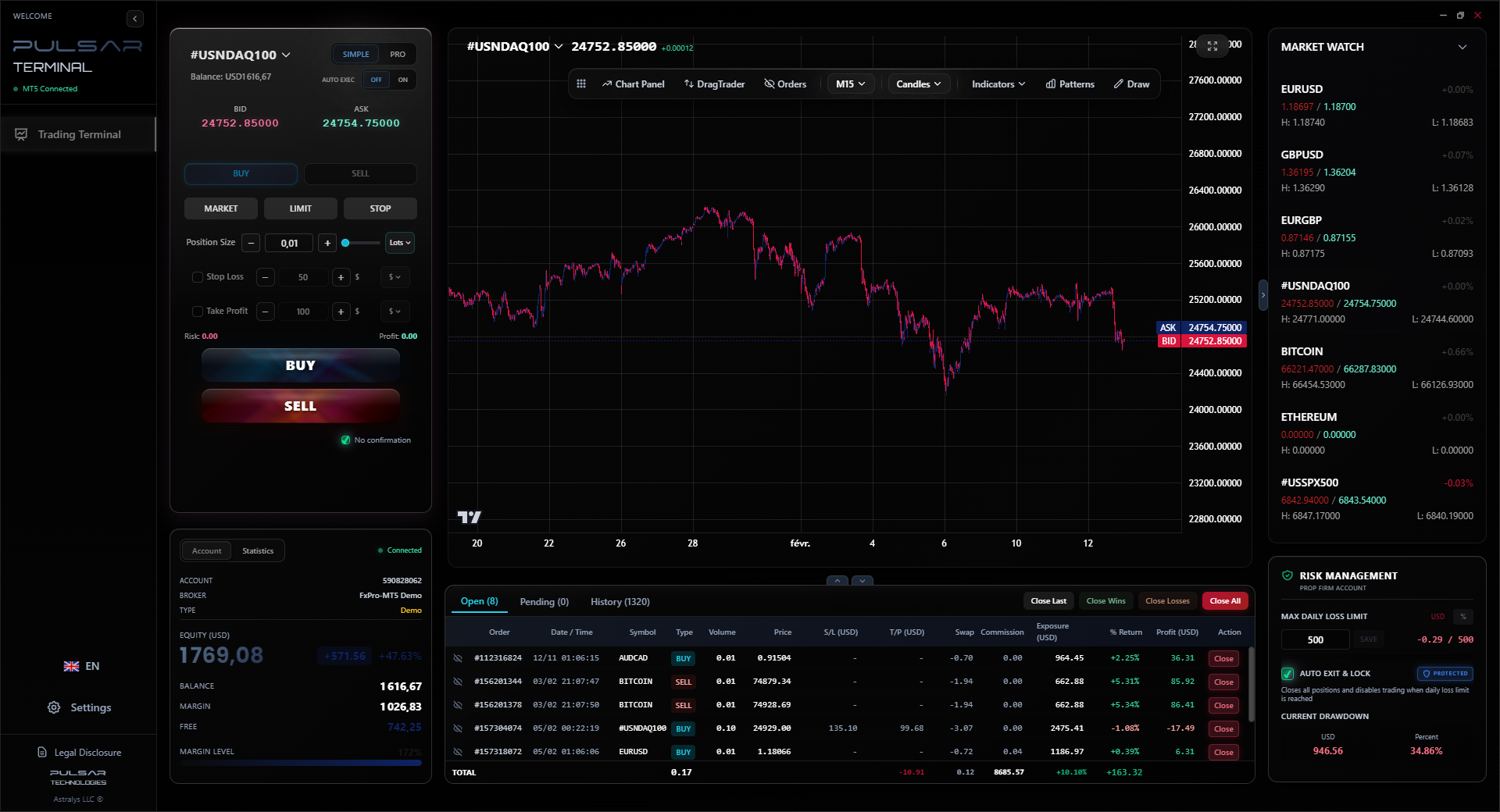
Managing trades across volatile session overlaps is stressful, but tools like Pulsar Terminal automate trailing stops and multi-level take-profits directly on your MT5 chart, so you can focus on the session's flow, not your mouse.
Pulsar Terminal
MT5 올인원 도구: 드래그앤드롭 주문, 다중 TP/SL, 트레일링 스톱, 그리드 트레이딩, 볼륨 프로파일, 프롭펌 보호. 매일 1,000명 이상의 트레이더가 사용.
“Quality of timing beats quantity of screen time every time. You don't need to trade 24 hours; you need to trade the right 4.”
Here’s what a disciplined trading day looks like for me, a day trader focused on EUR/USD and USD/ZAR:
- 06:00 - 09:00 SAST (Asian Session): I'm awake, but not trading. I review the overnight price action, mark key support/resistance levels on my charts, and scan the economic calendar. I plan my potential trades for the London open. No executions.
- 09:45 - 10:30 SAST (London Pre-Open/Open): I'm at my desk. I watch the 15-minute chart form its first candle of the London session. I look for a breakout of the Asian range. This is my highest-probability entry window. I might use a pending order to catch a break of the high/low.
- 10:30 - 16:00 SAST (Core London Session): I'm actively managing open trades, looking for follow-through. I avoid trading major news releases unless I'm already in a position.
- 16:00 - 19:00 SAST (London-New York Overlap): Maximum alertness. This is when trends accelerate or reverse. I look to take profits on successful London-session trades here. I'm very cautious about opening new positions after 17:30 SAST unless the trend is exceptionally strong.
- After 19:00 SAST: I close all day-trade charts. I might check on any swing positions, but I do not initiate anything new. The rest of the evening is for backtesting, education, and forgetting about the market.
This routine forces discipline. It ties my activity directly to the liquidity cycles of the different forex trading sessions. I'm not just trading whenever I feel like it; I'm trading when the market is most likely to reward a well-planned idea.
FAQ
Q1What is the best forex trading session for beginners in South Africa?
The London session (10:00-19:00 SAST) is the most forgiving for beginners. It has high liquidity, which means tighter spreads and more predictable, trend-driven price action. The Asian session is too slow and range-bound, which can lead to forcing bad trades, and the New York overlap can be too volatile. Start by paper trading the first two hours of the London session to get a feel for real market movement.
Q2Can I trade USD/ZAR at night in South Africa?
Technically yes, but you absolutely shouldn't unless it's a long-term swing trade you're willing to sit on for weeks. The liquidity for ZAR pairs dries up dramatically when London and Johannesburg are closed. You'll face much wider spreads (sometimes double the daytime spread) and increased risk of slippage on any news. It's a great way to turn a good analysis into a losing trade due to execution costs.
Q3How does the FSCA's 30:1 use limit affect my session trading?
It forces smarter position sizing, which is a good thing. During volatile session overlaps (like London-New York), a currency pair can move 50-100 pips quickly. With 30:1, you can't over-use a small account to chase these moves. You must use a position size calculator and accept that your profit per pip will be smaller. This actually protects you from being wiped out by a single bad trade during a high-volatility period.
Q4What time does the forex market open on Monday in SAST?
The forex market opens for the new trading week with the Sydney session at 00:00 SAST on Monday morning. However, this is a very quiet open. For practical purposes, most South African traders consider the market 'open for business' when the Tokyo session gets going around 04:00 SAST, and the real action begins with the London session at 10:00 SAST.
Q5Is there a 'worst' time to trade forex from South Africa?
Yes. The worst time is between approximately 21:00 SAST and 02:00 SAST. This is after New York traders have gone home and before Asia/Europe is fully active. It's often called the 'dead zone' or 'the witching hour.' Spreads are wide, price action is choppy and thin, and any movements are rarely sustained. This is when most stop-hunting and weird spikes occur.
Q6Do I need to stay up all night to be a successful forex trader in South Africa?
No, and trying to is a path to burnout and failure. You can be highly successful by only trading the London session (10:00-19:00 SAST) and perhaps the first hour of the New York overlap. This covers the highest volume periods of the day. The myth of the 24-hour trader is just that - a myth. Quality of timing beats quantity of screen time every time.
윈스턴 교수의 수업
핵심 요약:
- ✓Trade ZAR pairs only during London/SA hours (10:00-19:00 SAST).
- ✓The London-New York overlap (16:00-19:00 SAST) is peak volatility.
- ✓Avoid the 'dead zone' from 21:00 to 02:00 SAST.
- ✓Use a session indicator on your charts - it's non-negotiable.
- ✓Match your strategy: scalp in overlaps, day trade London, swing trade with session-aware entries.
이 기사가 얼마나 유용했나요?
별을 클릭하여 평가
주간 트레이딩 인사이트
무료 주간 분석 & 전략. 스팸 없음.
저자 소개
David van der Merwe
신흥시장 트레이더
요하네스버그 기반 트레이더로 신흥시장 통화 11년 경력. ZAR 통화쌍, FSCA 규제 거래, 남아공 시장 분석 전문.
댓글
위험 고지
금융 상품 거래에는 상당한 위험이 수반되며 모든 투자자에게 적합하지 않을 수 있습니다. 과거 성과가 미래 수익을 보장하지 않습니다. 이 콘텐츠는 교육 목적으로만 제공되며 투자 조언으로 간주되어서는 안 됩니다. 거래 전에 항상 직접 조사를 수행하십시오.
이 기사도 읽어보세요

Cara Trading Forex Sukses: 7 Prinsip dari Trader Profesional
Cara trading forex sukses dengan 7 prinsip trader pro: manajemen modal, disiplin, journal trading, backtest. Data nyata, bukan janji profit palsu.
Jam Trading Forex Terbaik untuk Trader Indonesia: Panduan Lengkap dengan Tabel Waktu
Panduan jam trading forex untuk trader Indonesia. Tabel 4 sesi dunia, jam emas 20:00-00:00, sesi mana yang harus dihindari. Data akurat + tips dari trader berpengalaman.
Top 5 Sàn Forex Uy Tín Nhất 2026: Review Jujur dari Trader Indonesia
Top 5 sàn forex uy tín 2026 untuk trader Indonesia. Review jujur: spread, deposit, withdraw, dukungan lokal. Exness, XM, IC Markets & lebih.
