


I remember the trade that made me swear off market makers for good.

Olumide Adeyemi
서아프리카 트레이딩 선구자 ·  Nigeria
☕ 12 분 소요
배울 내용:
- 1What Exactly is an ECN Broker? (And Why It Matters in Nigeria)
- 2ECN vs. Market Maker: The Nigerian Trader's Reality Check
- 3The Real Costs: Spreads, Commissions, and Hidden Fees
- 4How to Choose Your ECN Broker: A Nigerian Checklist
- 5My Trades: Two ECN Experiences (One Win, One Lesson)
- 6Common Pitfalls for Nigerian Traders with ECNs
- 7Your First Steps with an ECN Broker
I remember the trade that made me swear off market makers for good. It was on GBP/USD, back in 2015. I had a perfect setup, entered at 1.5280, and the price immediately shot in my direction. But then, it stalled. My broker's quote was lagging by a full 2 pips, and the spread on the pair ballooned from 1.8 to 5 pips right as I tried to take profit. I ended up with a measly 8-pip gain instead of the 25 I should have banked. That frustration, that feeling of your broker working against you, is exactly why you need to understand what a real ECN forex broker is. It's not just marketing jargon, it's the difference between fighting for scraps and getting a fair shot.
Let's cut through the noise. An ECN, or Electronic Communication Network, isn't just another account type. It's a completely different model. Think of it as a digital marketplace. Instead of your broker taking the other side of your trade (that's a market maker), an ECN broker connects you directly to a network of other participants. These include big banks, hedge funds, other retail traders like you and me, and liquidity providers.
When you place an order, it gets matched with the best available bid or ask price from anyone else in that network. Your broker isn't trading against you; they're just the middleman providing the access and charging a small commission for the service. The pricing is transparent. You see the real market depth, the actual buy and sell orders stacked up.
Why does this matter so much for us in Nigeria? Two words: fairness and cost. Our market is growing fast, with turnover jumping over 56% to $8.6 billion recently. But with that growth comes noise, and some brokers offer 'ECN-like' conditions that aren't the real deal. A true ECN gives you a fighting chance with razor-thin spreads, even during volatile news events when other brokers might freeze or widen spreads massively. It's about getting the same price access the big players get, just on a smaller scale. For active traders, especially those into scalping strategy, this is non-negotiable.

Warning: Just because a broker has an 'ECN' in their name or offers an 'ECN account' doesn't mean they are a pure ECN broker. Many are hybrids. The key is to look for 'agency model' execution, where they pass your trade straight through without intervention.

💡 윈스턴의 팁
The spread is a toll booth on your road to profit. An ECN broker simply charges the smallest, fairest toll. Your job is to drive a profitable route.
This is the core of it. Your choice here fundamentally changes your trading experience. Let me break it down with a table, then give you the real-world implications.
| Feature | ECN Broker | Market Maker Broker |
|---|---|---|
| Their Role | An intermediary/access provider. | Your direct counterparty (they take the other side of your trade). |
| Pricing | Aggregated from multiple liquidity providers. Transparent. | Set internally by the broker. Can be manipulated. |
| Spreads | Variable, often very low (can start from 0.0 pips), but you pay a commission. | Fixed or variable, but usually wider to incorporate the broker's profit. No commission. |
| Conflict of Interest | Low. They profit from your trading volume via commissions. | High. They profit when you lose. |
| Slippage | Can be positive or negative. You might get a better fill. | Usually negative (you get a worse fill). |
| Requotes | Extremely rare. Orders are executed instantly or rejected. | Common during fast markets. |
Here's the Nigerian context. Many of us start with market makers because they have flashy ads, local offices, and seemingly easier terms. I did. The problem is the hidden cost. That wider spread on EUR/USD isn't just a number, it's a headwind on every single trade. If you're trading 1 lot, a 2-pip spread versus a 0.2-pip spread plus a $3.50 commission is a huge difference in your break-even point.
I learned this the hard way when I was trying to swing trade USD/JPY. The spread would mysteriously widen right at the Tokyo open, just when I needed to adjust a stop. With an ECN, the spread might still move, but it's reacting to real liquidity drying up, not a dealer's decision. The transparency alone is worth the switch. You're trading the actual market, not your broker's version of it.
“An ECN broker removes one major obstacle - the broker conflict - but it doesn't make trading easy. You still have to be right about the market.”
Alright, let's talk numbers. This is where most guides get vague. I'll give you the specific breakdown I wish I had when I started.
The Core Trade-Off: Spread vs. Commission With an ECN broker, you're swapping a wide, all-inclusive spread for a tiny raw spread plus a separate commission. Here's the math that changed my perspective:
- Old Market Maker Trade (EUR/USD): Enter 1 lot. Spread is 1.8 pips. Your cost to open the trade is $18 (1.8 pips * $10 per pip).
- ECN Broker Trade (EUR/USD): Enter 1 lot. Raw spread is 0.1 pips. Commission is $3.50 per side ($7 round turn). Your total cost is (0.1 * $10) + $7 = $8.
You just saved $10 on the entry alone. For a high-frequency trader, this adds up to thousands per month.
Commission Structures Vary Not all ECN commissions are the same. Some charge per side, some per round turn. Here are real numbers from my experience and research:
- Pepperstone Razor Account: $3.50 per side per 100k lot. So $7 total. Their execution is solid.
- IC Markets: $3.00 - $3.50 per side. I've used them for years; their True ECN account is legit.
- FP Markets: Can range from $3 to $6 per side. Always check their latest schedule.
- XM's ECN: Surprisingly good at $3.50 per side, but do your own XM review for the full picture.
The Hidden (and Not-So-Hidden) Fees

Pro Tip: The commission is usually the only fee for trading. But watch out for these:
- Inactivity Fees: Many top ECN brokers like IC Markets or Pepperstone don't charge these. But some do after 6-12 months of no trading.
- Withdrawal Fees: This is a big one for Nigeria. Some brokers charge 1.5% or more for local bank transfers. I always use e-wallets like Skrill or crypto to avoid this. It's instant and often free.
- Currency Conversion: If your account is in USD but you deposit in Naira, you'll pay a conversion fee. Look for brokers like HFM or Exness that offer NGN-denominated accounts to keep things simple.
- Overnight Financing (Swap): This isn't a broker fee, but a market cost. ECN brokers typically pass these rates on directly. They can be positive or negative depending on your position and the interest rate differential.
Remember, the lowest commission isn't always best. A broker with a $2 commission but poor execution that causes 0.5 pips of slippage on every trade is more expensive than one with a $4 commission and rock-solid execution. It's total cost of trading that matters.
💡 윈스턴의 팁
A low commission is meaningless if your order fills 3 pips away from your price. Always judge an ECN by 'total cost of trading,' not just the advertised rate.
With so many options, how do you pick? Don't just go for the one with the shiniest website or the biggest bonus (hint: ECN brokers rarely offer deposit bonuses, and that's a good sign). Use this checklist.
Regulation & Safety: Your First Priority
Since Nigeria's SEC hasn't fully stepped into online forex regulation yet, your broker's international license is your safety net. Never, ever trade with an unregulated entity. Look for one of these on their website:
- ASIC (Australia): Tough regulator. My personal preference for serious capital.
- FCA (UK): Gold standard, but use is capped low for retail.
- CySEC (Cyprus): Common and decent protection under EU rules.
- FSCA (South Africa): Popular and well-regarded for African traders.
I keep the bulk of my funds with an ASIC-regulated broker like Pepperstone or IC Markets. I might have a smaller, tactical account with an FSA (Seychelles) entity for higher use on certain trades, but I never confuse the two. Know what you're getting into.
Trading Conditions That Actually Matter
- Minimum Deposit: Don't be fooled. Many true ECN brokers have low barriers. You can start with $100-$200. I started my first ECN account with $500 at IC Markets.
- use: They'll offer crazy use like 1:500 or even 1:1000. Please, ignore the maximum. I never use more than 1:30 on my main account. High use is a quick path to a margin call. Use a position size calculator religiously.
- Platform: MT4/MT5 is standard. But does the broker also offer cTrader? That's a platform built for ECN trading and often has even better raw pricing. I split my time between MT5 and cTrader now.
- Deposit/Withdrawal: Can you fund with your Nigerian bank card? How long do withdrawals take? I expect e-wallet withdrawals to be same-day. If it takes 5 business days, that's a red flag.
Test Them with a Demo
This is non-negotiable. Open a demo account. Watch the spreads during the London open (8 AM GMT) and during news events like NFP. See if orders are executed instantly. Try to break it. If you get frequent requotes on a demo labeled 'ECN', walk away.
“Moving to an ECN broker felt like turning on the lights in a dark room. I was no longer wrestling with my broker, just with my own decisions.”
Let me get specific. Theory is fine, but let's look at real trades from my journal.
The Win: Riding the EUR/USD News Spike This was last year during a ECB press conference. I was using my IC Markets ECN account. I had a pending buy stop order at 1.0950, anticipating a hawkish surprise. The news hit, and the price spiked. My order was filled at 1.0952 (2 pips positive slippage!). The raw spread was 0.3, commission $3.50. My total entry cost was $6.50. With a market maker, the spread would have widened to 8-10 pips, costing me $80-$100 just to get in. I took profit at 1.1020, banking a clean 68-pip move. The ECN model saved me nearly $100 in spread costs, which went straight into my profit.
The Lesson: When Liquidity Vanishes Not every story is perfect. I was trading XAU/USD (Gold) during a thin market period (Asian session after a US holiday). I went to close a position. The bid/ask spread on the depth of market showed a 40-cent width. I hit close. The order executed, but with 90 cents of negative slippage. Why? My relatively large order (3 lots) ate through all the available liquidity at the displayed price, and the next best price was much lower. The broker didn't cause this, the market did. The ECN gave me transparency - I could see the lack of orders in the depth - but it didn't protect me from a thin market. The lesson? Size matters, and market timing is everything, even on an ECN.
These experiences taught me that an ECN broker removes one major obstacle (the broker conflict), but it doesn't make trading easy. You still have to be right about the market. It just lets the market be the only thing you're fighting.
💡 윈스턴의 팁
The greatest feature of an ECN is transparency, not low cost. Seeing the true market depth teaches you more about price action than any indicator ever could.
Switching to an ECN broker feels like an upgrade, and it is. But you can still mess it up. Here's what to watch for.
Pitfall 1: Over-trading Because 'Costs Are Low' This was my biggest mistake early on. The spreads are so tight and commissions feel small, so you start taking marginal trades you never would have taken before. "It's only a $7 commission," you say. Do that 10 times a day on losing trades, and you've bled $70 in pure fees. The low cost should allow you to be more selective, not less. Use the savings to widen your stop-loss and give trades room to breathe.
Pitfall 2: Ignoring the Commission in Your Risk Calc You must factor the round-turn commission into your risk/reward. If you need a 10-pip stop loss, remember that 1 pip of spread + commission might be 0.8 pips of cost. So your effective risk is 10.8 pips. Your profit target needs to account for this too. I use my trading journal software to automatically deduct commissions from net profit so I see my true performance.
Pitfall 3: Chasing the Absolute Lowest Commission A broker offering $1 commissions might be cutting corners on execution speed or liquidity. I tried one years ago. The commission was fantastic, but my market orders on the EUR/USD guide during the open consistently slipped 2-3 pips. The cheap commission was a false economy. Stability and reliability are worth paying a dollar or two more for.
Pitfall 4: Not Understanding the Tax Implication This is critical in Nigeria. Your profits from forex trading are subject to Capital Gains Tax (CGT), currently at 10%. The FIRS is getting more sophisticated. A proper ECN broker gives you clear, detailed statements of all your trades, commissions, and net profit. This makes it infinitely easier to calculate your tax liability accurately. Keep those statements safe.
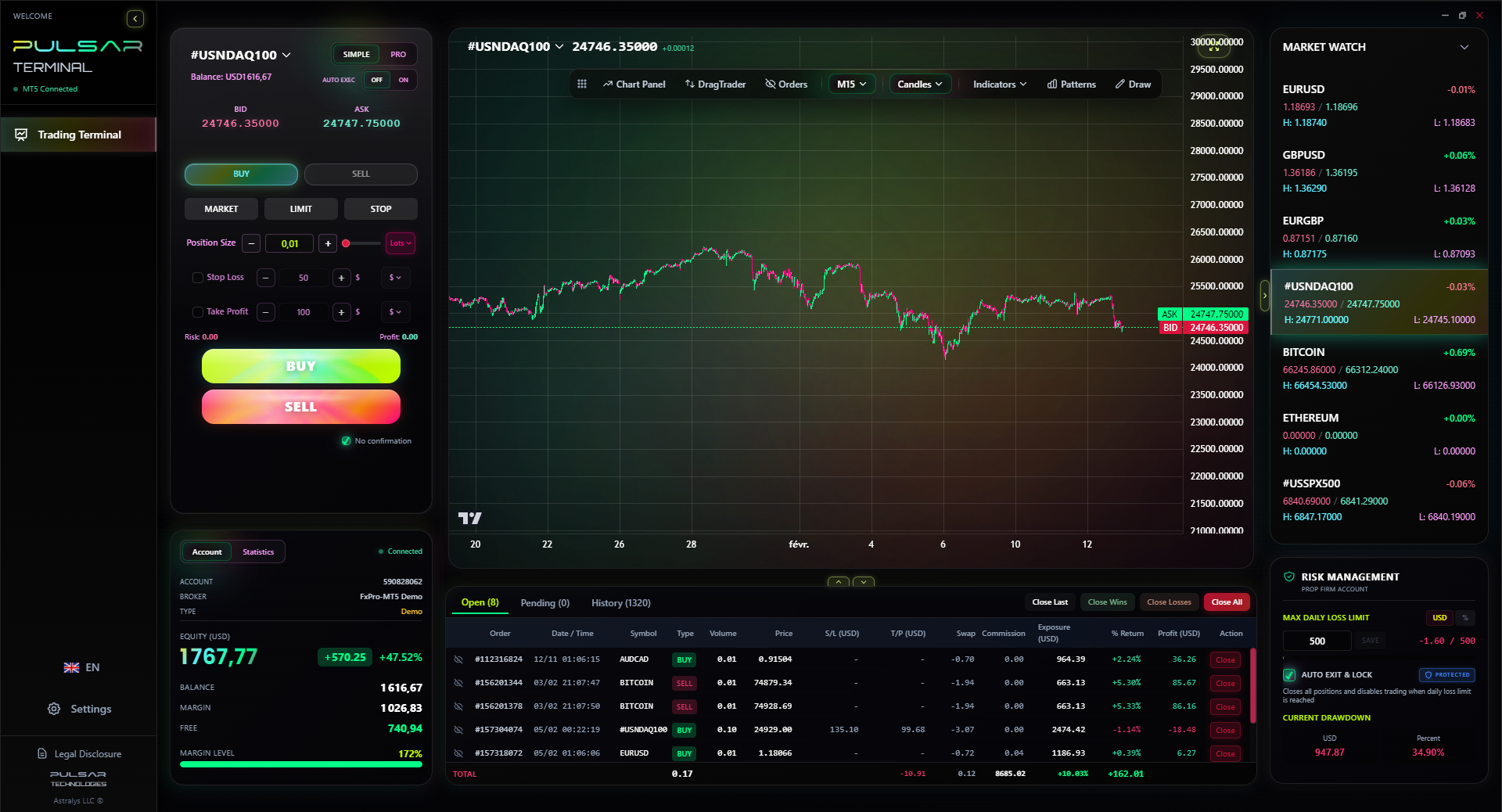
Managing multiple trades and setting precise stops on an ECN platform is easier with tools that automate risk management directly on your MT5 charts.
Pulsar Terminal
MT5 올인원 도구: 드래그앤드롭 주문, 다중 TP/SL, 트레일링 스톱, 그리드 트레이딩, 볼륨 프로파일, 프롭펌 보호. 매일 1,000명 이상의 트레이더가 사용.
“The low cost of an ECN should allow you to be more selective with your trades, not less. Use the savings to give your ideas more room to breathe.”
Convinced? Good. Here's your action plan to get started the right way.
- Shortlist 2-3 Brokers: Based on regulation and our checklist, pick a few. Look at Exness for NGN accounts, Pepperstone for raw execution, IC Markets for all-around reliability.
- Open a Demo Account with Each: Not for a day, for at least two weeks. Trade your normal strategy. Compare the fills, the spreads on your favorite pairs, the feel of the platform.
- Start Small for Real: Once you choose, open a live account with the minimum deposit. Don't throw your life savings in. Fund it with an amount you can afford to lose. I recommend starting with no more than $200-$300.
- Adjust Your Psychology: You'll see prices jump around more. That's normal. It's the real market, not a smoothed-out feed. Embrace the noise.
- Implement Tight Risk Management: This is even more important now. With tighter spreads, you might be tempted to use tighter stops. Resist. Use the position size calculator every single time. Your first goal is to survive, not to get rich.
Moving to an ECN broker felt like turning on the lights in a dark room. I could finally see the market for what it was. The path wasn't suddenly easier, but it was clearer. I was no longer wrestling with my broker, just with my own decisions and the collective wisdom of the market. That's a fight you can actually learn from and win.
FAQ
Q1Is forex trading with an ECN broker legal in Nigeria?
Yes, it's completely legal. The Central Bank of Nigeria (CBN) and SEC oversee financial markets, but there's no law banning you from trading with international brokers. The key is to use a reputable, internationally regulated ECN broker, as Nigeria's SEC doesn't yet specifically license online forex brokers. This is the standard practice for all serious Nigerian traders.
Q2What's the minimum deposit for an ECN account in Nigeria?
It varies, but you can start surprisingly low. Many top-tier ECN brokers have minimum deposits between $100 and $200. Some, like Exness Pro accounts, start at $200, while IC Markets is around $200. There are even a few with no minimum, but I'd be cautious and treat the $100-$200 range as a reasonable entry point for serious trading.
Q3How do I fund my ECN account from Nigeria?
You have several good options. Most Nigerian traders use direct Visa/Mastercard deposits from their local bank cards, which are usually instant. E-wallets like Skrill, Neteller, and Perfect Money are also very popular and often have free deposits/withdrawals. For larger amounts, some use cryptocurrency (USDT is common). A few brokers like HFM and FXTM offer direct Naira deposits into NGN-denominated accounts, which saves on conversion fees.
Q4Are ECN brokers more expensive than regular brokers?
Not for active traders. It's a different cost structure. Market makers have no commission but wider spreads. ECNs have tiny raw spreads plus a commission. For most trades, especially on major pairs, the total cost (spread + commission) on an ECN is significantly lower. For example, a 1-lot EUR/USD trade might cost $8 on an ECN versus $15-$20 on a standard account. If you trade infrequently with large positions, a market maker's all-in spread might be simpler, but for frequency, ECN wins.
Q5Can I use use like 1:500 with an ECN broker?
Technically, yes. Many international ECN brokers (especially those regulated in offshore jurisdictions like Seychelles) offer use up to 1:500, 1:1000, or even unlimited. However, this is a dangerous tool. I strongly advise against using maximum use. It's a surefire way to blow up your account. For sustainable trading, I never exceed 1:30 on my main account. Use a position size calculator to determine your lot size based on your risk, not the available use.
Q6Do ECN brokers offer bonuses or promotions?
Generally, no. Reputable true ECN brokers rarely offer deposit bonuses or unrealistic promotions. Their value proposition is transparent, low-cost execution, not gimmicks. If you see an 'ECN' broker offering a 100% deposit bonus, be very skeptical. That's often a hallmark of a market maker model, and such bonuses usually come with restrictive withdrawal terms (rollover requirements).
Q7How do I know if my broker is a true ECN?
Look for a few signs: 1) They charge a clear, per-lot commission. 2) They offer market depth (DOM) showing real buy/sell orders. 3) Their spreads on majors like EUR/USD are routinely at or below 0.2 pips. 4) They openly state they use an 'agency model' or 'STP/ECN' execution. 5) You experience positive slippage occasionally, not just negative. Test it on a demo during high volatility.
윈스턴 교수의 수업
핵심 요약:
- ✓ECN costs are spread + commission. Calculate the total, not just one.
- ✓True ECNs show market depth. If you can't see the order book, be suspicious.
- ✓use above 1:30 turns small mistakes into account-ending events.
- ✓Your broker's international regulation is your primary safety net in Nigeria.
- ✓Taxable profit = Net Profit (after all commissions and fees) * 10%.
이 기사가 얼마나 유용했나요?
별을 클릭하여 평가
주간 트레이딩 인사이트
무료 주간 분석 & 전략. 스팸 없음.
저자 소개
Olumide Adeyemi
서아프리카 트레이딩 선구자
나이지리아에서 가장 활발한 외환 트레이딩 교육자 중 한 명. 라고스에서 8년간 트레이딩 경험. 아프리카 트레이더를 위한 소자본 전략과 프롭 펌 챌린지 전문.
댓글
위험 고지
금융 상품 거래에는 상당한 위험이 수반되며 모든 투자자에게 적합하지 않을 수 있습니다. 과거 성과가 미래 수익을 보장하지 않습니다. 이 콘텐츠는 교육 목적으로만 제공되며 투자 조언으로 간주되어서는 안 됩니다. 거래 전에 항상 직접 조사를 수행하십시오.
이 기사도 읽어보세요

Cara Trading Forex Sukses: 7 Prinsip dari Trader Profesional
Cara trading forex sukses dengan 7 prinsip trader pro: manajemen modal, disiplin, journal trading, backtest. Data nyata, bukan janji profit palsu.
Jam Trading Forex Terbaik untuk Trader Indonesia: Panduan Lengkap dengan Tabel Waktu
Panduan jam trading forex untuk trader Indonesia. Tabel 4 sesi dunia, jam emas 20:00-00:00, sesi mana yang harus dihindari. Data akurat + tips dari trader berpengalaman.
Top 5 Sàn Forex Uy Tín Nhất 2026: Review Jujur dari Trader Indonesia
Top 5 sàn forex uy tín 2026 untuk trader Indonesia. Review jujur: spread, deposit, withdraw, dukungan lokal. Exness, XM, IC Markets & lebih.
