


I lost R4,200 in a single afternoon back in 2017.

David van der Merwe
신흥시장 트레이더 ·  South Africa
☕ 11 분 소요
배울 내용:
- 1Why FCA Regulation Actually Matters (For You in SA)
- 2Top England Brokers Accepting SA Clients: The Real Numbers
- 3The SA Specifics: ZAR Accounts, Deposits & The Tax Talk
- 4use: The FSCA's 30:1 Rule vs. The World
- 5Platforms & Tools: What Works From South Africa
- 6Common Pitfalls & How to Avoid Them
- 7Final Verdict & My Personal Approach
I lost R4,200 in a single afternoon back in 2017. It wasn't just a bad trade; it was a platform freeze during a Bank of England announcement while I was using a dodgy, offshore 'bucket shop' that had slick marketing but no real oversight. My stop-loss just... didn't trigger. That experience cost me real money, but it taught me the non-negotiable value of a properly regulated broker. For us in South Africa, England forex brokers, regulated by the UK's Financial Conduct Authority (FCA), represent a gold standard in safety. But using them from here isn't as simple as just signing up. You need to navigate taxes, ZAR accounts, and understand exactly what that FCA license means for you sitting in Cape Town or Johannesburg.
When you see 'FCA-regulated' on a broker's website, it's not just a fancy badge. For a South African trader, it's one of the strongest safety nets you can get outside of our own FSCA. Here's the practical difference it made for me.
The FCA is a Tier-1 regulator. That means they enforce strict rules: client money must be held in segregated accounts at top-tier banks (so the broker can't use your deposit for their office party), they require regular financial audits, and they have a compensation scheme (though note, this typically protects UK residents). More importantly for your trading, they mandate fair price execution and prohibit the sort of manipulative practices that can happen with unregulated entities.
I learned this the hard way. My early loss was with an unregulated firm. Later, I opened an account with an FCA-regulated broker like Pepperstone. The difference was night and day. Slippage during news events was predictable and minimal, not catastrophic. Withdrawals arrived in my bank account in 24 hours, not 5 business days of radio silence.

Warning: Just because a broker is FCA-regulated doesn't mean your specific account falls under that regulation. Many England forex brokers offer their international clients an account under a different entity (often based in Seychelles, Cyprus, or South Africa itself). You MUST check which entity you are signing up with. The protection and use limits will differ.
For example, an FCA account might offer max 30:1 use for retail clients, while their global entity could offer 500:1. Higher use is tempting, but it comes with less regulatory oversight. Your choice depends on your risk appetite and whether you prioritize protection or trading conditions.

💡 윈스턴의 팁
A broker is a utility, not a strategy. Spend 10 hours choosing one, then 10,000 hours learning to trade. The wrong utility will fail you at the worst possible time.
Let's get specific. Here are a few major England forex brokers that actively welcome South Africans, along with the details you care about: minimum deposit, typical spreads, and how they operate here.
The Major Players
IG Group: A giant. They're actually dual-regulated for us - FCA in the UK and FSCA here (FSP No 41393). This is a rare and powerful combo. They have a solid proprietary platform alongside MetaTrader. Minimum deposit can be as low as $50, but watch for their 2.1% fee on credit card deposits.
Pepperstone: A favorite among active traders for their razor-thin spreads. Fully authorized by the FCA. Their Raw Spread account can have EUR/USD spreads from 0.0 pips, but you pay a commission (around $7 per lot round turn). Perfect if you're scalping or trading large volumes.
Exness: This one's interesting. They are FCA-regulated, but they also have a strong global presence. They famously offer very low minimum deposits (from $10) and on their offshore entities, very high use. They also have an FSCA license. Their Standard account has no commission, but spreads are wider.
FxPro: Another solid, FCA-regulated name. They offer a good range of platforms including MT4, MT5, and cTrader. Minimum deposit is typically $100. Their spreads are competitive, usually around 1.4-1.6 pips on EUR/USD for their commission-free account.
Cutting Through the Marketing
Don't just look at the headline "from 0.0 pips!" You need to see the full cost structure. A 0.0 pip spread with a $7 commission can be cheaper than a 1.5 pip spread with no commission, depending on your trade size. Use a position size calculator to work it out for your typical trades.
Here’s a quick comparison of typical costs for a standard 1 lot (100,000 units) trade on EUR/USD:
| Broker (Example Account) | Avg. Spread | Commission | Total Cost per 1 Lot Trade |
|---|---|---|---|
| "Raw" Account (e.g., Pepperstone) | 0.1 pips | $7.00 | ~$8.00 |
| "Standard" Account (e.g., FxPro) | 1.5 pips | $0.00 | $15.00 |
| Local FSCA Broker | 0.7 pips | $0.00 | $7.00 |
Cost = (Spread in pips * Pip Value) + Commission. 1 pip on EUR/USD = $10 for 1 lot.
See? The "cheapest" spread isn't always the cheapest trade. I made this mistake early on, choosing a broker for its 0.0 pip headline only to find my profitability eaten by commissions on my small, frequent trades.
“High use doesn't make you a better trader; it just makes your mistakes more expensive, faster.”
This is where your life as a South African trader gets real. Dealing with England forex brokers means navigating currency conversion and, yes, the friendly folks at SARS.
ZAR-Denominated Accounts: A Lifesaver
Many top brokers now offer trading accounts denominated in South African Rand. This is a game-changer. It means your profit and loss are calculated in Rands from the get-go, eliminating a hidden cost: currency conversion on every single trade's result.
Before I used a ZAR account, I had a USD account. I'd make a $300 profit on EUR/USD, but by the time it was converted back to ZAR to withdraw (at the broker's often-poor rate), that profit shrunk. A ZAR account simplifies everything and makes your accounting crystal clear.
Getting Your Money In and Out
Thankfully, funding is easier than ever. Most brokers accept:
- Credit/Debit Cards (Visa/Mastercard): Instant, but some charge fees (like IG's 2.1%). Debit cards are often free.
- Bank Wire/EFT: Slower (1-3 days), but usually low fee. Many brokers now integrate with local gateways like Ozow for instant EFTs.
- E-Wallets: Skrill and Neteller are widely accepted. PayPal is less common.
I use a combination. Instant EFT for quick deposits to seize an opportunity, and bank wire for larger withdrawals to keep bank fees low.
The Tax Reality
Let's not kid ourselves. SARS wants its share. Forex trading profits are considered taxable income if you're trading actively. The rate is your marginal income tax rate (18% to 45%). If you trade very infrequently, it might be considered capital gains (18%), but assume it's income.
The good news? You can deduct legitimate trading expenses: your trading platform fees, data subscriptions, a portion of your internet bill, even educational courses. I keep a careful spreadsheet. When I paid for a advanced MACD indicator course, that was a deductible expense against my yearly profits.

Pro Tip: Open a separate bank account just for trading. Feed all deposits, withdrawals, and related expenses through it. Come tax season, you just hand the statement to your accountant. It saves countless hours and headaches.
💡 윈스턴의 팁
The 'entity' listed on your contract note is more important than the logo on the website. It defines your legal rights and protections. Read it.
This is a critical fork in the road for South African traders. Our local regulator, the FSCA, caps use at 30:1 for retail clients using locally licensed brokers. It's a safety rule to protect traders from wiping out their accounts too quickly.
However, when you use an England forex broker's international entity (not their UK FCA one), that limit often doesn't apply. You might see use offers of 100:1, 200:1, even 500:1.
Here's my take, forged from experience: 30:1 is plenty. Seriously.
Early on, I was seduced by 500:1. I thought it meant I could make huge profits with a tiny account. What it actually meant was I could take on enormous risk with a tiny account. I once turned R2,000 into R8,000 in a day on 500:1 use trading XAU/USD. I felt like a genius. The next week, using the same reckless position sizing, I lost R5,000 in 20 minutes. The volatility ate through my margin, triggered a margin call, and closed me out.
High use amplifies both gains AND losses. It's a tool for the experienced, not a shortcut for the new. The FSCA's 30:1 rule, while frustrating if you want to swing for the fences, is one of the best things for a new trader's longevity. If you do opt for higher use offshore, your risk management must be military-grade strict.
“Your broker is your most important piece of trading infrastructure. A shaky foundation collapses under pressure.”
Most England forex brokers will offer you MetaTrader 4 or 5. It's the global standard, and latency from SA to their servers (usually in London) is negligible for all but the most extreme scalpers. A 50-millisecond delay won't hurt your swing trading setup.
The real question is about advanced tools. This is where your choice of broker and third-party software matters.
Many brokers have proprietary web platforms that are excellent (like IG's or Pepperstone's). They're packed with analytics, news feeds, and smart charting tools. I use MT5 for my core chart analysis and a broker's web platform for quick monitoring and order management on the go.
One of the biggest upgrades to my trading came from using advanced trade management tools. Manually moving stop-losses to breakeven or setting trailing stops on multiple positions is a chore and prone to emotion.

Example: I had a great swing trade on GBP/USD, entry at 1.2650, target 1.2800. I wanted to move my stop to breakeven at 1.2710 and then trail it. Doing it manually, I got distracted, missed the level, and the trade retraced all the way back to my original stop for a breakeven instead of a locked-in 60-pip profit. Automation solves this.
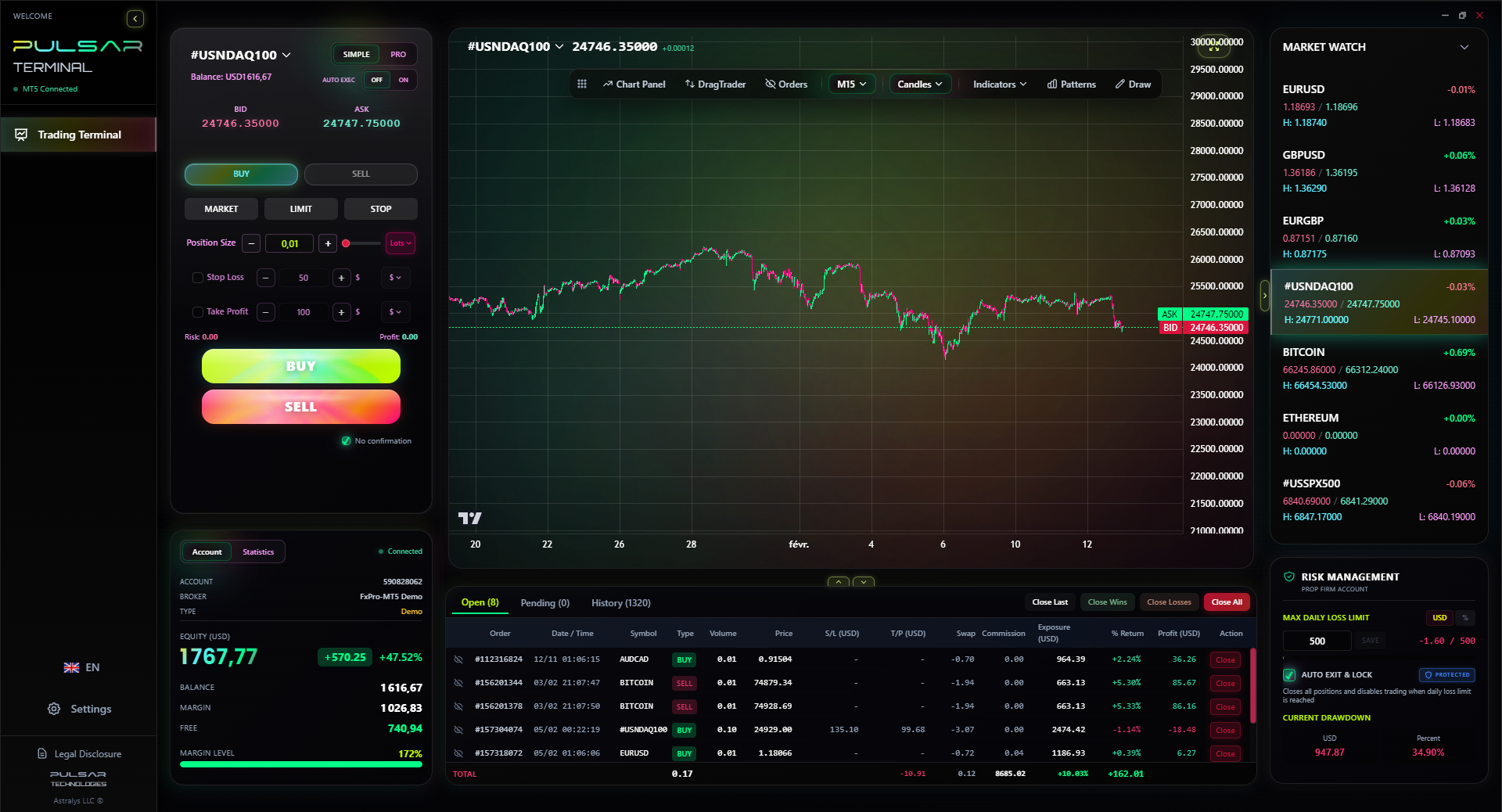
Managing complex trades and protecting profits from a South African connection is easier with tools that automate risk, like Pulsar Terminal's one-click trailing stop and breakeven functions on MT5.
Pulsar Terminal
MT5 올인원 도구: 드래그앤드롭 주문, 다중 TP/SL, 트레일링 스톱, 그리드 트레이딩, 볼륨 프로파일, 프롭펌 보호. 매일 1,000명 이상의 트레이더가 사용.
Let me save you some pain by sharing where I and others have stumbled.
Pitfall 1: Ignoring the Entity. As mentioned, you sign up on an FCA broker's website, but during registration, you're quietly shunted to their "Global" or "CYSEC" entity. Always check your account documentation and terms. Who is the legal counterparty to your trades?
Pitfall 2: Chasing Bonuses. Many offshore entities offer juicy deposit bonuses. These almost always come with restrictive withdrawal conditions (trade volume requirements). I've never seen a bonus scheme that truly benefits the trader in the long run. Focus on raw costs and execution quality instead.
Pitfall 3: Underestimating Currency Risk (in non-ZAR accounts). If your account is in USD and you deposit ZAR, you're already taking a forex bet. If the Rand strengthens, your account value in ZAR terms falls before you've even placed a trade. A ZAR account neutralizes this.
Pitfall 4: Poor Withdrawal Planning. Need profits for a bill? Don't wait until the last minute. Withdrawals via bank wire can take 2-5 business days. Plan your cash flow. I set a monthly 'salary' withdrawal regardless of performance to enforce discipline.
Pitfall 5: Not Testing Everything. Before you fund a live account, test the broker's platform with a demo. Then, deposit the minimum amount. Place a few small live trades and immediately request a withdrawal. This tests the entire cycle: execution, platform stability, and most importantly, how smoothly and quickly they give you your money back. Any hiccups here are a major red flag.
💡 윈스턴의 팁
If a withdrawal feels difficult when you test it with a small amount, imagine how difficult it will be with your life-changing profit. Test the exit first.
“A ZAR-denominated account isn't just convenient; it's a shield against hidden currency conversion taxes on your profits.”
So, should a South African trader use an England forex broker? Absolutely, but with your eyes wide open.
For me, the ideal balance is a broker that offers both strong international regulation (like the FCA) and a local presence or ZAR account functionality. The blend of world-class oversight and local convenience is hard to beat.
My current setup is with a broker that has an FCA-regulated parent but where I hold a ZAR-denominated account under their properly licensed South African entity. This gives me confidence in the group's integrity, trading conditions that are competitive globally, and the practical ease of dealing in Rands without hidden forex costs.
Start with safety. Prioritize regulation (FCA, FSCA) over flashy promises of insane use. Choose a broker that offers a ZAR account to simplify your life. Understand the full cost - spread plus commission. And never, ever forget that you are trading from South Africa, and SARS is your silent partner in every profitable trade.
Do the work upfront to choose the right broker. It's the most important trade you'll ever make, and it happens before you even click ‘buy’ or ‘sell’.
FAQ
Q1Is it legal for South Africans to trade with England forex brokers?
Yes, it's completely legal. South African residents are allowed to trade with both locally regulated brokers (FSCA) and foreign-regulated brokers like those overseen by the UK's FCA. The key is to ensure the broker is regulated by a reputable authority.
Q2Do I pay more tax if I use a foreign broker?
No, your tax liability to SARS is the same. You must declare all worldwide income, including forex profits from any broker, local or international. The tax rate depends on your trading frequency (typically income tax, 18%-45%) and is not affected by the broker's location. Keep careful records of all statements.
Q3What's better: an FCA-regulated account or an FSCA-regulated account?
It depends on your needs. An FSCA account gives you direct protection under South African law and a use cap of 30:1. An FCA account offers top-tier global oversight. Some brokers, like IG, are dual-regulated, offering the best of both. For higher use, you'd use the broker's international entity, which carries less direct regulatory protection.
Q4How do I avoid currency conversion fees with an international broker?
Look for a broker that offers a ZAR-denominated trading account. This means your account balance, profits, and losses are all in South African Rands, eliminating conversion fees on the trading result. You'll still pay a conversion spread when you deposit ZAR into a USD account if you go that route.
Q5What is the typical minimum deposit for an SA trader?
It varies widely. Some brokers like Fusion Markets have no minimum. Others like XM start at $5, Pepperstone and FxPro around $100-$200, and some premium accounts can be $250+. Local broker Khwezi Trade requires R500. Don't choose a broker based on minimum deposit alone - focus on regulation and costs.
Q6Can I use PayPal to fund my forex account in South Africa?
It's not very common with forex brokers directly. While some international brokers might offer it, more reliable methods for South Africans are Credit/Debit Cards (Visa/Mastercard), Bank Wire/EFT (often via Ozow for instant EFT), and e-wallets like Skrill or Neteller. FNB customers can withdraw from PayPal to their bank account.
Q7Will I face slower trade execution because I'm in South Africa?
For most retail trading styles, no. The latency (delay) between SA and the broker's servers in the UK or Europe is measured in milliseconds. This is irrelevant for day trading, swing trading, or position trading. Only ultra-low-latency scalpers might notice a difference, and even then, it's often negligible.
윈스턴 교수의 수업
핵심 요약:
- ✓Always verify the regulatory entity you're signing up with, not just the parent company.
- ✓Test the full deposit-trade-withdrawal cycle with minimum funds first.
- ✓Choose a ZAR account to eliminate hidden forex conversion costs.
- ✓The FSCA's 30:1 use cap is a protective gift for new traders.
- ✓Your trading log is your first line of defence at tax time.
이 기사가 얼마나 유용했나요?
별을 클릭하여 평가
주간 트레이딩 인사이트
무료 주간 분석 & 전략. 스팸 없음.
저자 소개
David van der Merwe
신흥시장 트레이더
요하네스버그 기반 트레이더로 신흥시장 통화 11년 경력. ZAR 통화쌍, FSCA 규제 거래, 남아공 시장 분석 전문.
댓글
위험 고지
금융 상품 거래에는 상당한 위험이 수반되며 모든 투자자에게 적합하지 않을 수 있습니다. 과거 성과가 미래 수익을 보장하지 않습니다. 이 콘텐츠는 교육 목적으로만 제공되며 투자 조언으로 간주되어서는 안 됩니다. 거래 전에 항상 직접 조사를 수행하십시오.
이 기사도 읽어보세요

Cara Trading Forex Sukses: 7 Prinsip dari Trader Profesional
Cara trading forex sukses dengan 7 prinsip trader pro: manajemen modal, disiplin, journal trading, backtest. Data nyata, bukan janji profit palsu.
Jam Trading Forex Terbaik untuk Trader Indonesia: Panduan Lengkap dengan Tabel Waktu
Panduan jam trading forex untuk trader Indonesia. Tabel 4 sesi dunia, jam emas 20:00-00:00, sesi mana yang harus dihindari. Data akurat + tips dari trader berpengalaman.
Top 5 Sàn Forex Uy Tín Nhất 2026: Review Jujur dari Trader Indonesia
Top 5 sàn forex uy tín 2026 untuk trader Indonesia. Review jujur: spread, deposit, withdraw, dukungan lokal. Exness, XM, IC Markets & lebih.
