


Most traders think their balance is their money.

Olumide Adeyemi
서아프리카 트레이딩 선구자 ·  Nigeria
☕ 10 분 소요
배울 내용:
- 1Balance vs. Equity: The Difference That Wipes Accounts
- 2How Equity Triggers a Margin Call (The Nigerian Scenario)
- 3Free Margin: Your Trading Power (and Danger Zone)
- 4Equity, Drawdown, and The Psychology of Survival
- 5A Practical Nigerian Trader's Guide to Equity Management
- 6The 3 Biggest Equity Mistakes Nigerian Traders Make
- 7Beyond the Basics: Using Equity for Advanced Strategy

Most traders think their balance is their money. That's the first step to getting a margin call. Your balance is just history, a record of settled trades. The number that actually matters, the one your broker is watching like a hawk, is your equity. If you don't understand what equity in forex means, you're trading blindfolded. Let's strip away the confusion and look at the only number that determines if you live to trade another day.
Here's the brutal truth I learned the hard way. Early in my career, I saw a ₦500,000 balance and thought I was sitting pretty. I had three open trades, each down about $100. No big deal, right? Then I got the notification. A margin call. I was confused, angry, and broke. I didn't understand that my balance was a lie.
Your balance is your account's cash value after all closed positions are settled. It doesn't change while you have open trades. It's a snapshot of the past.
Your equity is your real-time net worth. It's your balance plus or minus the floating profit/loss of all your open positions. This is the number your broker uses to calculate your margin level and decide if you're a risk. The formula is simple:

Equity = Balance + Floating Profit (or – Floating Loss)
If you have a ₦1,000,000 balance and three open trades showing a combined floating loss of ₦150,000, your equity is ₦850,000. That's your real money at that moment. Your broker doesn't care about your balance. They care if your equity falls below the required margin for your open trades. That's when they start closing your positions to protect themselves, starting with your biggest loser.

Warning: Never make a new trading decision based on your balance. Always check your equity first. It's the only number that reflects your current financial reality in the market.
“Your balance is a story about the past. Your equity is a warning or an opportunity about the present.”
This is where the rubber meets the road. Nigerian brokers, like the international ones we review such as Exness or XM, all operate on the same principle. They lend you money (use) to trade, and your equity is the collateral for that loan.
The Margin Level Calculation
Your margin level is the health bar of your account. It's calculated as:
Margin Level = (Equity / Used Margin) * 100%
Used Margin is the amount of your own cash locked up as collateral for your open trades. If you use high use, your used margin is small, but your risk is enormous.
Let's say you have:
- Balance: ₦400,000
- Floating Loss: -₦80,000
- Equity: ₦320,000
- Used Margin: ₦40,000
Your Margin Level = (₦320,000 / ₦40,000) * 100% = 800%. You're fine.
Now, let's say the market moves violently against you. Your floating loss deepens to -₦350,000.
- New Equity: ₦50,000 (₦400k balance - ₦350k loss)
- Used Margin: Still ₦40,000
New Margin Level = (₦50,000 / ₦40,000) * 100% = 125%.
The Stop Out Level
Most brokers have a 'Stop Out Level' at 50% or 20%. If your margin level hits that threshold, they begin automatically closing your positions, starting with the least profitable (or most losing), until your margin level recovers above the stop out level. You don't get a choice. It's an automated safety mechanism for them. This is what a margin call really looks like in practice. It's not an email asking for more money, it's a forced liquidation.

Example: If your broker's stop out is 50%, and in the example above your equity fell further to ₦20,000, your margin level would be 50%. The system would then start selling your positions to free up margin and reduce risk.

💡 윈스턴의 팁
Your equity is your oxygen tank. A diver doesn't watch the fish, he watches his gauge. Never let the excitement of the market make you forget the one number that keeps you alive.
“Free margin isn't a reward for good trading; it's ammunition that must be rationed.”
Once you grasp what equity in forex means, you meet its crucial partner: Free Margin. This is your available firepower, but also your temptation.
Free Margin = Equity – Used Margin
From our last example (before the big loss):
- Equity: ₦320,000
- Used Margin: ₦40,000
- Free Margin: ₦280,000
This ₦280,000 is the amount available to open new positions. It's what your platform shows as "available" or "usable" margin. This is where traders self-destruct. They see a large free margin and think, "I have room to add more trades." They pile on, increasing their used margin. But remember, your equity is now supporting a larger and larger position. A small market move against your entire portfolio can cause equity to plummet, sending your margin level into a death spiral.
I made this exact mistake in 2017. I was up $2,000 on a EUR/USD swing trade. My free margin looked huge. Instead of banking the profit, I used that free margin to open two more speculative positions on GBP pairs. A surprise news event hit, all three trades went red, and my equity evaporated in minutes. I turned a winning day into a margin call. Free margin isn't a reward. It's a responsibility.

Pro Tip: Treat Free Margin like emergency oxygen. Don't use it all. A good rule is to never let your Used Margin exceed 5-10% of your Equity. Use a position size calculator for every single trade to enforce this.

“Free margin isn't a reward for good trading; it's ammunition that must be rationed.”
Professional trading firms don't judge you by your balance. They judge you by your maximum equity drawdown. This is the peak-to-trough decline in your equity curve. It measures your worst-case historical loss. If you start with ₦1,000,000 equity, it rises to ₦1,200,000, then falls to ₦800,000 before recovering, your max drawdown is ₦400,000 (from ₦1.2M to ₦800k), or 33.3%.
Why is this the holy grail of risk metrics? Because it quantifies your pain. A 33% drawdown means you need a 50% return just to get back to breakeven. A 50% drawdown requires a 100% return. The math gets vicious.
Your equity curve is your trading fingerprint. A smooth, upward-sloping curve is the dream. A jagged, volatile curve that frequently dips deep is a scream for help. It means your risk is too high relative to your strategy's accuracy. Most Nigerian prop firm challenges, which we discuss in our broker reviews like IC Markets, have a strict max daily or overall drawdown limit based on your starting equity. Blow past it, and you're failed. They understand that controlling drawdown is more important than chasing profit.
This is where discipline links with mechanics. A solid swing trading plan with strict stop-losses will create a more controlled equity curve than reckless scalping without a defined edge. Watching your equity fluctuate is the ultimate psychological test. The goal isn't to avoid drawdowns, it's to manage them so they don't manage you.
💡 윈스턴의 팁
If you can't state your current maximum equity drawdown as a percentage within three seconds, you are not in control of your risk. You are being controlled by it.

“A 50% drawdown requires a 100% return just to break even. The math of recovery is merciless.”
Theory is fine, but what do you actually do? Here’s a step-by-step routine.
- Know Your Stop Out Level: Before you deposit a kobo, check your broker's specifics. Is stop out at 50%? 20%? This tells you how close to the edge you can go.
- Set a Hard Equity Floor: Decide on a maximum allowable drawdown from your starting equity. For example, "I will stop all trading for the month if my equity falls 20% from my starting capital." This is a circuit breaker.
- Monitor Margin Level, Not Just P&L: Have your trading platform open with the "Margin Level" column visible. Set a mental alert for yourself at 200%. If you hit it, you're taking on too much risk and need to close some positions, not add more.
- Use Equity-Based Position Sizing: This is non-negotiable. Don't trade a fixed lot size. Size each trade as a percentage of your current equity. If you risk 1% per trade and your equity is ₦500,000, your risk is ₦5,000. If a losing streak drops your equity to ₦400,000, your 1% risk is now ₦4,000. This automatically reduces your position size as you lose, preserving capital. Our position size calculator does this math for you.
- The Friday Night Review: Every Friday, record your closing equity. Plot it on a simple graph in Excel. This visual record is more valuable than any profit statement. It shows you the truth of your performance.
Example of Equity-Based Sizing:
- Strategy Risk per Trade: 1% of Equity
- Week 1 Equity: ₦1,000,000 → Max Risk/Trade = ₦10,000
- Week 3 (After a loss): Equity = ₦850,000 → Max Risk/Trade = ₦8,500 Your position size shrinks, forcing you to trade smaller and survive the downturn.
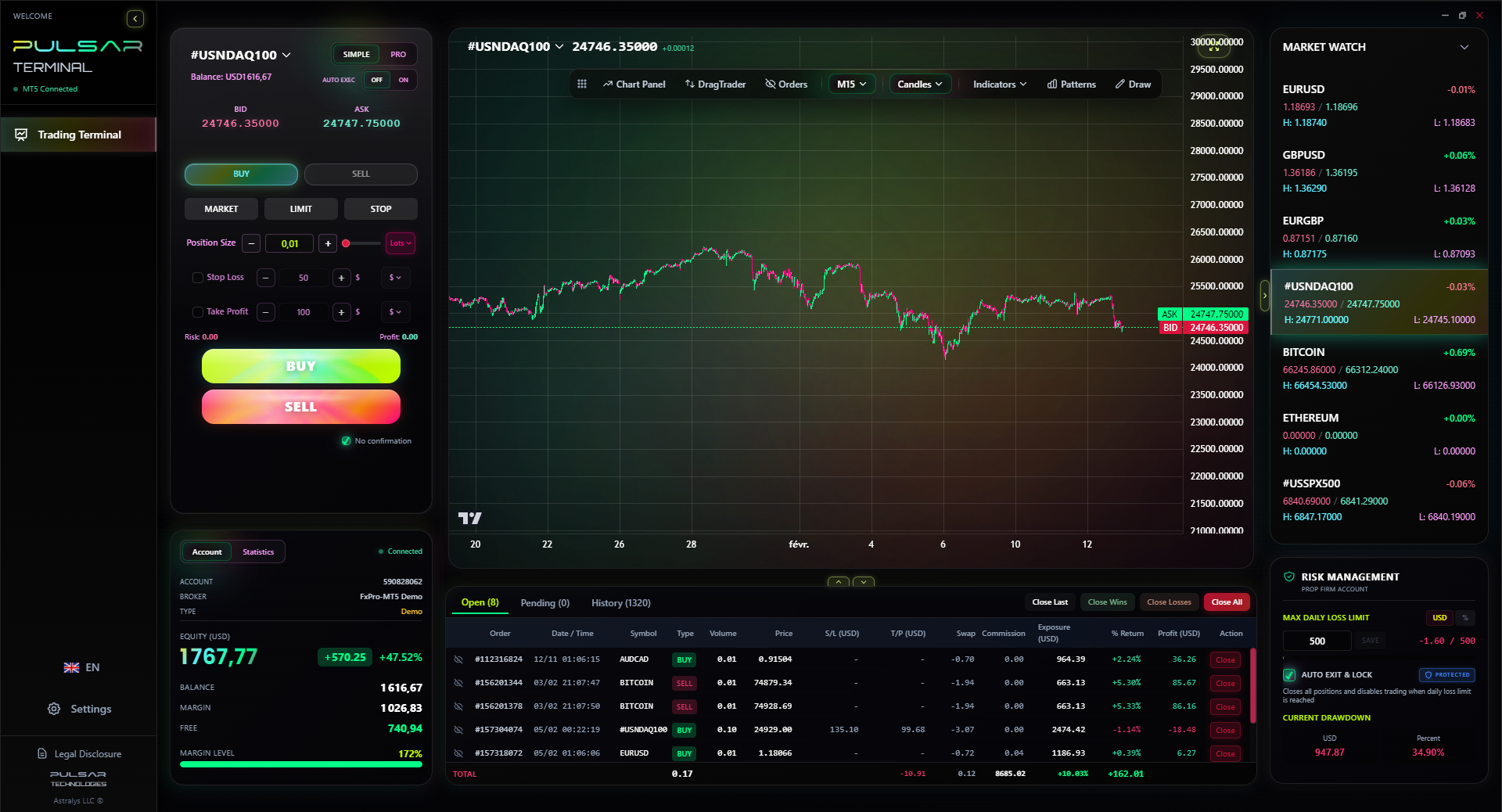
Manually calculating equity-based position sizes for every trade is tedious, but tools like Pulsar Terminal can automate risk calculations and set stops based on your total account equity directly on your MT5 platform.
Pulsar Terminal
MT5 올인원 도구: 드래그앤드롭 주문, 다중 TP/SL, 트레일링 스톱, 그리드 트레이딩, 볼륨 프로파일, 프롭펌 보호. 매일 1,000명 이상의 트레이더가 사용.
“A 50% drawdown requires a 100% return just to break even. The math of recovery is merciless.”
I've seen these destroy accounts over and over.
1. Adding to Losing Positions (Averaging Down): This is the #1 killer. Your equity is dropping, and you throw good money after bad to "lower your average entry." You're not lowering your average risk, you're concentrating it. Your used margin goes up while your equity goes down, crushing your margin level. It's a direct ticket to a stop out.
2. Confusing a High Balance with Safety: You have a great run, your balance is at a new high. You feel invincible and double your normal position size on the next trade. That trade goes against you. Because your position size was based on your inflated balance, not a sober percentage of equity, the loss is catastrophic. It wipes out a month of gains in hours.
3. Ignoring Overnight/Weekend Gaps: You hold a position over the weekend because the swap isn't bad. Friday's equity looks healthy. But news breaks over the weekend, and the market opens Sunday night with a huge gap against your position. Your equity can be decimated before you can even log in. Your stop-loss won't save you; it gets executed at the first available price, which could be miles past your set level. This is especially dangerous with volatile instruments like XAU/USD (gold).
The common thread? All these mistakes stem from focusing on the wrong number - balance, entry price, or pride - instead of the cold, hard reality of your live equity.
💡 윈스턴의 팁
The most profitable trade you'll ever make is the one you don't take because your equity was telling you to sit on your hands. Learn to listen to it.
“Brokers don't margin call your balance. They margin call your equity. Know the difference or pay the price.”
Once you're protecting your equity instinctively, you can use it to enhance your strategy.
Equity Trail Stops: Some platforms allow you to set a stop-loss based on a percentage of your total equity, not just the trade's entry price. For example, "close this trade if total account equity falls by 2% from its highest point since the trade opened." This protects your overall capital, not just the individual position.
Profit-Taking Based on Equity Milestones: This is a psychological master move. Set rules like, "When my equity hits a 10% gain for the month, I withdraw 30% of the profits." Or, "I will reduce my position size by half once I achieve a 5% equity growth for the week." This locks in gains and forces you to trade smaller when you're emotionally high, which is often when the biggest mistakes happen.
Correlation and Equity Risk: If you're long on USD/NGN and also long on EUR/USD, you're double-long on the US Dollar. A single USD move can hit both positions. Your equity will swing wildly. Understanding how your positions correlate helps you foresee large equity swings before they happen. A diversified portfolio that isn't truly diversified (all trades betting on the same market direction) is a silent equity killer.
, understanding what equity in forex means transforms you from a gambler hoping for profits to a risk manager focused on survival. Your equity isn't just a number, it's your life force in the markets. Guard it with your life.
FAQ
Q1What is equity in simple terms for a forex trader?
Equity is your real-time account value. It's your starting balance plus any open profit or minus any open loss. If you closed all your trades right now, equity is the amount of money you'd have left. It's the most important number on your screen.
Q2Is equity the same as balance?
Absolutely not. Balance is your cash after closed trades. Equity is your live net worth including open trades. Balance is history; equity is your current reality. Confusing them is a classic beginner mistake that leads to blown accounts.
Q3How does equity affect my ability to open new trades?
Your equity, minus the margin already used for current trades, gives you your Free Margin. Free Margin is the capital available to open new positions. If your equity falls too low, your free margin shrinks, and you may be unable to open new trades or face a margin call.
Q4What is a good margin level percentage to maintain?
There's no magic number, but you should stay well above your broker's stop out level (e.g., 50%). A margin level below 200% is a yellow flag. Below 100% is a critical red alert - it means your used margin equals or exceeds your equity, and you are one bad move from liquidation.
Q5Can my equity ever be higher than my balance?
Yes, and this is a good sign. It happens when you have open trades in profit. For example, a ₦1M balance with ₦150,000 in floating profit gives you ₦1.15M in equity. Your net worth is higher than your settled cash because you have winning positions running.
Q6Why did I get a margin call even though I still had money in my balance?
Because margin calls are based on equity, not balance. If your open losses are so large that your equity falls below the required margin level, the broker will close trades to protect their loan to you. Your balance might still show a positive number from past wins, but your current equity (balance - open losses) is too low to support your open positions.
Q7How often should I check my equity?
Constantly. It should be the primary number you glance at while you have open positions. Before entering any new trade, check your equity and calculate your risk as a percentage of it. It's more important than watching the fluctuating profit/loss of a single trade.
윈스턴 교수의 수업
핵심 요약:
- ✓Equity = Balance + Floating P/L. It's your live net worth.
- ✓Margin Calls are triggered by low Equity, not low Balance.
- ✓Never let Used Margin exceed 10% of your Equity.
- ✓A 33% drawdown needs a 50% gain to recover.
- ✓Size every trade as a percentage of current Equity.
이 기사가 얼마나 유용했나요?
별을 클릭하여 평가
주간 트레이딩 인사이트
무료 주간 분석 & 전략. 스팸 없음.
저자 소개
Olumide Adeyemi
서아프리카 트레이딩 선구자
나이지리아에서 가장 활발한 외환 트레이딩 교육자 중 한 명. 라고스에서 8년간 트레이딩 경험. 아프리카 트레이더를 위한 소자본 전략과 프롭 펌 챌린지 전문.
댓글
위험 고지
금융 상품 거래에는 상당한 위험이 수반되며 모든 투자자에게 적합하지 않을 수 있습니다. 과거 성과가 미래 수익을 보장하지 않습니다. 이 콘텐츠는 교육 목적으로만 제공되며 투자 조언으로 간주되어서는 안 됩니다. 거래 전에 항상 직접 조사를 수행하십시오.
이 기사도 읽어보세요

Cara Trading Forex Sukses: 7 Prinsip dari Trader Profesional
Cara trading forex sukses dengan 7 prinsip trader pro: manajemen modal, disiplin, journal trading, backtest. Data nyata, bukan janji profit palsu.
Jam Trading Forex Terbaik untuk Trader Indonesia: Panduan Lengkap dengan Tabel Waktu
Panduan jam trading forex untuk trader Indonesia. Tabel 4 sesi dunia, jam emas 20:00-00:00, sesi mana yang harus dihindari. Data akurat + tips dari trader berpengalaman.
Top 5 Sàn Forex Uy Tín Nhất 2026: Review Jujur dari Trader Indonesia
Top 5 sàn forex uy tín 2026 untuk trader Indonesia. Review jujur: spread, deposit, withdraw, dukungan lokal. Exness, XM, IC Markets & lebih.
