


Everyone thinks trading forex from Australia is just about the AUD/USD and finding an ASIC broker.

David van der Merwe
신흥시장 트레이더 ·  South Africa
☕ 11 분 소요
배울 내용:

Everyone thinks trading forex from Australia is just about the AUD/USD and finding an ASIC broker. That's the surface-level stuff you get from a quick Google search. The real story, the one that costs you money to learn, is about navigating a market that's both incredibly liquid and frustratingly isolated, dealing with tax rules that can gut your profits, and understanding why the 'Aussie' moves the way it does. I've traded from Sydney for over a decade, made every mistake in the book, and I'm here to set the record straight.
Let's get the first myth out of the way: Australia isn't a forex backwater, but its active trading hours are a specific, concentrated window. The Sydney session (roughly 5 AM to 2 PM AEST) kicks off the global day. It's when AUD, NZD, and JPY pairs see their first real volatility of the cycle. The liquidity is decent, but it's nothing like the London-New York overlap. I used to try and trade EUR/USD at 6 AM Sydney time. It was like watching paint dry, with spreads wide enough to drive a truck through. I learned the hard way to align my activity with the local session's strengths.
The AUD is a 'commodity currency.' This isn't just trader jargon. Its value is tied directly to what Australia digs out of the ground. Iron ore prices, coal, natural gas, and even gold. When Chinese industrial demand sneezes, the AUD catches a cold. I remember a trade in early 2022 where I was long AUD/USD based on a technical breakout. I ignored the plummeting iron ore futures. The chart looked great, but the fundamental pressure was immense. I gave back a 120-pip gain in a single afternoon session when the commodity data hit. Lesson learned: in forex Australia, you're not just trading a currency pair; you're trading the global resource market.

Warning: Don't underestimate the impact of Chinese economic data releases. They are often more important for the AUD than domestic Australian numbers like CPI. Set your calendar for Chinese PMI, Industrial Production, and GDP releases.
The other key player is the Reserve Bank of Australia (RBA). Their tone, especially on interest rates, dictates medium-term trends. But here's the twist: the market often moves before the RBA even speaks, pricing in expectations from employment and inflation data. By the time the official statement drops, the big move might already be over.

💡 윈스턴의 팁
The Sydney open isn't for new ideas. It's for executing the plan you made after analyzing the New York close. Your first trade should feel boring, almost inevitable.
“In forex Australia, you're not just trading a currency pair; you're trading the global resource market.”
Trading with an ASIC-regulated broker is non-negotiable for serious capital. The Australian Securities and Investments Commission is one of the world's toughest regulators. Your money is in a segregated client trust account. There's a statutory dispute resolution process. It's safe. But safety comes with... limitations.
The use Cap
This is the big one. Since 2021, ASIC has capped use for retail clients at 30:1 for major forex pairs like EUR/USD, and just 20:1 for minor pairs and gold (XAU/USD). Coming from an international account where 500:1 was normal, this felt like trading with handcuffs on. I fought it at first, tried to use offshore brokers. The anxiety wasn't worth it. I blew an account with an unregulated entity in Cyprus in 2019 - vanished into thin air. Poof. $8,000 gone.
The use cap forced me to become a better trader. It made my position size calculator my most important tool. I could no longer throw a tiny margin at a huge position and hope for the best. I had to be precise, patient, and pick my spots. It improved my win rate because I was forced to wait for higher-probability setups. For a guide on trading a popular pair with this use, see my EUR/USD guide.
Broker Selection
You'll see big names like Pepperstone and IC Markets headquartered here. They're excellent. Tight spreads, good platforms. But you need to read the fine print on fees. Some charge hefty commissions on raw spread accounts, others have wider spreads but no commission. For a high-volume scalping strategy, that difference is everything. I use a raw spread account and pay a commission per lot. My average cost per pip definition on the AUD/USD is about $0.50 all-in, which is competitive.

Pro Tip: Open a demo account with your shortlisted ASIC broker and track the live spreads during the Sydney open and major news events. Don't just look at the advertised 'average' spread. See what it's like when you actually want to trade.
💡 윈스턴의 팁
Treat the ASIC use cap as a blessing. It's the governor on your engine that stops you from blowing up on the first straight. Real speed comes from consistency, not horsepower.

“The use cap forced me to become a better trader. It made my position size calculator my most important tool.”
This is where living in the region gives you an edge. You feel the market rhythm.
AUD/USD: The flagship. It's liquid, but it's also a ping-pong ball between US dollar strength and Chinese commodity demand. I treat it as a range-bound pair unless there's a clear, fundamental driver (a massive RBA shift or a US Fed pivot). My most consistent profits come from fading extremes. When everyone is screaming 'AUD to the moon!' because iron ore is hot, I look for a technical resistance level to sell. Conversely, when panic sets in over Chinese growth, I look for support to buy. It's contrarian, but it works more often than not.
AUD/JPY: My favorite risk barometer. This is the pair that tells you how much appetite traders have for risk. When global markets are calm and optimistic, AUD/JPY rallies (buy the high-yielding AUD, sell the low-yielding JPY). When fear grips the markets, it collapses. I use the RSI indicator here to spot overbought/oversold conditions during these risk-on/risk-off swings. A trade from last October: AUD/JPY had sold off hard on Middle East tensions, hitting 94.50. The daily RSI was below 30. I went long at 94.70, targeting a return to 96.00 as a calm returned. It took five days, but it hit the target. A 130-pip move.
AUD/NZD: The 'trans-Tasman' battle. This is a tricky one. The economies are linked, so moves are often slower and more grinding. I use it less for directional trades and more for swing trading based on interest rate differentials between the RBA and the RBNZ. The spread definition can be wider here, so factor that in.
NZD/USD: Follows a similar script to the AUD/USD, but is even more sensitive to global dairy prices and risk sentiment. It's the more volatile cousin.
| Pair | Key Driver | My Typical Approach |
|---|---|---|
| AUD/USD | Iron Ore, China Data, US Dollar | Range fade at extremes, follow clear trends from RBA/Fed divergence. |
| AUD/JPY | Global Risk Sentiment | Trend-following during risk swings, use RSI for entry on pullbacks. |
| AUD/NZD | RBA vs. RBNZ Rate Outlook | Swing trades based on central bank policy divergence. |
| NZD/USD | Dairy Prices, Risk Sentiment | Similar to AUD/USD but with tighter stop-losses due to higher volatility. |
“The use cap forced me to become a better trader. It made my position size calculator my most important tool.”
This is the part that makes most new traders in Australia go pale. Your forex trading profits are subject to Capital Gains Tax (CGT). It's not a hobby. The ATO will treat it as a business if you're systematic, frequent, and aiming for profit (which you are).
Here's the brutal math I learned after my first profitable year. I made a net profit of $28,500. I was thrilled. Then my accountant asked for my trade logs. Every single trade - entry, exit, profit/loss in AUD. If you hold a position for less than 12 months, the gain is added to your taxable income. I was pushed into a higher tax bracket. My effective tax rate on those trading profits was over 39%. The thrill of the $28k win was gutted by an $11k+ tax bill.
Now, I do this religiously:
- Use a dedicated trading journal software that spits out a P&L report in AUD.
- Keep every single statement from my broker (Exness, XM, whoever you use).
- Consider the 12-month rule. If I have a massive winning swing trade, I might think twice about closing it just before the 12-month mark if it means the profit shifts from my marginal rate to the discounted CGT rate (50% discount). It changes your trade management.
Warning: You cannot claim losses against your personal salary/wage income to get a tax refund. Trading losses can only be offset against other investment income or carried forward to offset future trading profits. Don't get caught by this common misconception.
“My effective tax rate on those trading profits was over 39%. The thrill of the win was gutted by an $11k+ tax bill.”
MT4/MT5 are the kings here, supported by every major ASIC broker. But the real edge comes from the tools you bolt onto them.
I run MT5 for execution, but I use a separate charting package for analysis. Why? Speed and functionality. The native MT5 charts are fine, but when you're trying to manage multiple timeframes on AUD/JPY while watching the S&P 500 futures for risk sentiment, you need more screen real estate and more powerful drawing tools.
Volume analysis is critical, especially during the Sydney-Asia overlap. Seeing where large contracts are traded in the AUD/USD gives you clues about key support and resistance levels that a simple horizontal line won't show you. I also rely heavily on correlation matrices. Knowing that the AUD/USD has a strong positive correlation with copper futures, or a negative correlation with the US Dollar Index (DXY), helps confirm or contradict my technical view.
For gold trading, which many Aussies love, having clean tools is key. My XAU/USD guide details the specific indicators I use.
The biggest upgrade to my trading in the last two years was automating my risk management. Setting a stop-loss is one thing. Having a tool that can move it to breakeven after a certain move, or trail it, without me babysitting the screen at 2 AM, saved me from countless self-sabotaging decisions.
“My effective tax rate on those trading profits was over 39%. The thrill of the win was gutted by an $11k+ tax bill.”
1. Trading the London Open Half-Asleep: The London open is 4-5 PM AEST in winter, 5-6 PM in summer. It's a volatile period. I used to come home from work, tired, and try to trade the volatility. My decision-making was awful. I'd chase moves, ignore my rules. I lost more money in that first evening hour than any other time. Solution: Either trade it fresh, with a clear plan set before it opens, or don't trade it at all. Now, I often set pending orders before London opens and walk away.
2. Ignoring the 'Gap Risk' on Sundays: The forex market reopens Sunday evening (5 PM AEST). If something major happened over the weekend - a geopolitical shock, a surprise central bank announcement - pairs like AUD/JPY can gap dramatically. I once had a long AUD/JPY position over the weekend. A flare-up in North Korean tensions caused a 60-pip gap down against me on Sunday open. I was stopped out instantly before I could even react. The loss was larger than my planned risk. Now, I either close all positions before Friday's New York close or I use a broker that offers guaranteed stop-loss orders (for a premium) over the weekend.
3. Over-trading the AUD/USD Because It's 'My' Pair: Familiarity breeds contempt. Because I understood the AUD fundamentals, I thought I had an unbeatable edge. I traded it every day, even when the market was in a tight, choppy, 20-pip range. I got chopped up by spread and commission. Sometimes, the best trade for an Aussie forex trader is to not trade the Aussie at all. Look for clearer setups on EUR/USD or USD/CAD.
4. Not Respecting the use Cap: My early attempt to circumvent the ASIC rules by going offshore was a disaster. The lack of security far outweighed the benefit of higher use. I learned that proper position sizing with 30:1 use is more than enough to generate significant returns without the existential risk of a margin call from a rogue price spike.
💡 윈스턴의 팁
Your trading journal should have a column for 'Local Time.' Patterns in your losses will emerge - likely clustered when you're tired or distracted. Trade your schedule, not the market's.
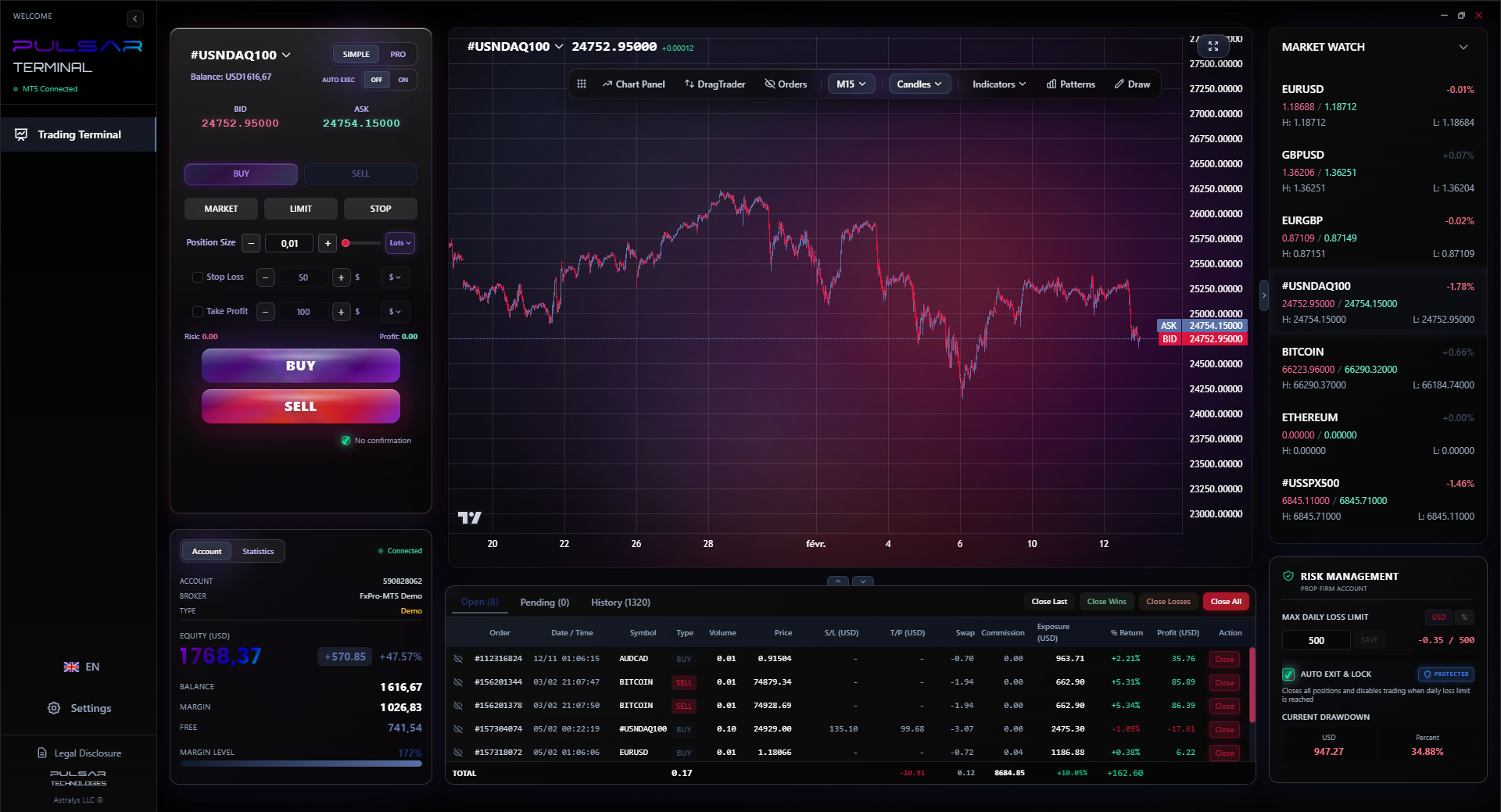
Managing risk across time zones is the Aussie trader's biggest challenge, which is why automating stop-losses, breakeven moves, and partial closures with a tool like Pulsar Terminal is a game-saver.
Pulsar Terminal
MT5 올인원 도구: 드래그앤드롭 주문, 다중 TP/SL, 트레일링 스톱, 그리드 트레이딩, 볼륨 프로파일, 프롭펌 보호. 매일 1,000명 이상의 트레이더가 사용.
“Sometimes, the best trade for an Aussie forex trader is to not trade the Aussie at all.”
Your location is a constraint, but also a framework. Build your routine around it.
The Sydney Session (5 AM - 2 PM AEST): This is your prime analysis and execution time for AUD, NZD, and Asian pairs. Check the overnight price action, review your charts, and place your trades for the day. The MACD indicator on the 4-hour chart is great for spotting the initial momentum direction here.
The London Session (4 PM - 1 AM AEST): This is for managing existing positions, not necessarily entering new ones unless you're a night owl. Use this time to adjust stop-losses, take partial profits, and plan for the next day. If you do trade, focus on the EUR and GBP pairs that come alive.
The New York Session (9 PM - 4 AM AEST): For most Aussies with day jobs, this is a no-go zone for active trading. It's where you're most prone to fatigue-induced errors. Automation is your friend here. Set your stops and limits and get some sleep.
Your strategy must account for the fact that you will miss moves that happen while you're asleep. That's okay. The market will always be there tomorrow. The goal isn't to catch every wave; it's to catch the ones you've prepared for and ride them with disciplined risk management. Focus on quality, not quantity. Two or three well-planned trades a week with a solid 2:1 risk-reward ratio will beat ten frantic, poorly planned trades every time.

FAQ
Q1Is forex trading legal in Australia?
Yes, absolutely. It's a fully regulated activity. You must trade with an Australian Financial Services (AFS) licensed broker, which will be regulated by ASIC. Trading with unregulated offshore brokers is legal for you, but it offers zero protection for your funds.
Q2What is the best time to trade forex in Australia?
The most active and optimal time is during the Sydney session overlap with Tokyo (5 AM - 11 AM AEST) for AUD/JPY and Asian pairs, and the Sydney-London overlap (4 PM - 8 PM AEST) for broader market volatility. The middle of the Australian night (New York session) is the least practical for most retail traders.
Q3How is forex trading taxed in Australia?
Profits are treated as capital gains. If you hold a position for under 12 months, the full profit is added to your annual income and taxed at your marginal rate. If held for over 12 months, you generally get a 50% discount on the capital gain for tax purposes. You must keep detailed records of every trade.
Q4Can I use high use with an Australian broker?
No, not as a retail client. ASIC has capped use at a maximum of 30:1 for major currency pairs and 20:1 for minors and gold. This is a protective measure. Professional clients can apply for higher use but must meet strict asset and experience tests.
Q5Which AUD pair is the most volatile?
AUD/JPY is typically the most volatile of the major AUD pairs due to its sensitivity to global risk sentiment. During times of market stress or euphoria, its daily ranges can significantly exceed those of AUD/USD.
Q6Do I need to pay GST on forex trading profits?
No. Forex trading is input-taxed for GST purposes, meaning you do not charge GST on your profits, nor can you claim GST credits on related expenses (like platform fees). Your tax liability is solely through Capital Gains Tax.
Q7What's the biggest mistake new traders in Australia make?
Two stand out: 1) Underestimating the impact of tax on their profits, leading to a nasty shock at tax time. 2) Trying to actively trade the New York session from Australia, which leads to exhaustion, poor decisions, and ignoring the excellent opportunities in their own time zone.
윈스턴 교수의 수업
핵심 요약:
- ✓Trade the Sydney & Asia overlap; it's your home-field advantage.
- ✓ASIC's 30:1 use is a tool for discipline, not a limitation.
- ✓Always convert your P&L to AUD and log it immediately for tax.
- ✓AUD/JPY is your canary in the coal mine for global risk.
- ✓Automate your stop management or you will sabotage yourself.
이 기사가 얼마나 유용했나요?
별을 클릭하여 평가
주간 트레이딩 인사이트
무료 주간 분석 & 전략. 스팸 없음.
저자 소개
David van der Merwe
신흥시장 트레이더
요하네스버그 기반 트레이더로 신흥시장 통화 11년 경력. ZAR 통화쌍, FSCA 규제 거래, 남아공 시장 분석 전문.
댓글
위험 고지
금융 상품 거래에는 상당한 위험이 수반되며 모든 투자자에게 적합하지 않을 수 있습니다. 과거 성과가 미래 수익을 보장하지 않습니다. 이 콘텐츠는 교육 목적으로만 제공되며 투자 조언으로 간주되어서는 안 됩니다. 거래 전에 항상 직접 조사를 수행하십시오.
이 기사도 읽어보세요

Cara Trading Forex Sukses: 7 Prinsip dari Trader Profesional
Cara trading forex sukses dengan 7 prinsip trader pro: manajemen modal, disiplin, journal trading, backtest. Data nyata, bukan janji profit palsu.
Jam Trading Forex Terbaik untuk Trader Indonesia: Panduan Lengkap dengan Tabel Waktu
Panduan jam trading forex untuk trader Indonesia. Tabel 4 sesi dunia, jam emas 20:00-00:00, sesi mana yang harus dihindari. Data akurat + tips dari trader berpengalaman.
Top 5 Sàn Forex Uy Tín Nhất 2026: Review Jujur dari Trader Indonesia
Top 5 sàn forex uy tín 2026 untuk trader Indonesia. Review jujur: spread, deposit, withdraw, dukungan lokal. Exness, XM, IC Markets & lebih.
