


You've probably seen the ads.

David van der Merwe
신흥시장 트레이더 ·  South Africa
☕ 9 분 소요
배울 내용:
You've probably seen the ads. 'Trade with the Chef!' 'Get a 70% bonus!' It sounds like a free lunch, and in trading, those don't exist. The truth is, xChief (formerly Forex Chef) is a polarizing broker that throws everything at you: insane use, flashy bonuses, and claims of tight spreads. But for a South African trader, the real question isn't about the sizzle, it's about the steak. Is this a platform that will help you build sustainable skills, or one that's designed to make you blow up faster? Let's set the record straight, no sugar-coating.
Forex Chef is dead. Long live xChief. That's the first thing you need to understand. The broker rebranded a while back, likely to distance itself from some of the baggage that came with the old name. Today, it's xChief, operating under a dual-structure that's crucial for you to grasp.
On paper for South Africans, there's XCHIEF ZA (PTY) LTD, registered with the FSCA (FSP 54829). This sounds good, right? A local entity. But here's the catch: this company acts solely as an intermediary. It's the middleman. Your actual trading account and money are held with XCHIEF LTD, which is regulated offshore by the Mwali International Services Authority (MISA) in the Comoros.
Let me be blunt: MISA is not the FSCA, the FCA, or CySEC. It's a light-touch regulator. This structure allows xChief to offer things Tier-1 regulated brokers can't, like 1:1000 use. It's a classic offshore model with a local face. The FSCA intermediary license provides a layer of oversight for the service you receive in SA, but the ultimate product provider is offshore. This isn't inherently evil, but it shifts the risk profile. You don't have the same stringent client money protection rules you'd get with a fully FSCA-licensed broker acting as the principal.
I made the mistake early in my career of chasing high use with a similar broker. I turned R5,000 into R25,000 in a week on 1:500 use. Felt like a genius. I gave it all back, plus another R3,000, in one bad EUR/USD trade the following Monday. The use giveth, and the use taketh away, violently.
“1:1000 use is a tool for scalping or extreme risk-takers, not for learning.”
This is where you need to put your skeptic hat on. The regulatory picture is the most important part of your due diligence.
The FSCA Link (XCHIEF ZA)
As mentioned, XCHIEF ZA is an FSP. This means they are authorized to give advice and render intermediary services for derivative products (like CFDs) in South Africa. They are legally accountable for how they market to you and the information they provide. If you have a serious complaint about their conduct in South Africa, you can escalate it to the FSCA Ombud. That's a positive.
The Offshore Reality (XCHIEF LTD)
Your contract, however, is with the MISA-regulated entity. Here's what that typically means (and doesn't mean):
- Segregated Funds: xChief states client funds are kept in separate bank accounts. This is standard good practice, but the enforcement mechanism under MISA is different from a top-tier regulator.
- Negative Balance Protection: They offer this, which is good. It means you can't lose more than your account balance.
- Investor Compensation: There is no equivalent to the FSCA's or FSCS's compensation scheme. If the broker goes under, your claim is against the company in the Comoros.

Warning: An FSCA intermediary license does NOT mean the offshore entity's operations are fully supervised by the FSCA. It's a distribution license, not a prudential license for the product itself. Your ultimate safety net is thinner.
When comparing brokers, look at this side-by-side. A broker like IC Markets holds an FSCA license for its local entity and is regulated by top-tier bodies like ASIC for its global operations. That's a stronger setup.
“Your contract is with an offshore entity. The FSCA intermediary license is a distribution license, not a prudential safety net.”
xChief's account lineup is designed to hook everyone, from the rookie with R150 to the semi-pro with more capital. Let's break down the numbers.
| Account Type | Min. Deposit | Spreads (from) | Commission | Max use |
|---|---|---|---|---|
| CENT | None | Not specified | None | 1:1000 |
| Classic+ | $10 (~R185) | 0.6 pips | None | 1:1000 |
| DirectFX | $50 (~R925) | Not specified | None | 1:1000 |
| xPRIME (ECN) | $2000 (~R37,000) | 0.0 pips | $2.5 per lot | 1:500 |
The use Trap
1:1000 use. Let that sink in. On a $10 deposit, you can control a $10,000 position. A 10-pip move against you wipes out 100% of your capital on a standard lot. It's a tool for scalping or extreme risk-takers, not for learning. I've seen more accounts destroyed by misused use than by any bad strategy. If you use this, your position size calculator is your holy book. A 1% risk rule becomes absolutely non-negotiable.
Spreads & Commissions
The Classic+ account at 0.6 pips with no commission is competitive for a standard account. The xPRIME ECN account is where serious volume traders would look, but the $2k minimum is a barrier. The CENT account is a mystery - reviews mention issues like 'off quote' errors, which is a major red flag for execution quality.
The Hidden Fees
Watch for withdrawal fees on certain methods and the inactivity fee after 12 months. These eat into your profits, especially if you're a casual trader.

💡 윈스턴의 팁
A broker offering 1:1000 use isn't doing you a favour. They're selling you a bigger shovel to dig your grave faster. Master trading with 1:10 or 1:30 first. If you can't make it work there, more use just means you'll fail more expensively.
“Your contract is with an offshore entity. The FSCA intermediary license is a distribution license, not a prudential safety net.”
xChief offers MetaTrader 4 and MetaTrader 5. Full stop. This is a good thing. MT4/MT5 are the industry standards for a reason - they're strong, familiar, and support countless custom indicators and Expert Advisors (EAs).
You won't get a fancy proprietary platform here, and honestly, you don't need one. MT5, in particular, is excellent for its depth of market features and superior back-testing capabilities. If you're learning, mastering MT5's built-in tools like the MACD indicator and RSI indicator is a better use of your time than chasing a broker's flashy UI.
Execution & Slippage
This is the murky area. With an offshore ECN/STP model, execution quality depends on their liquidity providers. The 'off quote' complaints on cent accounts are concerning. It suggests during volatile news events, their systems might not be able to provide a firm price for very small trades. For a scalping strategy, this is a deal-breaker. For a swing trading approach holding positions for days, it's less critical, but still annoying if it happens at your entry.
My experience? On a similar offshore broker years ago, I tried to scalp the GBP/USD during London open. My orders would get filled 2-3 pips away from my click price consistently. I thought it was my connection. It wasn't. It was poor liquidity. I moved to a broker with a better track record on execution, and the problem vanished.
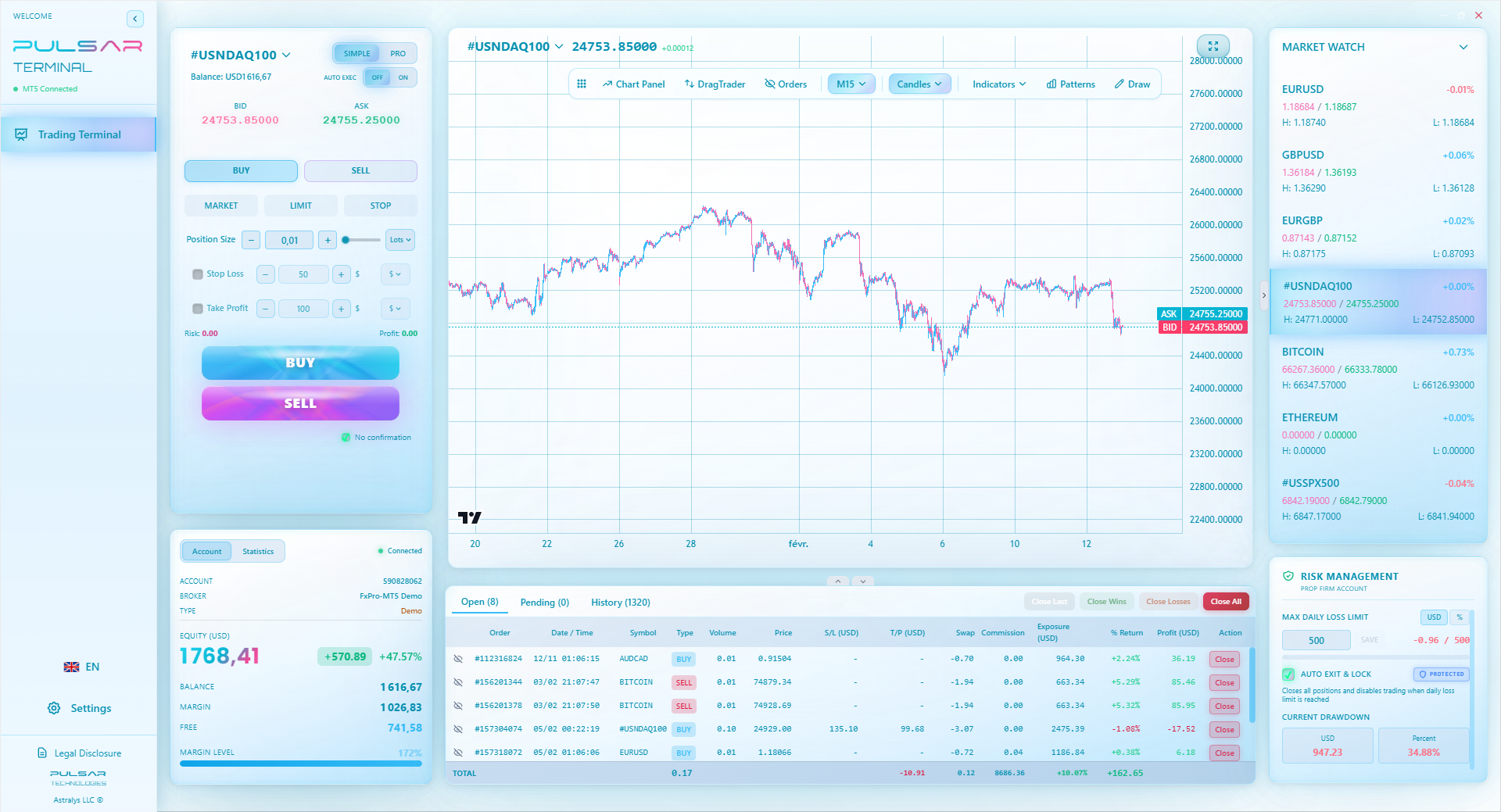
Managing extreme leverage and complex orders on MT5 requires precision; Pulsar Terminal's drag-and-drop orders and multi-TP/SL tools give you that control without the panic.
Pulsar Terminal
MT5 올인원 도구: 드래그앤드롭 주문, 다중 TP/SL, 트레일링 스톱, 그리드 트레이딩, 볼륨 프로파일, 프롭펌 보호. 매일 1,000명 이상의 트레이더가 사용.
“Bonus conditions are designed to keep you trading, often pushing you to trade larger sizes or more frequently than you should.”
Ah, the shiny objects. xChief is aggressive here: $100 No-Deposit Bonus, Welcome Bonuses up to $500, 70% trading credit on deposits. It feels like free money. It's not.
These bonuses almost always come with binding trading volume requirements. You cannot withdraw the bonus (or sometimes your own profits) until you've traded a certain number of lots. This is designed to keep you trading, often pushing you to trade larger sizes or more frequently than you should to hit the target.
Let's do the math with their 70% credit. You deposit R10,000, get a R7,000 trading credit. Your account shows R17,000. But that R7,000 isn't cash. If you start trading a standard lot (R1,000,000 position with use), a small loss can quickly wipe out your real R10,000, while the bonus remains as a useless number on the screen. It artificially inflates your perceived capital, distorting your risk management.
The monthly 'Gold Whale Contest' with cash prizes is a better promo - it's a straight competition. But the deposit bonuses? Treat them with extreme suspicion. They're a psychological trap more than a financial benefit. Your focus should be on the raw trading conditions: the spread definition, the execution, the platform. Not the confetti.
💡 윈스턴의 팁
Never, ever make a broker decision based on a bonus. The trading conditions - spreads, execution, platform stability - are the meal. The bonus is just a cheap plastic toy in the kids' menu. Focus on the food.
“Bonus conditions are designed to keep you trading, often pushing you to trade larger sizes or more frequently than you should.”
This is a practical headache for many South Africans. While xChief accepts SA clients, the South African Rand is not listed as a base account currency. You'll likely be depositing in USD, EUR, or GBP.
Payment Methods:
- Bank Cards (Visa/Mastercard): Reported issues by some users.
- Bank Wire: Slow, expensive with forex conversion fees from your bank.
- E-wallets (like Skrill): Also reported issues.
- USDT (Cryptocurrency): This is highlighted as a fast method. You'd need to buy USDT on a local exchange like VALR, send it via the BNB network, and then trade.
Every conversion from ZAR to USD and back costs you money - your bank's spread, the broker's spread, or the crypto exchange's fee. It erodes your edge before you've even placed a trade. Withdrawal fees on some methods add another layer of cost.
Compare this to a broker with a local ZAR account, like some offerings from Exness or XM for South Africa, where you can deposit and withdraw in Rands directly. The convenience and cost savings are significant for the retail trader.
“xChief is not for beginners, despite the $10 entry cost. The combination of extreme use and bonus psychology is a recipe for a margin call.”
After stripping away the marketing, who should consider xChief?
Potential Pros:
- Very Low Minimum Deposit: The $10 entry point is almost non-existent.
- High use Access: If you truly understand and can manage the nuclear risk of 1:1000, it's there.
- Competitive Spreads: The Classic+ 0.6 pip offer is decent for a commission-free account.
- MT4/MT5: You get the professional platforms.
Glaring Cons:
- Complex Offshore Regulation: Your money is under a light-touch regulator.
- use as a Crutch: It encourages terrible risk habits for beginners.
- Bonus Traps: The promotions can distort your trading psychology.
- ZAR Friction: No direct Rand accounts add cost and complexity.
- Execution Questions: User reports of 'off quote' errors are a serious concern.
My Take
xChief is not for beginners, despite the low entry cost. The combination of extreme use and bonus psychology is a recipe for a margin call. It's a broker for the experienced, self-disciplined trader who specifically wants high use for a defined strategy, understands the regulatory trade-off, and will ignore all the promotional noise. They are the 'forex chef' who knows exactly how hot the stove is.
For the vast majority of South Africans starting out or looking for a long-term home, I'd point you towards brokers with clearer FSCA oversight, ZAR accounts, and a focus on education over enticement. Build your skills on a platform where the rules are designed to protect you, not just attract you. Your capital is too hard-earned to be a line item in an offshore bonus scheme.
FAQ
Q1Is Forex Chef (xChief) legal and regulated in South Africa?
Yes, but with a big caveat. Their South African entity, XCHIEF ZA (PTY) LTD, is an authorized FSP (FSP 54829) with the FSCA. This allows them to act as an intermediary. However, your actual trading account and funds are held with their offshore entity, XCHIEF LTD, regulated by MISA in the Comoros. So, it's legal to use, but your ultimate regulator is not the FSCA.
Q2What is the minimum deposit for a South African trader?
Technically, you can start with their CENT account which has no minimum. Realistically, the Classic+ account at $10 (roughly R185) is the practical starting point. Remember, you'll need to convert your Rands to USD to fund it, incurring bank or exchange fees.
Q3Can I get the 1:1000 use as a South African?
Yes. Because xChief's product provider is offshore (not bound by ESMA or strict FSCA use caps for issuers), they offer up to 1:1000 use across most accounts. This is extremely high risk and not suitable for inexperienced traders.
Q4Are the bonuses and no-deposit offer worth it?
Almost never. These bonuses come with strict trading volume conditions (rollover requirements) that lock your funds. They encourage overtrading and distort your real account balance, which is terrible for learning proper risk management. Focus on the raw trading costs, not the promotional glitter.
Q5Can I withdraw my profits easily to a South African bank account?
You can withdraw, but it's not seamless. Since there's no ZAR account, profits are likely sent back in USD or EUR. Your bank will convert it to Rands at their rate, often with fees. Some e-wallet methods have withdrawal fees. Crypto (USDT) is noted as faster.
Q6How does xChief compare to Pepperstone or IC Markets for SA traders?
Key difference is regulation and focus. Brokers like Pepperstone and IC Markets are regulated by top-tier authorities (ASIC, FCA) and often have FSCA representatives. They offer lower use (like 1:500 max for retail), fewer 'bonus' traps, and often better execution technology. They cater to serious traders, while xChief's model heavily targets the high-use, bonus-seeking segment.
Q7What is the biggest risk of trading with xChief?
Yourself. The biggest risk is being seduced by the 1:1000 use and fake bonus capital into taking positions far too large for your account. The second biggest risk is the lighter investor protection under the MISA regulator compared to an FSCA-prudentially regulated broker.
윈스턴 교수의 수업
핵심 요약:
- ✓use above 1:100 is a professional tool, not a beginner's crutch.
- ✓Offshore regulation means less protection; know what you're signing up for.
- ✓Broker bonuses are psychological traps, not financial advantages.
- ✓Always prioritize execution quality and spreads over flashy account perks.
이 기사가 얼마나 유용했나요?
별을 클릭하여 평가
주간 트레이딩 인사이트
무료 주간 분석 & 전략. 스팸 없음.
저자 소개
David van der Merwe
신흥시장 트레이더
요하네스버그 기반 트레이더로 신흥시장 통화 11년 경력. ZAR 통화쌍, FSCA 규제 거래, 남아공 시장 분석 전문.
댓글
위험 고지
금융 상품 거래에는 상당한 위험이 수반되며 모든 투자자에게 적합하지 않을 수 있습니다. 과거 성과가 미래 수익을 보장하지 않습니다. 이 콘텐츠는 교육 목적으로만 제공되며 투자 조언으로 간주되어서는 안 됩니다. 거래 전에 항상 직접 조사를 수행하십시오.
이 기사도 읽어보세요

Cara Trading Forex Sukses: 7 Prinsip dari Trader Profesional
Cara trading forex sukses dengan 7 prinsip trader pro: manajemen modal, disiplin, journal trading, backtest. Data nyata, bukan janji profit palsu.
Jam Trading Forex Terbaik untuk Trader Indonesia: Panduan Lengkap dengan Tabel Waktu
Panduan jam trading forex untuk trader Indonesia. Tabel 4 sesi dunia, jam emas 20:00-00:00, sesi mana yang harus dihindari. Data akurat + tips dari trader berpengalaman.
Top 5 Sàn Forex Uy Tín Nhất 2026: Review Jujur dari Trader Indonesia
Top 5 sàn forex uy tín 2026 untuk trader Indonesia. Review jujur: spread, deposit, withdraw, dukungan lokal. Exness, XM, IC Markets & lebih.
