


I remember my first deposit with an international broker back in 2014.

David van der Merwe
신흥시장 트레이더 ·  South Africa
☕ 11 분 소요
배울 내용:
- 1The Official Number (And What It Really Means)
- 2The South African Context: Fees and the Rand
- 3Regulation and Safety: Is Your Money Protected?
- 4Account Types and Real Trading Costs
- 5Platforms and Tools: What You Actually Get
- 6How Forex.com Stacks Up Against Local Alternatives
- 7Step-by-Step: Depositing from South Africa
- 8Final Verdict: Is It Worth It For You?
I remember my first deposit with an international broker back in 2014. I sent over R1,500, thrilled to finally trade with a 'big name'. By the time the dollars landed in my account, over R200 had vanished into bank fees and a terrible exchange rate. That's the real lesson about a minimum deposit: the posted number is just the beginning. For us in South Africa, choosing where to put our money involves more than just checking if you have $100. We need to talk about the rand, the FSCA, and whether Forex.com's shiny global reputation is worth the potential headaches for a local trader just starting out.
Officially, the Forex.com broker minimum deposit is $100 USD. That's for their Standard, Commission, and MetaTrader accounts. It's a common, accessible entry point globally. But for you, sitting here in SA, that $100 isn't sitting in your bank account. You've got rands.
So, let's do the real math. At an exchange rate of roughly R18.50 to the dollar, that's R1,850. But you can't send exactly R1,850. Your bank will charge an international transfer fee (around R200-R300), and they'll give you a commercial exchange rate that's worse than the Google rate. To be safe, you should budget R2,200 to get a clean $100 into your account. That's the first hidden cost.
Forex.com also offers a Direct Market Access (DMA) account. They 'recommend' a $25,000 minimum. That's not a hard rule, but it tells you who that account is for: serious, high-volume traders. For context, $25,000 is about R462,500. If you're reading a guide about minimum deposits, that account isn't for you yet. Stick to understanding the Standard or Raw Spread accounts.

Warning: The $100 minimum is just to open the account. It is NOT a recommended starting trading capital. With 1:30 use, a $100 account is incredibly fragile. A few bad trades can wipe it out. I always advise new traders to start with capital they can afford to lose, which is usually significantly more than the bare minimum deposit.

💡 윈스턴의 팁
A broker's minimum deposit tells you the price of admission. Your own minimum capital should be the amount that lets you trade without sweating every pip. They are rarely the same number.
This is where most international broker guides miss the point for us. Forex.com is a global giant, but it's not built around the South African rand.
ZAR Accounts and Conversion Fees
Forex.com does not offer ZAR-denominated trading accounts. Your account will be in USD, EUR, or GBP. Every time you deposit ZAR, it gets converted. Forex.com charges a 0.5% fee on that conversion. When you withdraw profits back to your South African bank account, another conversion happens (another potential 0.5% fee, plus your bank's fees). These small percentages eat into your profits, especially if you're making frequent, smaller withdrawals. It's a drag on performance that traders using local EUR or USD accounts don't face.
Payment Methods: What Works from SA?
You can fund your Forex.com account via:
- International Bank Wire (most common, but slow and expensive).
- Credit/Debit Card (Visa/Mastercard). Faster, but your bank might treat it as a cash advance.
- E-wallets like PayPal or Skrill, if you have them funded in USD.
You'll notice local favorites like Ozow/Instant EFT aren't there. This lack of local payment integration is a key difference between Forex.com and brokers who specifically court the SA market, like XM or Pepperstone.
Trading the ZAR Pairs
Here's a paradox: while funding in ZAR is a hassle, trading ZAR pairs like USD/ZAR is excellent on Forex.com. They offer competitive spreads and good liquidity. I've traded USD/ZAR during SA budget speeches on their platform, and the execution was solid. So, you're using a global broker to trade your local currency, which is actually one of its strengths for an SA trader interested in that volatility.
“The real cost of a $100 minimum deposit from South Africa is closer to R2,200 once you factor in bank fees and a poor exchange rate.”
This is the most critical question. Forex.com is heavily regulated, but not primarily by our local watchdog, the FSCA.
Forex.com is regulated by some of the world's toughest authorities: the UK's FCA, the US CFTC/NFA, Australia's ASIC, and Cyprus's CySEC. This means client funds are segregated in top-tier banks, and they adhere to strict financial reporting. It's a very safe broker from a global perspective.
However, for a South African, there's a gap. Because they aren't FSCA-regulated, if you have a dispute, you can't easily walk into the FSCA's offices in Pretoria. Your complaint would go through their international entities (likely CySEC or the FCA). This isn't necessarily a deal-breaker - many of us use offshore brokers - but you must be comfortable with it. Your protection is under European or British law, not South African law.
I've had to contact support for a withdrawal query once. It was resolved, but it took 48 hours and several emails. With a locally regulated broker, a phone call during business hours can sometimes fix things faster. It's a trade-off: world-class safety versus local convenience.

Pro Tip: Always download your statements and keep records of all trades and communications. With any offshore broker, good record-keeping is your first line of defense if anything goes wrong.
The minimum deposit gets you in the door, but your trading style chooses the account. Getting this wrong can cost you more than any deposit fee.
| Account Type | Best For | Spreads (EUR/USD) | Commission | Minimum Deposit |
|---|---|---|---|---|
| Standard Account | New traders, casual traders. | Variable, starting around 0.8 pips. | None. | $100 |
| Commission Account (Raw Spread) | Active traders, scalping. | Raw, from 0.0 pips. | $5 per 100k lot (round turn). | $100 |
| MT4/MT5 Account | Traders who love the MetaTrader environment. | Similar to Standard or Commission, depending on choice. | As per account type. | $100 |
Here's the practical difference with real numbers from a trade I took last year:
- On a Standard account, I bought 1 lot of EUR/USD at a spread of 0.9 pips. My cost to enter was $9 (0.00009 * 100,000).
- On a Commission account, the spread was 0.1 pips ($1 cost), plus a $5 commission. Total cost: $6.
For that trade, the Commission account was cheaper. But if I were trading a 0.1 lot mini position, the $5 commission would dominate, making the Standard account cheaper. You need to use a position size calculator and know your typical trade size to pick the right one.
A mistake I made early on was choosing a Raw Spread account because 'zero spread' sounded amazing, but my trade sizes were too small. The commission murdered my profits. Start with the Standard account if you're unsure; you can always switch later.
💡 윈스턴의 팁
If you need a calculator to figure out if your deposit method is cost-effective, it probably isn't. Simplicity in funding is a feature worth paying for when you're starting.
“Forex.com's strength for South Africans isn't in taking our rands, but in letting us trade the rand with world-class tools.”
Your R2,200 deposit buys you access to some serious trading technology. This is where Forex.com shines.
You get MetaTrader 4 and MT5. If you're learning, this is perfect. Every tutorial, every indicator guide for the RSI or MACD, is based on MT4/5. It's the universal language of retail trading.
But Forex.com's real power is its own Advanced Trading Platform (ATP) and TradingView integration. The ATP has tools I now rely on: advanced charting, integrated news feeds from Reuters, and a great market depth window. For trading a volatile pair like XAU/USD (gold), seeing the order book can provide clues about short-term direction.
However, a word of caution. These advanced platforms can be overwhelming. I've seen new traders get so lost in drawing 20 different indicators they forget to actually watch the price action. Start simple. Use MT5 with just a couple of charts. Learn one platform properly before jumping to the next.

Example: On their ATP, I set an alert for USD/ZAR if it broke above R18.80. The alert popped, I checked the chart, saw momentum, and entered a quick swing trading position. The tools didn't make the trade for me, but they gave me the information to act fast.
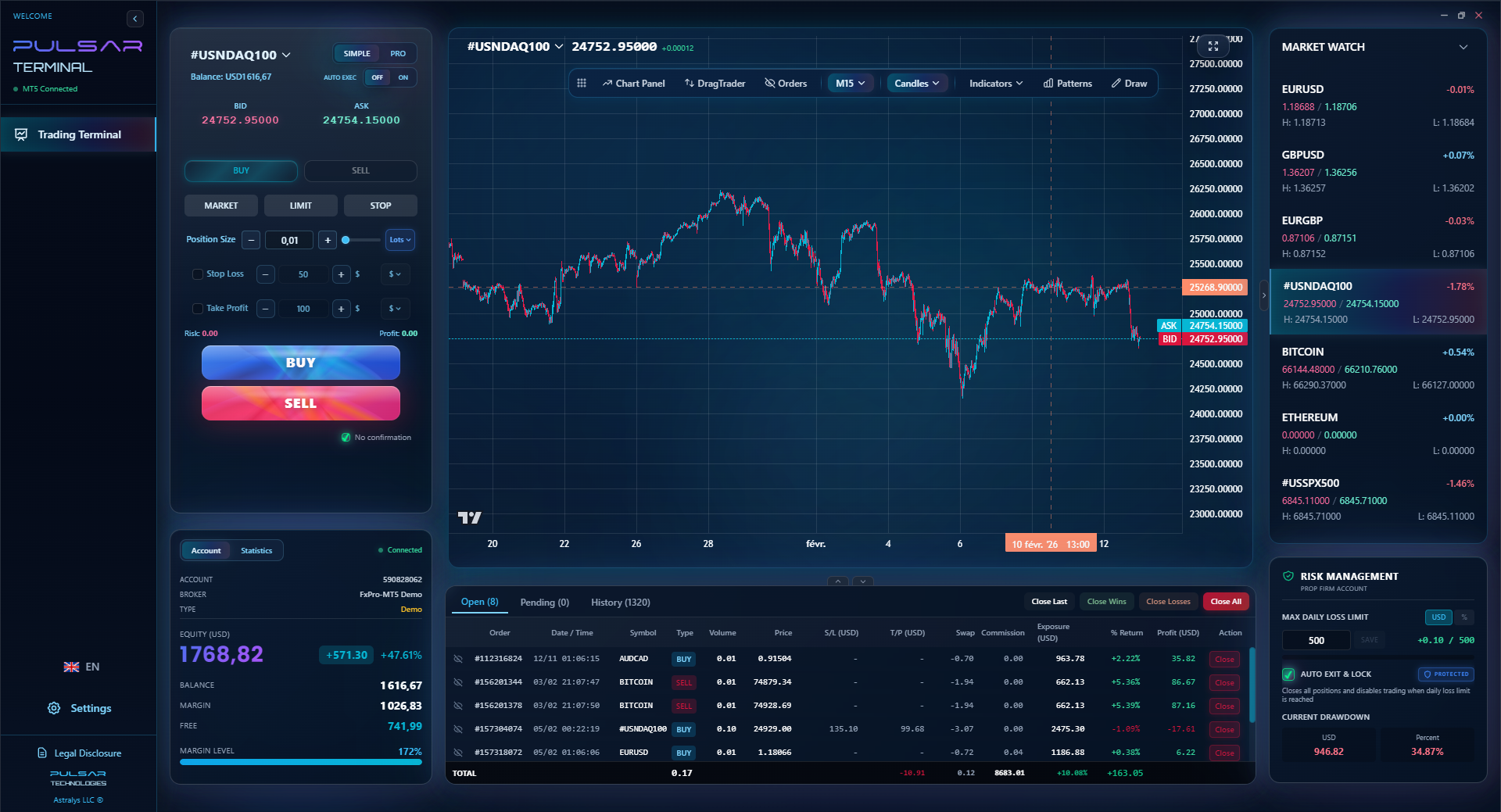
Managing complex trades on MT5 is easier with tools that let you set multiple take-profits and stop-losses with a single click, saving you from costly manual errors during volatile ZAR moves.
Pulsar Terminal
MT5 올인원 도구: 드래그앤드롭 주문, 다중 TP/SL, 트레일링 스톱, 그리드 트레이딩, 볼륨 프로파일, 프롭펌 보호. 매일 1,000명 이상의 트레이더가 사용.
Forex.com isn't your only option. Let's be honest, sometimes a broker that 'gets' South Africa makes life easier.
Forex.com's Pros:
- Global reputation and top-tier regulation.
- Excellent trading platforms and research tools.
- Wide range of markets (forex, indices, commodities, crypto).
- Good for trading ZAR pairs.
Forex.com's Cons for SA Traders:
- No ZAR accounts, leading to conversion fees.
- No local FSCA regulation.
- Limited local payment methods (no Instant EFT).
- Customer support isn't SA-timezone optimized.
Local-Focused Alternatives: Brokers like IC Markets or Exness (which do have FSCA registration) often offer ZAR accounts and Instant EFT deposits with no fees. Their minimum deposits can be lower (sometimes from $10 or R0). Their trade execution is also very good, often on par with Forex.com for the major pairs like EUR/USD.
The trade-off? They might not have the same breadth of proprietary research or the brand prestige. But for a South African focused on cost-effective deposits and withdrawals, they can be a smarter practical choice, especially when you're starting and every rand counts.
My advice? If you're a beginner who values ultimate safety and plans to trade mostly in USD, Forex.com is a solid, if slightly cumbersome, choice. If you want to fund your account with R500 on a Tuesday via Ozow and start trading immediately, look at the locally-focused brokers first.
“Choosing a broker is about matching their strengths to your weaknesses. Don't pick a global platform for local convenience.”
Let's walk through exactly how to get your money into Forex.com, anticipating the SA-specific hurdles.
- Open Your Account: Complete the application online. You'll need your SA ID, proof of residence (a utility bill less than 3 months old works), and bank statement.
- Verify Your Account: This can take 1-3 business days. Don't try to deposit before you're verified, it will just cause delays.
- Log In and Find Deposit Section: Once verified, go to the funding page.
- Choose 'International Bank Wire'. This is your most reliable method from SA.
- Forex.com will provide bank details (likely a USD account in the UK or Cyprus).
- Go to YOUR BANK's app or branch. Initiate an international SWIFT transfer.
- Crucial: You MUST include the unique reference number Forex.com gives you. If you forget this, your money could be lost in the banking system for weeks.
- Tell your bank the beneficiary is "FOREX.com" for client funds.
- Select that YOU PAY ALL BANK FEES (OUR charge). This ensures the full amount arrives. If you split fees, you might deposit R2,200 and only $107 arrives, which could be under the $100 minimum, causing a huge headache.
- Wait 3-5 Business Days. International wires aren't instant. The money will appear in your Forex.com USD account.
- Start Small. Once it lands, don't rush. Practice on a demo account first. Then, when you trade live, start with tiny positions - 0.01 lots - to get a feel for the real platform and live spreads before committing serious capital.
💡 윈스턴의 팁
The best platform is the one you understand. A $10,000 platform with tools you don't use is a worse choice than a simple one that lets you execute your plan without distraction.
So, is the Forex.com broker minimum deposit of $100 a good starting point for a South African trader?
It depends entirely on your profile.
Choose Forex.com if:
- You prioritize global regulatory safety above local convenience.
- You plan to trade larger sizes (over 0.5 lots regularly) where their Commission account pricing becomes competitive.
- You want access to their advanced platforms and research for trading global markets.
- You are comfortable managing currency conversion and international bank wires.
Look elsewhere if:
- Your trading capital is under R10,000. The deposit/withdrawal friction will eat a meaningful percentage of your money.
- You want the simplicity of a ZAR account and Instant EFT deposits.
- You feel more secure having the direct recourse of the FSCA.
- You are a complete beginner. The complexity is unnecessary; start with a simpler, local option.
My personal take? Forex.com is a fantastic broker that I use for a portion of my capital. But I didn't start with them. I started with a local broker to learn the ropes, understand pips and spreads, and avoid the currency hassle. Once I had a proven strategy and larger capital, I moved some funds to Forex.com for their platform tools and market access. That's the path I recommend. Don't get dazzled by the brand. Let your needs as a South African trader, and the real, total cost of getting your money in and out, guide your first choice.
FAQ
Q1Can I open a Forex.com account with South African Rand (ZAR)?
No, Forex.com does not offer ZAR-denominated trading accounts. Your account will be in USD, EUR, or GBP. When you deposit ZAR, it will be converted to your account currency, incurring a 0.5% conversion fee from Forex.com plus your bank's fees and exchange rate margin.
Q2Is Forex.com regulated by the FSCA in South Africa?
Forex.com is not directly regulated by the South African Financial Sector Conduct Authority (FSCA). It is regulated by several top-tier international authorities like the UK's FCA and Cyprus's CySEC. South African residents can open accounts under these international entities, but they do not fall under the FSCA's direct protection.
Q3What is the cheapest way to deposit from South Africa to Forex.com?
The most reliable method is an international bank wire. While it has fees (R200-R300 from your bank), it's universally accepted. To minimize costs, deposit larger amounts less frequently to amortize the fixed wire fee. Using a credit/debit card is faster but may be treated as a cash advance by your bank. E-wallets like Skrill are an option if you already have USD in them.
Q4Is $100 enough to start trading with on Forex.com?
While $100 meets the Forex.com minimum deposit requirement, it is not enough capital to trade safely. With typical use (e.g., 1:30), a single small market move can trigger a margin call. It's a technical minimum, not a practical one. You should start with risk capital you can afford to lose, which for most new traders should be significantly higher to allow for proper position sizing and learning.
Q5Which account type should I choose as a beginner?
Start with the Standard Account. It's commission-free, so your costs are simple (just the spread). The Commission (Raw Spread) account has lower spreads but charges $5 per lot traded, which can be expensive on small positions. Use the Standard account to learn, track your typical trade sizes, and then calculate if switching to a Commission account would be cheaper for your specific trading style.
Q6How long does a withdrawal back to my South African bank account take?
Withdrawals back to a South African bank account via international wire typically take 3 to 7 business days to process and arrive. Remember, the funds will be converted from your account currency (USD/EUR) back to ZAR, and Forex.com may apply a 0.5% conversion fee on that transaction as well.
윈스턴 교수의 수업
핵심 요약:
- ✓Budget R2,200+ for a $100 Forex.com deposit from SA.
- ✓Forex.com is not FSCA-regulated; your protection is international.
- ✓Start with a Standard account, not a Commission account.
- ✓Use a bank wire and pay ALL fees (OUR) to ensure the full amount arrives.
이 기사가 얼마나 유용했나요?
별을 클릭하여 평가
주간 트레이딩 인사이트
무료 주간 분석 & 전략. 스팸 없음.
저자 소개
David van der Merwe
신흥시장 트레이더
요하네스버그 기반 트레이더로 신흥시장 통화 11년 경력. ZAR 통화쌍, FSCA 규제 거래, 남아공 시장 분석 전문.
댓글
위험 고지
금융 상품 거래에는 상당한 위험이 수반되며 모든 투자자에게 적합하지 않을 수 있습니다. 과거 성과가 미래 수익을 보장하지 않습니다. 이 콘텐츠는 교육 목적으로만 제공되며 투자 조언으로 간주되어서는 안 됩니다. 거래 전에 항상 직접 조사를 수행하십시오.
이 기사도 읽어보세요

Cara Trading Forex Sukses: 7 Prinsip dari Trader Profesional
Cara trading forex sukses dengan 7 prinsip trader pro: manajemen modal, disiplin, journal trading, backtest. Data nyata, bukan janji profit palsu.
Jam Trading Forex Terbaik untuk Trader Indonesia: Panduan Lengkap dengan Tabel Waktu
Panduan jam trading forex untuk trader Indonesia. Tabel 4 sesi dunia, jam emas 20:00-00:00, sesi mana yang harus dihindari. Data akurat + tips dari trader berpengalaman.
Top 5 Sàn Forex Uy Tín Nhất 2026: Review Jujur dari Trader Indonesia
Top 5 sàn forex uy tín 2026 untuk trader Indonesia. Review jujur: spread, deposit, withdraw, dukungan lokal. Exness, XM, IC Markets & lebih.
