


Most forex day trading strategies you read about are pure fantasy, especially under Australia's strict ASIC rules.

Sarah Collins
트레이딩 전략가 ·  Australia
☕ 11 분 소요
배울 내용:
- 1The Australian Reality Check: Your First Trade Is Already Down
- 2Strategy 1: The London Session Breakout (My Daily Breadwinner)
- 3Strategy 2: AUD/USD Asian Range Scalping (The Double-Edged Sword)
- 4Strategy 3: High-Impact News Trading (The Controlled Burn)
- 5Building Your Daily Routine: The 4-Hour Australian Trader
- 6Brokers, Tools, and the Tech You Actually Need
Most forex day trading strategies you read about are pure fantasy, especially under Australia's strict ASIC rules. I've lost real money testing them so you don't have to. After twelve years trading the Aussie session, I've found only three approaches that consistently work when you factor in our 30:1 use limits and broker costs. This isn't theory - it's what survives contact with the AUD/USD market, complete with entry prices, mistakes, and the exact numbers you need to know.
Before we talk strategies, let's get brutally honest about trading costs here. That shiny 0.0 pip spread advertisement? It's a trap for the unprepared. You're paying commissions, and they add up fast when you're day trading.
I learned this the hard way in 2019. I was scalping the EUR/AUD, thrilled with my '0.8 pip spread' on a raw account. After 12 trades in a session, I was up 24 pips on paper. My position size calculator said that was a decent win. Then I checked my balance. I was down $18. The commission was $3.50 per side, per lot. At 1 lot per trade, that's $7 round trip. 12 trades meant $84 in commissions. My 24-pip profit at 1 lot on EUR/AUD was about $192... minus $84 left me with $108, not $192. The spread wasn't the cost; the commission was.
Here's what you're really working with:
| Cost Factor | What It Means For You |
|---|---|
| ASIC use (30:1 Majors) | You need more margin. A $10,000 account controls $300,000, not $500,000 like overseas traders. This changes your risk per trade dramatically. |
| Raw Account Commissions | Typically $3-$7 per 100k traded, each way. On a 5-lot AUD/USD scalp, that's $15-$35 just to enter and exit. Your strategy must account for this. |
| Standard Account Spreads | AUD/USD might be 1.0 pip instead of 0.3. On that same 5-lot trade, that's $50 vs $15 in spread cost. You need wider stops, which changes everything. |

Warning: If your strategy relies on 5-pip profits, Australian commissions will eat you alive. I see it every day. Your first profit target isn't zero pips; it's the number of pips needed to cover your transaction costs. For my main account with IC Markets, that's about 1.2 pips on EUR/USD just to break even on a 1-lot trade.
The good news? Once you build this reality into your plan, you can trade effectively. The brokers here, like Pepperstone and FP Markets, offer excellent execution. You just need a strategy tough enough for the local conditions.

💡 윈스턴의 팁
Your stop-loss isn't a suggestion. It's the price at which your idea is proven wrong. Moving it 'just a little further' is editing reality to suit your ego. Don't do it.
This is my core strategy, responsible for about 60% of my consistent profits. It works because it aligns with market mechanics, not guesswork. The concept is simple: the London open (5 PM Sydney time) creates a surge in volume and volatility. Price often breaks out of the tight range formed during the quiet Asian afternoon.
The Setup Rules
I only trade this on major pairs, especially EUR/USD and GBP/USD. Thirty minutes before London opens, I mark the high and low of the previous hour's range. That's my 'pre-open box.' My entry trigger is a clean break of that high or low with a closing 1-minute candle outside the range. Not a wick - a close.
My Trade Journal Entry: March 15, 2026
AUD/USD had been grinding between 0.6632 and 0.6640 for 90 minutes. London open approached. I placed a buy stop at 0.6642 and a sell stop at 0.6630, risking 0.3% of my account on each (about 7 pips). The buy triggered. Price rallied to 0.6655 within 18 minutes. I took half off at +13 pips, moved my stop to breakeven. Price then pulled back to my entry and took me out for breakeven on the second half. Net result: +6.5 pips on the full position size. A win, but not a home run.
Why This Works in Australia
Our 30:1 use forces discipline. You can't just throw huge position sizes at this. You need a clear level to break, and you need the stop to be tight. The London volatility provides the momentum, and the pre-defined range gives you a logical, low-risk entry point. It's about probability, not prediction.

Pro Tip: Don't trade this on AUD pairs during the Asian session. Wait for London liquidity. The AUD/JPY might look tempting at 4 PM Sydney time, but the real move often comes when Europe logs on. I use the MACD indicator on the 5-minute chart purely for confluence - if the breakout happens with MACD crossing in the same direction, it adds conviction.
“The biggest leak for Australian traders is trying to force action during the dead Sydney afternoon.”
Trading the Aussie during our own session is seductive. You're awake, the news is in your timezone, and it feels familiar. This strategy can work, but it's the one that taught me my most expensive lesson.
The idea is to scalp the 20-40 pip range that AUD/USD often establishes between 10 AM and 2 PM Sydney time. You fade the extremes using the 15-minute chart and a momentum oscillator like RSI.
Here's what went wrong. In July 2024, the RBA made a surprise comment on inflation at 11:30 AM. AUD/USD was at 0.6780, at the top of its range. RSI was overbought at 72. Perfect fade setup, right? I sold at 0.6781, stop at 0.6795 (14 pips). The news hit. Price spiked to 0.6793, then 0.6800... then 0.6815. My stop was annihilated. Loss: 1.4% of my account. I broke my own rule by trading right before a scheduled news event.
The Corrected Approach
Now, I only scalp this range under two conditions: 1) No major scheduled news for 90 minutes, and 2) I use a wider stop (at least 20 pips) and a smaller position. The profit target is smaller too - often just 8-12 pips. The math has to work with commissions. If my stop is 20 pips and my target is 10, I need a 70% win rate just to stay even. That's nearly impossible.
So I flipped it. I now look for a breakout from the Asian range later in the day. If AUD/USD has been stuck between 0.6650 and 0.6665 all morning, and then gets a clean break post-Tokyo lunch, that's a higher-probability trade. The failed scalp becomes a breakout signal. This mindset shift saved this strategy for me.

Example: Asian range high: 0.6660. Low: 0.6645. Price breaks above 0.6663. I enter long at 0.6664. Stop at 0.6659 (5 pips below breakout). Target: 0.6675 (11 pips). Risk/Reward: 1:2.2. This works because the market has shown where it doesn't want to go (the range), and you're betting on follow-through.
💡 윈스턴의 팁
The most important candle on your chart is the one *after* your entry. It tells you if the market agrees with your thesis. If it doesn't, get out. You can always re-enter.
I used to think news trading was for gamblers. Then I developed a system for it. It's not about guessing the direction; it's about capturing the inevitable volatility spike and the subsequent retracement. This is an advanced strategy, and I don't recommend it until you've mastered the first two.
The play is on the 'retrace' after the initial spike. When a high-impact news event drops (US Non-Farm Payrolls, CPI, RBA Rate Decision), price often rockets or plummets, then pulls back to fill some of the gap. You wait for that initial insane move to exhaust.
My Framework
- Identify the Event: Only A-grade news. RBA Cash Rate, US NFP, Fed Funds Rate.
- Wait 90 Seconds: Let the initial panic orders clear. The first move is a minefield.
- Look for Exhaustion: A very long candle in the news direction, followed by a candle with a long wick the other way. That's your signal the retrace is starting.
- Enter on the Retrace: I enter in the opposite direction of the initial news spike, aiming to capture 30-50% of the initial move's retracement.
Real example: February 2025, US CPI came in hotter than expected. EUR/USD was at 1.0920. News hit. It spiked down to 1.0880 in 45 seconds (40 pip drop). A monstrous red candle. The next 1-minute candle printed a long lower wick and closed near its high. Exhaustion signal. I bought at 1.0892. Stop at 1.0885 (just below the spike low). Price retraced back to 1.0910 over the next 20 minutes. I took profit at 1.0908. +16 pips.
The risk? If the news is truly approach-shifting, there's no retrace. It just keeps going. That's why the stop is tight and the position is small - never more than 0.5% of your account. This is a tactical play, not a core strategy. It requires a broker with rock-solid execution during news, like XM or Exness, to avoid slippage disasters.
“use is a limit, not a target. Just because you *can* use 30:1 doesn't mean you should.”
You can't trade all day. You'll burn out. Here's the routine I've settled into after years of trying to be a 24-hour warrior.
6:30 AM - 7:00 AM Sydney Time: Review. I'm not trading yet. I look at the daily charts of my 3-4 favorite pairs. Where did London and New York close? Is there a clear level? I note key support and resistance. I check the economic calendar. What's today's story?
9:30 AM - 12:00 PM: Asian Session Monitoring. If I'm doing the AUD/USD range play, this is the window. But I'm patient. I might place one, maybe two trades if the setup is perfect. Mostly, I'm watching how price behaves around those levels I marked earlier. This is often when I plan my London breakout trade, identifying that pre-open range.
4:45 PM - 6:00 PM: London Session Execution. This is my main trading window. I'm focused, screens clear. I'm executing the London breakout strategy. I'm in, I manage, I'm out. I might get one or two signals. After 6 PM, if I'm not in a trade, I'm done. The market often gets choppy.
10:30 PM+ (If Awake): News Play. Only if there's a major US event. I set an alarm, wake up, execute the retracement plan, and go back to sleep. No hanging around.
This routine respects the market's energy and my own. The biggest leak for Australian traders is trying to force action during the dead Sydney afternoon (2 PM - 4 PM). That's when I do my admin, review trades, and update my journal. Trying to trade then led to my worst losing streaks - boredom trading is a real account killer.
The key is having a strategy for each market phase, not one strategy you brute-force all day. Your scalping strategy might work in Asia, but you need a different approach for London volatility.
💡 윈스턴의 팁
Treat your trading capital like a soldier treats ammunition. You have a finite supply. Wasting it on low-probability shots means you have nothing left when the clear target appears.
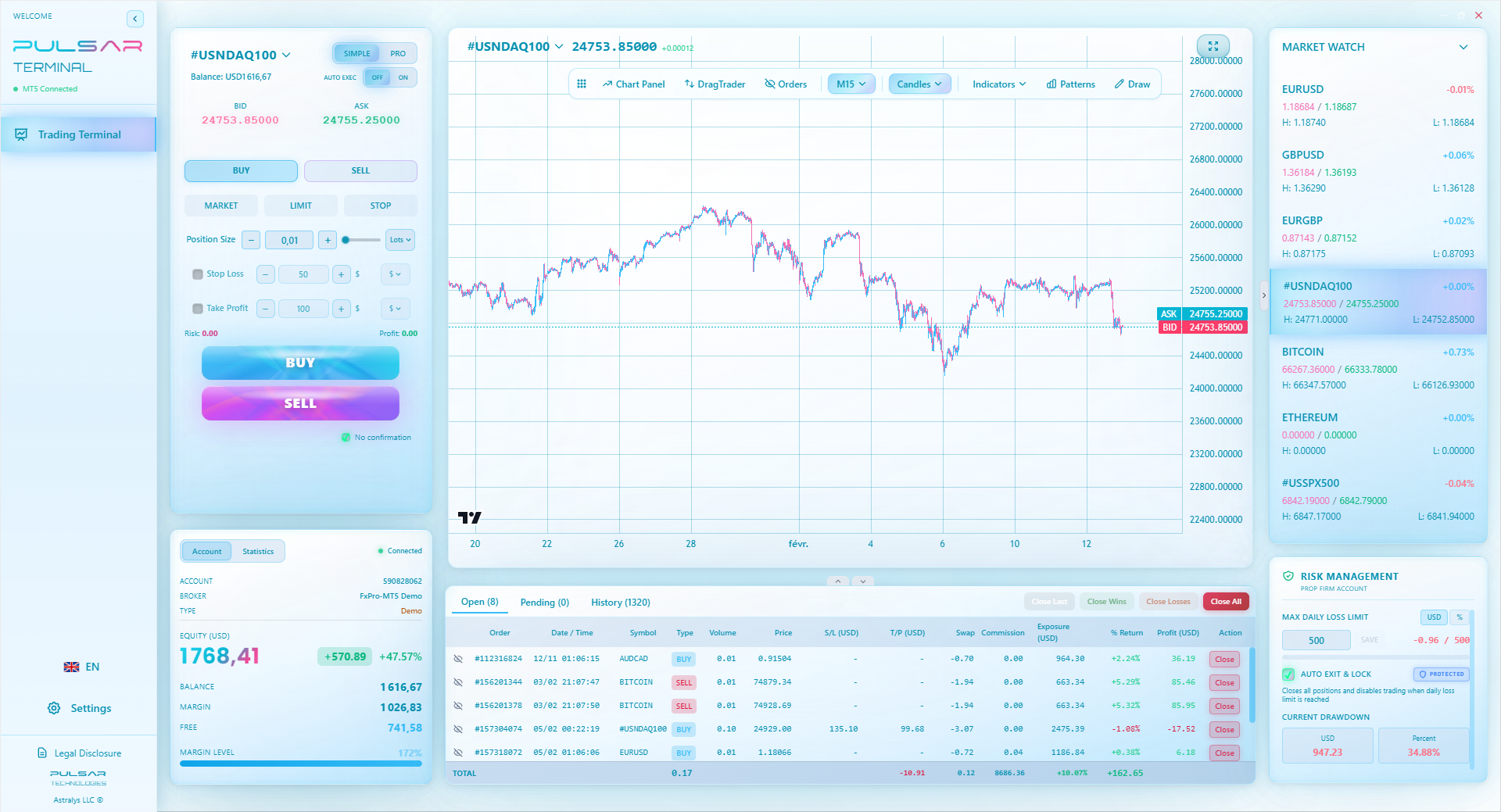
Managing multiple trades and adjusting stops across different sessions is complex, but tools like Pulsar Terminal automate this directly on your MT5 platform.
Pulsar Terminal
MT5 올인원 도구: 드래그앤드롭 주문, 다중 TP/SL, 트레일링 스톱, 그리드 트레이딩, 볼륨 프로파일, 프롭펌 보호. 매일 1,000명 이상의 트레이더가 사용.
Let's cut through the marketing. You don't need 2000 indicators. You need reliable execution, clear data, and a few tools that help you manage risk.
Broker Choice is a Cost Decision:
- For Scalping/Low Latency: You need a raw/ECN account. Look at Pepperstone Razor or IC Markets cTrader. The commissions are worth it for the tight spreads. Your strategy's success depends on entry/exit precision.
- For Swing or Wider Stop Strategies: A standard account from someone like AvaTrade might be fine. The wider spread is less of a percentage of your planned move.
Non-Negotiable Tools:
- A Proper Platform: MT4/MT5 is the standard for a reason. The customizability is unmatched. TradingView is great for analysis, but for execution, I'm on MT5.
- An Economic Calendar: I use Forex Factory's. It's free. Know when news is coming. Colour-code it: red for 'avoid trading', yellow for 'be cautious'.
- A Trade Journal: This is the most important tool. Not just 'won/lost'. Record your entry rationale, your emotional state, the time of day. I found 80% of my losses between 2-3 PM Sydney time. I stopped trading then. The data doesn't lie.
The ASIC Safety Net: Remember those use limits and negative balance protection? They're there for a reason. Use them. If you find yourself constantly hitting a margin call, your position size is wrong, not the use. The 30:1 cap forced me to become a better risk manager. I used to blame 50:1 for my losses overseas. The problem was me.
Finally, internet. Get a wired connection, not Wi-Fi. The one time my Wi-Fi dropped during a London breakout, I was stuck in a trade I couldn't manage. A $500 lesson in infrastructure.
FAQ
Q1What's the minimum capital needed for day trading forex in Australia?
There's no legal minimum, but practically, you need enough to survive the costs and use limits. With ASIC's 30:1 use, to day trade a standard lot (100k) of AUD/USD, you need about $3,333 in margin. I'd say a realistic minimum to trade properly, covering commissions and allowing for sensible risk, is $5,000. Starting with less means your position sizes are tiny, and commissions become a huge percentage of your profits.
Q2Which forex day trading strategy is best for beginners in Australia?
Hands down, the London Session Breakout. It has clear, objective rules (mark the range, wait for the break). It happens at a consistent time (5 PM Sydney). It doesn't require you to predict direction, just react to a confirmed move. Start by just watching it for a week. Paper trade it. It teaches discipline and respects the market's schedule. Avoid news trading and intense scalping as a beginner - the costs and speed will overwhelm you.
Q3How do I manage risk with ASIC's 30:1 use?
use is a limit, not a target. Just because you can use 30:1 doesn't mean you should. My rule: never use more than 5-10% of your available margin on a single trade. If you have a $10,000 account, 30:1 gives you $300,000 in buying power. 10% of that is $30,000. So, your maximum trade size should be around 0.3 lots on a major pair. This keeps your risk per trade small (1-2% of your account) and gives you room to breathe. Always use a stop-loss - your use makes this non-negotiable.
Q4Are ECN accounts with commissions better than standard accounts for day trading?
Almost always, yes. For day trading, you need tight spreads for precise entries and exits. A standard account might show a 1.0 pip spread on EUR/USD, while an ECN account shows 0.1 pips with a $3.50 commission. On a 1-lot trade, the standard account costs you $10 in spread. The ECN account costs $1 in spread + $7 in commission = $8. It's cheaper. On larger or more frequent trades, the ECN savings add up significantly. Just make sure your strategy's profit targets are wide enough to absorb the commission cost.
Q5What time is best for forex day trading in Australia?
The two key windows are the overlap of the Asian and London sessions (roughly 4 PM - 6 PM Sydney time) and the London open itself (5 PM Sydney). This is when liquidity and volatility spike, creating the best trends for strategies like breakouts. The Sydney morning (8 AM - 12 PM) can be good for range-bound strategies on AUD pairs, but moves are often slower. Avoid the dead afternoon (1 PM - 4 PM Sydney).
Q6How many trades should I take per day?
Quality over quantity. In my London breakout strategy, I often take only 1-2 trades per day. Sometimes zero if the setup isn't there. When I was scalping, I'd take 10-15 trades and end the week exhausted and often behind due to commissions. Your goal isn't to be busy; it's to be profitable. Forcing trades to 'be in the market' is the fastest way to give your money back to the brokers. A good day isn't defined by the number of trades, but by following your plan.
윈스턴 교수의 수업
핵심 요약:
- ✓Build all strategies around real costs: spreads + commissions.
- ✓Trade market phases, not just one strategy all day.
- ✓Use ASIC's 30:1 use as a risk-management tool, not a weapon.
- ✓Your daily routine is part of your edge. Stick to it.
이 기사가 얼마나 유용했나요?
별을 클릭하여 평가
주간 트레이딩 인사이트
무료 주간 분석 & 전략. 스팸 없음.
저자 소개
Sarah Collins
트레이딩 전략가
런던 기반 트레이딩 전략가로 금융시장 12년 경력. 시티 오브 런던 증권사 출신 분석가. GBP 통화쌍, 유럽 시장, FCA 규제 거래 전문.
댓글
위험 고지
금융 상품 거래에는 상당한 위험이 수반되며 모든 투자자에게 적합하지 않을 수 있습니다. 과거 성과가 미래 수익을 보장하지 않습니다. 이 콘텐츠는 교육 목적으로만 제공되며 투자 조언으로 간주되어서는 안 됩니다. 거래 전에 항상 직접 조사를 수행하십시오.
이 기사도 읽어보세요

Cara Trading Forex Sukses: 7 Prinsip dari Trader Profesional
Cara trading forex sukses dengan 7 prinsip trader pro: manajemen modal, disiplin, journal trading, backtest. Data nyata, bukan janji profit palsu.
Jam Trading Forex Terbaik untuk Trader Indonesia: Panduan Lengkap dengan Tabel Waktu
Panduan jam trading forex untuk trader Indonesia. Tabel 4 sesi dunia, jam emas 20:00-00:00, sesi mana yang harus dihindari. Data akurat + tips dari trader berpengalaman.
Top 5 Sàn Forex Uy Tín Nhất 2026: Review Jujur dari Trader Indonesia
Top 5 sàn forex uy tín 2026 untuk trader Indonesia. Review jujur: spread, deposit, withdraw, dukungan lokal. Exness, XM, IC Markets & lebih.
