


Let's cut through the noise.

David van der Merwe
신흥시장 트레이더 ·  South Africa
☕ 11 분 소요
배울 내용:
Let's cut through the noise. If you're in South Africa, you've seen the ads: Lambos, beachfront mansions, and some guy in sunglasses promising you'll become a 'forex giant' in 90 days. It's rubbish. The real giants here aren't the gurus, they're the institutions, the regulations, and the few brokers who actually play by the rules. I've traded through the FSB becoming the FSCA, through rand crashes, and through every scam that's washed up on our shores. This isn't about getting rich quick. It's about understanding the actual playing field so you don't get eaten alive.
Forget the self-proclaimed kings on social media. The true power players in South African forex are two entities: the Financial Sector Conduct Authority (FSCA) and the South African Reserve Bank (SARB). If you don't understand their rules, you're not trading, you're gambling with one hand tied behind your back.
The FSCA is your first line of defense. Since taking over from the FSB, they've tightened the screws. Any broker offering services here needs an FSP license. This isn't a nice-to-have; it's the law. It means they must segregate your funds from their own operating capital. I learned this the hard way back in 2012 with a now-defunct 'broker' that wasn't licensed. When they vanished, so did R15,000 of my capital. Poof. Gone. Lesson burned into my brain: always, always check the FSCA's public register for that license number.
Then there's SARB. They control the flow of money in and out of the country. Their exchange control rules aren't there to annoy you, they're there to protect the rand. A huge recent change (late 2025) is the tightening on non-residents taking money out. If you're trading for a foreign prop firm and winning, getting your payout just got more complex. The bank now needs a SARS Tax Compliance PIN before they can send it offshore. This is a big deal that most 'gurus' won't tell you about because they probably don't even know.

Warning: Trading with an unlicensed offshore broker might seem tempting for higher use. But if they collapse or refuse your withdrawal, the FSCA can't help you. You're on your own, and good luck with international financial law.
The use Cap
A major FSCA rule for retail traders: max use of 30:1. Yes, you'll see brokers advertising 1:500. Those are usually their global entities, not their FSCA-licensed one. If you're opening an account with an FSCA-regulated broker, your use will be capped. This isn't to stop you from making money, it's to stop you from blowing up your account in two seconds. I used to chase 1:100 on the rand pairs, thinking I was smart. One bad USD/ZAR trade in 2018 wiped out a month's profits. The cap forces discipline, and frankly, that's a good thing for most traders.
“The real giants here aren't the gurus, they're the institutions, the regulations, and the few brokers who actually play by the rules.”
The South African Rand (ZAR) is a beast of its own. It's liquid enough to be in the top 20 traded currencies globally, but it's still an emerging market currency. That means volatility, and I mean real volatility. When the US sneezes, the euro gets a cold, but the rand gets pneumonia.
Trading USD/ZAR or EUR/ZAR is a different ball game to EUR/USD. The spreads are wider. Expect 5 pips on USD/ZAR on a good day, and 14+ on EUR/ZAR. That's not your broker ripping you off, that's the cost of doing business in a less liquid market. You need to factor that into your position size calculator immediately. A 10-pip stop loss on EUR/USD is tight but possible. On EUR/ZAR, that's noise.
The rand reacts fiercely to local politics, load-shedding news, and commodity prices (especially platinum and gold). I once took a long USD/ZAR position right before a major cabinet reshuffle was announced. The rand strengthened on sheer optimism (completely illogical, but that's markets), and I was stopped out for a 2% loss before the news even officially broke. Local knowledge is an edge, but it's also a trap if you think you can predict politics.

Example: Let's say you trade 1 standard lot of USD/ZAR (100,000 units). At a rate of 18.50, each pip movement is worth roughly R100 (100,000 * 0.0001 * 18.50). A 50-pip stop loss isn't unusual, and that's a R5,000 risk. This is why proper position sizing is non-negotiable.
Payment methods are a nice local touch. Many brokers offer ZAR-denominated accounts to save you conversion fees. Funding via FNB or Standard Bank EFT is usually smooth. Some, like XM, even try with M-Pesa, though it's not as big here as in East Africa. Withdrawing profits back to your South African bank account from an FSCA-licensed broker is straightforward. Trying to get it from an offshore entity? Buckle up for paperwork and potential SARB scrutiny.

💡 윈스턴의 팁
The rand doesn't care about your opinion on politics. Trade the price on the chart, not the headline in the news.
“Trading USD/ZAR is a different ball game to EUR/USD. When the US sneezes, the euro gets a cold, but the rand gets pneumonia.”
The list of brokers serving South Africa is long, but the list of good, reliable ones is shorter. Based on my experience and the cold, hard numbers, here’s the lay of the land.
You have two broad categories: the large international 'forex giants' with local licenses, and the dedicated low-cost specialists.
The big names like IG and AvaTrade offer immense stability, great educational resources, and strong platforms. IG's proprietary platform is fantastic for beginners. But you pay for that safety in slightly higher spreads. IG's average EUR/USD spread is around 0.98 pips. That's fine for a swing trading approach, but painful if you're a scalper.
Then you have the low-raw-cost crew. IC Markets, Pepperstone, and Tickmill are the favorites for active traders. We're talking raw spreads from 0.0 pips on EUR/USD, with a small commission per lot. I run my main account with Pepperstone. On their Razor account, I regularly see EUR/USD at 0.1 pips with a $7 round-turn commission per 100k lot. For high-frequency trading, this cost structure is unbeatable.
Here’s a quick comparison of what matters for an active SA trader:
| Broker (FSCA Licensed) | Min. Deposit (ZAR approx) | EUR/USD Spread (Typical) | Key Platform | Best For |
|---|---|---|---|---|
| IG | R4,500+ | 0.9 - 1.2 pips | IG Platform, MT4 | Beginners, Swing Traders |
| Pepperstone | R3,600+ | 0.0 - 0.2 pips + commission | MT4, MT5, cTrader | Active Traders, Scalpers |
| IC Markets | R3,600+ | 0.0 - 0.2 pips + commission | MT4, MT5, cTrader | ECN Purists, Algorithmic Trading |
| XM | R90+ | 0.8 - 1.0 pips | MT4, MT5 | Micro Accounts, Low Barrier Entry |
| Tickmill | R1,800+ | 0.1 - 0.5 pips (Pro Account) | MT4, MT5 | Low-Cost Raw Spreads |
My mistake early on was chasing the absolute lowest spread without considering execution quality. I had a trade with a no-name broker where my limit order at 1.1050 on EUR/USD simply didn't get filled while the price ticked right through it. Slippage on news events was horrific. With the brokers above, especially the regulated ECN/STP ones, execution is generally fast and reliable. You get what you pay for.
“Your profit isn't just entry minus exit. It's entry minus exit minus costs minus tax. Ignore this, and you're fooling yourself.”
This is where dreams meet reality. Your profit isn't just entry minus exit. It's entry minus exit minus costs minus tax. Ignore this, and you're fooling yourself.
Let's break down the costs:
- The Spread: This is the broker's cut. On a major pair with a good broker, it's tiny. On USD/ZAR, it's a meaningful cost. If you're paying a 6-pip spread, you're already 6 pips in the red the moment you enter the trade.
- Commission: On raw accounts, you pay $3-$7 per 100k lot per side. So a full round turn is $6-$14. On a 10-pip target, that's a big chunk.
- Swap/Overnight Fees: Holding a position past 5 PM NY time? You pay or receive interest. For ZAR pairs, this can be significant. I once held a short EUR/ZAR position for a week, collecting a positive swap that actually added 20% to my profit. But going the other way can eat you alive. Always check the swap rates before holding.
Now, the big one: Tax. SARS views forex trading as income if you're doing it regularly (they'll call it a revenue intent). That means your net profits are added to your other income and taxed at your marginal rate. It's not a flat capital gains tax. You must keep careful records of every trade. I use a simple spreadsheet: date, pair, entry, exit, P/L in ZAR. My accountant needs this. Trying to explain your Exness statement to SARS is not a fun afternoon.

Pro Tip: Open a separate bank account just for trading. Fund your broker from it, and receive withdrawals into it. It makes tracking your capital flow and proving your cost base to SARS infinitely easier.
💡 윈스턴의 팁
A 30:1 use cap feels like a limit. For 95% of traders, it's a life-saving device. Use it as your maximum, not your target.
“Your profit isn't just entry minus exit. It's entry minus exit minus costs minus tax. Ignore this, and you're fooling yourself.”
You can't just copy a YouTube strategy built for the S&P 500 and apply it to the JSE or USD/ZAR. The markets have different personalities.
Volatility Adjustments: The Average True Range (ATR) of USD/ZAR is often 3-4 times that of EUR/USD. Your stop-loss distances must be proportional. A strategy that uses a 20-pip stop on EUR/USD might need a 60-80 pip stop on USD/ZAR. This dramatically changes your position size.
Time Zones Matter: The rand is most active during the Johannesburg and London overlaps (8 AM - 4 PM SAST). Liquidity dries up in the Asian session. If you're a scalping strategy enthusiast, trading USD/ZAR at 3 AM is a recipe for getting chopped up by wide spreads and erratic moves.
Indicator Settings: Common default settings often fail on exotic pairs. The RSI indicator can sit in overbought or oversold territory for weeks during a strong rand trend. I've found more success using longer timeframes for analysis on ZAR pairs. A daily chart is often clearer than a 1-hour chart full of noise.
One of my most consistent setups involves using the MACD indicator on the weekly chart of USD/ZAR to gauge the long-term momentum, then dropping to the 4-hour chart to find entries on pullbacks in the direction of the weekly trend. It's slow, maybe 2-3 trades a month, but it respects the rand's momentum-driven nature.
The biggest mistake I see? South African traders getting sucked into trading exotic crosses like GBP/ZAR or AUD/ZAR because they see big swings. The spreads are monstrous, and the liquidity is thin. Stick to the majors and USD/ZAR until you really know what you're doing. Trading EUR/USD might feel boring, but it's where you learn the craft without the extra tax of a 15-pip spread definition.
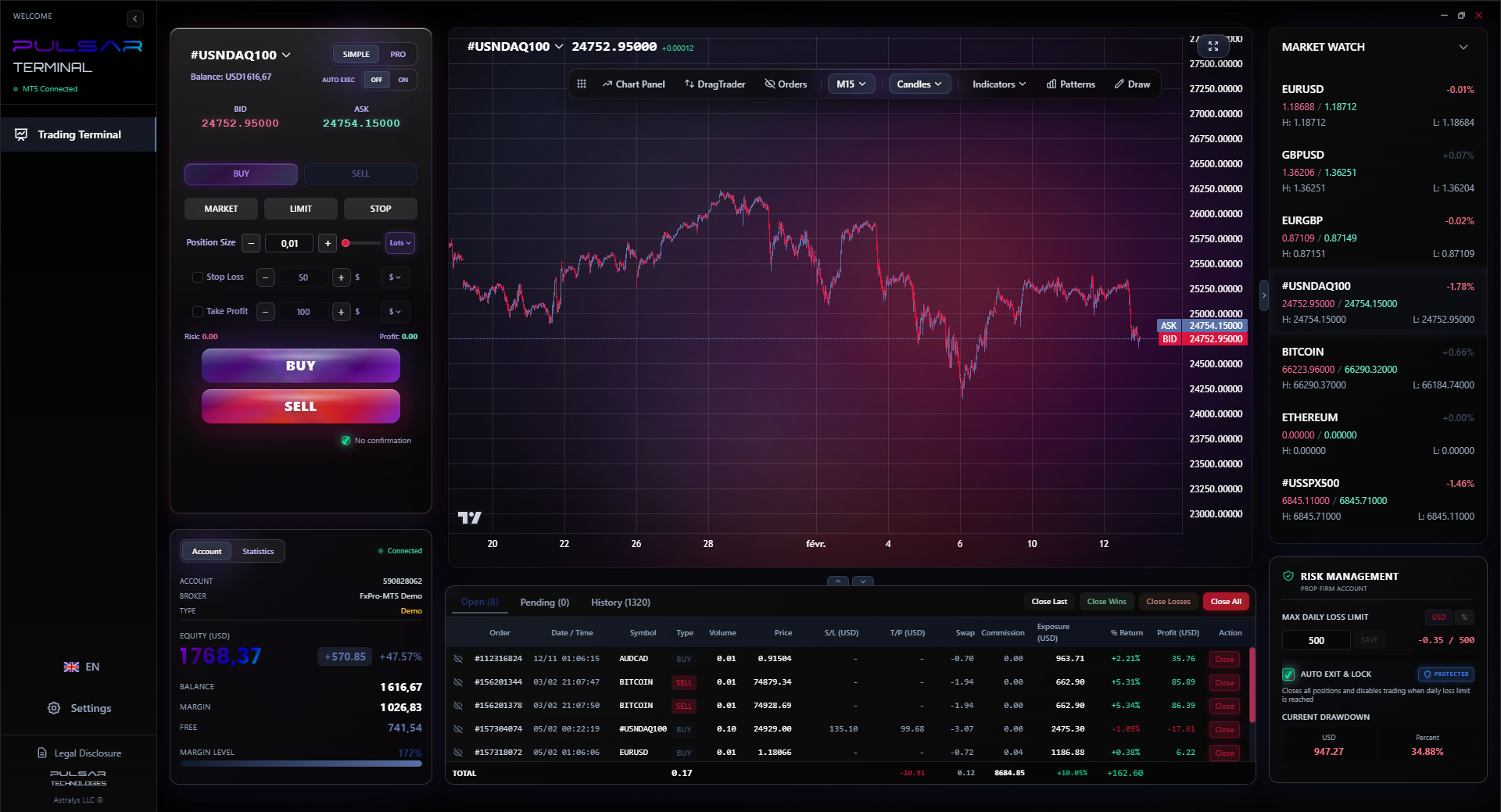
Managing multiple trades and strict stop losses on volatile pairs like USD/ZAR is stressful, but tools like Pulsar Terminal automate partial closures and trailing stops directly on your MT5 chart.
Pulsar Terminal
MT5 올인원 도구: 드래그앤드롭 주문, 다중 TP/SL, 트레일링 스톱, 그리드 트레이딩, 볼륨 프로파일, 프롭펌 보호. 매일 1,000명 이상의 트레이더가 사용.
“The FSCA use cap physically stops you from doing something catastrophically stupid. Thank them for it.”
Twelve years in, here’s my blunt advice for staying in the game.
Start Small, Really Small: That R500 minimum deposit from some brokers isn't a target, it's a warning. Start with money you can afford to lose completely. Use a demo account until your strategy is statistically profitable over at least 100 trades. Then fund a live account with the smallest amount possible. The psychological shift is real.
Embrace the 30:1 use Cap: It's a blessing. Calculate your position size so that a reasonable stop loss (say, 50 pips on USD/ZAR) risks no more than 1-2% of your account. The use cap physically stops you from doing something catastrophically stupid.
Beware of the 'Prop Firm' Path: It's very popular now. You pay a fee, pass a challenge, and trade their capital. Sounds great. But their rules are brutal: strict drawdown limits, often calculated daily. A single bad day can blow the entire account. If you go this route, your risk management must be flawless. These firms are designed for you to fail the challenge. Know that going in.
Tech is Your Friend: Use the tools. MT4 and MT5 are standards for a reason. Learn to use their trade terminal properly. Understand what a margin call is before it happens. Consider tools that help with trade management. Manually moving stop losses to breakeven is a chore; automation removes emotion and error.
Continuous Learning > Gurus: Don't buy a R10,000 course from a 'forex giant.' The free information from the actual giants (the big brokers' webinars, Babypips, tradingview community ideas) is superior. Spend that money on better internet, a second monitor, or books on market psychology.
Finally, have an exit plan. Not just for trades, but for your trading career. Define what success looks like. Is it a consistent monthly income? Growing a retirement pot? Without a goal, you'll just drift from one losing strategy to the next, chasing the ghost of that one perfect trade.
💡 윈스턴의 팁
Your first R10,000 profit is not for a new watch. It's proof of concept. Re-invest it into your trading capital or your education. The watches come later.
FAQ
Q1Is forex trading legal in South Africa?
Yes, completely legal. It's regulated by the Financial Sector Conduct Authority (FSCA). The key is to only use brokers who are licensed by the FSCA. This protects your funds and gives you legal recourse if something goes wrong.
Q2What is the best forex broker in South Africa?
There's no single 'best.' It depends on your style. For beginners and swing traders, IG is excellent. For active traders and scalpers wanting the lowest costs, Pepperstone or IC Markets are top-tier. Always verify their FSCA license number on the regulator's website.
Q3How much tax do I pay on forex profits in South Africa?
SARS typically treats active trading as income, not capital gains. Your net annual trading profit is added to your other income (salary, etc.) and taxed at your marginal income tax rate. You must declare it. Keep detailed records of all trades.
Q4Why are the spreads on USD/ZAR so high?
The South African Rand is an emerging market currency with lower liquidity than majors like the USD or EUR. The wider spread (often 5+ pips) is the market's price for that lower liquidity and higher volatility. It's not a broker scam, it's a market reality.
Q5Can I use international brokers like Exness or XM?
You can, but be careful. Many international brokers have separate entities. If you sign up with their global entity (often in St. Vincent or the Seychelles), you are NOT protected by FSCA rules. Only use their specifically FSCA-licensed entity if they have one. Check the legal company name on their website's SA section.
Q6What use can I get as a retail trader in SA?
The FSCA limits use to a maximum of 30:1 for retail clients. Some brokers advertise higher use (e.g., 1:500), but that is offered by their offshore entities. Your FSCA-regulated account will be capped at 30:1.
Q7What's the minimum amount I need to start trading forex?
Technically, some brokers like XM allow you to start with about R90. But this is a terrible idea. You need enough capital to trade sensible position sizes and survive drawdowns. A more realistic minimum to learn properly in a live environment is R5,000 - R10,000, and you should risk only a tiny fraction of that per trade.
윈스턴 교수의 수업
핵심 요약:
- ✓FSCA license is non-negotiable for fund safety.
- ✓USD/ZAR spreads are 5+ pips; factor that in.
- ✓Taxes apply to profits as income, not CGT.
- ✓use is capped at 30:1 for retail traders.
- ✓Trade the rand during JHB/London overlap for liquidity.
이 기사가 얼마나 유용했나요?
별을 클릭하여 평가
주간 트레이딩 인사이트
무료 주간 분석 & 전략. 스팸 없음.
저자 소개
David van der Merwe
신흥시장 트레이더
요하네스버그 기반 트레이더로 신흥시장 통화 11년 경력. ZAR 통화쌍, FSCA 규제 거래, 남아공 시장 분석 전문.
댓글
위험 고지
금융 상품 거래에는 상당한 위험이 수반되며 모든 투자자에게 적합하지 않을 수 있습니다. 과거 성과가 미래 수익을 보장하지 않습니다. 이 콘텐츠는 교육 목적으로만 제공되며 투자 조언으로 간주되어서는 안 됩니다. 거래 전에 항상 직접 조사를 수행하십시오.
이 기사도 읽어보세요

Cara Trading Forex Sukses: 7 Prinsip dari Trader Profesional
Cara trading forex sukses dengan 7 prinsip trader pro: manajemen modal, disiplin, journal trading, backtest. Data nyata, bukan janji profit palsu.
Jam Trading Forex Terbaik untuk Trader Indonesia: Panduan Lengkap dengan Tabel Waktu
Panduan jam trading forex untuk trader Indonesia. Tabel 4 sesi dunia, jam emas 20:00-00:00, sesi mana yang harus dihindari. Data akurat + tips dari trader berpengalaman.
Top 5 Sàn Forex Uy Tín Nhất 2026: Review Jujur dari Trader Indonesia
Top 5 sàn forex uy tín 2026 untuk trader Indonesia. Review jujur: spread, deposit, withdraw, dukungan lokal. Exness, XM, IC Markets & lebih.
