


Here's a fact that might surprise you: as a South African trader, you can legally move up to R12 million out of the country every single year.

David van der Merwe
신흥시장 트레이더 ·  South Africa
☕ 12 분 소요
배울 내용:
- 1The Big Picture: SARB, FSCA, and Why Two Sets of Rules Exist
- 2Your Personal Forex Allowances for 2026 (The Real Numbers)
- 3Tax on Forex Profits: The SARS Reality
- 4FSCA Brokers: use, Spreads, and the Real Costs
- 5The Hidden Fees (And How to Move Money Smartly)
- 6Common Pitfalls (And How to Avoid Them)
- 7Putting It All Together: A Simple Action Plan
Here's a fact that might surprise you: as a South African trader, you can legally move up to R12 million out of the country every single year. That's not a loophole, it's the official forex limits South Africa has in place. But if you think that means you can just fire up any offshore broker and go wild with 1:1000 use, you're in for a rude awakening. The rules are a complex mix of SARB controls, FSCA regulations, and SARS waiting for their cut. I've seen too many guys get tripped up by not understanding the difference between moving money for investment and actually trading. Let's break it all down, from the allowances you can use to the brokers you should trust, so you can trade with confidence and keep everything above board.
First thing you need to wrap your head around: there are two completely different sets of rules, from two different government bodies, and they govern different things. Mixing them up is the fastest way to get yourself into a regulatory headache.
The South African Reserve Bank (SARB) is all about capital flow. Their job, through Exchange Control, is to stop too much money from fleeing the country and to protect the Rand. They don't care if you're a profitable trader on Exness or IC Markets. They care about how much RAND you're converting to USD, EUR, or GBP and sending overseas. Their rules are about moving your money across the border.
The Financial Sector Conduct Authority (FSCA) is all about how you trade that money once it's overseas. They regulate the brokers. If you're trading with an FSCA-licensed broker, they ensure your funds are segregated (so the broker can't use them for their own bills), that there's some level of market fairness, and that the broker has solid anti-money laundering checks. Trading with an unregulated offshore broker might get you higher use, but you have zero protection if they go under or decide to freeze your account.

Warning: A common mistake is thinking an FSCA license gives you a 'pass' on SARB's limits. It doesn't. The FSCA ensures the broker is legit. SARB controls how much money you give to that legit broker. You need to comply with both.
I learned this the hard way early on. I funded an international broker account with a large sum, thinking it was just an 'investment.' SARB and my bank saw it as a foreign transfer that needed specific approval and documentation. The process got delayed for weeks.
“The R2 million allowance is your 'no-questions-asked' money for the year, but it doesn't give you a pass on how you trade it.”
This is the core of the forex limits South Africa system for individuals. Forget the old, confusing rules. As of 2026, it's been simplified into two clear buckets. Think of it as your annual "offshore transfer" budget.
The Single Discretionary Allowance (SDA): R2 Million
This is your "no-questions-asked" money. Every adult South African resident gets this per calendar year. You can use it for travel, buying stuff online, sending gifts to family abroad, or even making an initial deposit with a foreign broker. The key here is you do not need a Tax Compliance Status (TCS) PIN from SARS to use it. You just go to your bank (an Authorised Dealer) and tell them you want to use part of your SDA.
The Foreign Investment Allowance (FIA): R10 Million
This is the big one for serious investors and traders looking to build a larger offshore portfolio. You can move an additional R10 million out, but there are strings attached. You must be a taxpayer in good standing with SARS. You need to apply for and get a TCS PIN, and you'll have to provide documents proving the source of the funds (like salary slips, sale of asset documents, etc.). This money is intended for genuine investment - things like buying foreign stocks, property, or, yes, funding a substantial trading account.

Example: Let's say in 2026, you want to fund a $10,000 trading account (roughly R185,000). You also take a holiday to the US for R150,000. Your total offshore usage is R335,000. This comes entirely from your R2 million SDA. No TCS PIN needed. Easy.
A few other key limits:
- Online Card Purchases: You can spend up to R100,000 on a single foreign online transaction with your credit/debit card (up from R50,000). Great for software subscriptions like trading tools.
- Minors: Kids under 18 have a travel allowance of R400,000 per year.
Remember, these are annual limits. They reset on January 1st. If you don't use it, you lose it.

💡 윈스턴의 팁
Your annual forex allowance is a use-it-or-lose-it resource. Plan your funding strategy in January, don't wait for December.
“If you're actively trading, SARS sees you as running a business. Your profits are income, not capital gains.”
Alright, let's talk about the part nobody likes: giving SARS their share. This is where many retail traders get a nasty surprise. Here’s the blunt truth: if you're actively trading forex - entering and exiting positions regularly - SARS views your profits as ordinary revenue, not capital gains. You're running a business.
That means your profits get added to your other income (your salary, etc.) and taxed at your marginal income tax rate. Those rates start at 18% and go all the way up to 45%. Capital gains tax, at a maximum effective rate of 18%, is for people who buy and hold assets for the long term. That's not most of us doing scalping or swing trading.
You must register as a provisional taxpayer with SARS. You'll do two provisional tax payments per year (August and February) and a final reconciliation. The good news? You can deduct your trading losses from your taxable income. You can also deduct legitimate business expenses related to your trading - think internet costs, data subscriptions, a portion of your home office, and even fees for educational courses or this website.

Pro Tip: Keep a detailed trading journal. Not just entries and exits, but all related expenses. Use a simple spreadsheet or proper accounting software. When SARS asks (and they might), you need to show your working. I once had to account for three years of trading activity. That journal saved me months of headache.
I made a classic error in my second year of trading. I had a great year, netted about R280,000 in profit, and only declared it as a capital gain. SARS reassessed it as income, slapped me with penalties and interest on the difference. It was a painful, but valuable, lesson in playing by their rules from the start.
“If you're actively trading, SARS sees you as running a business. Your profits are income, not capital gains.”
So you've got your money offshore (within your limits). Now, who do you trade with? Going with an FSCA-regulated broker is the safest bet for South Africans. It keeps everything under the local regulatory umbrella. But safety often comes with restrictions, especially on use.
The FSCA, in line with global trends, has capped use for retail clients. You won't find the crazy 1:2000 offers from some offshore entities here. The max is typically 1:400 for major currency pairs, and often lower for minors and exotics. This is actually a good thing - it forces better risk management and prevents you from blowing up your account in two bad trades.
Here’s a quick look at some major FSCA-regulated brokers as of early 2026:
| Broker | Min. Deposit | Typical EUR/USD Spread | Max use (Retail) | Good For |
|---|---|---|---|---|
| AvaTrade | $100 | From 0.9 pips | 1:400 | User-friendly platform, good for beginners |
| Exness | As low as $1 | From 0.0 pips | 1:2000* (Pro) | Low costs, flexible accounts |
| FP Markets | $50 | From 0.0 pips | 1:500 (Pro) | Raw spreads, popular with active traders |
| HFM | ZAR 0 | From 0.0 pips | 1:2000* (Pro) | High use options (for eligible clients) |
| IG | $50 | Variable | 1:400 | Established, complete market access |
*Note: use above 1:400 is usually only available if you qualify as a "Professional Client" under FSCA rules, which requires meeting specific experience and portfolio size criteria. Don't bank on getting it.
The spread - the difference between the buy and sell price - is your primary trading cost. A "spread from 0.0 pips" usually means a commission-based account. You might pay $3.50 per lot per side, but get the raw interbank spread. This is often cheaper for high-volume traders. Always use a position size calculator that includes commission to know your true break-even point.
I started on a standard account with a 1.5 pip spread on EUR/USD. When I switched to a raw spread account with a commission, my costs dropped by about 40% because my trading volume had increased. It's worth doing the math as you grow.
💡 윈스턴의 팁
The spread isn't just a cost; it's the first hurdle your trade must overcome. A 2-pip spread means you're down R200 on a standard lot before the market even moves. Choose your broker and account type accordingly.
“The bank's 'exchange rate' is a magic trick. The real cost is in the 2-3% hidden spread they never advertise.”
This is where banks make their money, and most people don't even realize it. When you use your local bank to convert Rands to USD and send it overseas, you're getting hit with multiple fees.
- The Hidden Spread: The bank's exchange rate is always worse than the real market rate. This hidden margin is typically 2% to 3%. On a R100,000 transfer, that's R2,000-R3,000 gone before you even start.
- SWIFT/Telegraphic Transfer Fees: These are flat fees, usually between R500 and R1,000 for sending, and another R250-R350 for receiving. Some banks, like Capitec, clearly list these as R250 (SHA) or R500 (OUR) for sending.
- Administrative Fees: Some banks charge a straight "commission." Nedbank, for example, charges 2.15% (min R135) to buy forex.
So, how do you move money smarter?
- Use Specialized FX Providers: Companies like Wise (formerly TransferWise), CurrencyFair, or even some local FX bureaus often offer far better exchange rates (close to the real mid-market rate) and lower, transparent fees. I've saved thousands over the years by not using my main bank for FX.
- Plan Your Transfers: Instead of making multiple small transfers (and paying multiple SWIFT fees), consolidate your funding into fewer, larger transactions within your annual limits.
- Understand the FCA: If you're using the Foreign Investment Allowance (the R10m one), you'll likely have to go through your bank anyway, as they handle the TCS PIN process. Just be aware of the costs and maybe negotiate.
Always, always compare the final amount of foreign currency you will receive after all fees. The "exchange rate" the bank advertises is meaningless without this final calculation.
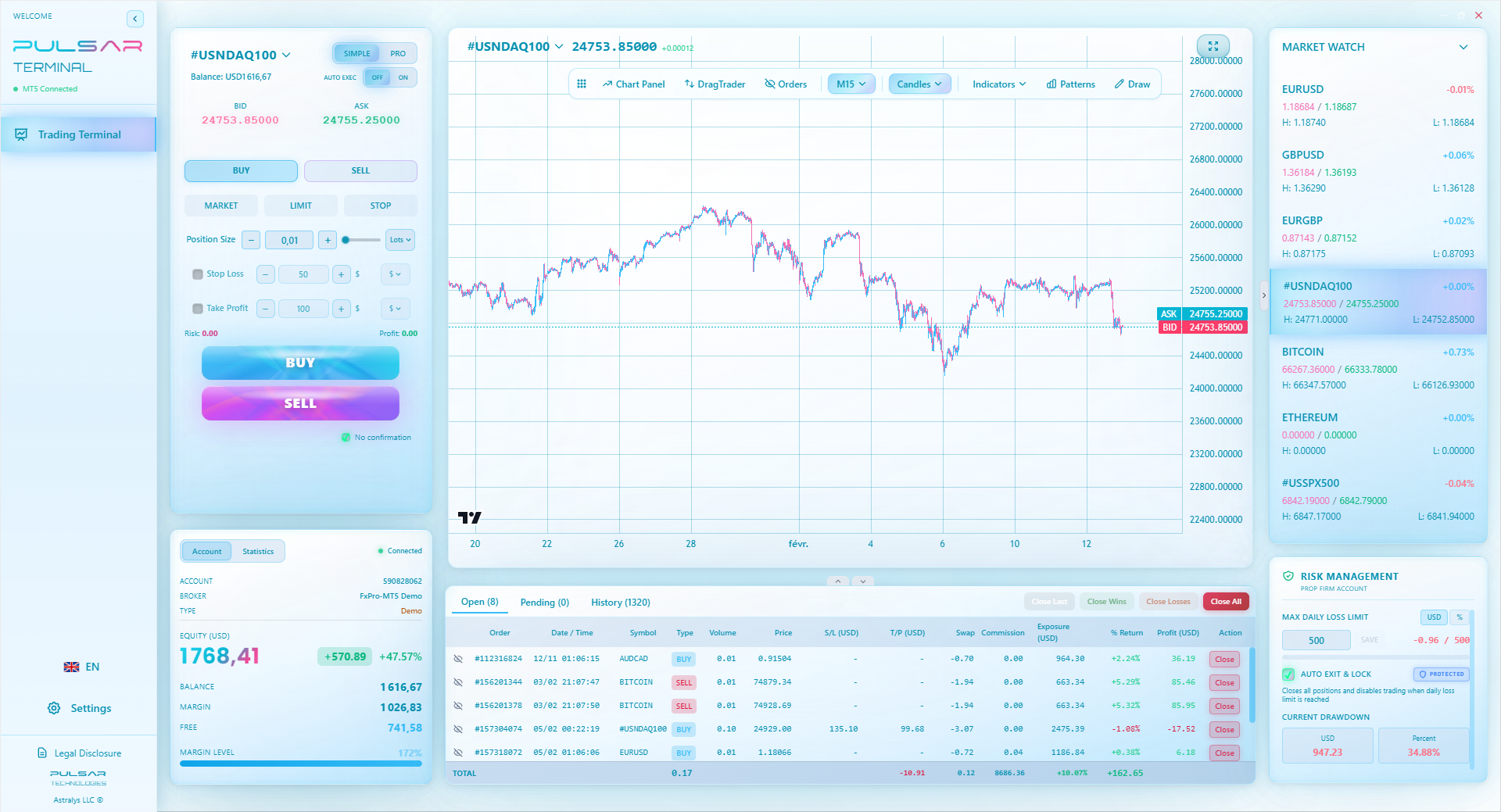
Managing risk across multiple trades is complex, but tools like Pulsar Terminal let you set and automate advanced stop-loss and take-profit strategies directly on your MT5 platform.
Pulsar Terminal
MT5 올인원 도구: 드래그앤드롭 주문, 다중 TP/SL, 트레일링 스톱, 그리드 트레이딩, 볼륨 프로파일, 프롭펌 보호. 매일 1,000명 이상의 트레이더가 사용.
“The bank's 'exchange rate' is a magic trick. The real cost is in the 2-3% hidden spread they never advertise.”
Let's run through the classic mistakes I've seen (and made) so you can sidestep them.
Pitfall 1: Ignoring SARS Until It's Too Late. You have a killer year trading XAU/USD and withdraw R500k. SARS data-matching picks up the foreign transfers and the income in your account. You get a letter. Suddenly you owe tax, plus interest, plus penalties. Solution: Register as a provisional taxpayer from day one. Set aside a percentage of every profitable withdrawal for tax. I keep 30% in a separate savings account.
Pitfall 2: Chasing Offshore use. You sign up with an unregulated broker in Cyprus or the Seychelles for 1:1000 use. You win big for a month, then a "requote" or platform freeze causes a massive loss. You have no recourse. Solution: Stick with FSCA-regulated brokers like Pepperstone or XM for your main account. The use cap protects you. If you must use an offshore broker for a specific strategy, only risk money you can afford to lose entirely.
Pitfall 3: Misunderstanding the Allowances. You think the R2m SDA is for "investments" and try to use it to buy a foreign property, but your bank stops it because property deposits need different approval. Solution: Be clear with your bank about the purpose of the transfer. For the SDA, stick to travel, gifts, and general "portfolio investment." For specific big-ticket items like property, get advice first.
Pitfall 4: Poor Risk Management. This isn't a regulatory pitfall, but it's the one that destroys accounts. High use without a stop-loss is a recipe for a margin call. Solution: Use a stop-loss on every single trade. No exceptions. Your risk per trade should never be more than 1-2% of your account. Tools like the MACD indicator or RSI indicator are for entry timing, not for deciding how much to risk.
💡 윈스턴의 팁
Tax is not a penalty on success; it's a cost of business. Factor a 25-30% provision into your profit-taking strategy from the very first withdrawal.
“High use from an unregulated broker isn't a feature; it's a hazard designed to separate you from your money faster.”
Feeling overwhelmed? Don't be. Here's a straightforward, step-by-step plan to get you trading legally and smartly in South Africa.
- Get Your House in Order: Register as a provisional taxpayer with SARS. Open a dedicated business banking account (or at least a separate savings account) for your trading funds. Start a trading journal.
- Choose Your Broker: Select an FSCA-regulated broker that fits your style. If you're new, start with a user-friendly one like AvaTrade. If you're more experienced and trade frequently, look at FP Markets or Exness for lower costs. Do your due diligence - read reviews like our Exness review or IC Markets review.
- Fund Your Account: Calculate how much of your R2 million SDA you want to allocate to trading for the year. Use a specialized FX provider (not your main bank) to convert your Rands to USD/EUR and send it to your broker. Keep all the transfer documentation.
- Trade with Discipline: Before you place a trade, know your entry, your stop-loss, and your take-profit. Use a position size calculator. Never risk more than you can afford to lose on a single idea.
- Keep Records and Pay Tax: Update your journal with every trade and expense. Every six months, calculate your profit/loss and pay your provisional tax. At year-end, work with a tax practitioner who understands trading to file your return.
The system isn't designed to stop you from trading. It's designed to ensure capital flows are recorded and everyone pays their fair share. Work within the forex limits South Africa has set, use regulated brokers, and manage your risk. Do that, and you can build a serious trading business right here from SA.
FAQ
Q1Can I use my full R2 million allowance to fund a forex trading account?
Yes, you can. The Single Discretionary Allowance (SDA) of R2 million per year can be used for "portfolio investment," which includes funding a trading account with a foreign broker. You don't need a Tax Compliance PIN for this. Just tell your bank you're using your SDA for offshore investment.
Q2What happens if I trade with an unregulated broker?
You operate outside of South African consumer protection. If the broker engages in malpractice (like manipulating spreads, refusing withdrawals, or going bankrupt), the FSCA cannot help you. Your funds are also not guaranteed to be segregated. It's a much higher-risk proposition. While not illegal per se, it's strongly discouraged for your primary trading capital.
Q3How does SARS know about my forex trading profits?
Through several channels: 1) Data-sharing with banks on large foreign transfers (both out for funding and in for withdrawals). 2) Third-party data from payment processors. 3) Your own declarations. 4) If you're audited. It's becoming increasingly difficult to hide this income, so full disclosure is the only safe policy.
Q4Is use of 1:500 available in South Africa?
For most retail traders with FSCA-regulated brokers, the maximum is 1:400 for major pairs. use of 1:500 or higher is usually reserved for clients who qualify as "Professional Clients." This requires meeting specific criteria set by the FSCA, like having a large portfolio (over R8.5 million) or significant trading experience in the relevant market.
Q5Can I deduct losses from my taxable income?
Yes, absolutely. If SARS views your trading as a business (which they do for active traders), your trading losses are considered a business expense. You can deduct your net loss from your other taxable income (like your salary), which reduces your overall tax bill for that year.
Q6What's the difference between the SDA and FIA?
The SDA (R2m) is quick and easy - no tax clearance needed. The FIA (R10m) is for larger, deliberate investments and requires a Tax Compliance Status (TCS) PIN from SARS, proving you're tax-compliant and providing source of funds. The SDA is for general use; the FIA is for serious investing.
Q7Are there limits on how much profit I can bring back into South Africa?
No, there are no limits on bringing foreign currency back into South Africa. You must declare amounts over a certain threshold (currently ZAR 100,000 in banknotes) when physically carrying it, but electronic transfers of profits back to your SA bank account are unlimited. However, the bank will report the incoming foreign currency, which forms part of your taxable income record.
윈스턴 교수의 수업
핵심 요약:
- ✓Use your R2m SDA first for broker funding; no tax PIN needed.
- ✓Always trade with an FSCA-regulated broker for fund safety.
- ✓Set aside 30% of profits immediately for SARS.
- ✓Never use your main bank for FX transfers; costs are 2-3% higher.
- ✓use above 1:400 is for pros; retail caps exist to protect you.
이 기사가 얼마나 유용했나요?
별을 클릭하여 평가
주간 트레이딩 인사이트
무료 주간 분석 & 전략. 스팸 없음.
저자 소개
David van der Merwe
신흥시장 트레이더
요하네스버그 기반 트레이더로 신흥시장 통화 11년 경력. ZAR 통화쌍, FSCA 규제 거래, 남아공 시장 분석 전문.
댓글
위험 고지
금융 상품 거래에는 상당한 위험이 수반되며 모든 투자자에게 적합하지 않을 수 있습니다. 과거 성과가 미래 수익을 보장하지 않습니다. 이 콘텐츠는 교육 목적으로만 제공되며 투자 조언으로 간주되어서는 안 됩니다. 거래 전에 항상 직접 조사를 수행하십시오.
이 기사도 읽어보세요

Cara Trading Forex Sukses: 7 Prinsip dari Trader Profesional
Cara trading forex sukses dengan 7 prinsip trader pro: manajemen modal, disiplin, journal trading, backtest. Data nyata, bukan janji profit palsu.
Jam Trading Forex Terbaik untuk Trader Indonesia: Panduan Lengkap dengan Tabel Waktu
Panduan jam trading forex untuk trader Indonesia. Tabel 4 sesi dunia, jam emas 20:00-00:00, sesi mana yang harus dihindari. Data akurat + tips dari trader berpengalaman.
Top 5 Sàn Forex Uy Tín Nhất 2026: Review Jujur dari Trader Indonesia
Top 5 sàn forex uy tín 2026 untuk trader Indonesia. Review jujur: spread, deposit, withdraw, dukungan lokal. Exness, XM, IC Markets & lebih.
