


I remember staring at my screen in 2018, watching USD/ZAR climb relentlessly.

David van der Merwe
신흥시장 트레이더 ·  South Africa
☕ 12 분 소요
배울 내용:
- 1What's the Forex Market Really Worth? (Globally and in SA)
- 2The Rules of the Game: FSCA Regulations You Can't Ignore
- 3The Real Costs of Trading Forex in South Africa
- 4Who Are You Really Trading Against?
- 5How to Not Blow Up: Risk Management for the SA Trader
- 6Choosing a Broker: What Actually Matters for South Africans
- 7The Bottom Line for South African Traders
I remember staring at my screen in 2018, watching USD/ZAR climb relentlessly. I was short, convinced the rand would strengthen. My position was too big, a classic rookie move. I didn't respect the market's sheer size or volatility. The trade hit my stop loss, wiping out R15,000 in an afternoon - a painful but necessary lesson. That loss taught me that understanding the true forex market worth isn't about bragging rights; it's about grasping the ocean you're swimming in so you don't get swept away. In South Africa, with our unique rules and the rand's wild swings, this knowledge is the difference between survival and a blown account.
When people throw around the term 'forex market worth,' they're usually talking about daily turnover - the sheer volume of money changing hands. Globally, it's a monster. The Bank for International Settlements (BIS) Triennial Survey pegs it at over $7.5 trillion traded every single day. That's not value locked up; it's money in motion. It makes the JSE look like a paddling pool.
For us in South Africa, the local slice of this pie is both significant and growing fast. As of 2024, the South African foreign exchange market was valued at USD 3.86 billion. The projections are even more telling: it's expected to balloon to nearly USD 6.85 billion by 2033. On a day-to-day basis, the average trading volume hit nearly $21.4 billion in April 2025. Let that sink in. Twenty-one billion dollars. Every day. That's the water you're trying to drink from a firehose.
This growth isn't random. It's driven by South Africa's role as a financial gateway to Africa, strong commodity trade flows (think gold and platinum), and sadly, a search for yield in a tough local economy. More and more people are turning to forex, hoping to beat inflation or create an income. But here's the brutal truth: the massive forex market worth doesn't mean it's easy money. It means you're competing against the most liquid, efficient, and ruthless market on the planet. Your edge isn't in predicting every move; it's in managing your tiny piece of it without getting crushed.

Example: That $21.4 billion daily volume? If just 0.1% of that was retail trader volume (a conservative guess), it's still over $21 million from people like you and me. That's a lot of orders hitting the market, often driven by emotion, not logic.

💡 윈스턴의 팁
The market's size is its greatest trick. It makes you feel anonymous, like your small trade doesn't matter. That's when it notices you the most.
“The massive forex market worth doesn't mean it's easy money. It means you're competing against the most liquid, efficient, and ruthless market on the planet.”
Trading in South Africa isn't the Wild West. We have one of the more strong regulatory frameworks among emerging markets, led by the Financial Sector Conduct Authority (FSCA). Ignoring their rules is a surefire way to get burned, either by a shady broker or by your own over-leveraged account.
The FSCA's job is market integrity and client protection. For you, the trader, this translates into a few critical mandates for any broker you should consider. First, client fund segregation. This means your deposit is held in a separate bank account from the broker's operating funds. If the broker goes under (it happens), your money should, in theory, be safe. Never, ever deposit with an unregulated entity promising the world.
The big one for risk management is use. Since 2021, the FSCA has capped use for retail traders at 30:1. This was a direct response to the epidemic of blown accounts. Let me be frank: if you think you need more than 30:1 to be profitable, you're not a trader, you're a gambler. I learned this the hard way early on. Yet, you'll still see some FSCA-licensed brokers advertising use up to 1:500. How? They often do this through a legal structure where their global entity (regulated elsewhere) services the client, while their local entity handles compliance. It's a grey area. My advice? Stick to the 30:1 limit. It will save you from yourself.
Other key rules involve strict Anti-Money Laundering (AML) checks - so get ready to submit your ID and proof of residence - and clear risk disclosures. Don't just click 'I agree' on that disclaimer. Actually read what the broker says about margin calls and volatility. The South African Reserve Bank (SARB) also monitors capital flows, so moving large sums in and out of the country requires the right channels. Using an unauthorized dealer for currency conversion is illegal.

Warning: A broker being 'FSCA-regulated' is the absolute minimum requirement. Check their license number on the FSCA website. Some offshore brokers popular internationally are not licensed to operate here, which leaves you with zero recourse if things go wrong.
“If you think you need more than 30:1 use to be profitable, you're not a trader, you're a gambler.”
The 'forex market worth' conversation is useless if you don't understand what it costs to play. Your profits start in the negative, thanks to spreads, commissions, and swaps. Let's break down the real numbers you'll face.
Spreads: This is the difference between the buy and sell price. It's your primary cost. On the EUR/USD, a good raw spread account from a broker like IC Markets or Pepperstone can show 0.0 pips, but you'll pay a commission. On a standard commission-free account, expect 0.8 pips and up. For ZAR pairs like USD/ZAR, spreads are wider due to lower liquidity - often 50-150 pips. That's R500-R1500 cost per standard lot right off the bat.
Commissions: If you choose a raw/ECN account, you pay per trade. It's typically $3.50 per side per 100k lot (so $7 round turn). This is often cheaper than wide spreads if you're trading larger sizes.
Overnight Financing (Swap): If you hold a position past 10 PM GMT (midnight SA time in summer), you pay or earn a swap rate based on the interest rate differential between the two currencies. For a scalping strategy, this is irrelevant. For swing trading, it can be a significant cost or a small income stream. Trading ZAR pairs? The SARB repo rate heavily influences these calculations.
The Minimum Deposit Myth: Brokers advertise tiny minimums - $1, $5, $10. This is a marketing trap. You cannot trade properly with $10. Even with 30:1 use, that's $300 of buying power. One bad move and you're done. A realistic starter deposit, in my view, is at least R5,000 to R10,000. This allows for sane position sizing and psychological breathing room. I started with R2,000 and was constantly one trade from ruin. The stress alone caused more mistakes.
Here’s a quick comparison of common account types:
| Account Feature | Standard/Commission-Free | Raw/ECN Account |
|---|---|---|
| Typical EUR/USD Spread | 0.8 - 1.5 pips | 0.0 - 0.2 pips |
| Commission | None | $3.50 - $7 per 100k lot (round turn) |
| Best For | Beginners, small accounts, infrequent trading | Active traders, scalpers, larger accounts |
| Hidden Cost | Wider spreads eat into profit on every trade. | You feel every commission, which can deter overtrading. |
“If you think you need more than 30:1 use to be profitable, you're not a trader, you're a gambler.”
This is the part most new traders completely miss. You're not just trading a chart. You're trading against other participants, and most of them have a colossal advantage.
The Big Players: Commercial banks, investment banks, and hedge funds account for the lion's share of that $7.5 trillion daily volume. They have direct interbank access, supercomputers, and teams of PhDs. They move markets with large orders. Your R10,000 order is a rounding error to them.
Market Makers & Your Broker: On the other side of many of your trades is often your broker's liquidity provider or the broker itself (if they are a market maker). They make money from the spread and from the flow of client orders. There's a inherent conflict of interest, though a well-regulated broker manages this.
Other Retail Traders: This is your immediate competition. The depressing statistic is that roughly 70-80% of retail traders lose money. You are statistically likely to be part of this group unless you do things radically differently. Their collective behavior - panic selling, FOMO buying - creates predictable patterns that smarter money exploits. Tools like the RSI indicator or MACD indicator often just measure this retail sentiment.
Yourself: This is your biggest opponent. Your psychology, your impatience, your greed, your fear. The market's size and volatility are weapons that turn these emotions against you. I once revenge-traded after a loss on XAU/USD, ignoring my plan, and turned a R3,000 loss into a R8,000 disaster in two hours. The market didn't do that. I did.
Understanding this landscape is humbling. It forces you to accept that you cannot out-muscle or out-smart the market. Your only viable strategy is to follow its flow, protect your capital ruthlessly, and exploit the small inefficiencies created by other emotional retail traders.
💡 윈스턴의 팁
A regulator capping your use is like a bartender cutting you off. They're not ruining your fun; they've seen how this story ends a thousand times before.
“You are statistically likely to be part of the losing 80% unless you do things radically differently.”
Given the sheer forex market worth and the opponents you face, survival isn't about finding a magic indicator. It's about iron-clad risk management. This is non-negotiable.
The 1% Rule (And Why You'll Want to Break It)
The golden rule is to never risk more than 1% of your trading capital on a single trade. On a R20,000 account, that's R200. If your stop loss is 50 pips on USD/ZAR, your position size must be small enough that a 50-pip loss equals R200. Use a position size calculator for this. Every. Single. Time.
You'll hate this rule. It feels slow. When you're confident, you'll think, 'Just this once, I'll risk 5%.' That's the siren song that sinks accounts. I broke it in 2019 on a 'sure thing' EUR/USD setup. I risked 8%. The trade went 70% in my favor, then reversed and hit my stop. The loss was devastating, not just financially, but psychologically. It took months to rebuild the confidence to trade normally.
use is a Tool, Not a Toy
The FSCA's 30:1 limit is a gift. Calculate your own safe use. If you have R10,000 and open a position with R100,000 notional value (10:1 use), you have room to breathe. If you use the full 30:1, you're at R300,000 exposure. A 3.3% move against you wipes your account. That can happen in minutes during news events. Use use to enable sensible position sizes, not to maximize them.
The Stop Loss is Sacred
Your stop loss is your life raft. Place it at a logical level where your trade idea is proven wrong - not based on how much money you're willing to lose. And once it's set, don't move it further away. Ever. The only acceptable move is to bring it to breakeven or trail it to lock in profits. Automate this if your psychology is weak.

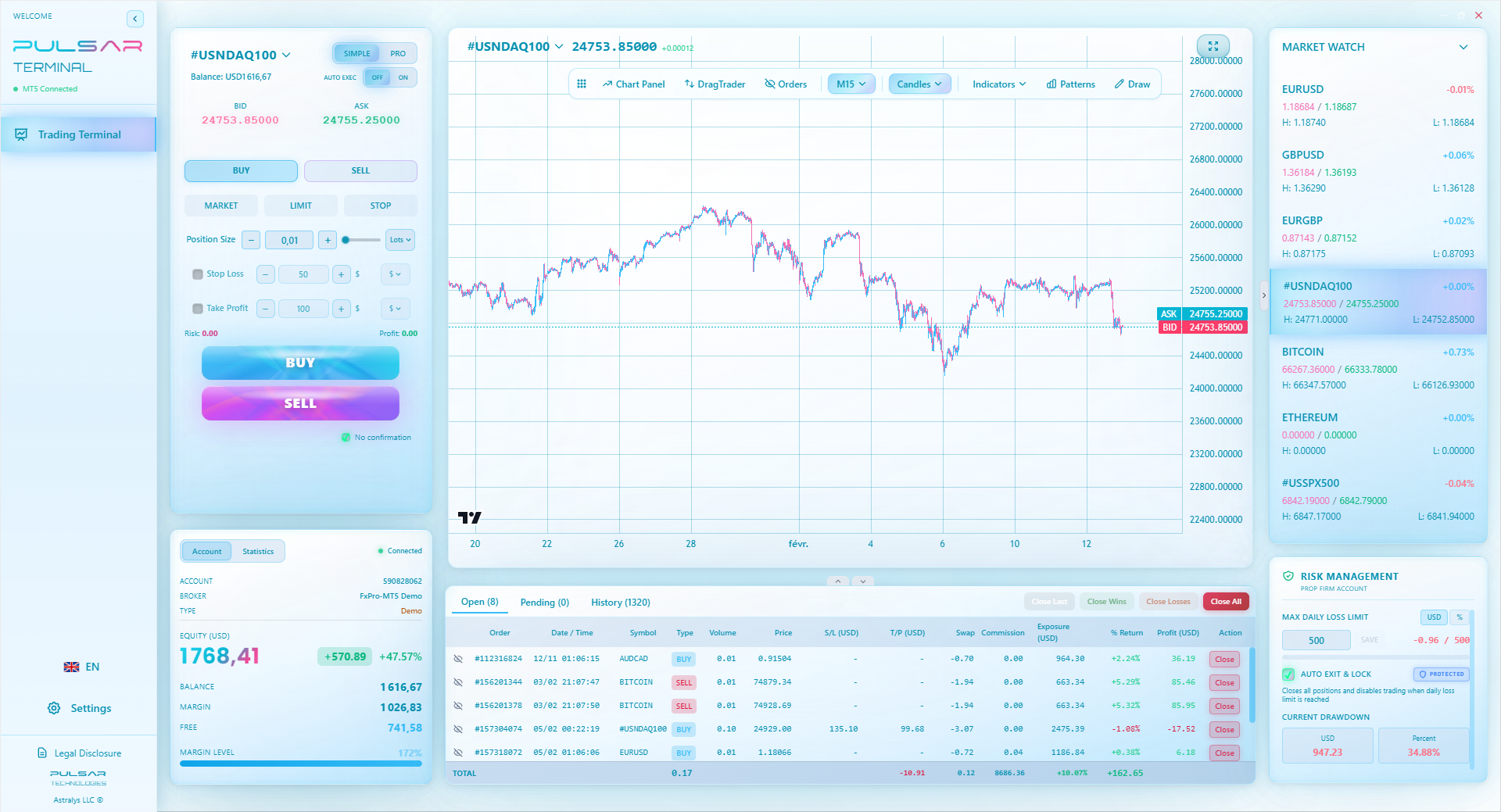
Pro Tip: Your trading platform's basic tools are often not enough for precise risk management. This is where a tool like Pulsar Terminal for MT5 shines. You can set multi-level take-profits and trailing stops that activate automatically, removing emotion from the equation. Instead of anxiously watching a winning trade turn into a loser, the software manages the exit for you based on your pre-set rules.
Managing multiple exits and trailing stops manually is where most profits vanish; Pulsar Terminal automates these precise risk management tasks directly on your MT5 chart.
Pulsar Terminal
MT5 올인원 도구: 드래그앤드롭 주문, 다중 TP/SL, 트레일링 스톱, 그리드 트레이딩, 볼륨 프로파일, 프롭펌 보호. 매일 1,000명 이상의 트레이더가 사용.
“You are statistically likely to be part of the losing 80% unless you do things radically differently.”
With over 200,000 active traders in SA, brokers are fighting for your business. Flashy ads promise easy wins. Ignore them. Here’s what to look for, in order of importance.
- FSCA Regulation: This is non-negotiable. It’s your basic safety net. Brokers like XM, Exness, and the others mentioned earlier have local regulation.
- Trading Costs: Compare the all-in cost for your style. If you're a scalper, a raw spread + commission account is cheaper. If you trade twice a week, a standard account might be fine. Don't just look at EUR/USD; check the spreads on the ZAR pairs or gold if you trade those.
- Deposit/Withdrawal in ZAR: This is huge. Funding in ZAR via EFT (like a normal bank transfer) avoids foreign currency fees. Some brokers offer ZAR-denominated accounts, which simplifies everything. Check processing times - you don't want your money stuck for a week.
- Platform & Tools: MT4/MT5 is the standard. But ask: does the broker offer quality market analysis, an economic calendar, and most importantly, reliable execution with no requotes during volatility? Slippage on news events is normal, but constant requotes are a sign of a poor liquidity feed.
- Customer Support: Test them. Call or email with a question before you deposit. Are they responsive? Do they have South African-based support or at least support during SA market hours?
Avoid brokers that push you towards maximum use or make profitability sound inevitable. A good broker provides the tools and fair conditions; they know most clients will lose, but they want the serious ones to stay for the long term.
💡 윈스턴의 팁
Your goal isn't to conquer the ocean. It's to build a boat that doesn't leak, sail a consistent course, and survive the inevitable storms. The destination is secondary.
“The first goal of trading is not to make a fortune. The first goal is to survive.”
So, what's the forex market worth to you? It's not a number to be impressed by. It's a measure of the opportunity and the danger.
The opportunity is real. You can access the world's largest market from your home in Johannesburg or Cape Town. You can trade the rand's moves based on local politics and global commodity prices - things you might intuitively understand. The market is growing, and the tools are more accessible than ever.
The danger is more real. The vast majority lose because they underestimate the market's power and overestimate their own skill. They treat trading like a lottery or a casino game, not a probabilistic business with strict risk parameters.
The forex market's worth - those billions in daily volume - doesn't care about your mortgage or your dreams. It's impersonal and efficient. Your success depends entirely on your ability to insert a disciplined, rules-based process into that chaotic flow. Start small. Risk tiny amounts. Focus on consistency, not home runs. Use the FSCA rules as a protective cage. And never forget that the most important account you're managing isn't on MT5; it's the one between your ears.
I'll leave you with this: the first goal of trading is not to make a fortune. The first goal is to survive. The second goal is to achieve consistent, small gains. The fortune, if it ever comes, is a byproduct of those first two goals, mastered over years. Don't let the staggering forex market worth fool you into thinking the path is any different.
FAQ
Q1Is forex trading legal in South Africa?
Yes, it's completely legal. However, you must use a broker authorized by the Financial Sector Conduct Authority (FSCA). Trading with an unregulated offshore broker is risky and may violate South African Reserve Bank exchange control regulations.
Q2What is the maximum use I can use in South Africa?
The FSCA has set a retail use limit of 30:1 for forex trading. While some brokers may offer higher use (like 1:500) through their international entities, sticking to the 30:1 limit is a critical risk management practice. Using more is a primary reason traders blow up their accounts.
Q3How much money do I need to start forex trading in South Africa?
Brokers may allow deposits as low as $1 or R500, but that's not enough to trade seriously. A more realistic starting amount that allows for proper risk management is between R5,000 and R10,000. This lets you use sensible position sizes and withstand normal market fluctuations without being wiped out by a single trade.
Q4What are the most traded forex pairs in South Africa?
Alongside global majors like EUR/USD, South African traders actively trade ZAR pairs. The most popular is USD/ZAR, followed by EUR/ZAR, GBP/ZAR, and AUD/ZAR. These pairs are highly sensitive to local political news, commodity prices (gold/platinum), and global risk sentiment.
Q5How are my funds protected with an FSCA-regulated broker?
FSCA rules require brokers to segregate client funds from the company's operational funds. This means your money is held in separate bank accounts. If the broker becomes insolvent, your trading capital should be protected and returned to you, unlike if it was mixed with the company's money.
Q6What is the biggest mistake new South African forex traders make?
Two mistakes are tied for first: using excessive use and having no risk management plan. They see the potential of the market's size and try to capture huge gains quickly, often by risking far too much on a single trade. They treat a pip definition as a point on a chart, not as a unit of real monetary risk.
Q7Can I trade forex as a side hustle in South Africa?
You can, but you must approach it with a business mindset, not a 'get-rich-quick' hobby. This means dedicated time for analysis, strict record-keeping for tax purposes (SARS may view profits as income), and the discipline to follow a trading plan even after a long day at your main job. Most successful part-time traders are swing traders, not scalpers.
윈스턴 교수의 수업
핵심 요약:
- ✓The SA forex market is worth $3.86bn, growing to $6.85bn by 2033.
- ✓FSCA use cap of 30:1 is a protective gift, not a limitation.
- ✓Never risk more than 1% of capital on a single trade.
- ✓Your biggest opponent is your own psychology, not the banks.
이 기사가 얼마나 유용했나요?
별을 클릭하여 평가
주간 트레이딩 인사이트
무료 주간 분석 & 전략. 스팸 없음.
저자 소개
David van der Merwe
신흥시장 트레이더
요하네스버그 기반 트레이더로 신흥시장 통화 11년 경력. ZAR 통화쌍, FSCA 규제 거래, 남아공 시장 분석 전문.
댓글
위험 고지
금융 상품 거래에는 상당한 위험이 수반되며 모든 투자자에게 적합하지 않을 수 있습니다. 과거 성과가 미래 수익을 보장하지 않습니다. 이 콘텐츠는 교육 목적으로만 제공되며 투자 조언으로 간주되어서는 안 됩니다. 거래 전에 항상 직접 조사를 수행하십시오.
이 기사도 읽어보세요

Cara Trading Forex Sukses: 7 Prinsip dari Trader Profesional
Cara trading forex sukses dengan 7 prinsip trader pro: manajemen modal, disiplin, journal trading, backtest. Data nyata, bukan janji profit palsu.
Jam Trading Forex Terbaik untuk Trader Indonesia: Panduan Lengkap dengan Tabel Waktu
Panduan jam trading forex untuk trader Indonesia. Tabel 4 sesi dunia, jam emas 20:00-00:00, sesi mana yang harus dihindari. Data akurat + tips dari trader berpengalaman.
Top 5 Sàn Forex Uy Tín Nhất 2026: Review Jujur dari Trader Indonesia
Top 5 sàn forex uy tín 2026 untuk trader Indonesia. Review jujur: spread, deposit, withdraw, dukungan lokal. Exness, XM, IC Markets & lebih.
