


You're searching for a forex mentor online because you're tired of losing money, right? I was there too.

Olumide Adeyemi
서아프리카 트레이딩 선구자 ·  Nigeria
☕ 12 분 소요
배울 내용:
- 1What a Real Mentor Actually Does (It's Not What You Think)
- 2The Real Cost of Mentorship in Nigeria: From Free to Millions
- 3Nigerian-Specific Red Flags and Scam Alerts
- 4Build Your Foundation First: The Self-Education You MUST Do
- 5Alternative Paths: Mentorship Doesn't Have to Be One-on-One
- 6A Trade That Changed Everything: My Mentorship Breakthrough
- 7The 5 Questions to Ask Any Potential Mentor
- 8Final Thoughts: It's a Marathon, Not a Sprint
You're searching for a forex mentor online because you're tired of losing money, right? I was there too. Back in 2012, I blew my first N50,000 trading account trying to follow signals from a 'guru' on Nairaland. The truth is, finding genuine guidance in Nigeria's crowded online space is tough. This isn't another list of courses to buy. It's my story of what actually worked, the expensive mistakes I made, and how you can find real mentorship without getting scammed.
Most people think a forex mentor online just gives you signals. That's the first mistake. A real mentor builds your process, not your dependency. My first proper mentor, a guy in Lagos I met through a trading floor, never gave me a single trade idea for the first three months. Instead, he made me journal every thought, every fear, every reason for entering and exiting. He was more like a therapist who understood charts.
A real mentor does three things you can't get from a free YouTube video. First, they provide context-specific feedback. Telling you "your risk is too high" is useless. Showing you that your 2% risk on a volatile pair like GBP/JPY during the London open is suicidal? That's mentorship. Second, they help you diagnose your own mistakes. I used to revenge trade. My mentor didn't just say "stop it." He made me track my P&L for 30 minutes after a loss. Seeing the data - I lost an average of 1.8% more in the hour after a losing trade - changed my behavior faster than any lecture.
Third, and most importantly, they hold you accountable to your own plan. When I wanted to jump into a gold trade because I saw someone on Twitter talking about it, he'd ask: "Is gold in your trading plan? What's your edge on XAU/USD?" If the answer was no, the trade was a no-go. This discipline is what separates a hobbyist from a professional. If you're looking for someone to just tell you when to buy and sell, you're looking for a signal seller, not a mentor. The latter is far more valuable for long-term swing trading or even disciplined scalping.

Warning: Any 'mentor' whose primary proof is screenshots of profits in a demo account or vague 'student testimonials' without verified track records is a major red flag. In Nigeria, ask for a verifiable broker statement over a 6-month period, even with details blurred. If they can't provide that, walk away.

💡 윈스턴의 팁
Your first mentor should be your trading journal. If you can't explain your past mistakes to yourself, no one else can fix them for you.
Let's talk numbers, because this is where dreams get priced. Mentorship costs in Nigeria exist on a wild spectrum.
The Free Tier (Usually Worth What You Pay For): This includes forums, Telegram groups, and free webinars. The information is often generic, recycled, and designed to upsell you to a paid course. I spent two years in this loop. The hidden cost? Your time and the bad habits you'll pick up.
The Mid-Tier (N50,000 - N500,000): This is the most dangerous zone. Here you find the flashy Instagram traders with rented cars and hotel balcony photos. They sell 'masterclasses' and 'signals VIP groups' for between N100k and N500k. I paid N250,000 for one in 2015. The 'strategy' was a basic moving average crossover. The signals were late. I lost another N200,000 following them before I quit. The mentorship was non-existent; after payment, access to the 'mentor' vanished.
The High-Tier (N1 Million+): This is actual, professional mentorship. It's rare and not advertised on social media. I paid $3,000 (about N2.7 million at the time) in 2018 to work with a professional fund manager for 6 months. This included weekly one-on-one screen-sharing sessions, portfolio reviews, and psychological coaching. He taught me about correlation, how to use a position size calculator properly for my account size, and how to manage a portfolio of trades, not just one. This was the single best investment I've made in trading.
The Value Equation
Don't look at the price. Look at the value. Ask: What is the structure? Is it one-on-one or group calls? How many hours of direct contact do you get? Will they review your trades? A N50,000 course with 10 hours of direct Q&A is better value than a N300,000 pre-recorded video library. My $3,000 mentor probably saved me over $20,000 in avoided losses. That's the math you need to do.
“The mid-tier, from N50k to N500k, is the most dangerous zone for aspiring traders.”
Our market has its own unique warning signs. You need to develop a radar for this.
-
The 'Prop Firm Guru': Someone claiming they can 'guarantee' you pass a prop firm challenge for a fee. They often sell 'special EA's or 'managed challenge services'. This is a scam. Prop firms like FTMO or The5%ers have strict rules. If you get caught using an EA or having someone else trade for you, you're banned. Real mentorship teaches you how to develop the consistency to pass on your own, often emphasizing tools that help with margin call avoidance and daily loss limits.
-
The WhatsApp/Telegram Signal Seller: They bombard you with screenshots of winning trades, always after the fact. They never show the full history, including losses. They pressure you with 'limited slots'. I joined one such group; the signals had no stop loss levels. When I asked, I was kicked out. A real mentor teaches you to place your own stop losses based on market structure.
-
The 'Secret Indigenous Strategy': Anyone claiming to have a secret strategy only known to 'insiders' or based on some mystical calculation is selling magic beans. Trading is probabilistic, not magical. Sound strategies are based on understood concepts like support/resistance, momentum (using tools like the RSI indicator), or trend following.
-
Payment in Crypto or to Personal Accounts: A legitimate business in Nigeria will have a corporate account. Insisting on USDT or payment to a personal Zenith or GTB account is a huge red flag. It means they don't want a traceable transaction.

Pro Tip: Before paying anyone, ask to speak to two past students. Not the curated testimonials on their site, but real people. A genuine mentor will have students willing to vouch for them. If they refuse or make excuses, you have your answer.
You cannot be mentored on advanced calculus if you don't know basic arithmetic. The same goes for trading. Before you spend a kobo on a forex mentor online, you must build a foundation yourself. This makes you a better student and helps you filter out nonsense.
Your Pre-Mentorship Checklist:
- Understand Basic Mechanics: Know what a pip is, how spread affects your trade, what use really means, and how to calculate your position size manually. Use a free position size calculator to practice.
- Paper Trade for 3 Months: Not to prove you can win, but to prove you can follow a simple plan. Pick one major pair like EUR/USD and one simple strategy. Execute it for 100 trades. Record every single one in a journal.
- Learn Basic Technical Analysis: You don't need 20 indicators. Understand candlestick patterns, support/resistance, and one trend indicator (like Moving Averages) and one momentum oscillator (like MACD or RSI).
- Read Trading Psychology Books: Start with 'Trading in the Zone' by Mark Douglas. It's more important than any indicator knowledge.
When I finally approached my $3k mentor, I had a journal of 200 paper trades, a list of 15 specific questions about my entries, and a clear understanding of where I was failing. He told me later that this preparation is why he took me on. He said most people come with empty accounts and empty heads, just asking for the 'secret'. Be the exception.
💡 윈스턴의 팁
The cost of a real mentor isn't an expense. It's the tuition for the most expensive school you never attended - the school of market losses.
“You cannot be mentored on advanced calculus if you don't know basic arithmetic. The same goes for trading.”
Formal, paid one-on-one mentorship is the gold standard, but it's expensive. There are other ways to get guidance.
Trading Communities (The Good Ones): Find small, focused Discord or Telegram groups moderated by a consistent, transparent trader. The key is that the moderator trades live, explains their reasoning, and discusses losses openly. I learned a huge amount about market sentiment from a small group focused on XAU/USD. The moderator would post his analysis, his planned entry, and his stop loss before the trade. Watching that process was useful.
Broker Education: Some international brokers with good local presence offer serious educational content. I'm not talking about basic webinars. Brokers like IC Markets and Pepperstone have in-depth video libraries and market analysis from professional analysts. While not personalized mentorship, it's high-quality, free information that can shape your thinking.
The 'Mirror' Method: This is what I did before I could afford a mentor. I would record myself planning my trade for the day, talking through my reasoning. Then I'd record myself reviewing the trades at the end of the day. Watching it back, I could see my own contradictions and emotional biases. It was painfully revealing, but it forced self-accountability.
The core of mentorship is feedback. If you can't get it from a person, create systems that give you feedback. Review your trades weekly with a checklist. Compare your plan versus your execution. This disciplined review is a form of self-mentorship that all pros do.
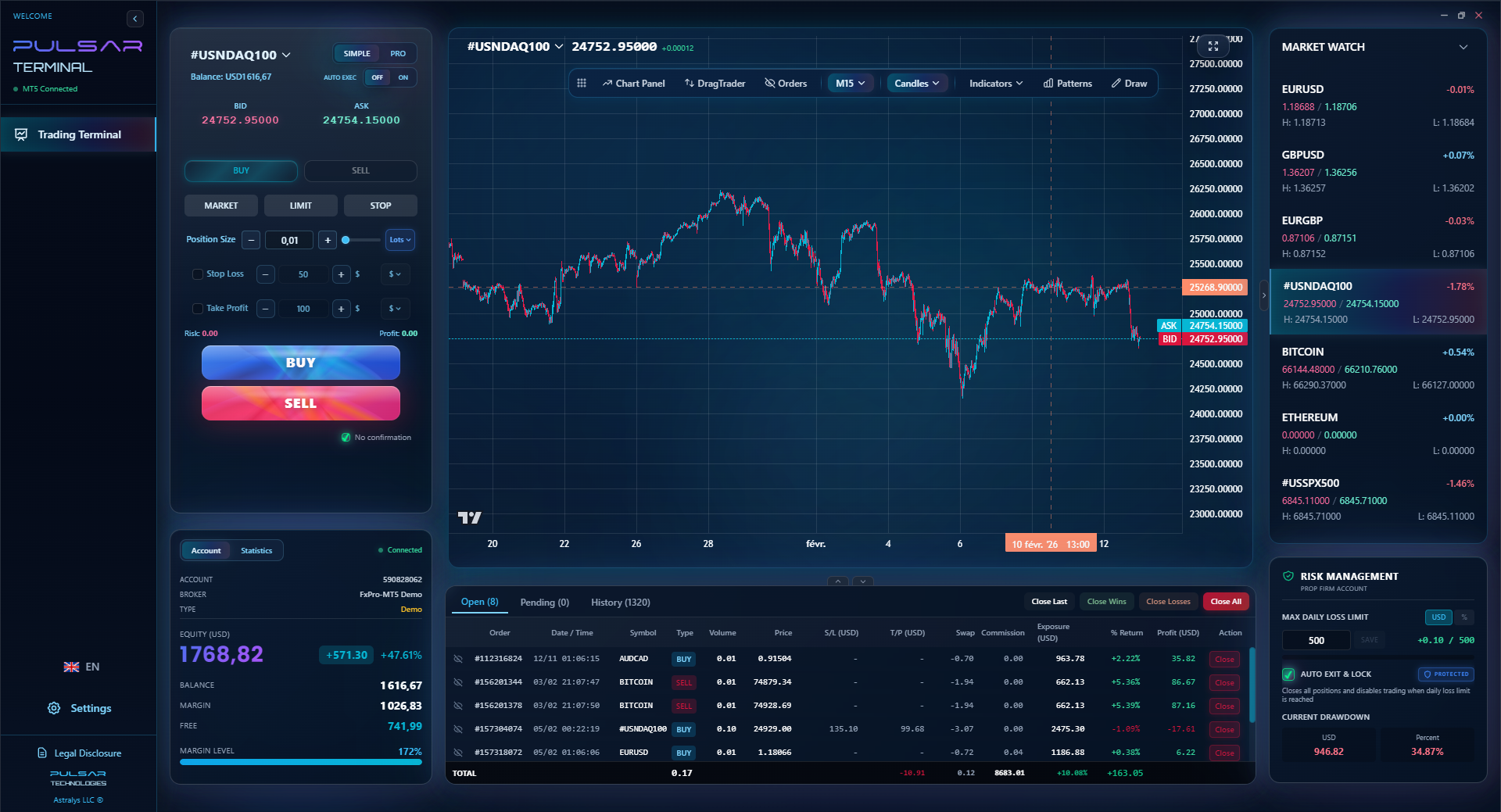
A key part of mentorship is learning to manage trades professionally, including using trailing stops and partial closures to lock in profits, which tools like Pulsar Terminal automate directly on your MT5 platform.
Pulsar Terminal
MT5 올인원 도구: 드래그앤드롭 주문, 다중 TP/SL, 트레일링 스톱, 그리드 트레이딩, 볼륨 프로파일, 프롭펌 보호. 매일 1,000명 이상의 트레이더가 사용.
Let me give you a concrete example of what mentorship looks like in action. It was October 2019, and I was looking at EUR/USD.
My Old Self (Pre-Mentor): I'd see it bouncing off a support level on the 1-hour chart. The RSI indicator was oversold. I'd think, "Great, bounce play!" I'd buy at 1.1000 with a tight 20-pip stop, risking 1% of my account. I'd get stopped out 70% of the time on the volatility.
My Mentored Self: My mentor had me zoom out. On the daily chart, price was in a clear downtrend, making lower highs and lower lows. The 'support' on the 1-hour was just a minor pause. His rule: "In a strong daily trend, only take trades in the direction of the trend on lower timeframes."
So, we waited. Price made a small pullback to a key resistance area (a previous low that turned into resistance) at 1.1050. The 4-hour chart showed momentum stalling. We entered a sell at 1.1045, with a stop loss at 1.1085 (40 pips, above the resistance). Our target was the next major daily swing low.
The Result: Entry: 1.1045. Stop Loss: 1.1085. Take Profit: 1.0950. Price never looked back. It sailed past our target and we rode it down to 1.0900, moving our stop to breakeven at 1.1045 after it passed 1.1000. Final gain: 95 pips on the first target, plus another 50 captured by trailing.
The lesson wasn't the profit. It was the process: Trend first. Wait for a high-probability setup in the trend's direction. Place your stop logically beyond structure, not based on how much you want to lose. That single trade, which he walked me through live on a screen share, rewired my brain. It cost me 40 pips of potential risk for a 95+ pip reward. That's the asymmetry a good mentor helps you find.
“The mentor isn't the solution. You are.”
Before you pay anyone, have a discovery call. Ask these questions. Their answers will tell you everything.
- "Can I see a verified broker statement of your live trading over the last 12 months?" If they hesitate, end the call. Performance is the only credential that matters.
- "What is your maximum drawdown, and what was your worst losing month?" Every real trader has this number. If they say they've never had a losing month, they're lying.
- "What is the structure of the mentorship? How many hours of direct contact do I get, and in what format?" Get specifics. "Unlimited access" often means unanswered WhatsApp messages.
- "What is your trading style (scalping, swing, position), and what markets do you specialize in?" You need a mentor whose style matches your personality and time commitment. A day trader can't effectively mentor a swing trader.
- "What do you expect from me as a student?" A good mentor will expect preparation, completed homework, and a commitment to the process. If they expect nothing, they're just after your money.
I asked my $3k mentor these questions. His answers were blunt, detailed, and backed by evidence. He expected 20 hours of work from me per week outside our sessions. That seriousness was what sold me.
💡 윈스턴의 팁
If a potential mentor's lifestyle on social media seems funded solely by selling mentorship, not trading, your spidey sense should be screaming.
Looking for a forex mentor online in Nigeria is a minefield. I know the desperation that drives the search. You want the shortcut, the magic key. I wanted it too.
The hard truth is this: the mentor isn't the solution. You are. The mentor is just a guide who helps you see the path you're already walking more clearly. They can't walk it for you. The real work - the screen time, the journaling, the emotional control - is 100% on you.
Start with building your foundation. Become a good student of the markets first. That alone will make you invisible to 90% of the scammers, because you'll recognize their nonsense. Then, seek guidance not to get signals, but to improve your process.
It took me 4 years of losses, bad courses, and frustration before I found real help. You can shorten that timeline by being smart, skeptical, and prepared. Don't look for a hero. Look for a coach. The difference is everything.

Example: Budget for mentorship like this: If you have a N500,000 trading account, spending N250,000 on a 'VIP signals group' is insane. That's 50% of your capital! A better allocation: N100,000 on foundational courses/books, N300,000 for trading capital (with strict risk management), and N100,000 saved for potential future real mentorship once you've proven you can be consistent in demo.
FAQ
Q1How much should I realistically pay for a forex mentor in Nigeria?
For genuine one-on-one mentorship from a verified profitable trader, expect to pay from N1 million to N3 million+ for a 3-6 month program. Anything in the N50k-N300k range is almost always a generic course or signal service disguised as mentorship. Remember, a real mentor's time is valuable because their trading skill is valuable.
Q2Can I become profitable without a paid mentor?
Yes, absolutely. It's harder and takes longer because you have to be your own critic. It requires immense discipline in self-study, paper trading, and brutally honest journaling. Many successful traders are self-taught. A mentor accelerates the process by helping you avoid costly, time-consuming mistakes you don't even know you're making.
Q3What's the biggest sign a 'mentor' is a scammer?
The guaranteed profit or passing of prop firm challenges. Trading is probabilistic; there are no guarantees. Anyone promising specific returns (e.g., "make 20% monthly") or selling a 'hack' for prop firm evaluations is running a scam. Also, pressure to pay immediately due to 'limited slots' is a classic sales tactic, not a mentorship sign-up.
Q4I joined a signal group. Is that the same as mentorship?
No. Not even close. A signal group is passive dependency. You're just following orders. Mentorship is active education. It's about understanding the 'why' behind a trade, learning to analyze the market yourself, and developing your own judgment. Signals teach you what to do. Mentorship teaches you how to think.
Q5Should my mentor trade the same broker as me?
It's helpful but not essential. What's more important is that they understand the mechanics of trading with a retail broker like Exness, XM, or IC Markets in Nigeria - issues like spreads widening during volatile news, deposit/withdrawal methods, and dealing with support. Their strategy should be applicable to the conditions your broker provides.
Q6How long does mentorship typically last?
A serious foundational mentorship program usually lasts 3 to 6 months. This is enough time to instill a process, work through multiple market cycles, and address psychological hurdles. You're not learning forever; you're learning to be self-sufficient. After that, you might check in quarterly for reviews, but the intensive daily/weekly guidance should phase out as you gain confidence.
윈스턴 교수의 수업
핵심 요약:
- ✓Foundations first: 3 months of paper trading is mandatory.
- ✓Verify performance: Demand 12-month verified broker statements.
- ✓Mentorship cost under N500k is usually a signal service in disguise.
- ✓The value is in personalized feedback, not generic signals.
- ✓Your trading journal is your first and most important mentor.
이 기사가 얼마나 유용했나요?
별을 클릭하여 평가
주간 트레이딩 인사이트
무료 주간 분석 & 전략. 스팸 없음.
저자 소개
Olumide Adeyemi
서아프리카 트레이딩 선구자
나이지리아에서 가장 활발한 외환 트레이딩 교육자 중 한 명. 라고스에서 8년간 트레이딩 경험. 아프리카 트레이더를 위한 소자본 전략과 프롭 펌 챌린지 전문.
댓글
위험 고지
금융 상품 거래에는 상당한 위험이 수반되며 모든 투자자에게 적합하지 않을 수 있습니다. 과거 성과가 미래 수익을 보장하지 않습니다. 이 콘텐츠는 교육 목적으로만 제공되며 투자 조언으로 간주되어서는 안 됩니다. 거래 전에 항상 직접 조사를 수행하십시오.
이 기사도 읽어보세요

Cara Trading Forex Sukses: 7 Prinsip dari Trader Profesional
Cara trading forex sukses dengan 7 prinsip trader pro: manajemen modal, disiplin, journal trading, backtest. Data nyata, bukan janji profit palsu.
Jam Trading Forex Terbaik untuk Trader Indonesia: Panduan Lengkap dengan Tabel Waktu
Panduan jam trading forex untuk trader Indonesia. Tabel 4 sesi dunia, jam emas 20:00-00:00, sesi mana yang harus dihindari. Data akurat + tips dari trader berpengalaman.
Top 5 Sàn Forex Uy Tín Nhất 2026: Review Jujur dari Trader Indonesia
Top 5 sàn forex uy tín 2026 untuk trader Indonesia. Review jujur: spread, deposit, withdraw, dukungan lokal. Exness, XM, IC Markets & lebih.
