


You've seen the ads, haven't you? The 'forex poster' on Instagram showing a guy in front of a Lamborghini, promising you can turn 50k Naira into 5 million in a month.

Olumide Adeyemi
서아프리카 트레이딩 선구자 ·  Nigeria
☕ 9 분 소요
배울 내용:
- 1What a 'Forex Poster' Really Represents (And Why It's Dangerous)
- 2The Real Nigerian Forex Market: CBN Rules and How You Actually Trade
- 3Why Nigerian Traders Blow Up Their Accounts: The Big Three Mistakes
- 4Building a Real Edge: Strategy for the Nigerian Mindset
- 5Essential Tools, Brokers, and How to Protect Your Capital
- 6From Poster Fantasy to Professional Mindset
You've seen the ads, haven't you? The 'forex poster' on Instagram showing a guy in front of a Lamborghini, promising you can turn 50k Naira into 5 million in a month. It looks like a simple blueprint for wealth. But what if that poster is the very reason you'll lose your money? I've been trading through multiple CBN regimes, Naira devaluations, and market crashes. The reality of trading in Nigeria has nothing to do with those glossy images. It's about understanding a market that's uniquely volatile, heavily regulated, and filled with traps designed to separate the hopeful from their capital. Let's talk about what's really on the other side of that poster.
A 'forex poster' isn't just an ad. It's a psychological hook designed to sell you a dream, not a skill. In Nigeria, where economic pressure is high, these images of luxury cars and stacks of dollars tap directly into a very real desire for financial escape. The problem is, they present trading as an event - a single, brilliant decision that changes everything. Real trading is a process. It's a grind of analysis, risk management, and emotional control.
I fell for this myself early on. I saw a course ad promising 'secret signals' and paid 150k Naira for it. The 'secret' was just a basic moving average crossover. I lost my first 200k Naira account in two weeks trying to follow those 'guaranteed' setups. The poster sells certainty. The market deals only in probabilities.
The local context makes this worse. With inflation hitting over 30% in 2024, the urge to find a fast hedge is intense. Scammers know this. They package basic financial concepts as exclusive 'mentorship' for fees that can run into hundreds of thousands of Naira. The real forex market doesn't care about your dreams. It's a global electronic network where banks, institutions, and yes, some retail traders, compete. Your success depends on your edge, not a poster's promise.

Warning: Any 'forex poster' or ad that shows luxury assets, promises specific returns (e.g., 'make 50% monthly'), or uses pressure tactics like 'limited slots' is almost certainly a scam. Regulated financial services don't market this way.

💡 윈스턴의 팁
If your trading plan would look silly on a poster, you're probably on the right track. The market rewards boring consistency, not theatrical genius.
Let's strip away the fantasy and look at the actual structure. As a retail trader in Nigeria, you're not directly trading the Naira on the interbank market governed by the new CBN FX Code. That code, effective December 2024, is for authorized dealers like banks. You're trading CFDs (Contracts for Difference) with international brokers on global currency pairs.
How Your Trade Really Works
When you buy EUR/USD on your phone with a broker like Exness or IC Markets, you're not buying physical euros. You're entering a contract with that broker to exchange the difference in the pair's price from entry to exit. Your broker hedges its risk in the broader market. Your profit or loss is in USD (or another base currency), which is then converted to Naira for you.
The Naira's Role and Volatility
Your local currency, the Naira, is your deposit and withdrawal vehicle. Its wild volatility is your silent partner in every trade. In early 2024, we saw the Naira swing from 1,035 to over 1,700 to the dollar. If you funded your account when the rate was 1,500/$ and the Naira strengthens to 1,200/$ when you withdraw profits, your Naira gains are significantly reduced, even if your USD trading profit was good. This is a critical layer of risk most 'forex posters' never mention.
Regulatory Reality
You must use brokers regulated outside Nigeria (like ASIC, CySEC, FCA). The CBN does not license retail forex brokers for speculative trading. This means you have no local regulatory protection. Your safety depends on the broker's international license and their reputation. Always verify this before depositing. The recent XM review and Pepperstone review on this site break down their regulatory standings, which is the first thing you should check.

Example: You deposit 300,000 Naira at a rate of 1,500 NGN/USD. That's $200. You grow your account to $300 (a 50% gain). But when you withdraw, the Naira has strengthened to 1,300 NGN/USD. Your $300 is now worth 390,000 Naira. Your profit is 90,000 Naira (30% in Naira terms), not the 150,000 Naira (50%) you might have expected. Currency risk works both ways.
“Your trading capital should be money that, if vanished tomorrow, doesn't affect your survival. This is non-negotiable.”
After coaching traders for years, I see the same three killers again and again. They're amplified by the local environment.
1. Trading Without a Buffer Against Naira Volatility. People trade with money they can't afford to lose - rent money, business capital. When the Naira dips or a trade goes against them, panic sets in. They need that capital back now, forcing them to take reckless trades. Your trading capital should be money that, if vanished tomorrow, doesn't affect your survival. This is non-negotiable.
2. Chasing 'Mentors' Instead of Building a Process. The culture of 'mentorship' here is often toxic. People pay 500k Naira to join a Telegram group where a 'guru' posts signals. You learn nothing, become dependent, and when the guru's hot streak ends (and it always does), you're left with empty pockets and zero skill. I learned this the hard way. Real education is understanding why a trade is taken, not just copying a ticket. Start with mastering one concept, like the RSI indicator or MACD indicator, instead of buying a vague 'system'.
3. Catastrophic Position Sizing. This is the number one technical reason for failure. I see traders with a 200k Naira account ($133) taking a 2-lot position on GBP/USD. That's insane use. A 10-pip move against them could wipe out 15% of their account. They think, 'I need to make big money fast.' The market hears, 'Here's a free donation.' Use a position size calculator religiously. Never risk more than 1-2% of your account on a single trade. On a $133 account, that's a risk of $1.33 to $2.66. It sounds small because it is. Growth is slow and steady, not explosive.
Your edge isn't a secret indicator. It's a consistent approach tailored to your psychology and market realities. Forget the get-rich-quick scalping strategy if you have a full-time job. You'll miss setups and overtrade.
For most Nigerians starting out, swing trading makes more sense. It holds trades for days, catching larger moves, and doesn't require you to stare at screens all day. Focus on major pairs like EUR/USD or XAU/USD (gold). They have better liquidity and tighter spreads than exotic pairs.
A Simple, Testable Plan
- Time: Analyze charts for 30 minutes each evening (Lagos time, after London close).
- Chart: Use the 4-hour and daily charts to find the trend. Draw key support and resistance levels.
- Trigger: Wait for price to pull back to a support (in an uptrend) or resistance (in a downtrend).
- Entry/Exit: Use a simple price action confirmation (like a bullish/bearish engulfing candle) to enter. Place your stop loss on the other side of the support/resistance level. Aim for a risk-reward ratio of at least 1:2.
This isn't sexy. It won't make a good 'forex poster'. But it's actionable, measurable, and teaches you how markets move. Backtest this on historical data for 100 trades. Write down every result. Only then should you use real money.

Pro Tip: Trade during the London-New York overlap (1 PM - 4 PM Lagos time). This is when liquidity and volatility are highest for major pairs, giving your trades the best chance to move cleanly without erratic spreads widening and stopping you out prematurely.
💡 윈스턴의 팁
Your most important indicator isn't on the chart. It's your bank statement. If your capital isn't growing over 100 trades, your system is broken.
“The goal isn't to be right on every trade. The goal is to be profitable over a hundred trades.”
Your broker is your lifeline. Choosing based on who has the flashiest ads is a recipe for disaster.
| Feature | Why It Matters for Nigerian Traders | What to Look For |
|---|---|---|
| Regulation | Your primary protection against fraud. | FCA, ASIC, CySEC licenses. Avoid unregulated 'offshore' brokers. |
| Deposit/Withdrawal | Getting your money in and out reliably. | Local bank transfer (USD/NGN), reliable e-wallets. Fast processing times. |
| Spreads & Commissions | Directly eats into your profit. Crucial for scalping. | Raw spread accounts or tight ECN spreads on majors (e.g., 0.1-0.3 pips on EUR/USD). |
| use | A tool that can build or destroy. | Start low (1:10 or 1:20). Avoid the maximum 1:1000+ offers. It's a trap. |
Capital Protection is a Daily Job:
- Use Stops. Always. A stop-loss isn't a failure. It's a pre-planned exit. Not using one is like driving without brakes.
- Understand Margin. Know exactly how much capital is required to hold a position. If your equity falls below the required margin, you'll get a margin call and your positions will be liquidated.
- Separate Accounts. Have a savings account, a living expenses account, and your trading account. Never cross the streams.
- Track Everything. Use a journal. Note the trade, the reasoning, the outcome, and - critically - your emotional state. You'll start to see your own patterns of mistake.
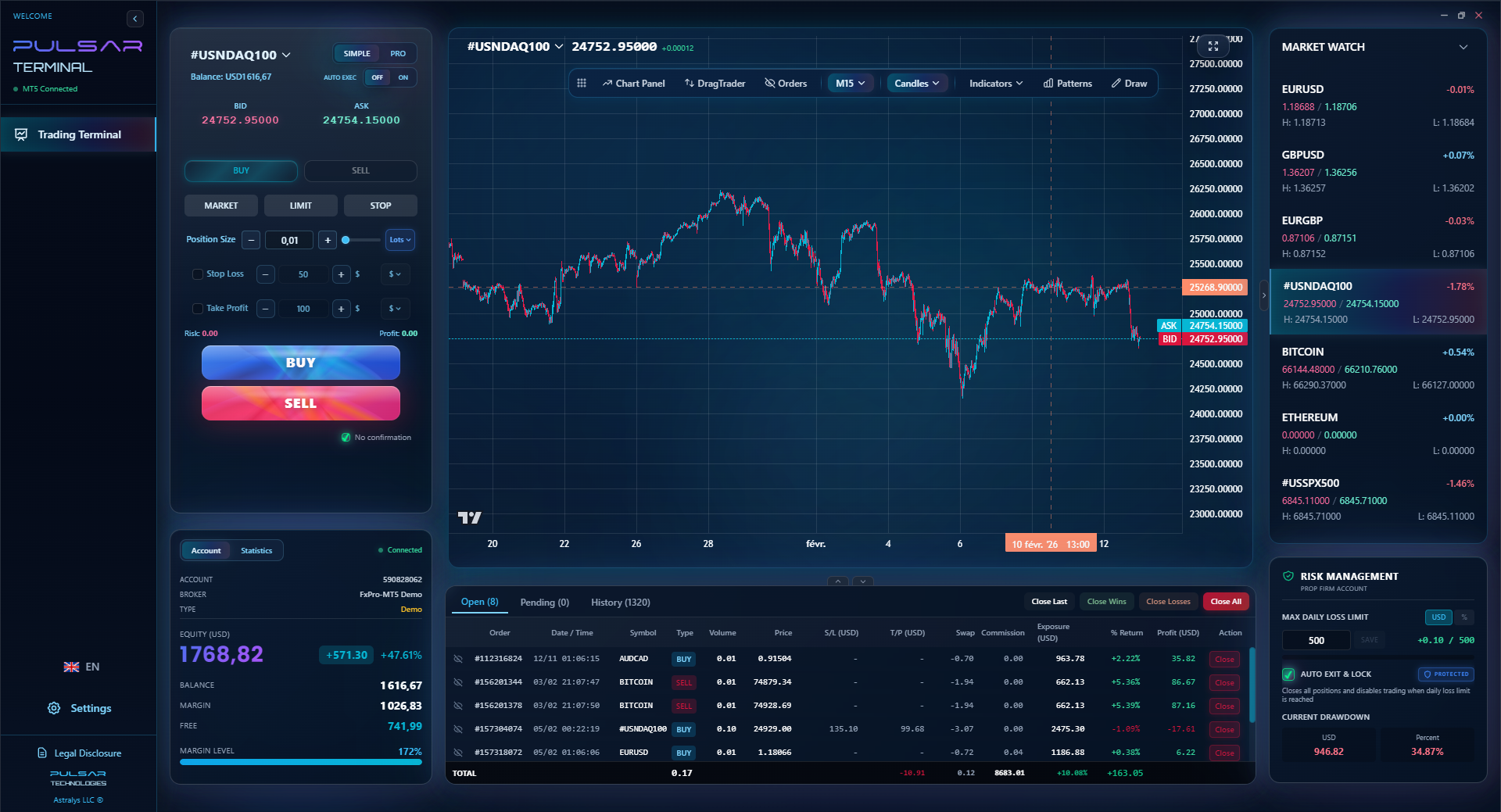
Protecting your capital requires precise order management, and Pulsar Terminal gives you drag-and-drop stop-loss and take-profit tools directly on your MT5 charts to execute your plan without hesitation.
Pulsar Terminal
MT5 올인원 도구: 드래그앤드롭 주문, 다중 TP/SL, 트레일링 스톱, 그리드 트레이딩, 볼륨 프로파일, 프롭펌 보호. 매일 1,000명 이상의 트레이더가 사용.
The shift happens when you stop looking for a hero and start building a system. The market doesn't know you're Nigerian. It doesn't care about your struggles or your dreams. It's a probability machine.
Your job is to find small, statistical edges and apply them with rigid discipline. Some months you'll be up 5%. Others you'll be down 2%. That's normal. The poster promises a vertical line to the moon. A real equity curve is a bumpy, upward-sloping crawl.
I remember my first profitable year. I made a 22% return. It felt anti-climactic after all the hype I'd consumed. But it was real. I could account for every Naira. I knew which setups worked and which didn't. That knowledge was worth more than any temporary win from following a signal.
Start small. A $100 account (about 150k Naira) is more than enough to learn. Focus on preserving that capital for 6 months. If you can do that, you're already ahead of 90% of traders who blow up in the first 90 days. The goal isn't to be right on every trade. The goal is to be profitable over a hundred trades. That journey begins when you ignore the next 'forex poster' and open your chart to study, not to dream.
FAQ
Q1Is forex trading legal in Nigeria?
Yes, but with a key distinction. Trading forex CFDs with internationally regulated brokers is legal for individuals. However, the Central Bank of Nigeria (CBN) does not license brokers for speculative retail trading. The CBN's FX regulations primarily govern the official interbank and BDC markets. You are responsible for ensuring your chosen broker is properly regulated abroad (e.g., by FCA, ASIC).
Q2What is the minimum amount I need to start forex trading in Nigeria?
You can start with as little as $10 (approx 15k Naira) with some micro accounts, but I strongly advise against it. Such a small amount forces you to use excessive use to see meaningful gains, which is incredibly risky. A more sensible starting capital for serious learning is $100-$200 (150k-300k Naira). This allows for proper position sizing and can withstand a series of small losses without blowing up.
Q3How do I fund my forex trading account from Nigeria?
Most international brokers accept deposits from Nigerian clients via bank wire transfer (in USD or Naira), credit/debit cards (Mastercard/Visa), and e-wallets like Skrill, Neteller, or Sticpay. Bank transfers can take 1-5 business days. Always check your broker's specific deposit options and any associated fees before funding.
Q4Why do I keep hitting a 'margin call'?
A margin call happens when your account equity falls below the required margin to maintain your open positions. This is usually caused by: 1) Trading too large a position size for your account balance (using too much use), 2) Not using a stop-loss, allowing a losing trade to run too far, or 3) A series of consecutive losses. The fix is to use a position size calculator and never risk more than 2% of your account per trade.
Q5Can I trade the Naira (NGN) directly?
Not in the typical retail CFD forex market. You won't find NGN pairs like USD/NGN on major retail platforms because the Naira is not freely convertible for speculative purposes. You trade major pairs (EUR/USD, GBP/USD) in USD, and your profits/losses are converted to/from Naira when you deposit and withdraw. Your exposure to the Naira is through this conversion rate, not direct trading.
Q6What's the difference between a pip and the spread?
A pip is the standard unit of movement in a currency pair (usually 0.0001 for most pairs). The spread is the difference between the buy (ask) and sell (bid) price, measured in pips. It's the broker's fee. A tight spread (e.g., 0.3 pips on EUR/USD) means you start your trade with a smaller loss. A wide spread means the market has to move further just for you to break even. Always check typical spreads for your chosen pair and trading style.
윈스턴 교수의 수업
핵심 요약:
- ✓Ignore all trading ads showing luxury assets.
- ✓Start with at least $100 (150k Naira) to learn properly.
- ✓Never risk more than 2% of your account on a single trade.
- ✓Choose brokers regulated by FCA, ASIC, or CySEC.
- ✓Swing trading fits a Nigerian lifestyle better than scalping.
이 기사가 얼마나 유용했나요?
별을 클릭하여 평가
주간 트레이딩 인사이트
무료 주간 분석 & 전략. 스팸 없음.
저자 소개
Olumide Adeyemi
서아프리카 트레이딩 선구자
나이지리아에서 가장 활발한 외환 트레이딩 교육자 중 한 명. 라고스에서 8년간 트레이딩 경험. 아프리카 트레이더를 위한 소자본 전략과 프롭 펌 챌린지 전문.
댓글
위험 고지
금융 상품 거래에는 상당한 위험이 수반되며 모든 투자자에게 적합하지 않을 수 있습니다. 과거 성과가 미래 수익을 보장하지 않습니다. 이 콘텐츠는 교육 목적으로만 제공되며 투자 조언으로 간주되어서는 안 됩니다. 거래 전에 항상 직접 조사를 수행하십시오.
이 기사도 읽어보세요

Cara Trading Forex Sukses: 7 Prinsip dari Trader Profesional
Cara trading forex sukses dengan 7 prinsip trader pro: manajemen modal, disiplin, journal trading, backtest. Data nyata, bukan janji profit palsu.
Jam Trading Forex Terbaik untuk Trader Indonesia: Panduan Lengkap dengan Tabel Waktu
Panduan jam trading forex untuk trader Indonesia. Tabel 4 sesi dunia, jam emas 20:00-00:00, sesi mana yang harus dihindari. Data akurat + tips dari trader berpengalaman.
Top 5 Sàn Forex Uy Tín Nhất 2026: Review Jujur dari Trader Indonesia
Top 5 sàn forex uy tín 2026 untuk trader Indonesia. Review jujur: spread, deposit, withdraw, dukungan lokal. Exness, XM, IC Markets & lebih.
