


How many rand have you wasted on forex signal services that promised the moon and delivered a rock? You're not alone.

David van der Merwe
신흥시장 트레이더 ·  South Africa
☕ 9 분 소요
배울 내용:
- 1Signals: Scam, Crutch, or Legit Tool?
- 2The Two Pillars of Real Analysis: Technicals & Fundamentals
- 3Trading the Rand: Local Knowledge is Power
- 4Gear Up: Brokers, Platforms, and Essential Tools
- 5The Mentor's Method: Building a Process, Not Chasing Signals
- 6Pitfalls to Avoid: The South African Trader's Kill List
How many rand have you wasted on forex signal services that promised the moon and delivered a rock? You're not alone. Every week, I see South African traders chasing the 'perfect signal' instead of building the skill to analyze the market themselves. This guide isn't about finding a magic bullet. It's about tearing down the hype around forex signals & analysis and showing you how to build a real, sustainable edge. We'll look at what's legal, what's a scam, and how to use analysis to make your own calls.
Let's cut through the noise. A forex signal is just a suggestion to buy or sell a currency pair at a specific price, with suggested stop-loss and take-profit levels. In South Africa, they're everywhere – Telegram groups, WhatsApp broadcasts, fancy websites charging $100 a month. The brutal truth? 95% are worthless, and the other 5% require you to understand why the trade was taken to use them effectively.
I fell for this early on. Paid R800 a month to a 'proprietary algorithmic signal service' based in Cape Town. The first week, three trades, all winners! I was hooked. Then the drawdown hit. A string of seven losses wiped out my gains and then some. The provider's excuse? 'Market anomaly.' My mistake? Blindly following without a clue about the market context or the strategy's logic.

Warning: Any signal provider that guarantees profits, shows only winning trades, or pressures you with 'limited-time offers' is running a scam. The FSCA regularly issues warnings about these unregulated entities. Your protection is zero.
So, are they all bad? Not necessarily. A legitimate signal from a transparent strategy can be a useful educational tool. It can show you how a more experienced trader structures a trade. But it must become a starting point for your own forex signals & analysis, not the end point. Your goal should be to reverse-engineer the signal. Why this pair? Why this entry? What analysis supports it?

💡 윈스턴의 팁
A signal without a clear, written rationale is just noise. If the provider can't explain the 'why' in one sentence, ignore it.
“Your goal is not to find profitable signals. Your goal is to build a profitable process.”
This is where you stop being a passenger and start driving. Your own analysis is the only thing you can truly trust. It boils down to two main areas, and you need a bit of both.
Technical Analysis: Reading the Chart's Story
This is about price action, patterns, and indicators. It's what most retail traders start with. In South Africa, with our load-shedding and sometimes shaky internet, you need strong, simple methods that don't require constant screen time. I'm a big fan of price action and a few key indicators.
For example, I don't just look for a moving average crossover. I wait for price to react at a key level, like a previous daily high or low, and then see if the RSI indicator shows divergence. That's a much stronger signal. On USD/ZAR, which is famously volatile, I use wider stops but also look for momentum confirmation with the MACD indicator on the 4-hour chart. A classic trade I took last year: USD/ZAR was testing the 18.50 resistance level for the third time. Price made a lower high on the 1-hour chart, while the RSI made a clear lower high (bearish divergence). I shorted at 18.48, placed a stop at 18.65, and took profit at 18.15. The analysis gave me the conviction to hold through the noise.
Fundamental Analysis: The 'Why' Behind the Move
This is where many traders tuning in from Johannesburg or Durban drop the ball. They'll trade the Rand without knowing the price of platinum. Fundamental analysis is about the economic health of a country. For ZAR pairs, you MUST watch:
- SARB Interest Rate Decisions: The repo rate is everything. A hike typically strengthens the Rand (all else being equal).
- Commodity Prices: ZAR is a commodity currency. Strong gold, platinum, and coal prices often support it.
- Political & Global Risk Sentiment: ZAR is an 'risk-on' currency. When global investors are fearful, they pull money out of markets like South Africa.

Pro Tip: Don't get lost in the data. For fundamentals, focus on the big three for your chosen pair: Interest Rates, Inflation (CPI), and Employment data. Set a calendar alert for South African CPI and US Non-Farm Payrolls if you trade USD/ZAR.
“Trading USD/ZAR at 2 AM SAST is a recipe for getting ripped off by the spread.”
Trading USD/ZAR or EUR/ZAR isn't like trading EUR/USD. You're playing in a different league with different rules. The average daily volume for ZAR pairs is huge (over $20 billion), but the liquidity can dry up faster than a dam in the Karoo during off-hours, leading to wicked spreads.
Our 30:1 use limit from the FSCA is actually a blessing in disguise for ZAR pairs. Why? Because the volatility can be brutal. A 100-pip move on EUR/USD is an event. On USD/ZAR, it's a quiet Tuesday afternoon. I learned this the hard way early on. I treated a USD/ZAR trade like a major pair, used a 50-pip stop, and was taken out in minutes by a routine spike. The spread alone on some brokers can be 50-80 pips during volatile news events.
You need to adjust your entire approach:
- Position Size Smaller: Because of the volatility, your position size must be smaller. Use a position size calculator religiously. A 2% risk on USD/ZAR feels very different than on EUR/USD.
- Wider Stops: Accept it. Your stop-loss needs room to breathe. This means your profit target needs to be proportionally larger, or you need a higher win rate to compensate.
- Watch SA Trading Hours: The sweet spot is when London is open (10:00 - 19:00 SAST). That's when you get the best liquidity and tightest spreads. Trying to scalp USD/ZAR at 2 AM SAST is a recipe for getting ripped off by the spread.
Broker choice is critical. You need one with reliable execution during our market hours. I've found Exness and IC Markets to have consistently decent ZAR spreads, but always check their specs for your specific account type.
💡 윈스턴의 팁
Your first profit target should always be to move your stop-loss to breakeven. Protecting capital is job one. Profits are a bonus.
“The journal turns experience into wisdom. The screenshot doesn't lie.”
You can't build a house with a spoon. Your broker and platform are your tools. For South Africans, the first filter is regulation. Only use an FSCA-licensed broker. This isn't a suggestion; it's your primary defense. Your funds are segregated, and you have a local recourse if things go wrong. Yes, offshore brokers might offer 500:1 use. They also offer zero protection when they disappear with your deposit.
Platforms: MT4 and MT5 are the standards here for a reason. They're stable, familiar, and support most indicators and Expert Advisors (EAs). While brokers like XM and Pepperstone offer great versions, the platform itself is just the canvas.
The real edge comes from how you use it. This is where tool suites come in. Having a platform that lets you manage risk efficiently is non-negotiable, especially with our volatile Rand. Manually moving stop-losses to breakeven or setting a trailing stop on a fast-moving ZAR trade is stressful and error-prone.

Example: Let's say you buy USD/ZAR at 18.00, risking R1000 with a 100-pip stop (at 17.90). If price moves to 18.20, you might want to move your stop to 18.10 (breakeven plus 10). Doing this manually while watching other charts is how you miss the move. Automation removes the emotion and the fumble.
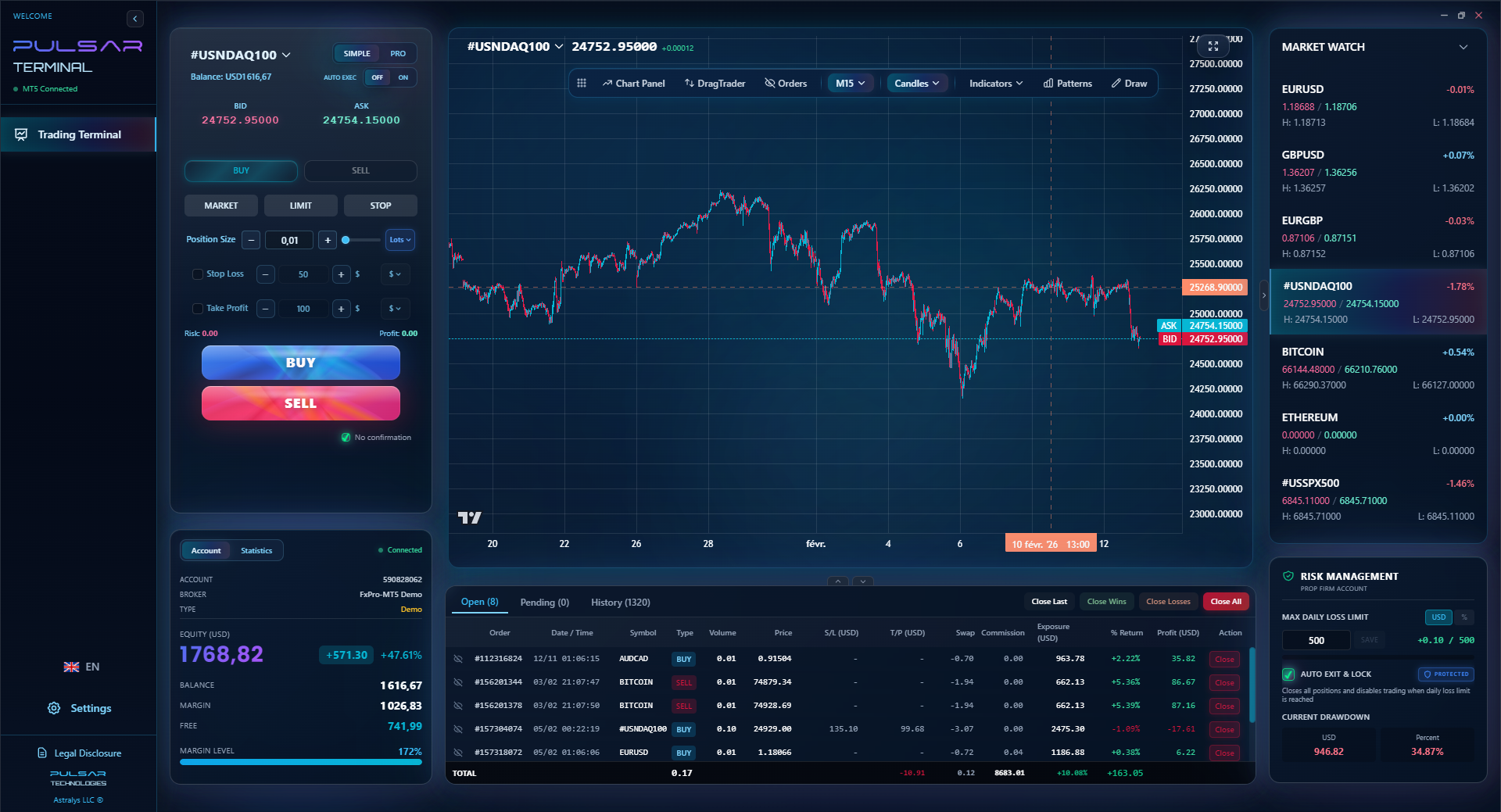
Managing complex trades on volatile pairs like USD/ZAR requires precision tools; Pulsar Terminal's drag-and-drop orders and automated trailing stops on MT5 take the emotion and error out of execution.
Pulsar Terminal
MT5 올인원 도구: 드래그앤드롭 주문, 다중 TP/SL, 트레일링 스톱, 그리드 트레이딩, 볼륨 프로파일, 프롭펌 보호. 매일 1,000명 이상의 트레이더가 사용.
“The journal turns experience into wisdom. The screenshot doesn't lie.”
Here’s what I tell every trader I mentor in Pretoria or Cape Town: Your goal is not to find profitable signals. Your goal is to build a profitable process. Signals are an output. Your analysis and risk management process is the machine.
Step 1: The Daily Scan. Every day, before you even think about a trade, do this:
- Check the economic calendar. What’s due out for the US, EU, and SA?
- Scan the major pairs and your watchlist (including USD/ZAR, EUR/ZAR). Look for price sitting at obvious support/resistance.
- Note the overall market mood (risk-on/risk-off).
Step 2: The Trade Thesis. If you see a potential setup, write down your thesis. "USD/ZAR is approaching the 18.80 resistance level for the second time. SA CPI data tomorrow could be a catalyst. I will look for a rejection candle on the 4-hour chart to consider a short, targeting 18.40." This forces clarity.
Step 3: The Risk Plan. Before you enter, know:
- Your exact entry, stop-loss, and take-profit.
- Your position size (use the calculator!).
- What will make you wrong? If price closes above 18.85 on the 4H, your thesis is broken. Exit.
Step 4: The Journal. This is the most important step. After every trade, win or lose, write down:
- The chart time, your thesis.
- What happened.
- Your emotional state.
- A screenshot.
I journaled a losing EUR/USD trade where I ignored overbought RSI because I was 'sure' it would break higher. Reviewing that screenshot months later, the mistake was glaring. The journal turns experience into wisdom. This process turns you from a signal-follower into a self-sufficient trader. It’s how you graduate from needing someone else’s forex signals & analysis to generating your own.
💡 윈스턴의 팁
The most important indicator on your chart is the one showing your open P&L. If watching it makes you anxious, your position size is too large.
“Over-leveraging on ZAR pairs is a fast road to a margin call.”
Let's be blunt about how traders here blow up their accounts. Avoid these like a pothole on the N1.
- Over-leveraging on ZAR Pairs: Even with the 30:1 FSCA limit, it's too easy to size too big because a ZAR pip definition is worth less in dollar terms. Don't compensate by taking a massive position. A 100-pip stop on USD/ZAR can be hit in a blink. That's a fast road to a margin call.
- Trading Around SARB Announcements Without a Plan: The 30 minutes before and after a SARB rate decision is a casino. The spread definition will widen massively. Either have a very clear, pre-planned swing trading idea based on the outcome, or stay out entirely. Don't try to scalp the news.
- Ignoring the Tax Man: SARS doesn't care about your losing trades. Profits are taxable income. Keep careful records of all trades, deposits, and withdrawals. Talk to an accountant who understands trading. That 45% top tax bracket is real.
- Chasing 'FSCA-Registered' Signal Providers: Here's a loophole: a company can be registered with the FSCA as a financial services provider but only for 'advice' or 'educational services.' That doesn't mean their signals are good or that they're allowed to manage your money. The registration is often a marketing ploy. Do deep due diligence.
- Using Unreliable Internet/Power: This is our unique challenge. A trade can turn during load-shedding. Have a UPS for your router and PC. Know how to manage positions from your phone's data. A broker with a reliable mobile app isn't a luxury here, it's a necessity.
FAQ
Q1Are free forex signal groups on WhatsApp or Telegram worth it?
Almost never. They are often run by unqualified individuals or used as 'bait' to lure you into a paid service or a specific broker (where they get a kickback). The signals are usually late, vague, or come with no risk management. The clutter and hype in these groups are detrimental to developing your own calm, analytical mindset.
Q2What's more important for trading USD/ZAR, technical or fundamental analysis?
For the Rand, fundamentals often drive the major, sustained trends (like a multi-month move based on interest rate cycles). Technical analysis is better for pinpointing your entry and exit within that trend. You need both. Ignoring SA inflation data while trading ZAR is like fishing without checking the weather.
Q3Can I make a living from forex signals in South Africa?
Making a living from following signals is incredibly risky and unlikely to be sustainable. The provider has no skin in your game. Making a living from your own analysis is possible, but it requires treating it like a serious business: significant capital, rigorous risk management, and years of disciplined practice. Don't quit your day job.
Q4How much money do I realistically need to start?
You can open an account with as little as R500 or $10. But to realistically apply proper risk management and not be wiped out by a few bad trades, you need enough so that a 1-2% risk per trade is a meaningful amount to learn with, but not a life-changing loss. For most, a starting capital of R20,000 - R50,000 allows for sensible position sizing on major and ZAR pairs without the pressure of needing to double the account in a month.
Q5Do I need to pay for expensive trading software or courses?
No. The best software is a reliable broker platform (like MT5) and your own journal. Most paid courses repackage free information you can find with diligent study. The value is in structured learning and mentorship, but be wildly skeptical of anyone promising a 'secret system.' The real work is internal: developing discipline and emotional control, which no software can give you.
Q6How do I know if a signal provider is legitimately FSCA regulated?
Go directly to the FSCA's official website and use their searchable register. Don't rely on a badge on the provider's site. Look up the FSP number they provide. Check what categories they are licensed for (e.g., 'Discretionary Financial Services' is very different from 'Advice on Forex Derivatives'). If they claim to manage your money, they need a specific license for that. If it's unclear, call the FSCA.
윈스턴 교수의 수업
핵심 요약:
- ✓Reverse-engineer every signal; understand its logic.
- ✓Adjust position size for ZAR volatility; use a calculator.
- ✓Fundamentals drive ZAR trends; techs find your entry.
- ✓The FSCA register is your first check for any provider.
- ✓Journal every trade with a screenshot; review weekly.
이 기사가 얼마나 유용했나요?
별을 클릭하여 평가
주간 트레이딩 인사이트
무료 주간 분석 & 전략. 스팸 없음.
저자 소개
David van der Merwe
신흥시장 트레이더
요하네스버그 기반 트레이더로 신흥시장 통화 11년 경력. ZAR 통화쌍, FSCA 규제 거래, 남아공 시장 분석 전문.
댓글
위험 고지
금융 상품 거래에는 상당한 위험이 수반되며 모든 투자자에게 적합하지 않을 수 있습니다. 과거 성과가 미래 수익을 보장하지 않습니다. 이 콘텐츠는 교육 목적으로만 제공되며 투자 조언으로 간주되어서는 안 됩니다. 거래 전에 항상 직접 조사를 수행하십시오.
이 기사도 읽어보세요

Cara Trading Forex Sukses: 7 Prinsip dari Trader Profesional
Cara trading forex sukses dengan 7 prinsip trader pro: manajemen modal, disiplin, journal trading, backtest. Data nyata, bukan janji profit palsu.
Jam Trading Forex Terbaik untuk Trader Indonesia: Panduan Lengkap dengan Tabel Waktu
Panduan jam trading forex untuk trader Indonesia. Tabel 4 sesi dunia, jam emas 20:00-00:00, sesi mana yang harus dihindari. Data akurat + tips dari trader berpengalaman.
Top 5 Sàn Forex Uy Tín Nhất 2026: Review Jujur dari Trader Indonesia
Top 5 sàn forex uy tín 2026 untuk trader Indonesia. Review jujur: spread, deposit, withdraw, dukungan lokal. Exness, XM, IC Markets & lebih.
