


You're looking at a chart, ready to pull the trigger on a EUR/USD trade.

David van der Merwe
신흥시장 트레이더 ·  South Africa
☕ 9 분 소요
배울 내용:
- 1What Exactly Is a Forex Spread?
- 2Fixed vs. Variable Spreads: Which One Bites?
- 3How Spreads Eat Your Profits (A Real Trade Story)
- 4Brokers, Account Types, and the Raw Numbers for SA Traders
- 5Trading Strategies: Working With Spreads, Not Against Them
- 6Mistakes I Made (So You Don't Have To)
- 7The Nasty Cousin: Spread and Slippage
You're looking at a chart, ready to pull the trigger on a EUR/USD trade. The price looks good, the setup is there. But have you really accounted for the true cost of getting into that trade? I'm not talking about some hidden fee. I'm talking about the spread. It's the first thing you pay and the most consistent drain on your account if you don't understand it. Let me tell you, I learned this the hard way in my early days, watching profitable trades turn to break-evens because I ignored this basic forex spread definition.
At its core, the spread is the difference between the price you can buy at (the Ask) and the price you can sell at (the Bid). It's not a commission. It's built right into the price quote. Think of it like this: you walk into a forex pawn shop. They'll buy your old US Dollars (Bid) for a bit less than they'll sell you new ones (Ask). That gap is their profit, and in trading, it's often the broker's.
For us in South Africa, trading with ZAR-based accounts, this gets interesting. When you trade EUR/USD, you're often seeing a price quoted in USD. But your profit and loss, and that spread cost, are converted back to Rand. A 1.0 pip spread on EUR/USD might cost you $1 on a mini lot, but that could be R18 or R19 depending on the USD/ZAR rate that day. Your costs fluctuate with our local currency.

Example: Let's say GBP/USD is quoted as 1.2600 / 1.2603. The Bid (sell price) is 1.2600. The Ask (buy price) is 1.2603. The spread is 3 pips. If you buy at 1.2603, the price needs to move up 3 pips just for you to break even on the trade. That's your immediate handicap.

💡 윈스턴의 팁
A spread isn't a fee you pay later. It's the distance the price must run before your trade even starts breathing. Plan your race accordingly.
This is a crucial choice, and it tripped me up early on. I started with a broker offering super tight 'fixed' spreads. It felt safe, predictable. Then, during a major news event like a SARB interest rate announcement, my orders simply wouldn't fill. The price on my platform was frozen while the real market screamed past it. That's the trade-off.
Fixed Spreads: They stay the same (mostly). Good for budgeting and certain strategies like some forms of scalping strategy. But during high volatility, you might face requotes or rejected orders. Your guaranteed cost comes with a potential liquidity risk.
Variable Spreads: These move with the market. On a calm Tuesday afternoon, they can be razor-thin, often lower than fixed spreads. But when news hits or liquidity dries up (like during the London/New York handover), they can widen dramatically. I've seen EUR/USD spreads blow out to 15-20 pips during an ECB press conference.
The South African Session Quirk
Pay attention to our local market hours (7am-5pm SAST). During the Johannesburg session, liquidity on major pairs is lower than during the London overlap. You'll often see slightly wider variable spreads on pairs like EUR/USD until Europe comes online. It's a small thing, but it adds up if you're an active day trader.

“The spread is the first thing you pay and the most consistent drain on your account if you don't understand it.”
Let's get personal with some numbers. This is where the rubber meets the road. Early in my career, I was obsessed with catching small, 10-pip moves on USD/ZAR. My strategy was 'working,' but my account was stagnant. I couldn't figure out why.
I went back and analyzed a month of trades. Here’s a typical loser: I'd buy USD/ZAR at 18.4050 (Ask). My stop loss at 18.3950 (100 pips). The spread was 50 pips (yes, exotic pairs are wide). The moment I entered, I was already 50 pips in the hole. The price only needed to drop 50 pips to hit my stop, not 100. My effective risk was double what I thought. I was getting stopped out constantly because I used a generic position size calculator without factoring in the spread cost as part of my risk.

Warning: Never calculate your risk from your entry price. Calculate it from the moment your trade is live, which is after the spread cost. A 20-pip stop with a 2-pip spread is fine. A 20-pip stop with a 10-pip spread on some exotics? You're basically gambling.
The flip side? On a winner, the spread is the first hurdle. A 30-pip gain on a pair with a 5-pip spread is really a 25-pip gain. It forces you to be more selective. You need moves with enough meat on the bone to cover the cost of doing business. This realization pushed me away from scalping exotics and towards swing trading major pairs where the spread was a smaller percentage of my target.
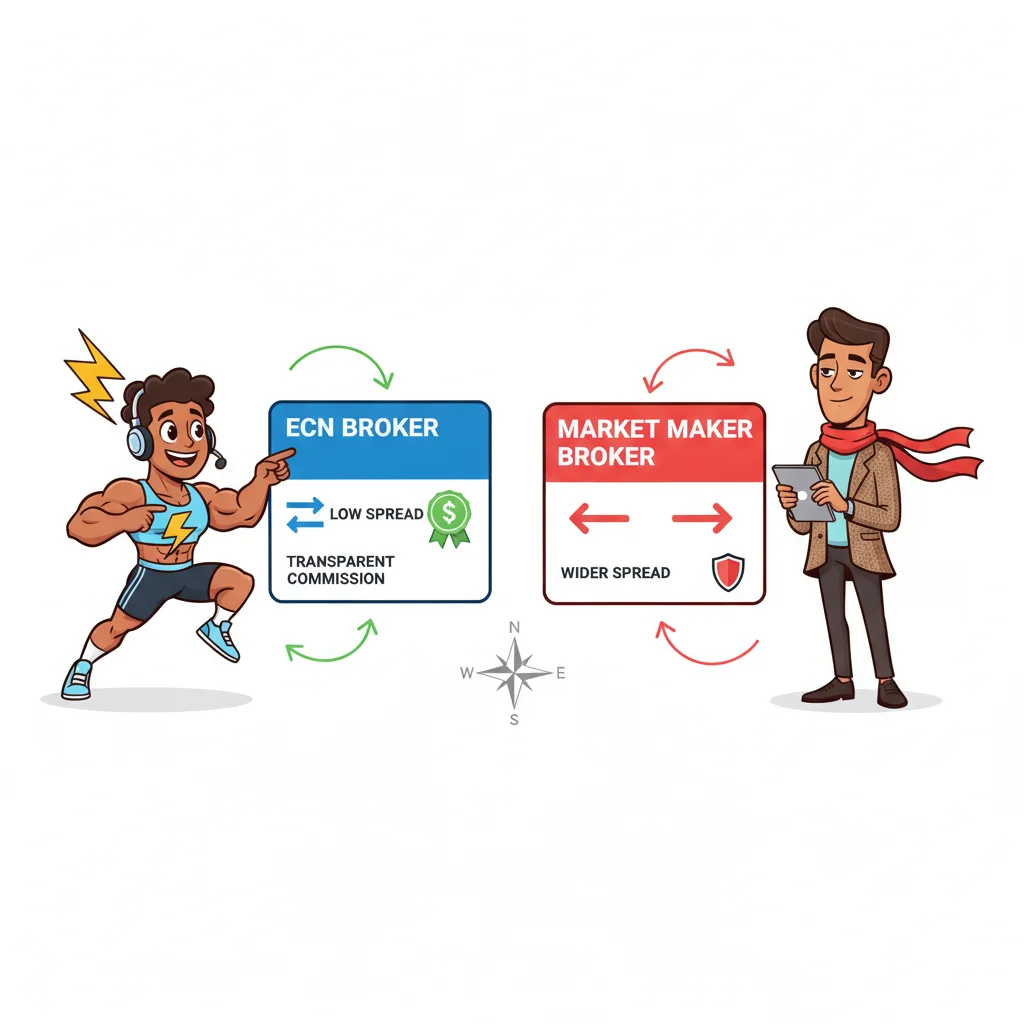
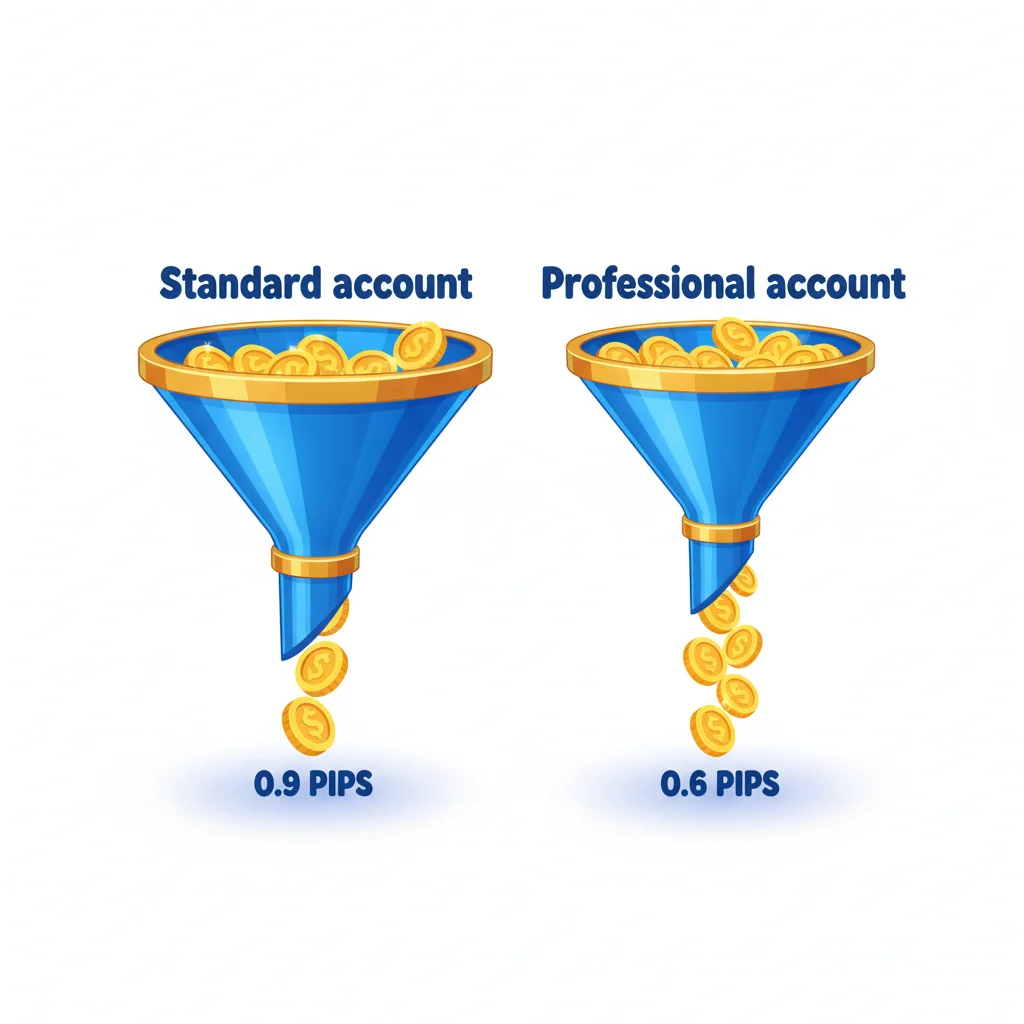
Not all accounts are created equal. Many brokers offer different account tiers with different spread models. The common ones are Standard (commission-free, wider spreads) and Raw/ECN (tighter spreads, plus a commission per trade).
Let's break it down with some real-world examples from brokers popular here:
| Account Type | Typical EUR/USD Spread | Commission (per lot) | Best For... |
|---|---|---|---|
| Standard | 1.0 - 1.5 pips | R0 | Beginners, longer-term traders, smaller accounts. The cost is simple, but buried. |
| Raw/ECN | 0.0 - 0.3 pips | $3.5 - $7 (≈ R65 - R130) | Active traders, scalpers, large volumes. You see the true cost. |
I made the switch to a Raw account after that USD/ZAR disaster. Why? Transparency. Seeing a R65 commission hit my statement hurt, but it made me accountable. That '0.0 pip' spread was liberating for entry precision, but I had to be sure my trade idea could cover the explicit fee. It improved my discipline overnight.
Do your homework. Check reviews for how brokers' spreads hold up during volatile times. A broker like IC Markets or Pepperstone is known for stable ECN pricing, which is vital if you're using tight stops. Others might be better for standard accounts. Don't just look at the advertised 'from' spread. Look at the average.
💡 윈스턴의 팁
If your trading strategy feels brilliant on a demo account but bleeds on a live account, check the spreads first. Demos often have ideal, unrealistic pricing.
“I was getting stopped out constantly because I used a generic position size calculator without factoring in the spread cost as part of my risk.”
You can't fight the spread, so you have to design your trading around it. Here’s what I changed after my lessons.
1. Avoid High-Spread Times: I don't open new positions right before major news events (like US Non-Farm Payrolls). The spread widening can instantly invalidate your risk/reward. I also avoid the first and last 15 minutes of major sessions when liquidity is thin.
2. Choose Your Pairs Wisely: My bread and butter became majors like EUR/USD guide and XAU/USD guide (Gold). Their spreads are consistently low. I treat exotic pairs (like USD/ZAR, EUR/TRY) as occasional, high-conviction swing trades only, where my target is hundreds of pips, not tens.
3. Factor Spread into Your Stop Loss: This is non-negotiable. If my technical stop is 30 pips away, and the spread is 3 pips, I mentally consider my stop as 27 pips away for risk calculation purposes. Better yet, I use a tool that can set the stop loss order factoring in the spread automatically, so I'm not doing mental gymnastics.
4. Patience with Entries: On a Raw account, I can often place a limit order between the Bid and Ask and get filled. I'm not chasing the price. I'm letting the spread work for me as a buyer or seller. This requires patience, but it gives you an immediate edge.

Pro Tip: If you're scalping strategy, the spread is your enemy. You must use the lowest-spread account possible (ECN/Raw) and stick to EUR/USD, USD/JPY, or other major pairs. A 10-pip scalp with a 2-pip spread means 20% of your profit is gone before you start.
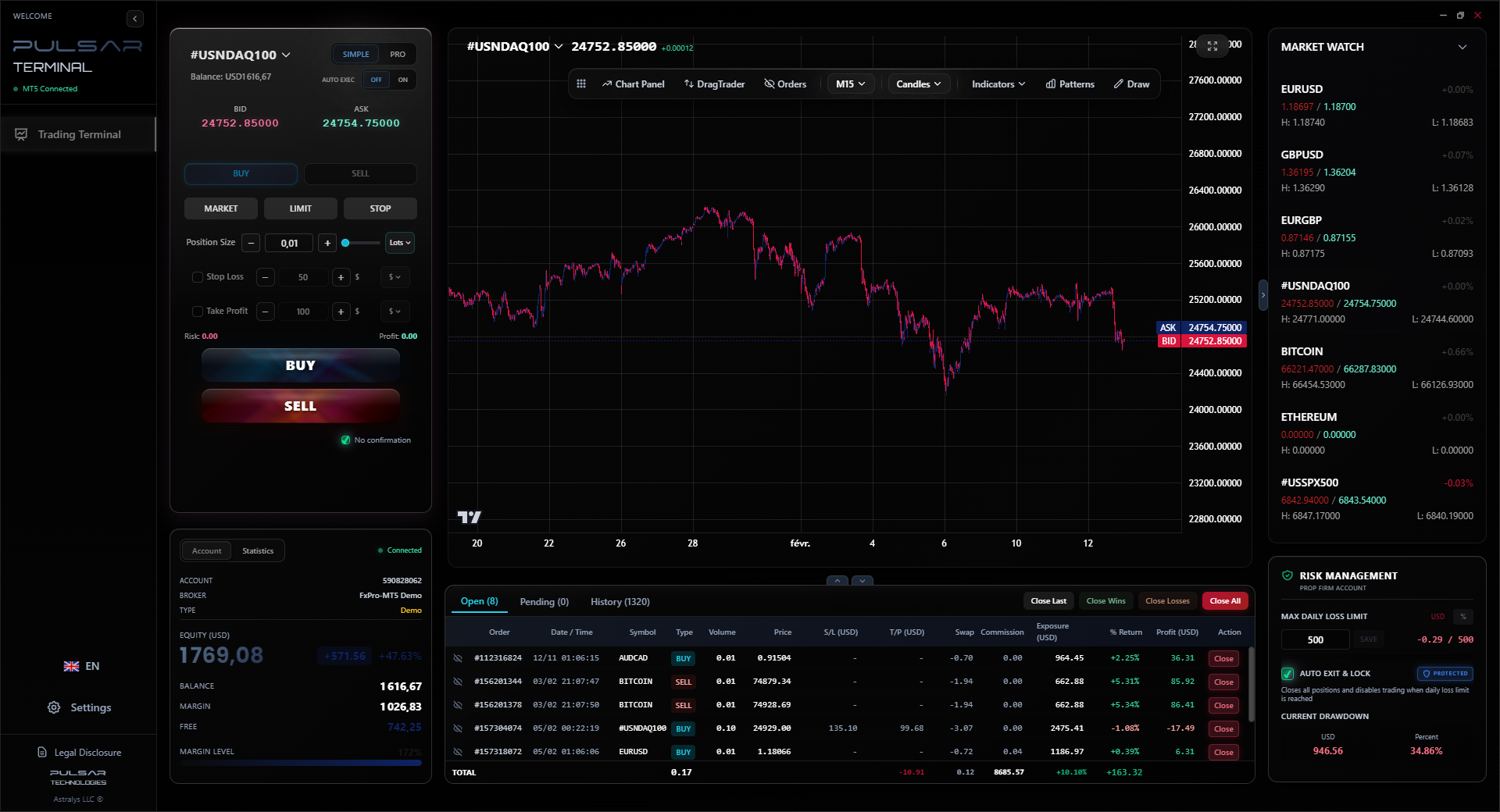
Manually calculating stop distances after the spread is tedious; Pulsar Terminal's order tools let you set stops and targets that automatically account for this, removing the mental guesswork.
Pulsar Terminal
MT5 올인원 도구: 드래그앤드롭 주문, 다중 TP/SL, 트레일링 스톱, 그리드 트레이딩, 볼륨 프로파일, 프롭펌 보호. 매일 1,000명 이상의 트레이더가 사용.
Let's be brutally honest. I've paid the 'spread tuition fee' so you might not have to.
Mistake 1: Chasing Exotics for the 'Action'. USD/ZAR, EUR/TRY – they move fast and feel exciting. But that 40-80 pip spread is a monster. I'd have a 150-pip winning trade that felt great, but after the spread, it was a 70-pip gain. The risk/reward was terrible. I now use exotics sparingly, like a spice, not a main course.
Mistake 2: Ignoring Spread in Backtests. I built a beautiful scalping strategy that showed 80% profitability in a backtest. I forgot to add spread costs. In live trading, that 'profitability' vanished because each trade started 1-2 pips in the red. Always deduct the average spread from your backtest results.
Mistake 3: Trading During Low Liquidity. I used to try and trade the Asian session from SA. Spreads on GBP pairs were wide, and my small stops were getting hunted. The market was quiet, so brokers widened spreads to protect themselves. My edge was non-existent. I learned to trade my timezone's sweet spots: the London open and the London/New York overlap.
The biggest lesson? Respect the spread as a fundamental cost of business. It's the market's admission fee. If your strategy can't comfortably pay that fee and still make a profit, you don't have a strategy. You have a hope.
💡 윈스턴의 팁
Treat a wide-spread exotic pair like a lion. Admire it from a distance, and only approach with a very large, well-planned trap (a wide stop and a huge target).
“If your strategy can't comfortably pay the spread and still make a profit, you don't have a strategy. You have a hope.”
If the spread is a predictable fee, slippage is the unpredictable surcharge. It's when your order fills at a worse price than you expected. This happens most during fast markets.
Here's how they team up to hurt you: Let's say you have a stop loss order on USD/ZAR. The spread is normally 50 pips. News hits, the spread instantly widens to 150 pips, and price spikes down. Your stop loss at 18.4000 might get filled at 18.3850 – that's 150 pips of slippage on top of the already-wide spread. Your loss just exploded.
This is a critical part of the forex spread definition in practice. The quoted spread is the best-case scenario. The executed spread (including slippage) is the real cost. This is why risk management is everything. A single bad fill can blow through your daily loss limit if you're over-leveraged. I learned to use guaranteed stops (if offered, but they cost extra) for high-risk events, or simply stay out of the market altogether. No trade is better than a catastrophic one. Understanding this relationship is key to avoiding a margin call from an event you never saw coming.
FAQ
Q1What is a good forex spread for a beginner in South Africa?
For a beginner, consistency is more important than ultra-low costs. A fixed or stable variable spread of 1.0 - 1.5 pips on major pairs like EUR/USD from a reputable broker is a good starting point. It's predictable, allowing you to focus on learning without surprise costs. Avoid exotic pairs until you're very comfortable.
Q2How is the spread calculated in Rands?
The spread is first calculated in the quote currency of the pair (usually USD for majors). That cost is then converted to ZAR at the current USD/ZAR rate. For example, a 1-pip spread on a standard lot of EUR/USD costs $10. If USD/ZAR is at 18.50, that's a R185 cost built into your trade entry.
Q3Do all forex brokers have the same spreads?
No, absolutely not. Spreads vary massively between brokers and even between account types at the same broker. ECN/RAW accounts typically have the lowest spreads but charge a commission. Always check a broker's average spread, not just the 'from' figure, and read reviews from other SA traders. Check our Exness review or XM review for specific examples.
Q4What's more important, low spread or no commission?
It depends on your trading style. For high-frequency scalping, low spread + commission is usually cheaper overall. For longer-term swing trading with fewer trades, a slightly higher spread with no commission might be simpler and cost-effective. You need to do the math based on your typical trade volume.
Q5Can spreads go to zero?
On an ECN/Raw account display, you will often see a '0.0' pip spread. This means the Bid and Ask are the same price at that millisecond. However, you still pay a commission to the broker for the trade. There's always a cost; it's just presented differently. True 'zero cost' trading doesn't exist.
Q6Why is the USD/ZAR spread so high compared to EUR/USD?
Liquidity. EUR/USD is the most traded financial instrument in the world. Millions of orders create tight competition. USD/ZAR is an exotic pair with far less trading volume. To help a trade, brokers and banks take on more risk, so they charge a wider spread (often 40-80 pips) to compensate.
Q7How does the spread affect my stop-loss and take-profit orders?
Crucially. A buy order's take-profit is triggered by the Bid price. A sell order's take-profit is triggered by the Ask price. The spread is the gap between them. So, if you buy and set a TP 10 pips away, the Ask must move 10 pips for the Bid to reach your TP level. Your effective target is 10 pips + the spread.
윈스턴 교수의 수업
핵심 요약:
- ✓Calculate risk from post-spread entry, not your order price.
- ✓Major pairs (EUR/USD) offer spreads under 1.5 pips; exotics (USD/ZAR) can be 50+.
- ✓Variable spreads widen on news: avoid new entries 5 mins before major events.
- ✓For scalping, ECN accounts with commissions beat standard accounts with wide spreads.
이 기사가 얼마나 유용했나요?
별을 클릭하여 평가
주간 트레이딩 인사이트
무료 주간 분석 & 전략. 스팸 없음.
저자 소개
David van der Merwe
신흥시장 트레이더
요하네스버그 기반 트레이더로 신흥시장 통화 11년 경력. ZAR 통화쌍, FSCA 규제 거래, 남아공 시장 분석 전문.
댓글
위험 고지
금융 상품 거래에는 상당한 위험이 수반되며 모든 투자자에게 적합하지 않을 수 있습니다. 과거 성과가 미래 수익을 보장하지 않습니다. 이 콘텐츠는 교육 목적으로만 제공되며 투자 조언으로 간주되어서는 안 됩니다. 거래 전에 항상 직접 조사를 수행하십시오.
이 기사도 읽어보세요

Cara Trading Forex Sukses: 7 Prinsip dari Trader Profesional
Cara trading forex sukses dengan 7 prinsip trader pro: manajemen modal, disiplin, journal trading, backtest. Data nyata, bukan janji profit palsu.
Jam Trading Forex Terbaik untuk Trader Indonesia: Panduan Lengkap dengan Tabel Waktu
Panduan jam trading forex untuk trader Indonesia. Tabel 4 sesi dunia, jam emas 20:00-00:00, sesi mana yang harus dihindari. Data akurat + tips dari trader berpengalaman.
Top 5 Sàn Forex Uy Tín Nhất 2026: Review Jujur dari Trader Indonesia
Top 5 sàn forex uy tín 2026 untuk trader Indonesia. Review jujur: spread, deposit, withdraw, dukungan lokal. Exness, XM, IC Markets & lebih.
