


Let's cut the nonsense.

Olumide Adeyemi
서아프리카 트레이딩 선구자 ·  Nigeria
☕ 12 분 소요
배울 내용:
- 1What Is a Forex Spread? The Simple Truth
- 2Why Spreads Hit Nigerian Traders Harder
- 3Fixed vs. Variable Spreads: Which One for You?
- 4Calculating the Real Cost: It's More Than Pips
- 5How to Minimize Spread Impact: A Trader's Playbook
- 6Selecting a Broker in Nigeria: The Spread Checklist
- 7Common Spread Mistakes I've Made (So You Don't Have To)
- 8Advanced Concepts: When You're Ready to Dig Deeper
Let's cut the nonsense. If you're trading forex in Nigeria and not obsessing over the spread, you're basically throwing money at your broker before you even make a trade. The forex spread meaning isn't some minor detail, it's the single most important cost you face, especially when you're already battling a 10% tax on profits and funding your account at a terrible rate. I've watched too many traders with solid strategies get bled dry by ignoring this. In this guide, I'll show you exactly what a spread is, how it works in the Nigerian context, and the brutal math of why a 'small' difference can wreck your account.
Forget the textbook definitions. A forex spread is the broker's cut. It's the difference between the price you can buy a currency pair at (the Ask) and the price you can sell it at (the Bid). You see it on your chart as two lines, the Bid and the Ask. That gap between them? That's the cost of doing business, paid the instant you open a trade.
It's measured in pips. For most pairs like EUR/USD, one pip is 0.0001. So, if EUR/USD is quoted as Bid: 1.0850 / Ask: 1.0852, the spread is 2 pips. You buy at 1.0852, and the market would have to move 2 pips in your favor just for you to break even. That's the race you're running before you even start.

Example: You buy 1 standard lot (100,000 units) of EUR/USD with a 2-pip spread. Each pip on that lot size is worth about $10. Your trade is $20 in the red from the moment you click 'Buy'. The market needs to move 2 pips up for you to be at zero.
Brokers make money from this gap. They're not charities. Some offer 'zero spread' accounts, but then they charge a commission per trade. It's the same idea, just packaged differently. The cost is always there. Understanding this basic pip definition is non-negotiable.

💡 윈스턴의 팁
Your first profit target should always be greater than the spread. If your average win is 5 pips and the spread is 4, you're working for the broker, not yourself.
Our situation here isn't the same as a trader in London or New York. We have unique pressures that make managing spreads not just smart, but critical for survival.
First, funding. The CBN has made it clear: using the official forex window to fund a trading account is a no-go. So, you're likely funding through a bureau de change or a parallel market transfer, paying a premium that can be 5%, 10%, or even more above the official rate. You're starting your trading journey already down because of your deposit. Adding wide spreads on top of that is a recipe for blowing up your account fast.
Then there's the tax man. Remember, you owe 10% Capital Gains Tax on your gross profits. Let's do some brutal math. If your strategy yields a 15% return in a year, but you paid 2% in total spread costs across all your trades, your real pre-tax gain is 13%. After the 10% tax, you're left with 11.7%. Your spread cost ate nearly a third of your net profit. Ignore it at your peril.
The Liquidity Problem
Major forex pairs like EUR/USD have massive liquidity globally. But when you trade exotics or even minor pairs, liquidity drops. For a Nigerian trader interested in pairs involving the Naira (which you generally can't trade directly on major platforms) or African currencies, spreads can be monstrous. I once looked at a USD/ZAR (South African Rand) trade during thin liquidity; the spread was over 50 pips. The trade would have needed to move 50 pips instantly just to break even. I walked away.

Warning: Trading during major news events (like US Non-Farm Payrolls or CBN announcements) will see spreads widen dramatically on all brokers, sometimes 10x their normal size. Placing a market order during these times is financial suicide.
“The spread isn't a fee, it's the first mile of a race you have to run before you can even start competing.”
This is a classic debate. You need to know which environment suits your style.
Fixed Spreads: As the name says, they don't change (well, almost never). A broker like AvaTrade might offer a fixed 1.0 pip spread on EUR/USD.
- Pros: Predictable costs. Great for budgeting and for certain automated strategies where you need known entry costs. You're insulated from short-term volatility spikes.
- Cons: The fixed spread is usually higher than the average variable spread. You're paying a premium for that stability. Also, during extreme market chaos, even fixed-spread brokers may 'requote' you or widen spreads temporarily.
Variable Spreads: These float with market liquidity. On a calm Tuesday afternoon, EUR/USD might be at 0.2 pips on a broker like IC Markets. During the London/New York session overlap, it might tighten to 0.1. At 1:30 PM Nigerian time on NFP day, it could blow out to 5 pips.
- Pros: Generally lower average costs during normal market hours. You get the true, raw market price.
- Cons: Unpredictable. Can destroy short-term strategies like scalping if they widen unexpectedly. Requires more discipline.
My take? If you're a new trader or a swing trader who holds positions for days, variable spreads are usually better - your trade's overall movement will dwarf the spread fluctuation. If you're a scalper or using a very precise algorithmic strategy, a good fixed-spread account can be worth the extra cost. Always check a broker's typical spread history. Our Exness review and Pepperstone review break down their spread profiles in detail.
Knowing the spread is 2 pips is one thing. Knowing what that costs in Naira is another. This is where most traders get lazy, and it costs them.
The formula is simple, but the implications are huge:
Cost in Quote Currency = Spread (in pips) × Pip Value × Number of Lots
Let's use a real example from my own trading journal. Last month, I was trading GBP/USD. My strategy involved quick, 5-10 pip profit targets.
- Broker A: Offered a typical spread of 1.8 pips on GBP/USD.
- Broker B (my ECN broker): Offered 0.8 pips average, plus a $5 commission per round lot.
I placed a 0.5 lot trade.
- With Broker A: Cost = 1.8 pips × ($10 per pip per lot × 0.5 lots) = $9.00
- With Broker B: Cost = (0.8 pips × $5) + $5 commission = $4.00 + $5.00 = $9.00
Surprise! The cost was identical. The 'zero spread' broker wasn't cheaper for my trade size. The lesson? Don't just look at the pip spread number. You must calculate the total cost of entry, including any commissions. For larger lot sizes, the commission model often wins. For tiny lot sizes, a raw spread-plus-commission might be more expensive.
This is why using a position size calculator that includes spread cost is essential. It tells you your true break-even point. If your average profit per trade is only 7 pips, a 3-pip spread means nearly half your potential profit is gone before you start. Your strategy is dead on arrival.
💡 윈스턴의 팁
Test a broker's spreads on a demo account at 2 AM Nigerian time and at 2 PM. The difference will tell you everything about their liquidity sources.
“In Nigeria, you're already trading at a disadvantage because of funding costs. Wide spreads just double down on that handicap.”
You can't eliminate the spread, but you can outsmart it. Here’s how I’ve learned to do it over the years.
1. Trade the Majors, Avoid the Exotics. Stick to EUR/USD, GBP/USD, USD/JPY, AUD/USD, USD/CAD. These have the tightest spreads because they have the most liquidity. The difference is staggering. While EUR/USD sits at 0.2-0.6 pips, something like USD/TRY (Turkish Lira) can be 50+ pips. I learned this the hard way early on, trading a minor pair and wondering why I was always losing. Check our EUR/USD guide for why it's the king of liquidity.
2. Mind Your Trading Sessions. The market is most liquid (and spreads are tightest) when two major financial centers are open. The sweet spot is the London-New York overlap (2 PM - 5 PM Nigerian time). Avoid trading during the Sydney session late at night or early on Sunday evening when markets are thin. Spreads are wider.
3. Use Limit Orders, Not Market Orders. A market order says "fill me at the best available price right now," which is the Ask (if buying). A limit order says "only fill me if the price reaches this specific, better level." You can often set a buy limit order below the current Ask price, effectively getting a better entry and reducing the spread's bite. This requires patience.
4. Choose Your Broker Like Your Life Depends on It. This is the biggest lever you have. Don't just go for the broker with the flashy ads on Nigerian sites. Look for brokers with proven, tight spreads. Regulated entities like IC Markets or Pepperstone, which we cover in our IC Markets review, consistently show tight variable spreads. Always verify their spread data on independent sites or demo accounts.
5. Adjust Your Strategy for Spread Cost. If you're a scalping strategy enthusiast, you need spreads under 1 pip, period. For swing trading, you have more leeway, but you should still factor it into your risk-reward. A 1:3 risk-reward ratio with a 3-pip spread is very different from the same ratio with a 1-pip spread.
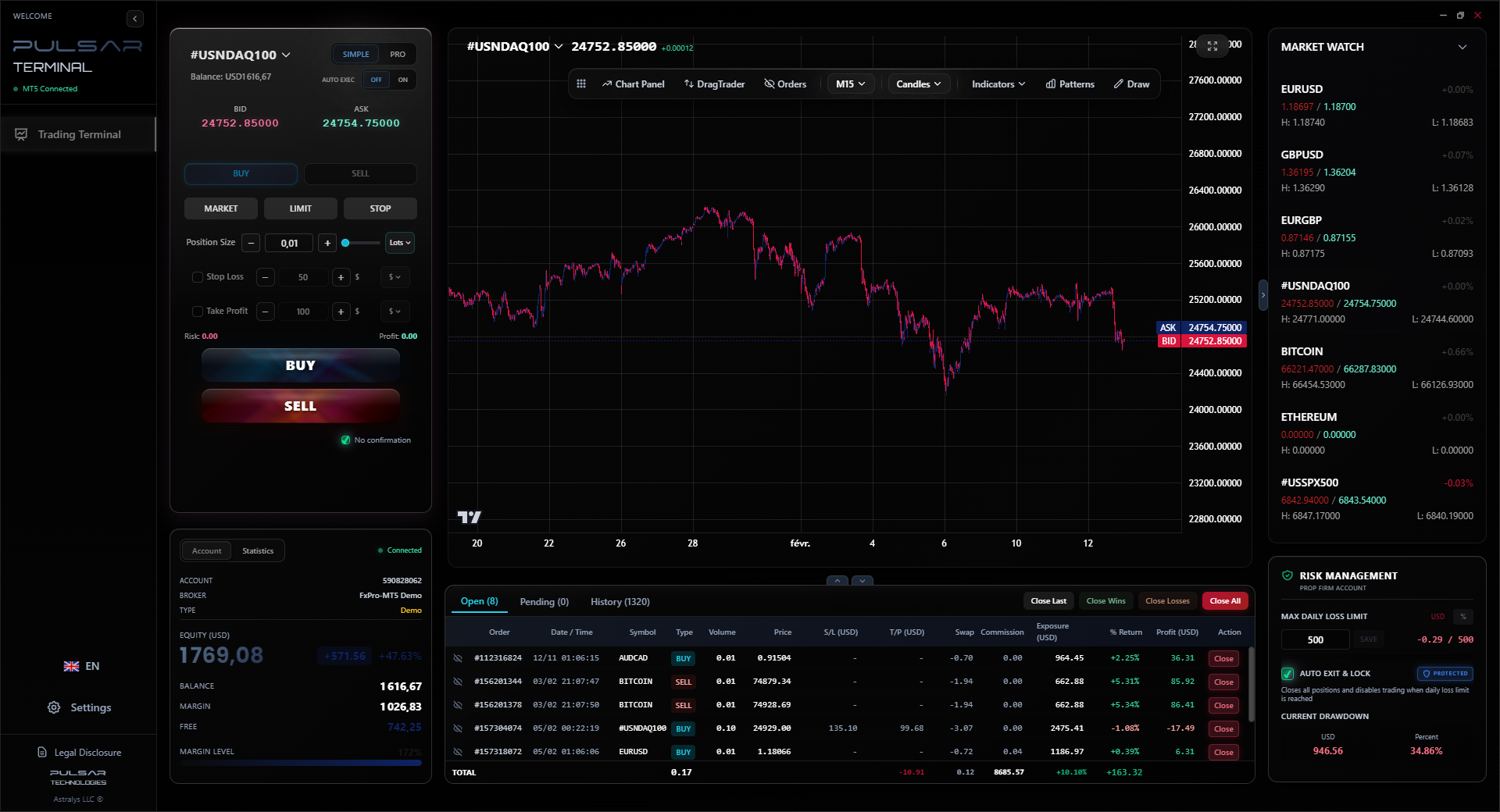
Managing precise entries and exits to combat spread cost is easier with tools like Pulsar Terminal, which lets you drag-and-drop orders and set multiple take-profit levels directly on your MT5 chart.
Pulsar Terminal
MT5 올인원 도구: 드래그앤드롭 주문, 다중 TP/SL, 트레일링 스톱, 그리드 트레이딩, 볼륨 프로파일, 프롭펌 보호. 매일 1,000명 이상의 트레이더가 사용.
Given our local challenges, here’s your practical checklist for picking a broker, with spread as priority number one.
- Regulation (The Safety Net): Since local CBN/SEC oversight for retail forex is light, you want a broker regulated by a top-tier foreign authority like the UK's FCA, Australia's ASIC, or Cyprus's CySEC. This protects your funds. Many brokers serving Nigeria operate under the FSCA (South Africa) or other reputable bodies.
- Spread Data (The Proof): Don't take their word for it. Look for brokers that publish average spread statistics or, better yet, offer a live spread monitor on their website. The average for EUR/USD among good brokers should be under 0.5 pips for variable accounts.
- Account Type: Decide if you need a Standard (spread-only) account or an ECN/Raw (spread + commission) account. Do the math for your typical trade size to see which is cheaper.
- Minimum Deposit & Funding: Can you start small? Many like Pepperstone or XM offer no minimum deposit, which is great for testing. Check their deposit methods for Nigeria - do they accept local bank transfers, cards, or fintech apps? What are their conversion fees? Our XM review details their local payment options.
- The Demo Test: This is non-negotiable. Open a demo account and trade it for at least two weeks. Watch the spreads during different times of day and around news events. See if they match the broker's claims.
Here’s a quick comparison based on typical offerings:
| Broker Type | Typical EUR/USD Spread | Best For | Watch Out For |
|---|---|---|---|
| ECN/Raw Account | 0.0 - 0.2 pips + commission | Scalpers, high-volume traders | Commission can be costly on very small trades. |
| Standard Variable | 0.5 - 1.5 pips | Most retail traders, swing traders | Spreads can widen significantly on news. |
| Fixed Spread | 1.0 - 2.0 pips | New traders, algorithmic strategies | Usually higher average cost than variable. |
“I've seen more strategies killed by ignoring spread costs than by bad technical analysis.”
Let me be vulnerable. I've lost money to stupid spread-related errors. Learn from my losses.
Mistake 1: Chasing 'Zero Spread' Bonuses. Early on, I signed up with an offshore broker offering 'zero spread forever!' It was unregulated. The spreads were indeed tiny during demo testing. But when I funded my live account and started trading, I experienced constant requotes and 'slippage' that always went against me. The lack of spread was a illusion; they were making money by manipulating my execution price. I lost about $500 before I cut my losses. The real cost was never the spread, it was the lack of honest execution.
Mistake 2: Ignoring Spread in My Backtesting. I developed a nice-looking scalping strategy on a demo account that assumed 0.5 pip spreads. It had a 60% win rate. I went live on an account with average 1.8 pip spreads. The strategy failed immediately. Why? My average profit target was 5 pips. The spread increase ate 1.3 pips of that, turning a marginally profitable system into a losing one. Always deduct the real, live spread cost from your backtest results.
Mistake 3: Trading Right Before Major News. I once had a pending order set just before a US Federal Reserve announcement. I thought I was clever. The news hit, volatility spiked, and my order was filled. The spread at that moment was 15 pips on GBP/USD instead of the usual 1.5. My trade was 15 pips underwater instantly. It never recovered. I learned to close all positions and cancel pending orders 15 minutes before high-impact news. The potential reward is never worth that kind of instant deficit.

Pro Tip: Your trading platform should show your 'floating P&L' the second your trade is open. If that number is a deep red immediately, you've been hit by a wide spread. Take a screenshot, note the time, and check if it was during a news event. This data is gold for refining your timing.
💡 윈스턴의 팁
If you're paying more than 1 pip on EUR/USD during London hours, you're probably at the wrong broker. Shop around.
Once you've mastered the basics, here's what to explore next.
Bid-Ask Spread vs. Slippage: The spread is a known, quoted cost. Slippage is an execution cost. It's when your order is filled at a worse price than you requested. This happens during fast markets. A market order to buy EUR/USD at 1.0850 might get filled at 1.0853. You paid the 2-pip spread plus 1 pip of slippage. Limit orders protect against negative slippage.
The Markup on CFDs: Remember, when you trade forex, you're usually trading a CFD (Contract for Difference). The broker's quoted price is derived from the interbank market price plus their markup. The spread is part of that markup. Understanding this reminds you that you're not in the interbank market; you're in a broker's environment.
Spreads and Correlation: This is a neat trick. If you're trading correlated pairs (like EUR/USD and GBP/USD), be aware that a widening spread on one often precedes widening on the other during times of stress. It's a canary in the coal mine for liquidity drying up.
Tools to Help: This is where technology becomes your ally. A good trading terminal will show you live bid/ask prices. Even better, tools like volume profile can help you identify high-liquidity price levels where spreads might naturally be tighter. Combining spread awareness with technical analysis from indicators like the RSI indicator or MACD indicator gives you a more complete picture.
FAQ
Q1Is a lower spread always better?
Not always. A 'zero spread' account with a high commission can be more expensive for small trades. A fixed spread might be higher on average but provides cost certainty, which is valuable for some strategies. You must calculate the total cost of entry (spread + commission) for your typical trade size.
Q2What is a good spread for a beginner in Nigeria?
For major pairs like EUR/USD, look for an average spread under 1.0 pip on a standard account. This keeps your costs manageable while you learn. Avoid brokers whose typical spreads are consistently above 1.5 pips on the majors.
Q3How does the 10% Nigerian tax interact with spread costs?
The tax is on gross profits. Spreads reduce your gross profit. So, you pay tax on what's left after the spread and other costs are factored in. A high spread cost directly reduces your taxable profit, but it's a terrible way to lower your tax bill - it means you're making less money overall.
Q4Can I get a margin call because of spread widening?
Indirectly, yes. If you have open positions and spreads widen dramatically (like during a news event), the 'mark-to-market' value of your positions is calculated using the less favorable Bid/Ask prices. This can suddenly show a larger loss on your account, pushing your margin level down and potentially triggering a margin call if you're over-leveraged.
Q5Should I use a stop-loss to protect against spread widening?
A stop-loss becomes a market order when triggered. If it triggers during a period of extreme spread widening, you could be filled at a much worse price than you intended (slippage). To mitigate this, some traders use guaranteed stop-loss orders (if offered, usually for a fee) or simply avoid holding trades through known high-volatility events.
Q6What's the difference between spread and commission?
The spread is the built-in cost reflected in the difference between buy and sell prices. A commission is a separate, fixed fee charged per trade (e.g., $5 per lot). Both are broker revenue. ECN accounts often have tiny spreads but charge a commission. The goal is to compare the total cost of both models.
윈스턴 교수의 수업
핵심 요약:
- ✓The spread is your primary trading cost, paid instantly.
- ✓Calculate total cost (spread + commission) in Naira, not just pips.
- ✓Trade major pairs during high-liquidity sessions for tightest spreads.
- ✓Factor spread into your risk-reward; it changes everything.
- ✓A 2-pip spread on a 5-pip target consumes 40% of your profit.
이 기사가 얼마나 유용했나요?
별을 클릭하여 평가
주간 트레이딩 인사이트
무료 주간 분석 & 전략. 스팸 없음.
저자 소개
Olumide Adeyemi
서아프리카 트레이딩 선구자
나이지리아에서 가장 활발한 외환 트레이딩 교육자 중 한 명. 라고스에서 8년간 트레이딩 경험. 아프리카 트레이더를 위한 소자본 전략과 프롭 펌 챌린지 전문.
댓글
위험 고지
금융 상품 거래에는 상당한 위험이 수반되며 모든 투자자에게 적합하지 않을 수 있습니다. 과거 성과가 미래 수익을 보장하지 않습니다. 이 콘텐츠는 교육 목적으로만 제공되며 투자 조언으로 간주되어서는 안 됩니다. 거래 전에 항상 직접 조사를 수행하십시오.
이 기사도 읽어보세요

Cara Trading Forex Sukses: 7 Prinsip dari Trader Profesional
Cara trading forex sukses dengan 7 prinsip trader pro: manajemen modal, disiplin, journal trading, backtest. Data nyata, bukan janji profit palsu.
Jam Trading Forex Terbaik untuk Trader Indonesia: Panduan Lengkap dengan Tabel Waktu
Panduan jam trading forex untuk trader Indonesia. Tabel 4 sesi dunia, jam emas 20:00-00:00, sesi mana yang harus dihindari. Data akurat + tips dari trader berpengalaman.
Top 5 Sàn Forex Uy Tín Nhất 2026: Review Jujur dari Trader Indonesia
Top 5 sàn forex uy tín 2026 untuk trader Indonesia. Review jujur: spread, deposit, withdraw, dukungan lokal. Exness, XM, IC Markets & lebih.
