


Everyone's chasing the 'forex summit' - that mythical peak of consistent profits and trading enlightenment.

David van der Merwe
신흥시장 트레이더 ·  South Africa
☕ 9 분 소요
배울 내용:
Everyone's chasing the 'forex summit' - that mythical peak of consistent profits and trading enlightenment. In South Africa, that chase is fueled by slick Instagram ads promising Lambos from a R500 deposit. Let me be blunt: most of that is rubbish. The real summit isn't about getting rich quick; it's about navigating a heavily regulated, volatile market without getting your account blown up. I've been trading ZAR pairs since before the FSCA capped use, and I've seen more traders fail than succeed. This isn't another motivational speech. This is a map of the actual terrain, complete with the pitfalls, the real numbers, and the few paths that might actually get you somewhere.
Let's get the boring but critical stuff out of the way first. Trading is legal here, but it's not the wild west. The Financial Sector Conduct Authority (FSCA) runs the show, and they've got rules. Good rules, mostly.
The 30:1 use cap for retail traders is the big one. It came in back in 2021, and honestly, it saved a lot of rookies from themselves. Before that, you could get 500:1 from some offshore bucketshops and vaporize your capital in minutes. Now, with 30:1, your losses are slower, which gives you time to learn. If you're screaming that you need more use to make real money, you're not ready for more use. Professional status exists, but the criteria are strict: you need a portfolio over ZAR 7 million or proven experience and a big enough account. Don't bother faking it.
Broker Licensing: Non-Negotiable
Only use an FSCA-licensed broker. Full stop. Check their FSP number on the FSCA's public register. This isn't a suggestion; it's your first line of defense. It means they must segregate client funds (your money is kept separate from the company's operating cash) and adhere to transparency rules. I learned this the hard way early on with an unregulated 'broker' that mysteriously froze withdrawals during a winning streak. Poof. Gone.

Warning: The South African Reserve Bank (SARB) has its own rules. You generally cannot speculate directly against the Rand with an offshore entity without approval. Stick with FSCA brokers for ZAR pairs to keep it clean.
The regulation is a double-edged sword. It protects you from outright fraud, but it also limits your tools. You have to be smarter with your capital, which is the whole point of becoming a good trader. Start by mastering a solid swing trading approach that doesn't rely on insane use.

💡 윈스턴의 팁
The market's job is to make you feel stupid right before it makes you rich. Your job is to not believe the first part.
“The real summit isn't about getting rich quick; it's about navigating a heavily regulated, volatile market without getting your account blown up.”
Forget the 'zero deposit' hype. Let's talk about the money that actually moves - yours, going to the broker.
Spreads and Commissions: This is your primary cost. It varies wildly. On a major pair like EUR/USD, you can find raw spreads from 0.0 pips plus a commission (e.g., $3-$6 per lot per side), or commission-free accounts with spreads from 0.6 pips up to 1.6 pips. For the volatile USD/ZAR, expect spreads to be much wider, often 50-100 pips or more. That's not a scam; it's the cost of liquidity for an emerging market currency.
Here’s a quick comparison from my own experience:
| Broker Type | EUR/USD Spread (Typical) | Cost per 1 Lot (R100k) | Best For |
|---|---|---|---|
| Raw/ECN Account | 0.1 pips + $4 commission | ~ZAR 11 (spread) + ZAR 75 (comm) | High-volume scalping, pros |
| Standard Account | 1.2 pips, no commission | ~ZAR 132 | Newer traders, lower frequency |
Other Fees:
- Overnight Financing (Swap): If you hold a position past 10 PM GMT, you pay or earn interest. On USD/ZAR, this can be significant. I once held a short USD/ZAR trade for a week, and the negative swap ate nearly 30% of my paper profits before the move even happened. Always check the swap rates.
- Deposit/Withdrawal: Many brokers offer free EFTs from SA banks. But watch out for international wire fees. Standard Bank, for example, charges around R250 for an outgoing foreign payment.
Minimum Deposits: Yes, you can start with $5 or ZAR 500. But should you? With that amount, a single pip movement might be worth a few cents. You'll overtrade just to see meaningful P&L. My blunt advice? Don't trade live with less than R5,000. For a serious shot, aim for R20,000. This lets you use sane position size calculator outputs and actually manage risk.
“A 100-pip move on USD/ZAR is a regular Tuesday.”
The market is crowded. Here’s my take on some major players, having funded accounts with most of them over the years.
For the Cost-Conscious Active Trader:
- Tickmill (FSCA Regulated): Their Raw account is legit. I've traded there for years. The EUR/USD spread is routinely 0.1 pips with a $3 commission. Effective cost: 0.71 pips. Execution is sharp. Minimum deposit is $100.
- Exness (FSCA Regulated): Popular for a reason. Ultra-low minimum deposits (from $10) and raw spreads. Their offshore entities offer crazy use, but for trading in SA under FSCA, you're capped at 30:1. Solid for XAU/USD trading.
For the Beginner Who Wants Simplicity:
- XM (FSCA Regulated): Easy start ($5 min), user-friendly platforms. Their commission-free account spreads are higher (0.6-0.8 on EUR/USD), but it's all baked in. Good education.
- Plus500: Their intuitive WebTrader is great for understanding CFDs without the clutter of MT4. But their spreads are on the wider side. It's a good sandbox, not necessarily a long-term home for serious technical traders.
My Personal Workhorse: I run my main strategy on IC Markets. While their FSCA regulation is via a global entity, their raw spreads on the True ECN account are consistently the best I've found for my volume. I'm talking 0.2 pips on EUR/USD during London open. I once caught a 120-pip move on EUR/USD and saved nearly $12 in spread costs compared to my old standard account broker. That adds up.

Pro Tip: Don't get hypnotized by 'zero spread' claims. Look at the effective cost: spread + commission. A 0.0 pip spread with a $10 round-turn commission is more expensive than a 1.0 pip spread with no commission on a typical trade.
“The realistic target for a skilled trader with a R50,000 account is a 2-5% return per month. That's the summit.”
This is our home game. USD/ZAR is one of the most traded African pairs globally, and it's a beast. It's not for the faint-hearted.
What Moves It?
- Commodity Prices: We're a resource economy. Strong gold/platinum prices often strengthen the Rand (lower USD/ZAR). Weakness hits us hard.
- Global Risk Sentiment: When the world panics, investors flee emerging markets like SA. USD/ZAR shoots up.
- US Dollar Strength: This is the big one. A strong DXY crushes the ZAR.
- Local Politics & Eskom: Sadly, our domestic drama gets priced in. Loadshedding forecasts move the market.
A Trade I Got Wrong (Badly): In early 2025, with USD/ZAR around 18.90, I thought it was overextended. Commodities were okay, and we had a "good" political news cycle. I went short, targeting 18.40. Then the Fed got super hawkish, the dollar ripped, and a major local miner went on strike. USD/ZAR screamed to 19.50. I didn't have a hard stop (idiot). I watched a 60-pip paper profit turn into a 600-pip loss. I finally bailed at 19.48. That loss was 15% of my account. It taught me to always, always use a stop-loss on ZAR pairs and respect the global macro trend over local news.
How to Approach It: Treat it like a volatile stock, not a major forex pair. Use wider stops (150-300 pips). Position size tiny. A 100-pip move on USD/ZAR is a regular Tuesday. I now use the MACD indicator on the 4H chart just to gauge momentum shifts and avoid stepping in front of freight trains.
💡 윈스턴의 팁
If you wouldn't risk the same amount of money on a single hand of blackjack, you're risking too much on a single trade.
“The realistic target for a skilled trader with a R50,000 account is a 2-5% return per month. That's the summit.”
Let's crush the biggest fantasy. The global stat is that 51-89% of retail CFD traders lose money. In SA, I'd bet we're at the higher end of that range. The 'forex summit' is a lonely place.
What 'Making It' Actually Looks Like: The stories of traders making R100k a month from R10k are the 0.1%. They're either lying, on a lucky streak, or genuine prodigies. The realistic target for a skilled, intermediate trader with a R50,000 account is a 2-5% return per month. That's R1,000 to R2,500. Consistent, month after month. That's the summit. From there, you scale your capital.
Why People Blow Up:
- Over-leveraging: Even at 30:1, it's too much for beginners. They risk 5-10% per trade.
- Chasing Losses: One bad trade turns into five revenge trades.
- No Edge: They're just guessing, using a lagging RSI indicator on a 1-minute chart.
- Ignoring Costs: Trading a high-spread account with a scalping strategy is a guaranteed way to fund your broker's new yacht.
My First Profitable Year: It took me three years of blowing up small accounts. My first consistently profitable year, I turned a R25,000 account into R38,000 over 12 months. That's a 52% return, which sounds amazing, right? It was about R1,083 per month on average. Hardly glamorous. But it was sustainable. The key was cutting my average position risk from 3% to 0.8% and focusing on quality, not quantity.
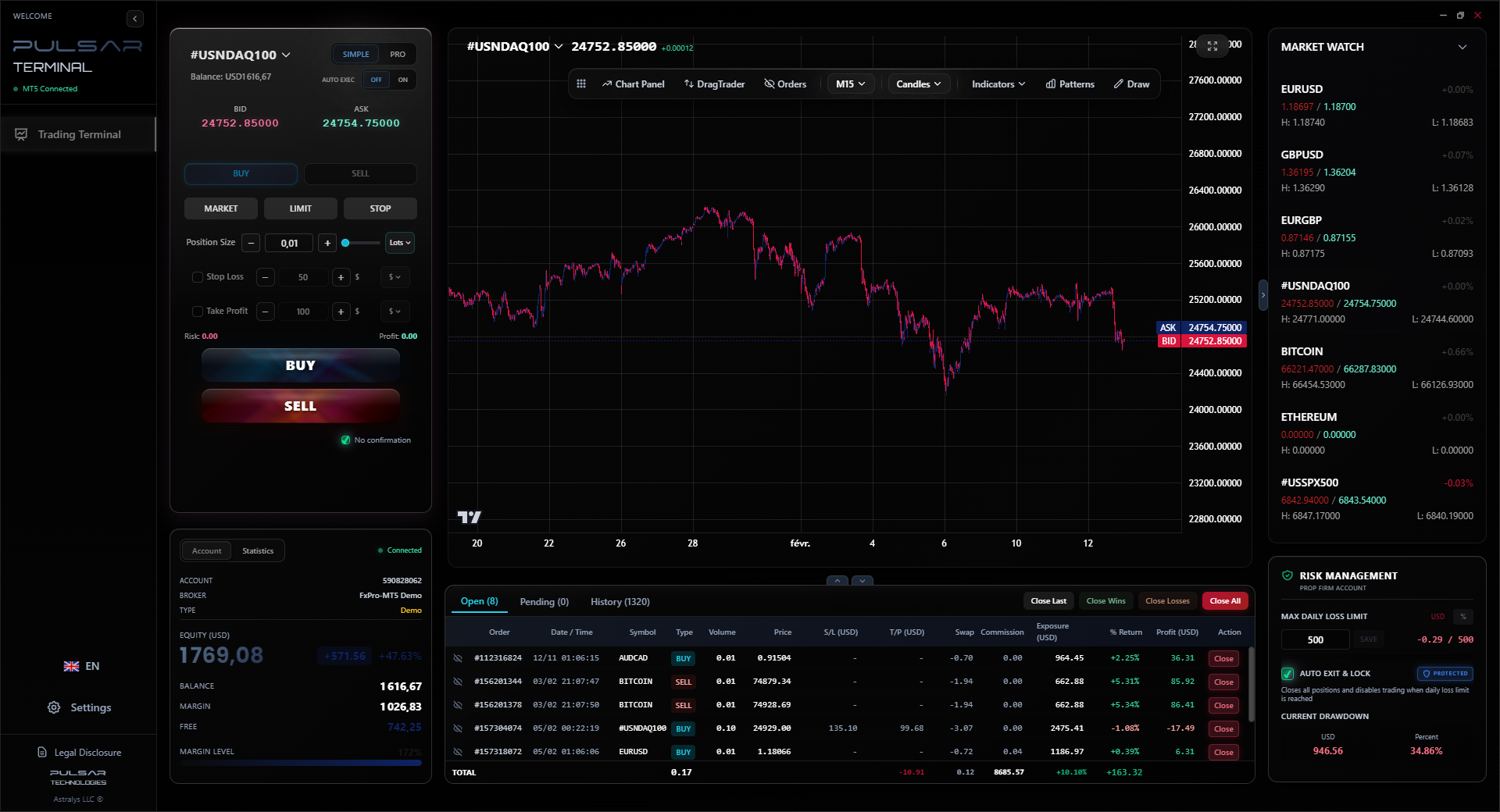
When your strategy depends on precise risk management like trailing stops and partial closures, manually clicking on a volatile chart is a great way to make a costly mistake.
Pulsar Terminal
MT5 올인원 도구: 드래그앤드롭 주문, 다중 TP/SL, 트레일링 스톱, 그리드 트레이딩, 볼륨 프로파일, 프롭펌 보호. 매일 1,000명 이상의 트레이더가 사용.
“This job is 90% psychology, 9% risk management, and 1% strategy.”
So you still want to climb? Here's the gear you need.
Phase 1: Education & Simulation (Months 1-3)
- Learn the Jargon: Know what a spread, margin call, and swap are inside out.
- Pick ONE Strategy: Don't collect 20 indicators. Master one. Price action support/resistance or a simple moving average crossover on the H4 chart.
- Demo Trade RELIGIOUSLY: Treat the virtual ZAR 100,000 like real money. Your goal isn't to double it; your goal is to have three consecutive months of not losing it. Track every trade in a journal.
Phase 2: Live Trading with Scarce Capital (Months 4-6)
- Deposit the Minimum: Start with that R5,000 at a broker like XM or Exness.
- Risk 0.5% Per Trade: That's R25. Yes, it feels pointless. The point is to practice execution and emotion with real stakes.
- Withdraw Your First Profits: When you make 10% (R500), withdraw it. It proves the system works and gives you a psychological win.
Phase 3: Scaling (Month 7+)
- Gradually Add Capital: Only after 6 months of break-even or better performance.
- Automate Your Rules: This is where tools become force multipliers. If your strategy uses trailing stops, manual execution is a hassle.
- Specialize: Become an expert on one or two pairs. Maybe it's EUR/USD and Gold. Know their personality better than anyone.
This job is 90% psychology, 9% risk management, and 1% strategy. The summit isn't a dollar figure. It's the day you realize your emotions no longer control your mouse clicks.
FAQ
Q1Is forex trading legal and safe in South Africa?
Yes, it's legal. Its safety depends entirely on you using an FSCA-licensed broker. This ensures client fund segregation and regulatory oversight. Trading itself is high-risk, but the environment is regulated to prevent outright fraud.
Q2What is the best forex broker in South Africa for beginners?
There's no single 'best.' For a beginner wanting low barriers and simplicity, XM or Exness are solid starting points due to their low minimum deposits (from $5) and user-friendly platforms. Just remember to start on a demo account first, regardless of the broker.
Q3How much money do I need to start forex trading in South Africa?
You can technically start with ZAR 500. But to trade properly - using sane position sizes and not being forced to over-use - a minimum of R5,000 is realistic. For serious, sustainable trading, R20,000 is a more practical base to work from.
Q4Why is the USD/ZAR pair so volatile?
The South African Rand is an emerging market currency. Its value is heavily influenced by global risk sentiment, US dollar strength, and commodity prices (like gold and platinum). Local factors like electricity supply (Eskom) and political stability also add significant volatility, making big daily swings common.
Q5Can I use use higher than 30:1 in South Africa?
No, not as a retail trader. The FSCA has capped use at 30:1 for major currency pairs. Some brokers may offer higher use through their offshore entities, but trading there means you forfeit FSCA protection, which is a terrible trade-off.
Q6What percentage of forex traders actually make money in SA?
There are no official SA-specific stats, but global figures show most lose money. Based on the use cap coming in later here and the general market hype, I'd estimate the failure rate in South Africa is at least 80%. Consistent profitability requires years of discipline and education.
Q7What trading platform do most South African traders use?
MetaTrader 4 (MT4) and MetaTrader 5 (MT5) are by far the most popular. They're versatile, support automated trading (Expert Advisors), and are offered by almost every broker. Some brokers like Plus500 and IG have their own proprietary platforms which are simpler but may lack advanced tools.
윈스턴 교수의 수업
핵심 요약:
- ✓FSCA's 30:1 use cap is a lifesaver, not a limit.
- ✓Effective cost (spread + commission) matters more than advertised spread.
- ✓Risk a maximum of 0.5-1% of your capital per trade.
- ✓USD/ZAR requires 150-300 pip stops; trade it small.
- ✓A 2-5% monthly return is a massive, sustainable success.
이 기사가 얼마나 유용했나요?
별을 클릭하여 평가
주간 트레이딩 인사이트
무료 주간 분석 & 전략. 스팸 없음.
저자 소개
David van der Merwe
신흥시장 트레이더
요하네스버그 기반 트레이더로 신흥시장 통화 11년 경력. ZAR 통화쌍, FSCA 규제 거래, 남아공 시장 분석 전문.
댓글
위험 고지
금융 상품 거래에는 상당한 위험이 수반되며 모든 투자자에게 적합하지 않을 수 있습니다. 과거 성과가 미래 수익을 보장하지 않습니다. 이 콘텐츠는 교육 목적으로만 제공되며 투자 조언으로 간주되어서는 안 됩니다. 거래 전에 항상 직접 조사를 수행하십시오.
이 기사도 읽어보세요

Cara Trading Forex Sukses: 7 Prinsip dari Trader Profesional
Cara trading forex sukses dengan 7 prinsip trader pro: manajemen modal, disiplin, journal trading, backtest. Data nyata, bukan janji profit palsu.
Jam Trading Forex Terbaik untuk Trader Indonesia: Panduan Lengkap dengan Tabel Waktu
Panduan jam trading forex untuk trader Indonesia. Tabel 4 sesi dunia, jam emas 20:00-00:00, sesi mana yang harus dihindari. Data akurat + tips dari trader berpengalaman.
Top 5 Sàn Forex Uy Tín Nhất 2026: Review Jujur dari Trader Indonesia
Top 5 sàn forex uy tín 2026 untuk trader Indonesia. Review jujur: spread, deposit, withdraw, dukungan lokal. Exness, XM, IC Markets & lebih.
