


Here's the truth most 'gurus' won't tell you: your forex trading background in India is built on a legal minefield, not a solid foundation.

Rajesh Sharma
수석 외환 애널리스트 ·  India
India
☕ 11 분 소요
배울 내용:
- 1The Legal Reality Check: What You Can Actually Trade
- 2Market Size Myths vs. Real Liquidity
- 3The Real Cost Breakdown: Spreads, Fees, and Hidden Taxes
- 4The Broker Landscape: SEBI vs. Offshore Traps
- 5Trading Psychology in the Indian Context
- 6Building Your Edge: A Realistic Path Forward
- 7The Future: Is a Regulatory Storm Coming?
Here's the truth most 'gurus' won't tell you: your forex trading background in India is built on a legal minefield, not a solid foundation. Everyone's selling you the dream of trading EUR/USD from your bedroom, but they're skipping the part where the RBI could come knocking. I've traded through three regulatory crackdowns here, and I'll show you exactly what's legal, what's not, and how to actually build a sustainable trading career without ending up on the wrong side of FEMA. Forget the hype - this is the real background check you need.
Let's cut through the nonsense. Your forex trading background in India is defined by one document: the Foreign Exchange Management Act (FEMA) of 1999. It's not complicated, but brokers make it sound like rocket science so you'll ignore it.
The rule is simple: you can only trade currency pairs where the Indian Rupee (INR) is one side. That's it. USD/INR, EUR/INR, GBP/INR, JPY/INR. These are traded as exchange-traded derivatives on the NSE, BSE, or MSE through a SEBI-regulated broker like Zerodha or Upstox. That's the legal path.
Everything else? EUR/USD, GBP/JPY, gold (XAU/USD)? Trading those through an offshore broker like Exness or IC Markets is technically a FEMA violation. The RBI has said repeatedly that the Liberalised Remittance Scheme (LRS) is NOT for speculative forex trading. They even publish an 'Alert List' of unauthorized platforms.
Now, here's the messy reality everyone lives with: thousands of Indian traders use offshore brokers anyway. The enforcement is sporadic. But in April 2026, the RBI dropped a bombshell new rule prohibiting banks from offering certain rupee derivative contracts to curb speculation. The walls are getting higher.

Warning: Using your LRS limit to fund an offshore trading account for spot forex is illegal. If you get flagged, your bank can freeze the remittance and you could face penalties. I know three traders who had transactions reversed in 2023.
So you have a choice: stay completely legal with INR pairs on Indian exchanges, or understand the real risk you're taking going offshore. There's no middle ground, no matter what a broker's website says.

💡 윈스턴의 팁
Your first ₹50,000 is for paying tuition to the market, not for buying a bike. Expect to lose it while learning. If you can't afford to light it on fire, you can't afford to trade.
You'll see reports saying India's forex market is worth $33 billion and growing at 8.4% a year. Sounds impressive, right? It's mostly noise. The number that matters for your trading background is daily turnover, and for the INR pairs you're allowed to trade, it's a different game.
The average daily turnover for the entire Indian forex market hit about $60 billion in 2024. That's decent, but compare it to the global EUR/USD market that does over $2 trillion daily. The liquidity in USD/INR futures is good during Indian trading hours (9 AM to 5 PM IST), but try holding a position overnight when London and New York are active and the INR isn't trading. The spreads can widen, and your stop-loss might get hit by a random spike.
I learned this the hard way in 2021. I was long USD/INR futures, entered at 74.85, with a stop at 74.70. During the US session, some unrelated news spooked emerging market currencies. The electronic order book thinned out, and my stop was executed at 74.65 - a 5-pip slippage that turned a small loss into a nasty one. That's the reality of trading a locally liquid but globally niche market.
Where the Real Volume Is
For the legal INR pairs, volume concentrates around the RBI's reference rate fixings and major economic data releases. For the illegal-but-popular pairs like EUR/USD traded offshore, you're getting global liquidity, but you're also competing with hedge funds and algorithms. Your scalping strategy might work on paper, but the execution speed from India adds latency.
The growth story is real - NRI remittances are huge ($153 billion in deposits by 2024), and FDI keeps flowing in. This creates genuine currency flows you can trade. But don't confuse economic growth with easy trading conditions. They're not the same thing.
“Your forex trading background in India is defined by one document: the Foreign Exchange Management Act (FEMA) of 1999.”
This is where your trading background gets expensive if you're not careful. Let's talk numbers.
On Indian Exchanges (Legal Route): You're paying brokerage fees (often a flat fee per lot), exchange charges, GST (18% on brokerage), and STT (Securities Transaction Tax). The spread on the USD/INR future might be just 0.5 paisa (half a pip), which is tight. But add it all up. On a typical ₹10 lakh position, your total cost to enter and exit could be around ₹200-300. That's not terrible.
On Offshore Platforms (The Grey Route): Here, the game is spreads and commissions. Look at this comparison from my own accounts:
| Broker | Account Type | Avg. EUR/USD Spread | Commission (per lot) |
|---|---|---|---|
| XM (via Standard) | Standard | 2.0 pips | $0 |
| Tickmill (via Raw) | Raw | 0.1 pips | $2 per side |
| IC Markets | Raw Spread | 0.1 pips | $3.5 per side |

Example: A 1-lot trade on EUR/USD with Tickmill. Spread cost: 0.1 pips = $1. Commission: $2 entry + $2 exit = $4. Total cost: $5. On XM with a 2-pip spread and no commission, the cost is 2 pips = $20. The 'zero commission' account is often far more expensive.
Then come the funding costs. Depositing to an offshore broker? Your Indian bank might charge 3-5% for an international card transaction, plus GST. Using UPI or NetBanking with a local payment gateway? They might offer better rates, but it's another layer.
And finally, taxes. Capital gains from trading currency derivatives on Indian exchanges are taxed at 10% (if held less than 12 months). For offshore trading profits? It's a grey area. Most accountants will treat it as speculative business income, taxed at your income slab rate (could be 30%+). I set aside 33% of any offshore profit immediately. It hurts, but an IT notice hurts more.
Your position size calculator must include all these costs, not just the spread. Most traders fail because they only calculate the market risk, not the transaction cost risk.
💡 윈스턴의 팁
The 'RBI put' is real. When USD/INR spikes too fast, they step in. Don't be the hero fighting the central bank. Trade with them, not against them.
Choosing a broker is the first major decision in your trading background, and in India, it's a fork in the road.
Route 1: The SEBI-Regulated Brokers These are your stockbrokers: Zerodha, Upstox, Angel One, ICICI Direct. They give you access to the USD/INR, EUR/INR futures on the NSE. Pros: It's 100% legal, safe, and integrated with your bank. Cons: The product range is limited to 4-5 INR pairs. You can't trade commodities, global indices, or the major forex pairs. Their platforms (like Kite) are good for equities but feel clunky for pure forex trading compared to MT5.
Route 2: The Offshore Brokers These are the international brands like XM, Pepperstone, and FP Markets. They'll happily accept Indian clients. Pros: You get the full universe - 50+ forex pairs, metals, indices, crypto CFDs. You get powerful platforms like MT4/MT5 or cTrader. You can use use up to 1000:1 (though I beg you not to).
The massive, glaring con: It operates in a regulatory grey zone. Your funds are not protected by SEBI or Indian law. You're relying on Cyprus's CySEC or the Seychelles' FSA. If the broker goes under or there's a dispute, your legal recourse is weak and international.

Pro Tip: If you go offshore, only use brokers with a long track record and top-tier global regulation (like ASIC in Australia, even if they serve you via a different entity). Read our deep Exness review and IC Markets review to see how we stress-test their claims. Check their withdrawal policies specifically for Indian clients.
Minimum deposits are a marketing trick. A $5 minimum deposit (like XM offers) is just to get you in the door. To trade properly with sensible risk, you need at least $500-$1000. That $100 minimum at FxPro or Tickmill is more realistic.
use is the siren song. FxPro offers 1:30 on majors for Indian clients under ESMA-like rules, which is sane. Some others offer 500:1 or 1000:1. Using that is a one-way ticket to a margin call. I blew my first $2,000 account in 2012 using 400:1 use. A 25-pip move wiped me out. It was a cheap, necessary lesson.
“Using 500:1 use is a one-way ticket to a margin call. I blew my first $2,000 account in 2012 using 400:1. It was a cheap, necessary lesson.”
Your mindset is shaped by your environment. In India, the trading background noise is uniquely toxic.
First, you have the 'option writer' culture from the equity markets, where selling premiums is seen as 'safe income.' This mindset leaks into forex. People sell USD/INR options naked, collecting small premiums until a sharp RBI intervention or oil price spike blows them up. I've seen it happen repeatedly. Forex isn't about collecting rent; it's about catching trends.
Second, the 'get rich quick' pressure is immense. Family expectations, social media fakery, and stories of crypto millionaires create a desperation that kills discipline. You start overtrading, chasing, ignoring your plan. I once took 47 trades in one week trying to make a monthly target. I ended the week down 8%. My swing trading plan called for 4-5 trades a month max.
Third, the legal ambiguity adds a layer of stress. Is that email from the broker a platform issue, or the start of a regulatory block? It sits in the back of your mind. You need to make a decision: accept the risk if you go offshore, or accept the limitation if you stay on-exchange. This indecision itself becomes a performance killer.
The market also has local rhythms. The USD/INR often has a muted reaction to global risk-off events because the RBI steps in to manage volatility. You can't just follow the textbook. You need to understand the 'RBI put' - the informal floor under the rupee they sometimes defend. It's not on any chart, but every local trader knows it exists.
Building a calm, disciplined psychology here means filtering out 90% of the local trading 'guru' content, accepting slower growth, and defining success on your own terms, not your cousin's LinkedIn brags.
💡 윈스턴의 팁
If you're trading offshore, keep a separate, old-school notebook logging every trade, deposit, and withdrawal. If things go sideways, a paper trail is your only friend.
So, with this messy background, how do you actually build an edge? You specialize.
If you trade on Indian exchanges (USD/INR): Your edge comes from understanding local macro. Track oil prices (India's biggest import), FDI flows, RBI policy statements, and the dollar index (DXY). The USD/INR has a strong positive correlation with DXY, but with RBI smoothing. Use longer timeframes. The 4-hour and daily charts work better than 5-minute noise. The MACD indicator on a daily chart, looking for divergence with price, gave me one of my best USD/INR trades: short at 75.20, covered at 73.80, a 140-pip move over three weeks.
If you trade offshore (Major pairs): Your edge is in time-zone mastery. The London open (1:30 PM IST) and the London-New York overlap (7:30 PM IST) are the most volatile, liquid sessions. Structure your day around them. Also, accept that you're a small fish. Use tight risk management. A 1:1 risk-reward ratio is a myth for retail traders in these markets; aim for 1.5:1 or better.
Regardless of your path, your toolkit is critical. You need a platform that lets you manage risk efficiently. Setting multiple take-profit levels or moving a stop to breakeven shouldn't require five clicks while the market moves.
Technology is your force multiplier. Use a proper journal (not an Excel sheet). Backtest your ideas. And get a platform that removes friction from your trading. Manual trailing stops are how you let winners turn into losers.
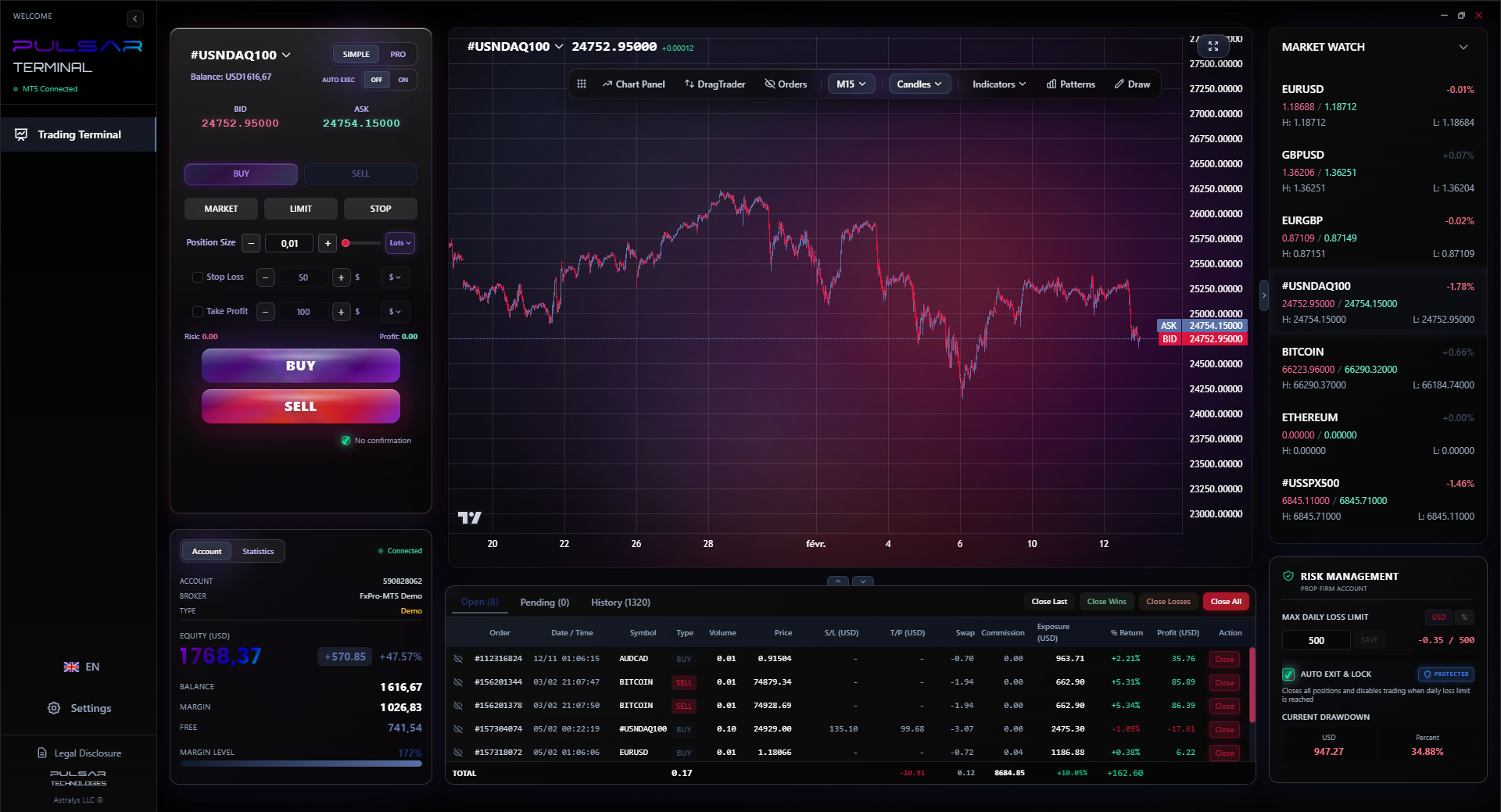
Managing complex trades and risk across different sessions is exhausting, which is why a tool that automates order management directly on your MT5 platform is non-negotiable for serious traders.
Pulsar Terminal
MT5 올인원 도구: 드래그앤드롭 주문, 다중 TP/SL, 트레일링 스톱, 그리드 트레이딩, 볼륨 프로파일, 프롭펌 보호. 매일 1,000명 이상의 트레이더가 사용.
“The 'get rich quick' pressure in India creates a desperation that kills trading discipline. I once took 47 trades in one week trying to make a monthly target. I ended the week down 8%.”
Let's be blunt: the current situation is unstable. The RBI isn't stupid. They see the capital outflows to offshore brokers. The April 2026 move to curb rupee derivatives for residents and non-residents is a direct shot across the bow.
The government's warning in March 2026 about unauthorized platforms wasn't for show. The next logical step is pressure on payment gateways and banks to block transactions to known CFD/forex broker entities. It's happened in other countries; it can happen here.
What does this mean for your trading background?
- Have an exit strategy for offshore funds. Don't keep all your capital with one broker. Know their withdrawal methods and timelines.
- Consider the GIFT City loophole. The International Financial Services Centre (IFSC) in GIFT City allows trading in global products (including non-INR forex pairs) through IFSC-registered brokers, using your LRS limit. It's legal, but the broker choice is limited, and costs are higher. It's a potential future-safe path.
- Diversify your skills. If your entire edge is scalping EUR/USD on a Seychelles-regulated broker, you're vulnerable. Learn to trade the Indian derivatives market too. It's boring, but it's permanent.
The market will keep growing - projected to hit $68 billion by 2034. But growth and regulatory freedom are not the same. The smart trader builds a background that is compliant, or at least prepared for compliance. The reckless one ignores the writing on the wall until their funding method gets blocked. I know which one I'd rather be.
FAQ
Q1Is forex trading legal in India?
Yes, but only specific types. Trading currency pairs involving the Indian Rupee (like USD/INR) on SEBI-regulated exchanges like the NSE is 100% legal. Trading major pairs like EUR/USD through international offshore brokers operates in a legal grey area and is considered a violation of FEMA rules by the RBI, though enforcement is targeted.
Q2What is the best broker for forex trading in India?
There is no single 'best' broker - it depends on your chosen path. For legal, exchange-traded INR pairs, Zerodha and Upstox are top contenders. For accessing global markets (with associated legal risk), brokers with strong international regulation like IC Markets or Pepperstone are often used. You must read detailed reviews like our XM review to check their specific policies for Indian clients.
Q3How much tax do I pay on forex trading profits?
For legal trading on Indian exchanges, profits are treated as capital gains and taxed at 10% (for holdings less than 12 months). For profits from offshore trading, the tax treatment is unclear but typically considered speculative business income, taxed at your applicable income tax slab rate (which can be 30% or more). Always consult a CA.
Q4Can I use my LRS limit for forex trading?
No. The Reserve Bank of India has explicitly stated that the Liberalised Remittance Scheme (LRS) cannot be used for margin trading or speculative forex trading on international platforms. Using it to fund an offshore trading account is a violation of FEMA rules.
Q5What is the minimum amount needed to start forex trading?
You can technically start with as little as $5 with some offshore brokers, but it's a gimmick. To trade properly with sensible risk management, a realistic minimum is at least ₹50,000-₹1,00,000 ($600-$1200). On Indian exchanges, the margin for a single USD/INR futures contract requires roughly ₹15,000-₹20,000.
Q6What is a pip in USD/INR trading?
In USD/INR futures traded on the NSE, a pip is 0.25 paisa. The contract is quoted with two decimal places (e.g., 83.4525). A move from 83.4525 to 83.4550 is a 1-pip move. The value of 1 pip on a standard contract (USD 1000) is ₹0.25. Understand this fully with our pip definition guide.
Q7Has the RBI banned forex trading?
No, the RBI has not banned forex trading. It has banned unauthorized and speculative forex trading outside the permitted channels. Their recent 2026 actions further tightened rules on rupee derivatives to curb speculation, making the legal environment for certain activities more restrictive.
윈스턴 교수의 수업
핵심 요약:
- ✓Only INR pairs on Indian exchanges are 100% legal.
- ✓Offshore trading risks legal action & tax ambiguity.
- ✓Realistic starting capital is ₹50k+, not $5.
- ✓use above 1:30 is a destruction tool.
- ✓Factor ALL costs: spread, commission, GST, tax.
이 기사가 얼마나 유용했나요?
별을 클릭하여 평가
주간 트레이딩 인사이트
무료 주간 분석 & 전략. 스팸 없음.
저자 소개
Rajesh Sharma
수석 외환 애널리스트
인도 및 남아시아 시장에서 10년 이상의 트레이딩 경력. NSE 통화 파생상품으로 시작해 국제 외환시장으로 전향. USD/INR 및 신흥시장 통화쌍 전문.
댓글
위험 고지
금융 상품 거래에는 상당한 위험이 수반되며 모든 투자자에게 적합하지 않을 수 있습니다. 과거 성과가 미래 수익을 보장하지 않습니다. 이 콘텐츠는 교육 목적으로만 제공되며 투자 조언으로 간주되어서는 안 됩니다. 거래 전에 항상 직접 조사를 수행하십시오.
이 기사도 읽어보세요

Cara Trading Forex Sukses: 7 Prinsip dari Trader Profesional
Cara trading forex sukses dengan 7 prinsip trader pro: manajemen modal, disiplin, journal trading, backtest. Data nyata, bukan janji profit palsu.
Jam Trading Forex Terbaik untuk Trader Indonesia: Panduan Lengkap dengan Tabel Waktu
Panduan jam trading forex untuk trader Indonesia. Tabel 4 sesi dunia, jam emas 20:00-00:00, sesi mana yang harus dihindari. Data akurat + tips dari trader berpengalaman.
Top 5 Sàn Forex Uy Tín Nhất 2026: Review Jujur dari Trader Indonesia
Top 5 sàn forex uy tín 2026 untuk trader Indonesia. Review jujur: spread, deposit, withdraw, dukungan lokal. Exness, XM, IC Markets & lebih.
