


You're checking your charts, everything looks calm, and then boom - your USD/ZAR trade blows through your stop loss in seconds.

David van der Merwe
신흥시장 트레이더 ·  South Africa
☕ 10 분 소요
배울 내용:
- 1What Is a Forex Economic Calendar (And Why You Can't Ignore It)
- 2The Events That Actually Move the Rand (Forget the Rest)
- 3How to Read the Calendar: Forecast vs. Actual Isn't Enough
- 4Trading Strategies: Playing the News Without Getting Shot
- 5The Costly Mistakes Every South African Trader Makes (And How to Stop)
- 6Practical Tools: Which Calendars to Use and How to Set Them Up
- 7Making the Calendar Part of Your Trading DNA
You're checking your charts, everything looks calm, and then boom - your USD/ZAR trade blows through your stop loss in seconds. Sound familiar? That's the power of a scheduled economic event you missed. Most South African traders treat the forex trading calendar like a boring school timetable. I used to as well, until I lost R8,500 in under a minute during a surprise SARB announcement. This guide isn't about just listing events. It's about teaching you how to use the calendar as a weapon, not just a reference book. We'll focus on what matters for the Rand, how to position yourself, and the brutal mistakes you need to stop making.
Think of the forex economic calendar as the market's diary of scheduled volatility. It lists the dates and times when governments and central banks release data that tells the story of an economy. We're talking inflation figures (CPI), employment numbers, interest rate decisions, and GDP growth.
For you in South Africa, it's the difference between trading on a quiet highway and trying to cross the N1 at peak hour. The calendar tells you when the big trucks (institutional money) are about to change lanes. Ignoring it is like trading blindfolded.
I learned this the hard way early on. I was long on EUR/USD, feeling clever with my technical setup. I didn't check the calendar. The US Non-Farm Payrolls data hit, the pair spiked 80 pips against me in a heartbeat, and my stop loss got filled at the worst possible price. That was a $400 lesson in paying attention. The calendar doesn't predict the future, but it tells you when the rules of the game are about to change.

Warning: A common rookie mistake is only looking at the calendar after you've entered a trade. By then, it's too late. Your analysis should always start with 'What's on the calendar today?'
You don't need to watch every global event. You need to focus on the ones that directly impact the currencies you trade. For ZAR pairs, this is your shortlist.
South African Events (The Home Game)
-
SARB Interest Rate Decision: This is the big one. The South African Reserve Bank's call on the repo rate is the single most important event for the Rand. A hike typically strengthens ZAR (in theory), a cut weakens it. The tone of the statement (hawkish vs. dovish) is often more important than the decision itself.
-
South African CPI (Inflation): The primary data point the SARB looks at. A high print increases rate hike expectations, boosting the Rand. I once caught a nice 150-pip move on USD/ZAR short after a hotter-than-expected CPI print. The key was being positioned before the release, not chasing it after.
-
Budget Speech & Medium-Term Budget Policy Statement (MTBPS): Pure fiscal drama. The market looks for credible plans to manage debt and growth. A poorly received budget can hammer the Rand. This is less about a quick 5-minute trade and more about setting a trend for weeks.
Major Global Events (The Away Game)
Your ZAR trade will get rocked by these, even if they're not about SA.
-
US Federal Reserve (FOMC) Decisions & Press Conferences: The US Dollar is the world's reserve currency. What the Fed does drowns out almost everything else. A strong USD often means a weaker ZAR.
-
US Non-Farm Payrolls (NFP): The first Friday of every month. It's a jobs report, but it moves every market. Expect spreads to widen and liquidity to dry up on major pairs like EUR/USD seconds before the print.
-
Major Global CPI & Central Bank Decisions (ECB, BoE, etc.): These create waves in major pairs, which then flow into crosses like EUR/ZAR or GBP/ZAR.
Here’s a quick table of what to expect:
| Event Type | Volatility Expectation | Typical ZAR Reaction Time |
|---|---|---|
| SARB Rate Decision | Very High | Immediate & lasts hours/days |
| US FOMC | Extreme (for USD/ZAR) | Immediate & lasts days |
| SA CPI | High | Immediate, lasts hours |
| US NFP | High (on USD pairs) | Immediate, 30-60 mins of chaos |
| Mid-Tier SA Data (Retail Sales, PMI) | Medium | Quick spike, often fades |
“The calendar doesn't predict the future, but it tells you when the rules of the game are about to change.”
You open your calendar and see three columns: Previous, Forecast, Actual. Most traders think: "If Actual is better than Forecast, buy the currency!" If only it were that simple. That's a great way to get caught in a fake-out move.
The real game is in the deviation and the market's prior positioning. Let me give you a real example from my trading log. The forecast for US Core CPI was 0.3% month-on-month. The actual came out at 0.4%. That's a positive deviation, right? USD should rally. It did, for about 90 seconds. Then it reversed and sold off hard all day. Why? Because the market was already long USD expecting a hot number. The 'good news' was already priced in. The 'sell the fact' reaction crushed it.

Example:
- Event: US CPI. Forecast: 5.2%. Actual: 5.3%.
- Simple Logic: Actual > Forecast = Good for USD. Buy USD/ZAR.
- Advanced Logic: Market was expecting a worst number (5.5%), and had already sold USD. A 5.3% is better than feared. This can trigger a 'short squeeze' where USD rallies as everyone rushes to cover their bets against it. Context is everything.
You also need to watch the revisions. A current print that meets forecast, but with a sharp upward revision to last month's number, can be just as bullish as a beat. Always look at the whole picture, not just one number. Using tools like a good position size calculator becomes non-negotiable during these high-volatility windows, because your normal stop distance might be useless.

💡 윈스턴의 팁
The market's reaction to news tells you more about its mood than the news itself. A 'good' number that gets sold is a market screaming 'risk off.' Watch the price, not the headline.

There are three main ways to approach news events. I've used all three, and two of them will test your nerves.
1. The Pre-News Positioning (The High-Stakes Bet) This is where you analyse the sentiment and place your trade before the number drops. You're betting on the direction of the surprise. It requires strong conviction and even stronger risk management. Your stop loss must be wide enough to survive the initial spike but tight enough to not ruin you. I don't recommend this for new traders. The margin call risk is real.
2. The Post-News Momentum Trade (The Chase) You wait for the release, see the clear reaction (e.g., USD/ZAR drops 50 pips instantly on a dovish SARB), and jump in on the retest, hoping the trend continues. This is more reactive. The danger? You're often entering after the best price is gone, and you can get caught in a reversal if the move was just a short-term overreaction.
3. The Straddle/Volatility Play (The Neutral Trap) Some traders place opposite pending orders above and below the current price, hoping the news will trigger one and they can catch a big move. This seems clever until the news causes a massive spike that triggers both your buy and sell orders before reversing (a classic 'spike and fade'), leaving you with two losing trades. I've been burned by this more than once.

Pro Tip: My most consistent approach now? I often just stay out. If I have a profitable swing trading position open, I might tighten my stop to breakeven or take partial profit before a major event. Protecting capital is better than gambling on news. For pure news plays, I only take the clearest setups with the wind at my back (e.g., a consensus for a SARB hike and they deliver it).
“Protecting capital is better than gambling on news.”
Let's get blunt about where you're probably going wrong.
Mistake 1: Trading Low-Impact Events. You see 'German Wholesale Prices' on the calendar and hold your breath. Stop it. Filter your calendar to only show 'High' impact events. The noise from low-impact news will just give you false signals and anxiety.
Mistake 2: Not Accounting for Spread Widening. Your broker isn't evil, but they're not a charity. Seconds before major news, the spread definition on your USD/ZAR trade can blow out from 3 pips to 30 pips or more. If your stop loss is 20 pips away, you could get stopped out at the widened spread price before the market even reaches your intended stop level. This is why trading right on the news with tight stops is a broker's dream.
Mistake 3: Ignoring the 'Whisper Number'. The official forecast is public. The 'whisper number' is what the big desks in London and New York are really expecting, based on late-breaking data or sentiment. You can gauge this by watching price action in the hour before the release. If EUR/USD is creeping up before US data, the whisper might be dollar-negative.
Mistake 4: Forgetting About ZAR-Specific Liquidity. The Rand isn't the Euro. Around major SA events, liquidity can vanish. This means a moderate-sized trade from you can move the price more than you'd think, and getting out of a bad trade can be more expensive. Always use limit orders, not market orders, around these times.
💡 윈스턴의 팁
If you feel your heart pounding waiting for a news release, your position is too big. Size down until the event feels like research, not a lottery ticket.
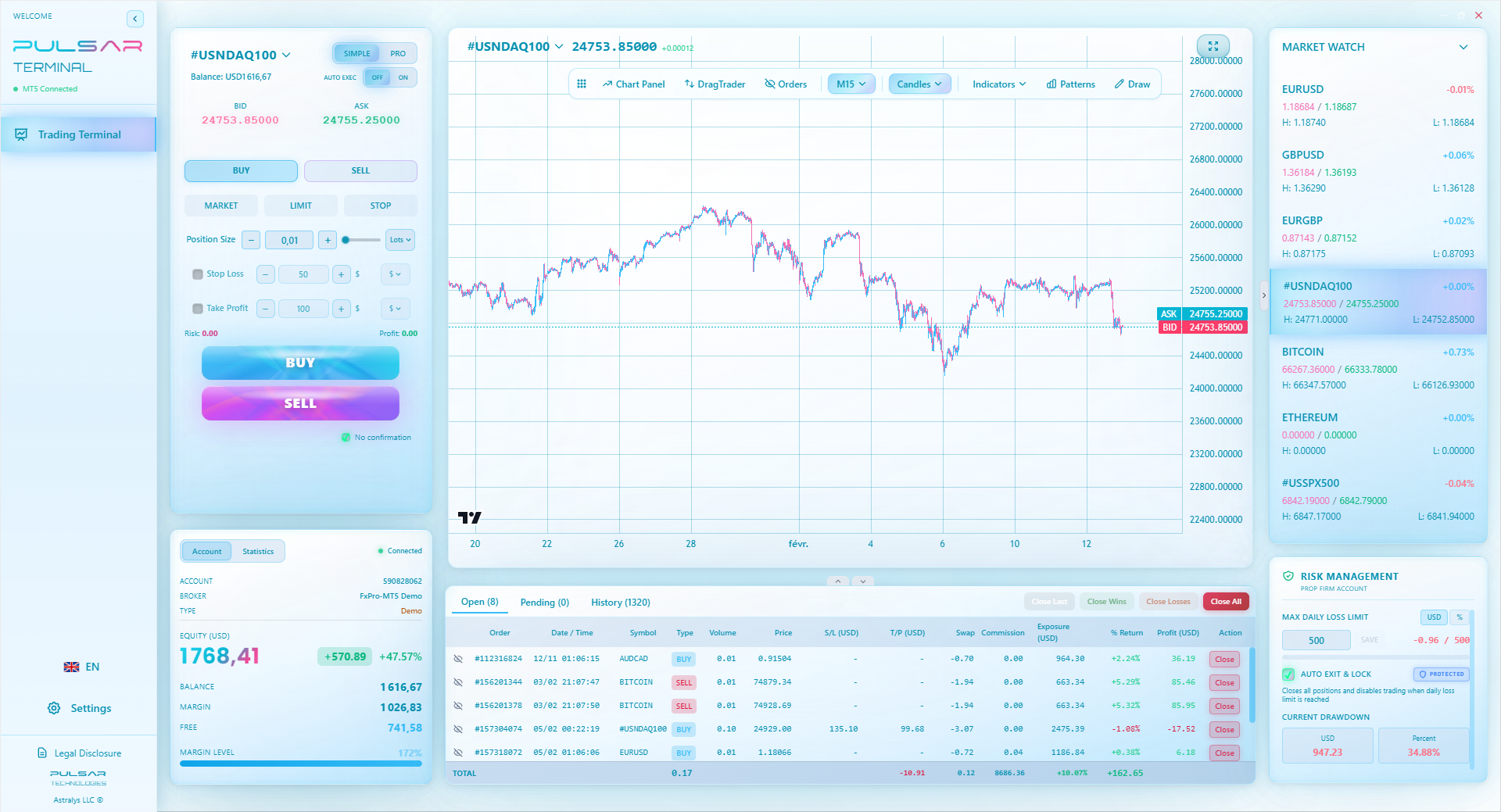
Managing multiple trades and stops around volatile news events is stressful, which is why tools like Pulsar Terminal allow you to set multi-level take-profits and stop-losses with partial closures directly on your MT5 charts, automating your exit plan before the news hits.
Pulsar Terminal
MT5 올인원 도구: 드래그앤드롭 주문, 다중 TP/SL, 트레일링 스톱, 그리드 트레이딩, 볼륨 프로파일, 프롭펌 보호. 매일 1,000명 이상의 트레이더가 사용.
You don't need to pay for this. The best tools are free.
-
ForexFactory.com: The old reliable. It's ugly, but it works. Set your time zone to GMT+2 (Johannesburg) and filter for 'High' impact events. The great feature is the historical charts showing how price moved during past events.
-
Investing.com Calendar: Cleaner interface. You can filter by country (select South Africa) and by impact. Very user-friendly for mobile checking.
-
Your Broker's Calendar: Brokers like Exness, IC Markets, and Pepperstone have built-in calendars in their client areas. The advantage is they're often tailored to the instruments they offer.
My Daily Setup:
- Every morning, I open ForexFactory in a browser tab. It stays open all day.
- I highlight any High-impact events for the next 24 hours, especially those between 2:00 PM and 6:00 PM SAST (when US data drops).
- I make a rule: no new trades opening 15 minutes before a High-impact event on any currency in my pair.
- I adjust any existing stops to breakeven if the trade is in profit, or I accept that the event might take me out.
This 5-minute routine has saved me more money than any fancy indicator ever could.

“Respecting the calendar transforms you from a gambler reacting to price to a strategist anticipating environments.”
The forex trading calendar isn't a separate tool. It's the first page of your trading plan for the day. Here’s how to stitch it in.
For the Analyst: Before you draw a single trendline or look at the MACD indicator, check the calendar. Is there an event that could invalidate your technical setup in the next 4 hours? If yes, your analysis is provisional at best.
For the Risk Manager: This is where it's crucial. Your position size for a day with an FOMC meeting should be smaller than for a calm Tuesday with no news. Volatility is a measure of risk. Higher scheduled volatility means you should mechanically reduce your exposure. Don't let greed override this.
For the Prop Firm Trader: If you're trying to pass a challenge with a firm like FTMO or The5%ers, news events are your biggest threat. One bad NFP can blow your daily loss limit. You need a strict rule: flat positions before major High-impact events. It's boring, but it's how you survive. Discipline here is everything.
, respecting the calendar transforms you from a gambler reacting to price to a strategist anticipating environments. It won't make you win every trade, but it will stop you from losing trades you never should have been in.
FAQ
Q1What time zone should I set my economic calendar to?
Always set it to your local time zone (GMT+2 for South Africa). This eliminates mental conversion errors. A US event at 14:30 SAST is far easier to plan for than trying to remember it's at 12:30 GMT.
Q2Should I close all my trades before major news?
Not necessarily all, but you must manage them. For profitable trades, consider moving your stop to breakeven. For trades at a loss or trades that are highly sensitive to the event (like a USD/ZAR trade before US CPI), yes, closing is the safest play. Protecting capital is a win.
Q3Why does the market sometimes move opposite to what the data suggests?
This is usually due to 'buy the rumour, sell the fact' or vice versa. The market often prices in expectations before the release. If the actual data is just 'as expected,' there's no new information to drive the move further, so traders take profits, causing a reversal. The initial headline number also doesn't capture revisions or underlying details.
Q4Is it better to trade during high-impact news or avoid it?
For most retail traders, especially beginners, avoiding it is the smarter long-term strategy. The volatility is extreme, spreads widen, and emotions run high. Focus on trading the quieter periods where technical analysis and your scalping strategy or swing strategy have a cleaner environment to work.
Q5Which economic indicator is most important for the South African Rand?
The SARB Interest Rate Decision is number one. It directly influences capital flows into South Africa. After that, South African CPI (inflation) is critical as it dictates the SARB's future actions. Globally, US Federal Reserve policy and the US Dollar's strength are the dominant external forces on ZAR.
Q6Can I use the economic calendar for trading gold (XAU/USD)?
Absolutely. Gold is heavily influenced by US real interest rates (which are driven by Fed policy and inflation data) and the US Dollar. High-impact US events like CPI, FOMC, and NFP will move gold significantly. Check our XAU/USD guide for more specifics on trading gold around news.
윈스턴 교수의 수업
핵심 요약:
- ✓Filter calendars to HIGH impact only; ignore the noise.
- ✓Always account for spread widening before major news.
- ✓The 'whisper number' & market positioning beat the official forecast.
- ✓Reduce position size on high-volatility news days.
- ✓For ZAR, SARB decisions & US Fed events are non-negotiable.
이 기사가 얼마나 유용했나요?
별을 클릭하여 평가
주간 트레이딩 인사이트
무료 주간 분석 & 전략. 스팸 없음.
저자 소개
David van der Merwe
신흥시장 트레이더
요하네스버그 기반 트레이더로 신흥시장 통화 11년 경력. ZAR 통화쌍, FSCA 규제 거래, 남아공 시장 분석 전문.
댓글
위험 고지
금융 상품 거래에는 상당한 위험이 수반되며 모든 투자자에게 적합하지 않을 수 있습니다. 과거 성과가 미래 수익을 보장하지 않습니다. 이 콘텐츠는 교육 목적으로만 제공되며 투자 조언으로 간주되어서는 안 됩니다. 거래 전에 항상 직접 조사를 수행하십시오.
이 기사도 읽어보세요

Cara Trading Forex Sukses: 7 Prinsip dari Trader Profesional
Cara trading forex sukses dengan 7 prinsip trader pro: manajemen modal, disiplin, journal trading, backtest. Data nyata, bukan janji profit palsu.
Jam Trading Forex Terbaik untuk Trader Indonesia: Panduan Lengkap dengan Tabel Waktu
Panduan jam trading forex untuk trader Indonesia. Tabel 4 sesi dunia, jam emas 20:00-00:00, sesi mana yang harus dihindari. Data akurat + tips dari trader berpengalaman.
Top 5 Sàn Forex Uy Tín Nhất 2026: Review Jujur dari Trader Indonesia
Top 5 sàn forex uy tín 2026 untuk trader Indonesia. Review jujur: spread, deposit, withdraw, dukungan lokal. Exness, XM, IC Markets & lebih.
