


I remember staring at my screen in late 2023, watching USD/INR tick up while my offshore EUR/USD position bled red.

Rajesh Sharma
수석 외환 애널리스트 ·  India
India
☕ 11 분 소요
배울 내용:

I remember staring at my screen in late 2023, watching USD/INR tick up while my offshore EUR/USD position bled red. The RBI had just issued another warning list, and a cold knot formed in my stomach. Was I about to get my bank account frozen? That moment forced me to stop guessing and finally understand the real, non-negotiable rules for forex trading in India. The truth isn't simple, but it's clear. Let's cut through the noise.
Let's settle this first. The question 'forex trading in India legal or illegal' has a definitive, two-part answer.
Forex trading is legal in India, but only under very specific, tightly controlled conditions set by the Reserve Bank of India (RBI) and the Securities and Exchange Board of India (SEBI). Step outside those conditions, and it becomes illegal. Full stop.
The core law is the Foreign Exchange Management Act (FEMA) of 1999. Think of FEMA as the rulebook, and the RBI as the strict referee who doesn't tolerate fouls.
Here’s what’s explicitly LEGAL:
- Trading currency derivatives (futures and options) on recognized Indian exchanges like the NSE, BSE, or MCX-SX.
- Trading only currency pairs where the Indian Rupee (INR) is one side. Your universe is: USD/INR, EUR/INR, GBP/INR, JPY/INR.
- Doing this through a SEBI-regulated Indian broker like Zerodha, ICICI Direct, or Angel One.
Here’s what’s explicitly ILLEGAL:
- Trading major pairs like EUR/USD, GBP/USD, or AUD/JPY from India.
- Opening an account with an offshore broker (like Exness, IC Markets, or XM) to trade those pairs, even if they happily accept your Indian passport and address proof.
- Using the Liberalised Remittance Scheme (LRS) – that $250,000 annual limit – to fund speculative forex trading abroad. The RBI says no. Using it for that purpose violates FEMA.

Warning: Just because an international broker's website has a Hindi translation and accepts UPI deposits doesn't make it legal for you as an Indian resident. Many appear on the RBI's official 'Alert List' of unauthorized entities. Getting profits out later can become a major headache, or worse.
I learned this the semi-hard way. Early on, I funded an offshore account with a small $200 via Skrill. I made a few hundred dollars scalping EUR/USD. Withdrawing it back to my Indian bank account triggered questions. Nothing catastrophic happened, but the anxiety wasn't worth the profit. I was lucky. Others have had accounts frozen during investigations.
The intent of these rules isn't to punish you. It's to control capital flight and protect the rupee's stability. As a trader, you need to respect that boundary, or you're not trading, you're gambling with legal risk.

💡 윈스턴의 팁
The market's first lesson is often about rules, not charts. In India, the most important support and resistance levels are written by the RBI. Trade outside them, and your account will break.


“The question 'forex trading in India legal or illegal' has a definitive answer. Legal on Indian exchanges with INR pairs. Illegal offshore with major pairs.”
So, if you can only trade INR pairs, is it even worth it? Absolutely. The USD/INR futures contract on the NSE is one of the most liquid derivatives contracts in the country. There's plenty of movement and opportunity.
Setting Up Your Legal Trading Account
First, you need an account with a SEBI-registered broker that offers currency derivatives. The process is straightforward:
- Choose a broker (Zerodha, Upstox, 5paisa, etc.).
- Complete the KYC: PAN card, Aadhaar, bank details, income proof.
- Sign the agreements and activate the currency segment on your demat/trading account.
- Fund your account via Net Banking, UPI, or bank transfer.
You're not trading a 'forex spot' market. You're trading standardized futures contracts. For example, a USD/INR futures contract has a fixed lot size (usually $1000 worth) and expires on a specific date each month. This structure actually simplifies things for beginners.
The Trading Reality: Costs and use
Forget the 1:500 use you see advertised offshore. The RBI caps use for authorized dealers at a conservative 1:10. On a $1000 contract, you might need around ₹8,000-10,000 in margin. This low use is a blessing in disguise. It forces proper position size calculator use and prevents the instant blow-ups so common with high use.
You'll pay brokerage fees (often a flat ₹20 per order), exchange charges, and GST. The spread is effectively baked into the futures price. It's a different cost structure than the spread+commission model of international brokers.
My first legal trade was a USD/INR short in April 2024. I sold one contract at 83.42, expecting RBI intervention to strengthen the rupee. I used a simple RSI indicator divergence on the hourly chart. I placed a tight stop at 83.55, risking about ₹1,300. The pair dipped to 83.15 over two days, and I exited at 83.20 for a 22-pip gain. That's ₹220 ($2.65) after fees. Not glamorous, but it was clean, legal, and the profit hit my bank account the next day with zero worry.
This is the environment for swing trading and longer-term positional plays on the rupee. For rapid-fire scalping strategy, the liquidity is deep enough during market hours (9 AM to 5 PM IST).
“Forget 1:500 use. The RBI's 1:10 cap is a blessing that prevents the instant blow-ups so common elsewhere.”
I get it. The legal market feels limited. Your YouTube feed is full of traders analyzing Gold (XAU/USD) and the Euro. The allure of offshore brokers is strong. They offer every pair, use up to 1:1000, bonuses, and slick platforms like MT5. I was tempted too.
But you have to understand what you're really signing up for.
The Regulatory Void: When you trade with an offshore broker as an Indian resident, you are outside the protection of SEBI and Indian courts. If the broker faces issues (like CySEC's recent crackdowns) or simply decides to withhold your withdrawal, your recourse is limited to complaining to a financial regulator in Cyprus, the Seychelles, or Vanuatu. Good luck.
The Banking Blockade: This is the biggest practical risk. The RBI directs banks to monitor transactions for unauthorized forex trading. If they see repeated international transfers to a known brokerage firm, they can block the transaction, freeze your account for investigation, or even report it. Getting your profits back into India can be labeled as 'unauthorized foreign exchange receipt,' which is a compliance nightmare.
The Tax Trap: Say you do manage to make a profit and get it back. How do you show it? You can't declare it as income from a SEBI-regulated activity. You'd have to creatively (and riskily) mask it, opening yourself up to severe penalties from the Income Tax department.

Pro Tip: If you're determined to explore global markets, look into the GIFT City exception. The RBI now allows using the LRS to invest in securities through IFSC-registered brokers in GIFT City. It's a nascent but legal channel. It's not for spot forex, but for equities and other instruments. It shows where the legal window is cracking open.
I have a friend who ignored this. He funded an account with a popular offshore broker reviewed on sites like Exness review or IC Markets review. He made $5,000 trading NASDAQ CFDs. When he tried to withdraw $3,000, his bank flagged it, asked for a source of funds, and refused the credit. He's been stuck in paperwork for months. The profit is just a number on a screen.
💡 윈스턴의 팁
A 22-pip gain on a legal trade you can sleep peacefully about is worth infinitely more than a 200-pip gain that comes with a knot of anxiety about your bank account. Peace of mind is a trader's most valuable asset.

“Your offshore trading profit is just a number on a screen until it's in your Indian bank account. That's when the real challenge begins.”
This is where many new traders get a brutal awakening. The taxman always gets his share, and forex trading income is no exception. Whether you trade legally on the NSE or illegally offshore (if you can get the money home), you owe tax.
For legal trading on Indian exchanges, your profits are treated as either Business Income or Capital Gains.
- Business Income: If you trade frequently, with significant volume, it's considered a business. Profits are added to your total income and taxed at your slab rate (up to 30% + cess). The good news? You can deduct expenses: brokerage fees, data subscriptions, internet bills, even a portion of your home rent/loan if you have a dedicated home office.
- Capital Gains: If trades are less frequent, they may be considered speculative short-term capital gains (held less than 36 months for these contracts). These are also added to your income and taxed at your slab rate.
Key Numbers You Must Know:
- Advance Tax: If your total tax liability for the year is likely to exceed ₹10,000, you must pay advance tax in installments (June 15, Sept 15, Dec 15, March 15). Missing this leads to interest penalties.
- Tax Audit: If your trading turnover exceeds ₹10 crore in a year, a tax audit by a Chartered Accountant is mandatory. For most retail traders, this isn't a concern, but it's the law.
For illegal offshore trading profits, the tax problem is even messier. You can't openly declare the income as 'forex trading from an unregulated broker.' People often try to label it as 'gifts' or 'consultancy,' which is risky if scrutinized.
📊 Example: Let's say you make a profit of ₹2,00,000 from legal USD/INR trading in a year. You're in the 30% tax slab. You'd owe ~₹60,000 in tax, minus any deductible expenses. You need to have set aside that ₹60,000 from your profits. If you didn't, you're digging into your capital.
My biggest early mistake was not tracking trades for tax purposes. Come March, I had a spreadsheet nightmare. Now, I use a simple journal: Date, Instrument, Buy/Sell Price, Quantity, P&L. My CA uses it to file my ITR. It's non-negotiable.
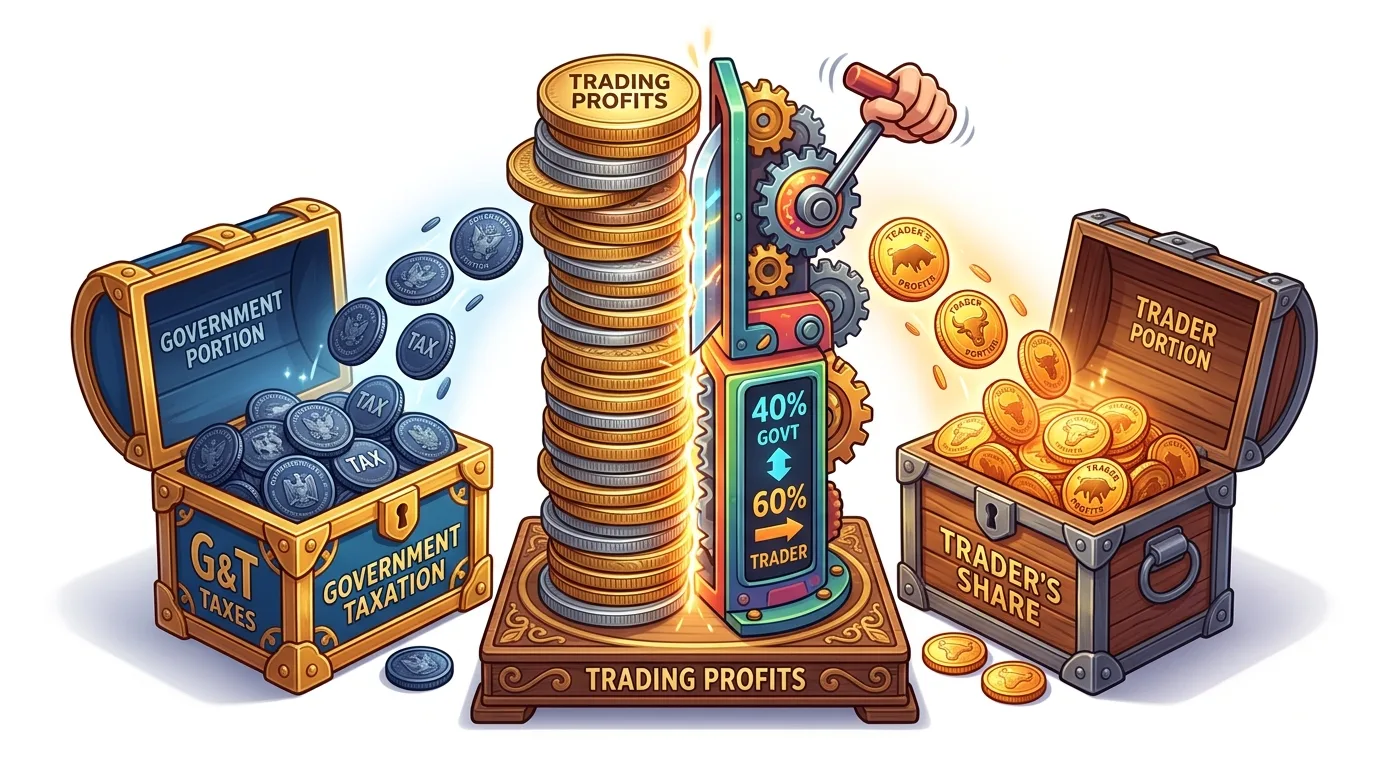
“Your offshore trading profit is just a number on a screen until it's in your Indian bank account. That's when the real challenge begins.”
Given the constraints, how do you build a real trading journey in India?
Step 1: Start Legally, Master the Basics. Open that demat account with a discount broker. Trade just one USD/INR futures contract. Your goal isn't to get rich. Your goal is to learn the mechanics: how orders fill, how margin works, how emotions feel with real money on a legal platform. Practice risk management with the 1:10 use. Use this time to study MACD indicator or other tools on the INR charts. Understand what moves the rupee: RBI policy, oil prices, foreign flows.
Step 2: Develop an Edge in Your Limited Pond. The USD/INR isn't random. It has patterns influenced by local and global flows. Can you identify times of day with highest volatility (usually around 9 AM and when London opens)? Can you trade based on RBI intervention levels? This is where your research matters. The pool is smaller, so your edge needs to be sharper.
Step 3: Consider the GIFT City Route for Global Diversion. If you have capital and want regulated access to global stocks or commodities, explore brokers in GIFT City. It's the government's own financial hub. This is the safest way to legally participate in markets beyond INR pairs, though offerings are still expanding.
Step 4: Never Stop the Paper Trade. Your craving to trade EUR/USD? Satisfy it with a demo account. Run a simulated portfolio on an offshore platform. Test your strategies there. If you can consistently make paper profits for 6-12 months, you've developed a skill. That skill might be portable if regulations ever change, or if you relocate. But you've taken on zero legal risk.
I keep two journals: one for my real NSE trades, and one for my 'paper prop firm challenge' on a simulated MT5 account trading Gold and the Dow. It keeps my skills sharp without crossing the line.
, trading in India is about playing the long game with integrity. The rules are strict to protect the economy and, ironically, to protect you from yourself. The traders who last are those who see the boundary not as a cage, but as the defined edges of their playing field.
💡 윈스턴의 팁
Your trading journal should have two columns most forget: 'Tax Liability' and 'Regulatory Status'. If you can't fill them clearly, you're not managing risk, you're hiding from it.

When trading USD/INR futures, managing multiple take-profit levels and moving stops to breakeven is key, and Pulsar Terminal automates these advanced order types directly on your MT5 platform.
Pulsar Terminal
MT5 올인원 도구: 드래그앤드롭 주문, 다중 TP/SL, 트레일링 스톱, 그리드 트레이딩, 볼륨 프로파일, 프롭펌 보호. 매일 1,000명 이상의 트레이더가 사용.

“Trading in India is about playing the long game with integrity. See the rules not as a cage, but as the defined edges of your playing field.”
Is forex trading taxable in India?
Yes, 100%. Profits from legal trading are taxable as business income or capital gains. You must file it in your ITR. Ignorance is not an excuse with the tax department.
Can I use Forex.com, OctaFX, or XM in India?
They may accept you as a client, but it is not legal for you as an Indian resident to trade forex pairs (like EUR/USD) with them. Using them violates FEMA rules. Funding these accounts can lead to banking issues.
What is the minimum deposit to start legal forex trading in India?
With Indian brokers, you can start with a few thousand rupees. The margin for one USD/INR futures contract might be around ₹8,000-10,000. So, a ₹15,000 - ₹20,000 account is a realistic starting point to trade one contract with a sensible stop-loss.
Is trading in currency futures on NSE safe?
Yes, it's one of the safest ways. Your funds are with a SEBI-regulated broker, client money is segregated, and the exchange itself guarantees the trade. You're protected by Indian law.
What happens if I get caught trading with an offshore broker?
Potential consequences include: your bank account being frozen for investigation, penalties from the RBI for FEMA violation, tax evasion charges from the IT department, and difficulty in future international banking. It's a serious compliance breach.
Can I trade cryptocurrencies instead?
Crypto trading operates in its own regulatory grey area. It's not banned, but it's also not a regulated financial product like currency futures. Banks may still block transactions to crypto exchanges. It's a different set of risks altogether.
FAQ
Q1Is forex trading taxable in India?
Absolutely. Profits from legal forex trading (on Indian exchanges) are fully taxable. They are treated as either 'Business Income' or 'Speculative Short-Term Capital Gains' and must be added to your total annual income, taxed at your applicable slab rate. You must file this in your Income Tax Return (ITR).
Q2Can I use international brokers like Forex.com or XM if I'm in India?
Technically, they might open your account. However, it is illegal under FEMA for an Indian resident to trade foreign currency pairs (like EUR/USD) through these offshore platforms. Using them puts you at risk of banking blocks, frozen accounts, and legal penalties. They are not regulated by SEBI for this activity in India.
Q3What's the minimum amount needed to start trading legally?
You can start with a relatively small amount. For example, to trade one standard USD/INR futures contract on the NSE, you might need approximately ₹8,000 to ₹10,000 as margin with a reputable broker. A starting capital of ₹20,000-₹30,000 allows for sensible position size calculator use and risk management on a single contract.
Q4Is trading currency futures on the NSE safe?
Yes, it is the safest and only fully regulated way to trade forex in India. Your funds are with a SEBI-regulated broker who must keep client money segregated. The trade itself is executed and cleared through the National Stock Exchange, which provides a high level of security and transparency.
Q5What are the real risks of using an offshore broker?
The risks are significant: 1) Your bank may block deposits/withdrawals and freeze your account for investigation. 2) You have no legal recourse under Indian law if the broker has issues. 3) Bringing profits back to India can be flagged as unauthorized foreign income, leading to tax and FEMA violation penalties. 4) You could face a margin call or worse with the extreme use they offer.
Q6Can I trade Gold or global indices legally from India?
For spot Gold (XAU/USD) or global index CFDs, the direct offshore route is illegal. However, you can legally trade Gold and Silver futures contracts on Indian commodity exchanges (MCX). For global equities, the new, legal avenue is to use the Liberalised Remittance Scheme (LRS) to invest through SEBI-regulated brokers in GIFT City (IFSC).
윈스턴 교수의 수업
핵심 요약:
- ✓Only trade INR pairs (USD/INR, EUR/INR) on SEBI-regulated exchanges.
- ✓Offshore brokers for EUR/USD are illegal under FEMA, full stop.
- ✓RBI caps use at 1:10. Use it to build discipline.
- ✓Always calculate tax liability on profits immediately. Set 30% aside.
- ✓GIFT City is the only legal window for regulated global access.
이 기사가 얼마나 유용했나요?
별을 클릭하여 평가
주간 트레이딩 인사이트
무료 주간 분석 & 전략. 스팸 없음.
저자 소개
Rajesh Sharma
수석 외환 애널리스트
인도 및 남아시아 시장에서 10년 이상의 트레이딩 경력. NSE 통화 파생상품으로 시작해 국제 외환시장으로 전향. USD/INR 및 신흥시장 통화쌍 전문.
댓글
위험 고지
금융 상품 거래에는 상당한 위험이 수반되며 모든 투자자에게 적합하지 않을 수 있습니다. 과거 성과가 미래 수익을 보장하지 않습니다. 이 콘텐츠는 교육 목적으로만 제공되며 투자 조언으로 간주되어서는 안 됩니다. 거래 전에 항상 직접 조사를 수행하십시오.
이 기사도 읽어보세요

Cara Trading Forex Sukses: 7 Prinsip dari Trader Profesional
Cara trading forex sukses dengan 7 prinsip trader pro: manajemen modal, disiplin, journal trading, backtest. Data nyata, bukan janji profit palsu.
Jam Trading Forex Terbaik untuk Trader Indonesia: Panduan Lengkap dengan Tabel Waktu
Panduan jam trading forex untuk trader Indonesia. Tabel 4 sesi dunia, jam emas 20:00-00:00, sesi mana yang harus dihindari. Data akurat + tips dari trader berpengalaman.
Top 5 Sàn Forex Uy Tín Nhất 2026: Review Jujur dari Trader Indonesia
Top 5 sàn forex uy tín 2026 untuk trader Indonesia. Review jujur: spread, deposit, withdraw, dukungan lokal. Exness, XM, IC Markets & lebih.
