


Every other WhatsApp group in Lagos and Nairobi is buzzing with 'forex signals' and screenshots of Lamborghinis supposedly bought with trading profits.

Olumide Adeyemi
서아프리카 트레이딩 선구자 ·  Nigeria
☕ 10 분 소요
배울 내용:
Every other WhatsApp group in Lagos and Nairobi is buzzing with 'forex signals' and screenshots of Lamborghinis supposedly bought with trading profits. Let's cut through the noise. The unspoken truth about forex trading in Kenya, and frankly anywhere, is that it's designed for you to lose. Not because of some conspiracy, but because of psychology, poor risk management, and a fundamental misunderstanding of the game. I've blown up accounts. I've seen friends lose millions of Naira. This guide isn't about getting rich quick; it's about understanding the battlefield so you don't get slaughtered in your first week.
This is the first point of confusion. Forex trading in Kenya is legal for individuals using their own capital. The primary watchdog is the Capital Markets Authority (CMA) of Kenya. They regulate brokers operating within Kenya, like the local operations of some international firms.
However, here's where it gets tricky for a Nigerian trader looking at the Kenyan market. Most Kenyan retail traders don't just trade the Kenyan Shilling (KES). They're on global pairs like EUR/USD and GBP/USD, using international brokers regulated offshore (in Cyprus, the UK, South Africa, etc.). The CMA's reach is limited to entities physically present and licensed in Kenya.
As a Nigerian, you can absolutely sign up with a broker that accepts Kenyan clients, but you're primarily under that broker's home regulation, not Kenyan law. Your tax obligations, however, remain in Nigeria. Profits are technically subject to Capital Gains Tax. The Central Bank of Nigeria (CBN) doesn't ban you from trading, but they control how you move money. Funding an international broker account from Nigeria is its own adventure, often involving domiciliary accounts or e-wallets like Skrill because of restrictions on Naira cards.

Warning: If a 'Kenyan' broker promises you insane use like 1:1000 and guaranteed returns, run. The CMA caps use for retail clients much lower than some offshore jurisdictions. High use is a one-way ticket to a margin call.
The real safety isn't in a 'Kenyan' license, but in choosing a broker with strong, Tier-1 global regulation. Many brokers popular in Kenya, like Pepperstone or IC Markets, hold Australian (ASIC) or European (CySEC) licenses, which offer better client protection.

💡 윈스턴의 팁
Your first profit target should always be your initial stop-loss level. Getting to breakeven turns off the risk. Everything after that is pure opportunity.
“The unspoken truth about forex trading is that it's designed for you to lose. Not because of some conspiracy, but because of psychology.”
Brokers advertise 'tight spreads' and 'zero commissions' to get you in the door. That's the marketing. The real cost of forex trading in Kenya is a silent killer of accounts.
The Obvious Costs: Spreads & Commissions
Yes, you pay the spread - the difference between the buy and sell price. On a major pair like EUR/USD, a good raw spread account might charge 0.1 pips plus a $3.50 commission per lot. On a standard account, the spread might be 1.2 pips with no commission. You need to know what a pip is worth for your trade size to calculate this properly.
The Hidden Killer: Swap Rates
This is where many new traders get ambushed. If you hold a position overnight, you pay or receive a swap fee (also called a rollover). This is an interest rate differential. For some pairs, like going long on USD/TRY, the negative swap can be enormous - it can literally cost you more per night than your potential profit. I once held a AUD/JPY trade for two weeks, convinced I was right on the direction. I made 45 pips, but the swap fees ate 38 of them. A win that felt like a loss.
The Psychological Cost
This is the big one. The cost of a bad trade isn't just the money lost. It's the revenge trading that follows, the missed sleep, the doubt that creeps in. You can't put a number on it, but it's the most expensive cost of all.

Example: Let's say you trade one standard lot (100,000 units) of EUR/USD. A 1.2 pip spread costs you $12 the moment you enter. Hold it for three nights with a -$5 daily swap? That's another $15. You're down $27 before the market even moves in your favor. This is why scalping strategies that aim for 5-10 pips are so difficult to pull off profitably - the costs eat your edge.
“A win that feels like a loss is often the result of hidden costs eating your profits overnight.”
The global failure rate is high, but in emerging markets like Kenya and Nigeria, specific local factors make it worse.
1. The 'Side Hustle' Mentality: People approach forex as a quick side gig, not a professional skill requiring 1,000+ hours of study. They trade between meetings or at night, exhausted, with no real edge.
2. Signal Service Dependency: There's a massive culture of buying signals from 'gurus.' I tried this early on. Paid 50,000 KES for a monthly signal service. The first week, they hit 3 wins in a row. I got excited and increased my lot size. The fourth signal was a loser that wiped out all the gains and more. The guru disappeared from the Telegram group. You are outsourcing your brain, and when it goes wrong, you have no plan.
3. Inadequate Capital: Trading with $100 (about 13,000 KES) and using 1:500 use means the smallest market wobble obliterates you. You're forced to be a perfectionist, which creates panic. Proper position sizing is non-negotiable, but with tiny accounts, it feels impossible.
4. Trading the Naira/Kenyan Shilling Volatility: Some try to trade exotic pairs like USD/NGN or USD/KES. The spreads are huge (sometimes 50+ pips), and the moves can be driven by central bank announcements you have no insight into. It's not trading; it's gambling on political news.
My own failure story? In 2019, I had a classic blow-up. I turned $2,000 into $5,000 in two months trading gold (XAU/USD). Got cocky. Put on a massive position without a stop loss, convinced the Fed would hint at dovish policy. They didn't. I watched the price drop $30 in an hour, frozen, refusing to accept I was wrong. Account balance: $87. That was the tuition fee for my most important lesson: your ego is your worst enemy.
“A win that feels like a loss is often the result of hidden costs eating your profits overnight.”
Forget the Lamborghini. Aim for consistent, small gains that compound. Here’s a boring, effective framework.
1. Start with a Demo, But Not Forever: Demo trade for 3-6 months until you have a written, tested strategy. But know that demo trading doesn't simulate slippage or the gut-churn of real money. Move to a tiny live account ($100-200) as soon as you're consistently profitable on demo for a month.
2. The 1% Rule is Gospel: Never, ever risk more than 1% of your account on a single trade. If you have a $1,000 account, your maximum loss per trade is $10. This means your stop loss distance and position size are calculated together. A position size calculator is your most important tool.
3. Choose Your Weapons Wisely: Don't use 10 indicators. Pick two or three. I use a simple structure: Price action + RSI for divergence + a moving average for trend context. That's it. More tools just create more confusion.
4. Have a Written Trading Plan: This is your business plan. It must answer: What pairs do I trade? What time of day? What are my entry criteria? Where is my stop loss? Where is my take profit? What is my daily loss limit (I use 3%)? If you don't have it written, you don't have a plan.
5. Journal Every Trade: Not just "bought EUR/USD, won." Log: Entry price, stop loss, take profit, lot size, reason for entry (e.g., "bullish engulfing at daily support"), emotional state. Review weekly. This is how you find your personal flaws.
💡 윈스턴의 팁
If you feel the urge to double your position size after a loss, close the platform. Go for a walk. That feeling is the number one cause of account implosions.
“The goal for your first year shouldn't be profitability. It should be survival.”
This is the practical stuff that can trip you up.
Brokers Accepting Kenyan Clients: You'll see a mix. Some international brokers have a strong local presence. Look for regulation (ASIC, FCA, CySEC are top-tier), low and transparent costs, and a platform that suits you. Exness and XM are widely used in Africa for their accessibility. Pepperstone is renowned for its raw spreads and excellent execution.
Trading Platforms: MetaTrader 4 (MT4) is the king in Kenya. MT5 is gaining ground. They're reliable, have heaps of indicators, and support Expert Advisors (EAs) for automation. Most brokers offer them.
Payment Methods in Kenya: This is easier than in Nigeria sometimes. Common options include:
- M-Pesa: The giant. Direct deposits and withdrawals to/from many brokers. Fast and convenient.
- Bank Wire Transfer: Reliable but can be slower (1-3 days) and have higher fees.
- Credit/Debit Cards: Visa/Mastercard deposits are usually instant.
- E-wallets: Skrill, Neteller, and even cryptocurrency are options.
Always check the broker's specific deposit/withdrawal page for fees and processing times. A good test is to make a small withdrawal first to see how smooth the process is before you commit larger capital.
“The goal for your first year shouldn't be profitability. It should be survival.”
Once you've mastered the 1% rule, level up. This is what separates the survivors from the occasional winners.
Correlation Risk: Don't think you're diversified if you're long EUR/USD, long GBP/USD, and short USD/CHF. These pairs are highly correlated. You've put on one huge trade. A dollar surge will hit all three. Know your correlations.
Using a Trailing Stop: This locks in profits as a trade moves in your favor. It's emotionally hard to do manually because you're constantly moving your stop. In 2021, I caught a great swing trade on USD/CAD that ran for 220 pips. I used a manual 50-pip trailing stop from the peak. I left 70 pips on the table, but I banked 150 pips cleanly. The alternative - trying to pick the top - usually ends with you giving back most of the profit.
The Breakeven Stop: Once a trade is in profit by a certain amount (e.g., 1.5x your initial risk), move your stop loss to your entry price. This turns a risky trade into a risk-free one. Your worst-case scenario is now a scratch, not a loss.
Event Risk: Don't hold positions through major news events (Non-Farm Payrolls, CPI releases, central bank decisions) unless that's your specific strategy. The spreads widen, and price can gap right through your stop loss. I learned this the hard way losing on a GBP trade during a Brexit headline gap.
💡 윈스턴의 팁
Track your win *rate* less, and your risk-to-reward *ratio* more. You can be right only 40% of the time and still be profitable if your average win is three times your average loss.
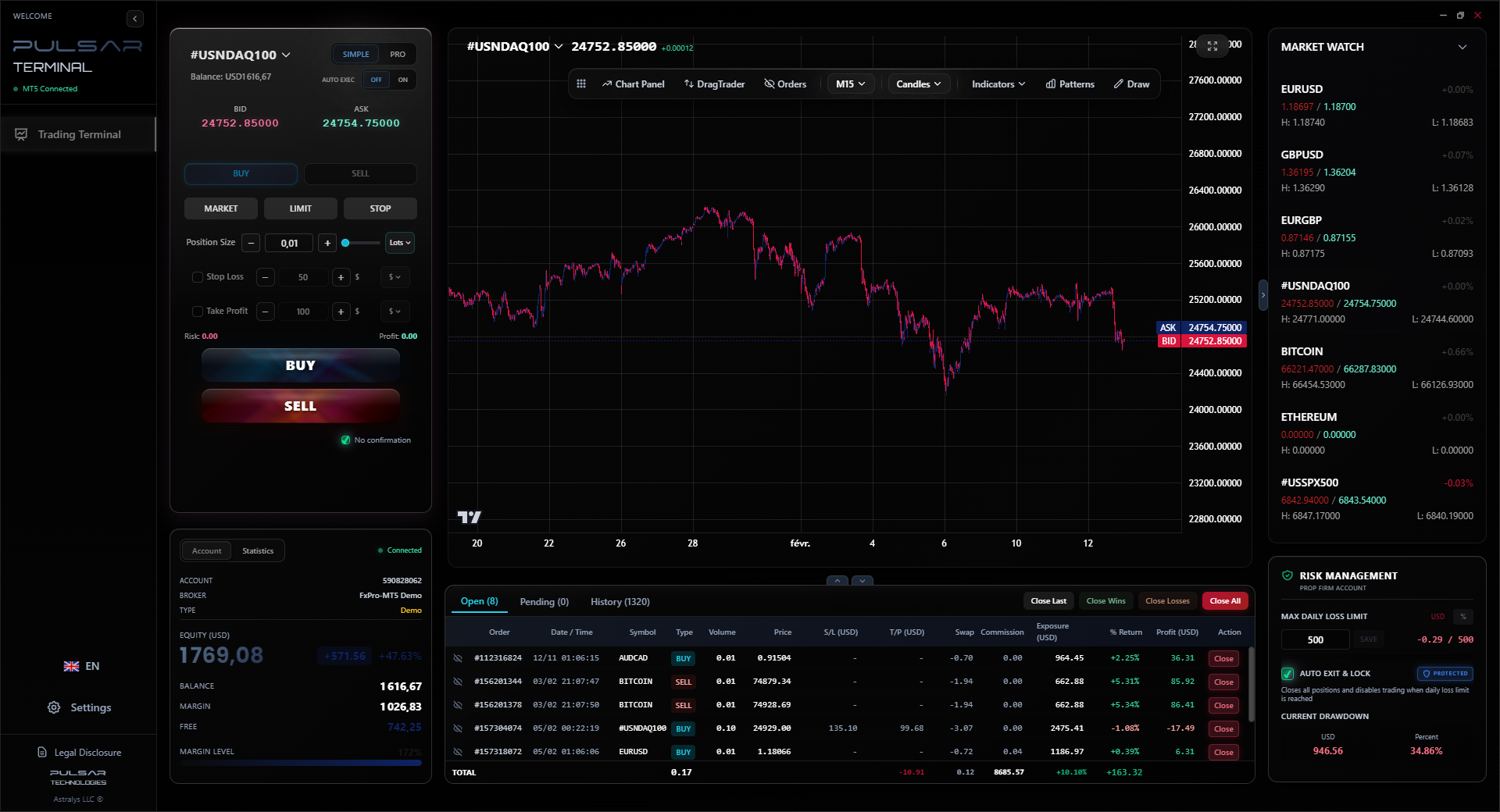
Manually managing advanced stops and partial closures is stressful and error-prone, which is why professional tools that automate these tasks directly on your MT5 chart are essential for strict risk management.
Pulsar Terminal
MT5 올인원 도구: 드래그앤드롭 주문, 다중 TP/SL, 트레일링 스톱, 그리드 트레이딩, 볼륨 프로파일, 프롭펌 보호. 매일 1,000명 이상의 트레이더가 사용.
“Your ego is your worst enemy in trading. The market doesn't care about your opinion.”
Let's kill some fairy tales.
Myth 1: "You need a huge account to start." False. You need a huge account to live off trading. You can start learning with a small account. The key is scaling your risk appropriately. A $100 account risking 1% per trade is a perfect training ground.
Myth 2: "Indicators will tell you the future." No. The MACD, RSI, Stochastic - they are all lagging. They tell you what has happened. Price action is king. Indicators are just filters for your price action analysis.
Myth 3: "More trades = more chances to win." This is the fast track to blowing up. Professional traders often wait days for one high-probability setup. Forcing trades in a quiet market just racks up costs and emotional fatigue.
Myth 4: "Forex trading in Kenya is a scam." The market itself isn't a scam. It's a legitimate, decentralized global market. The environment around it in some circles is flooded with scammers: fake gurus, Ponzi scheme 'fund managers', and unregulated bucket shops. The tool isn't broken; many of the people selling it are.
The final reality? This is a skill, like surgery or playing the piano. It takes years of deliberate, painful practice. There are no shortcuts. The goal for your first year shouldn't be profitability. It should be survival. Keep your account intact, learn your lessons cheaply, and build your process. The money comes later, only if you respect the game more than you desire the prize.
FAQ
Q1Is forex trading taxable in Kenya?
Yes. The Kenya Revenue Authority (KRA) considers trading profits as taxable income. You are required to declare your earnings and pay the appropriate income tax. Keep detailed records of all your trades, deposits, and withdrawals.
Q2What is the best broker for beginners in Kenya?
There's no single 'best' broker. For a beginner, prioritize a broker with strong regulation, a user-friendly platform like MT4, low minimum deposits, and reliable customer support. Brokers like XM or Exness are popular starting points due to their accessibility, but always do your own due diligence.
Q3Can I trade forex with 5000 KES?
Technically, yes. Some brokers allow deposits that small. But practically, it's extremely difficult to trade successfully with such a small amount. Even risking 1% (50 KES) means your stop loss will be very tight, making you vulnerable to market noise. It's better to use that 5000 KES for education and save more capital before trading live.
Q4How much can I realistically make from forex trading?
A realistic, professional target for a consistently good trader is 10-20% return on account capital per year. Anyone promising you monthly returns of 50% or more is lying. Focus on the process of making good trades; the percentage returns will follow based on your risk parameters.
Q5What is the most traded currency pair in Kenya?
While the USD/KES pair is relevant locally, the vast majority of retail forex trading volume in Kenya is in major global pairs like EUR/USD, GBP/USD, and USD/JPY. These pairs have the tightest spreads and highest liquidity, making them more suitable for most retail strategies.
Q6Are forex trading courses worth it in Kenya?
Some are, most aren't. Be extremely wary of expensive courses that promise secret strategies. The core principles of trading (risk management, psychology, basic technical analysis) are available for free online. A good course should teach process and discipline, not a 'magic indicator.' Consider a course only after you've exhausted free, reputable resources.
윈스턴 교수의 수업
핵심 요약:
- ✓Risk a maximum of 1% of capital per trade.
- ✓Swap fees can turn winning trades into losers.
- ✓Demo trade for 3-6 months minimum.
- ✓Write down every trade in a journal.
- ✓Avoid trading during major news events.
이 기사가 얼마나 유용했나요?
별을 클릭하여 평가
주간 트레이딩 인사이트
무료 주간 분석 & 전략. 스팸 없음.
저자 소개
Olumide Adeyemi
서아프리카 트레이딩 선구자
나이지리아에서 가장 활발한 외환 트레이딩 교육자 중 한 명. 라고스에서 8년간 트레이딩 경험. 아프리카 트레이더를 위한 소자본 전략과 프롭 펌 챌린지 전문.
댓글
위험 고지
금융 상품 거래에는 상당한 위험이 수반되며 모든 투자자에게 적합하지 않을 수 있습니다. 과거 성과가 미래 수익을 보장하지 않습니다. 이 콘텐츠는 교육 목적으로만 제공되며 투자 조언으로 간주되어서는 안 됩니다. 거래 전에 항상 직접 조사를 수행하십시오.
이 기사도 읽어보세요

Cara Trading Forex Sukses: 7 Prinsip dari Trader Profesional
Cara trading forex sukses dengan 7 prinsip trader pro: manajemen modal, disiplin, journal trading, backtest. Data nyata, bukan janji profit palsu.
Jam Trading Forex Terbaik untuk Trader Indonesia: Panduan Lengkap dengan Tabel Waktu
Panduan jam trading forex untuk trader Indonesia. Tabel 4 sesi dunia, jam emas 20:00-00:00, sesi mana yang harus dihindari. Data akurat + tips dari trader berpengalaman.
Top 5 Sàn Forex Uy Tín Nhất 2026: Review Jujur dari Trader Indonesia
Top 5 sàn forex uy tín 2026 untuk trader Indonesia. Review jujur: spread, deposit, withdraw, dukungan lokal. Exness, XM, IC Markets & lebih.
