


I lost $1,200 in under an hour because I ignored the clock.
Sarah Collins
트레이딩 전략가 ·  Australia
☕ 9 분 소요
배울 내용:
- 1Why Market Hours Aren't Just a Schedule
- 2The Three Major Sessions (in Your Time Zone)
- 3The Overlap: Where the Real Money Moves
- 4The Dead Zones (And How to Survive Them)
- 5Trading AUD Pairs: The Home Field Advantage
- 6Practical, Session-Based Strategies
- 7Tools and Habits for Time-Aware Trading
- 8Putting It All Together: A Week in the Life

I lost $1,200 in under an hour because I ignored the clock. It was a Tuesday night around 11 PM Sydney time. I saw a nice setup on the AUD/USD, entered a 2-lot position, and then... nothing. The spread widened from 1.2 to over 5 pips. Price just sat there, churning. When it finally moved, it was a sharp, news-driven spike against me. I got stopped out before the real move even began. That trade taught me a brutal lesson: in forex, timing isn't just about entries and exits. It's about knowing when the market is actually awake and when it's just sleepwalking, ready to trip you up.
Most beginners think of the forex market as a 24/5 monolith. It's not. It's a relay race between three major financial centres: Asia (Tokyo, Sydney), Europe (London), and North America (New York). When one hands off to the next, everything changes: liquidity, volatility, and the character of the price action.
Think of liquidity as the depth of the pool. During peak hours, it's an ocean. You can jump in (place a large order) without making a big splash (slippage). During off-hours, it's a paddling pool. Your modest order can cause a ripple that moves the price against you. That's what happened to me that Tuesday night. I was trading in the dead zone between the New York close and the Asian open.
Volatility is the size of the waves. No waves (low volatility) means no trends to ride for swing trading. Massive waves (high volatility) can capsize you if you're not prepared. Your job is to know when the pool is deep enough and the waves are right for your style.

Warning: Trading major news events during low-liquidity sessions (like Asian session for USD data) is asking for trouble. The thin order book can lead to wild, erratic spikes that blow through stops before reversing. I've seen a 30-pip stop loss get hit on a 2-pip move.
Forget GMT. Let's talk AEST/AEDT. This is your home turf.
The Asian Session (Including Sydney)
Roughly 7:00 AM - 4:00 PM AEST (Sydney Open to Tokyo Close) This is our session. The AUD, JPY, and NZD are the main actors here. Don't expect fireworks. It's often range-bound, but that can be perfect for certain strategies. The focus is on Asian economic data and Chinese news. If you're trading AUD/USD or AUD/JPY, this is where you'll see the initial reaction.
I once caught a beautiful 45-pip move on AUD/JPY by entering at 8:15 AM AEST, right as the Sydney flow was established and reacting to a Japanese GDP revision. The move was clean and logical. Trying the same trade at 2 AM? Forget it.
The London Session
Roughly 4:00 PM - 1:00 AM AEST (London Open to Close) The big dog arrives. This is where volume truly picks up. All major pairs get active, especially those with the EUR and GBP. This session sets the tone for the day. Most major trends either start or accelerate here.
The New York Session
Roughly 9:00 PM - 6:00 AM AEST (NY Open to Close) This is where the US dollar takes centre stage. US economic data (NFP, CPI, Fed decisions) drops here, causing the day's biggest moves. The overlap with London (9 PM - 1 AM AEST) is the golden hours for forex trading market hours.

Example: My most consistent profits come from the 9 PM - 11 PM AEST window. On a typical day, the EUR/USD average true range (ATR) might be 50 pips. During that 2-hour overlap, it can easily do 30-40 of those pips. That's where the money is made.

💡 윈스턴의 팁
The market's liquidity has a heartbeat. Learn its rhythm - the strong thump of the overlap, the faint pulse of the dead zone. Trade with the beat, not against it.

“The London-New York overlap isn't just a time slot; it's where the market's personality shifts from cautious to decisive.”
If you only trade one window, make it the London-New York overlap (9 PM - 1 AM AEST). This is the super-session. Why?
- Maximum Liquidity: Banks, funds, and algos from two major centres are active. Spreads on majors like EUR/USD are often at their tightest. You can check real-time spreads on brokers like IC Markets or Pepperstone to see this in action.
- High Volatility: With two massive pools of capital interacting, trends develop quickly. False breakouts are less common (though not extinct).
- Reaction to News: European afternoon news and US morning news both fall in this window.
Here’s a personal rule: I never hold a scalping strategy position past 1 AM AEST if I'm not already in profit. The transition from overlap to pure New York session can be choppy and unpredictable. The market's personality changes.
A trade that worked here: Shorting GBP/USD at 1.2850 during the overlap after a failed break of a London high. I rode it down to 1.2790 for 60 pips, closing half before a US data release. The volume confirmed the move every step of the way.

This is where accounts go to die slowly. Recognise these periods:
- The Sydney Twilight (4 PM - 7 PM AEST): London hasn't fully woken up, and Asia is packing up. Liquidity evaporates. I've been whipsawed here more times than I care to admit. The chart looks like it's moving, but it's all noise.
- The New York Afternoon (3 AM - 6 AM AEST): The US has gone home, and Asia isn't quite open. This is the quietest time globally. Unless you're trading a specific, low-volatility system, just walk away. Seriously. Go to bed.
- Friday Afternoon (NY Close through Weekend): Liquidity dries up rapidly after the NY close. Weekend risk (gap openings) isn't worth the few extra pips. I close all discretionary positions by 6 AM AEST Friday.
My failed $1,200 trade was in Dead Zone #2. The lesson cost me real money so you don't have to pay it. During these times, I might analyse charts or plan for the next session, but I almost never execute. It's like fishing in a drained pond.
“Your failed trade at 3 AM isn't a signal problem; it's a timing problem. The market was asleep.”
As an Aussie trader, you have an edge with AUD pairs (AUD/USD, AUD/JPY, AUD/NZD). You're awake for their most important data.
- AUD/USD: Its most active period is during the Asian session and the early London session. Key local data (Employment Change, CPI, RBA announcements) drops at 11:30 AM AEST. You're there to see the immediate reaction and the follow-through. By the time New York opens, the market has often absorbed the news.
- AUD/JPY: A classic risk barometer. It's most liquid during the Tokyo session and the Asian/London overlap. Watch it for clues on broader market sentiment.

Pro Tip: When trading AUD/USD around the Asian open (7 AM AEST), wait 30-60 minutes for the initial orders to be absorbed. The first spike or drop is often a head fake. I enter on a retracement back to the opening range. Using a tool like the MACD indicator on a 15-minute chart here can help filter the noise.
Remember, your edge is local knowledge and presence. Don't waste it by trying to trade EUR/CHF at 3 AM.
💡 윈스턴의 팁
Your greatest edge as an Australian trader is your circadian rhythm aligned with the AUD. Don't squander it chasing the EUR in the middle of your night.

Your strategy should match the session's personality.
Asian Session (7 AM - 4 PM AEST): Think range and breakout failures. Price often consolidates. Look for support/resistance levels on the 1-hour or 4-hour chart. Fade (trade against) breakouts that occur on low volume. I use the RSI indicator to spot overbought/oversold conditions within these ranges.
London-New York Overlap (9 PM - 1 AM AEST): Think momentum and trend continuation. This is where you run with breakouts. Look for pairs that have established a direction in the London morning and enter on a pullback during the overlap. This is where a good position size calculator is critical, as volatility is high.
Pure New York (Post-1 AM AEST): Often about reactions. The market digests the day's moves and US data. It can be trend-continuation or mean-reversion. Be more selective. I often switch to lower timeframes (like 5-min) but with reduced position size.
A strategy that failed: Trying to scalp EUR/USD breakouts during the Asian session. The lack of follow-through stopped me out repeatedly. I was forcing a high-volatility strategy into a low-volatility environment.
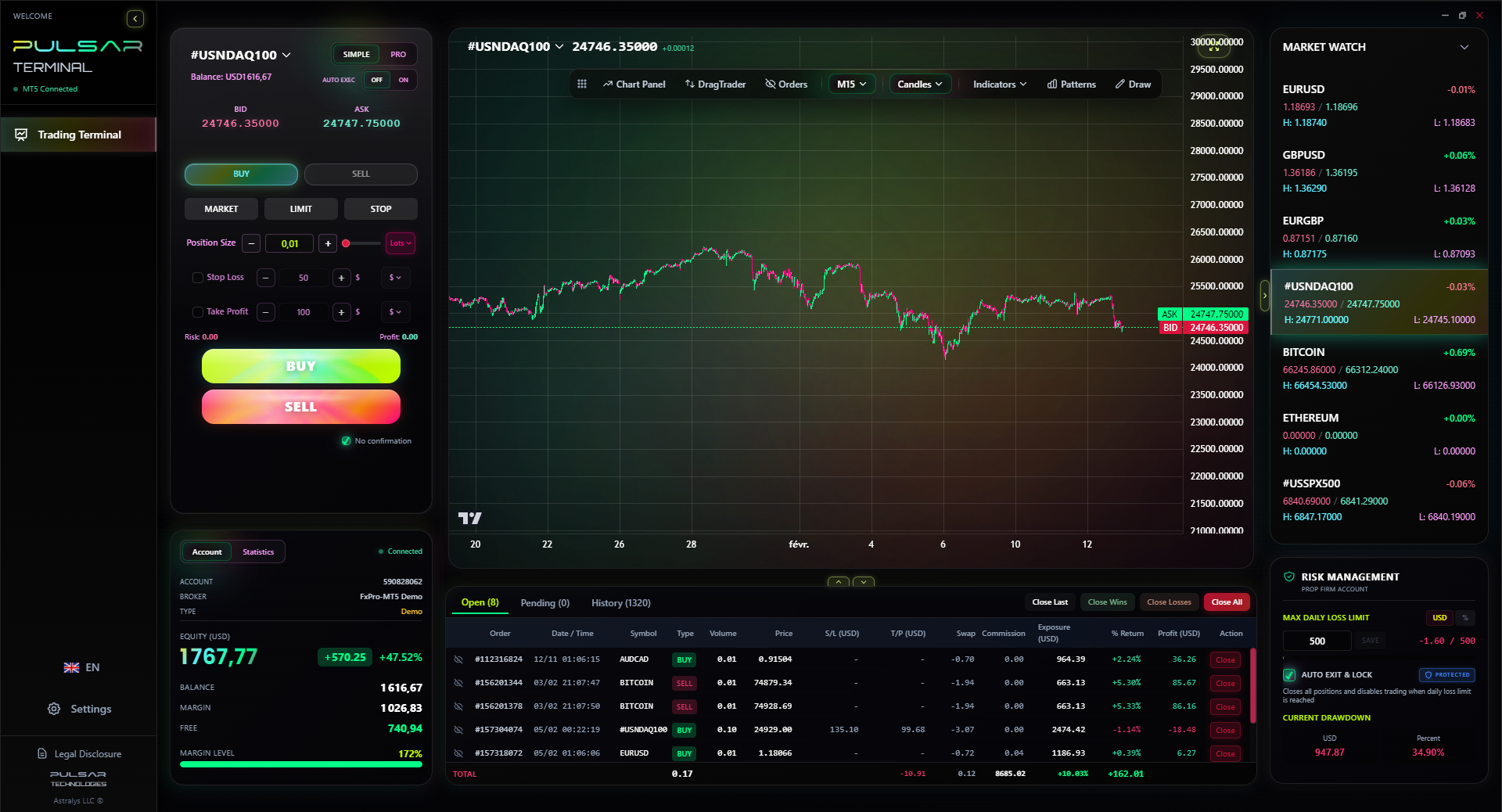
When trading volatile session overlaps, managing multiple take-profit levels and a trailing stop manually is stressful; Pulsar Terminal automates this directly on your MT5 chart.
Pulsar Terminal
MT5 올인원 도구: 드래그앤드롭 주문, 다중 TP/SL, 트레일링 스톱, 그리드 트레이딩, 볼륨 프로파일, 프롭펌 보호. 매일 1,000명 이상의 트레이더가 사용.
“In forex, the clock is as important as the chart.”
You can't manage what you don't measure.
- Session Indicator on Charts: Most platforms (MT4/MT5) have free indicators that shade the different sessions on your chart. Get one. It's a constant visual reminder.
- Economic Calendar Filter: Filter your calendar to show only high-impact events for the session you're trading. Why clutter your mind with US data when you're trading the Asian open?
- Keep a Trading Journal with Timestamps: Note not just your P&L, but the exact time of entry and exit. After 20 trades, you'll see a pattern. I found 80% of my losing scalps were between 3 AM and 5 AM AEST. That data doesn't lie.
- Set Session-Specific Alerts: Use price alerts for key levels. Don't sit and stare at a dead chart. Let the market come to you.
Brokers like Exness or XM often have economic calendars built into their platforms, which you can set to AEST. Use it.
The single best habit? Have a formal trading schedule and stick to it. Mine is 7:30-9:30 AM AEST for AUD setups, and 9:00-11:30 PM AEST for the overlap. Outside those hours, I'm not in front of the charts. This discipline alone saved me from countless impulsive, off-session trades.
💡 윈스턴의 팁
A trading plan without defined market hours is a ship without a tide chart. You might float, but you'll never sail efficiently to your destination.
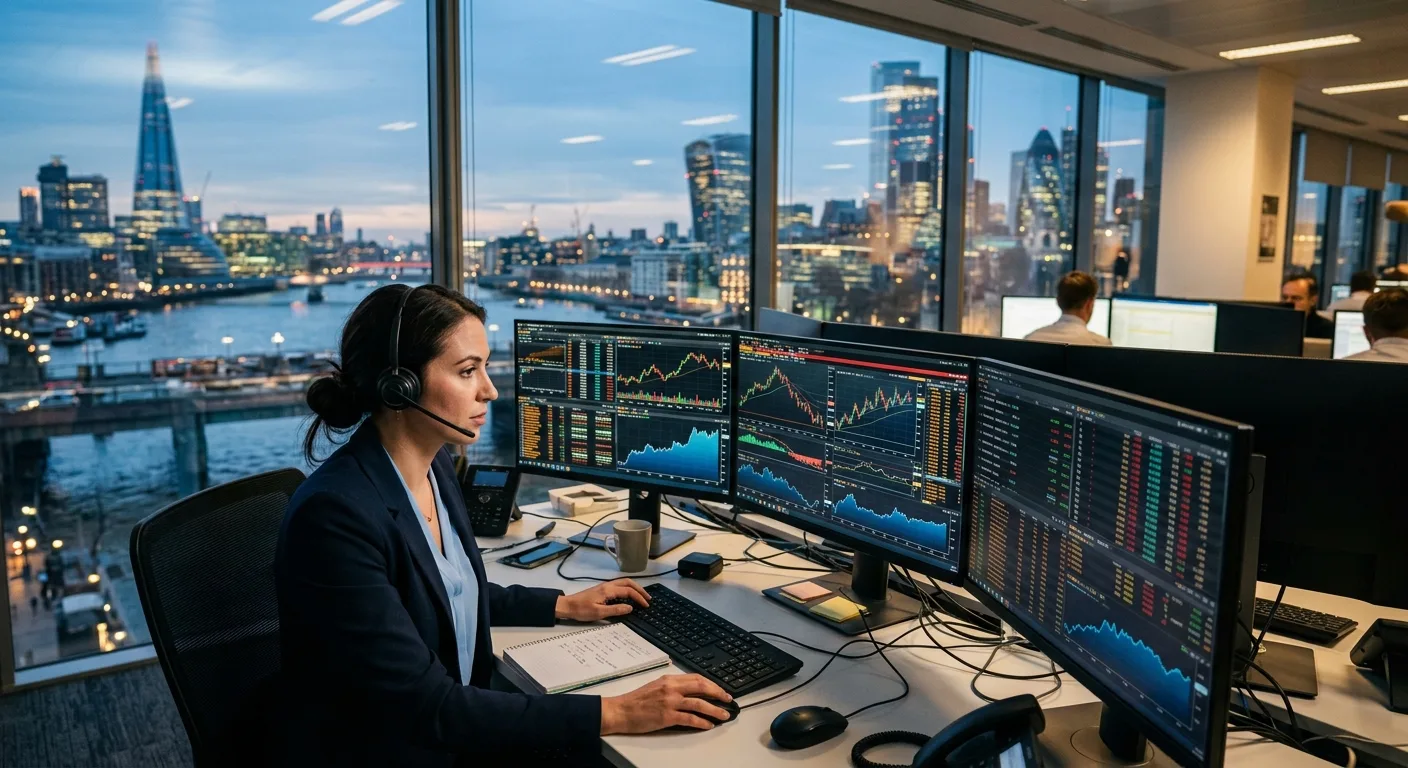
Let's make this concrete. Here’s how I might approach a typical week, focusing on AUD/USD and EUR/USD.
Monday (Asian Lead): Focus on the Asian open (7 AM AEST). How did the pairs gap from Friday's close? Look for early direction. Trade is often cautious. I might take one small position based on the weekly opening range.
Tuesday - Thursday (The Core): This is prime time. My main trading window is the 9 PM - 11:30 PM AEST overlap. I've done my analysis during the day. I'm looking for setups that align with the broader daily trend. These days offer the clearest trends.
Friday (Manage Risk): I might trade the Asian session or early overlap, but my goal is to be flat or have very small, hedged positions by the New York afternoon (after 3 AM AEST). I will not hold a risky position over the weekend. The potential for a gap due to geopolitical news isn't worth it. Understanding a margin call is one thing; experiencing one because of a Sunday night gap is another.
The key is rhythm. The market has one. Your job is to find where your trading rhythm syncs with it, not fight against the tide of liquidity.

FAQ
Q1What are the best forex trading market hours for beginners in Australia?
Stick to the London-New York overlap (9 PM - 1 AM AEST). The high liquidity means tighter spreads and cleaner, more predictable price action. Avoid the dead zones (4-7 PM AEST and 3-6 AM AEST) where low liquidity creates choppy, misleading moves.
Q2Is the Sydney session good for trading?
It can be, but you need the right expectations. It's generally lower volatility. It's excellent for trading AUD and JPY pairs, often in ranges. It's poor for trying to scalp big moves on EUR/USD. Play to its strengths: patience and range-trading strategies.
Q3Can I trade forex 24 hours a day from Australia?
Technically, yes. Practically, it's a terrible idea. Trading during low-liquidity hours (like the late NY/early Asia window) exposes you to wider spreads, increased slippage, and erratic price spikes. Fatigue also leads to costly mistakes. Quality over quantity always wins.
Q4What time does the forex market open and close in Sydney time?
The forex market is always 'open' somewhere, but the key Sydney session open is around 7:00 AM AEST. The global trading day effectively 'closes' for the weekend after the New York session finishes, around 6:00 AM AEST Saturday.
Q5How do market hours affect my stop-loss and take-profit orders?
Dramatically. During low-liquidity hours, a wider spread can trigger your stop-loss even if the 'true' price didn't hit it (this is called 'stop hunting' in thin markets). Always use a stop that accounts for the typical spread widening of the session you're in. A 10-pip stop in the overlap might be fine, but it's dangerous at 4 AM.
Q6Should I trade during major news releases?
Only if you have a specific, tested news-trading strategy and understand the risks. News during high-liquidity sessions (like US data during the overlap) causes big moves. The same news during a dead zone can cause insane, non-directional spikes that will hit your stop and reverse. Know the session's capacity before adding news volatility.
Q7What's the most important overlap for an AUD/USD trader?
The early Asian/London overlap (around 4 PM - 6 PM AEST) is key. London traders are reacting to the Asian session's price action and Australian data. This is often when AUD/USD finds its intraday direction for the European and US sessions.
윈스턴 교수의 수업
핵심 요약:
- ✓Trade the London-NY overlap (9pm-1am AEST) for 70% of your volume.
- ✓Avoid the 3am-6am AEST dead zone completely.
- ✓Size positions for the session's volatility, not your ambition.
- ✓AUD pairs are your home-field advantage; use it.
- ✓A 5-pip spread at 4am can kill a 10-pip stop loss.
이 기사가 얼마나 유용했나요?
별을 클릭하여 평가
주간 트레이딩 인사이트
무료 주간 분석 & 전략. 스팸 없음.
저자 소개
Sarah Collins
트레이딩 전략가
런던 기반 트레이딩 전략가로 금융시장 12년 경력. 시티 오브 런던 증권사 출신 분석가. GBP 통화쌍, 유럽 시장, FCA 규제 거래 전문.
댓글
위험 고지
금융 상품 거래에는 상당한 위험이 수반되며 모든 투자자에게 적합하지 않을 수 있습니다. 과거 성과가 미래 수익을 보장하지 않습니다. 이 콘텐츠는 교육 목적으로만 제공되며 투자 조언으로 간주되어서는 안 됩니다. 거래 전에 항상 직접 조사를 수행하십시오.
이 기사도 읽어보세요

Cara Trading Forex Sukses: 7 Prinsip dari Trader Profesional
Cara trading forex sukses dengan 7 prinsip trader pro: manajemen modal, disiplin, journal trading, backtest. Data nyata, bukan janji profit palsu.
Jam Trading Forex Terbaik untuk Trader Indonesia: Panduan Lengkap dengan Tabel Waktu
Panduan jam trading forex untuk trader Indonesia. Tabel 4 sesi dunia, jam emas 20:00-00:00, sesi mana yang harus dihindari. Data akurat + tips dari trader berpengalaman.
Top 5 Sàn Forex Uy Tín Nhất 2026: Review Jujur dari Trader Indonesia
Top 5 sàn forex uy tín 2026 untuk trader Indonesia. Review jujur: spread, deposit, withdraw, dukungan lokal. Exness, XM, IC Markets & lebih.
