


I remember staring at my screen in 2015, watching a USD/GHS trade go completely against me.

Olumide Adeyemi
서아프리카 트레이딩 선구자
☕ 11 분 소요
배울 내용:
I remember staring at my screen in 2015, watching a USD/GHS trade go completely against me. I'd bought dollars at GHS 3.80, convinced the Cedi would keep weakening. The Bank of Ghana intervened, the rate snapped back to GHS 3.65, and I got stopped out for a $500 loss. That was a cheap lesson. The expensive ones came later, when I thought more complicated strategies were the answer. The truth? The best forex trading techniques aren't about complexity. They're about understanding price, managing your risk like your life depends on it, and knowing how your local market moves. Let's talk about what actually works here.
When I first started, my charts looked like a rainbow explosion. I had the RSI, MACD, Bollinger Bands, Stochastic... you name it. I thought more lines meant more insight. All it did was confuse me and lag behind what price was actually doing. The single biggest shift in my trading came when I stripped everything back and just learned to read the candles.
Price action is simply analyzing the movement of price itself to make trading decisions. It's the foundation every other technique should build on. In Ghana, where internet speeds can be inconsistent and you need to make quick sense of market moves, a clean chart is your best friend.
The Three Things Price Tells You
Price only does three things: it trends up, trends down, or moves sideways (ranges). Your first job on any chart is to figure out which one it's doing right now. A simple trick? Draw a trendline. If you can connect a series of higher lows, you're in an uptrend. Connect lower highs? That's a downtrend. If price is just bouncing between two horizontal levels, it's ranging. I can't tell you how many times I've lost money trying to buy in a clear downtrend because an oscillator was 'oversold.'
Key Price Action Setups for Ghanaian Traders
Two setups I use constantly are the pin bar and the inside bar. A pin bar is a candle with a long wick and a small body, showing price rejected a level hard. An inside bar is a candle completely within the range of the previous candle, showing consolidation. When you see these at key support or resistance levels, they often signal the next move.
For example, last month on EUR/USD, price approached a major resistance level at 1.0950 that had held three times before. It formed a clear pin bar with the wick shooting up and rejecting that level. I sold on the break of the pin bar's low, set a stop above the wick, and rode it down 40 pips. No fancy indicators needed, just pure price reaction. You can learn more about combining these concepts with tools like the MACD indicator later, but master the raw price first.

Warning: Don't fall for the 'Holy Grail' system sellers. Anyone promising you a 100% win rate with price action is lying. It's a framework for understanding probability, not a crystal ball.

💡 윈스턴의 팁
A clean chart is a clear mind. If you can't explain your trade setup in one sentence using only support, resistance, and candle patterns, you shouldn't take it.
“The best forex trading techniques aren't about complexity. They're about understanding price and managing your risk like your life depends on it.”
This is the boring part that saves your account. If you don't get this right, none of the other forex trading techniques matter. The Cedi's volatility alone makes this non-negotiable. You might be right on the direction of USD/GHS, but a sudden 5% spike from BoG news can wipe you out if you're over-leveraged.
The 1% Rule (And Why It's Not Enough Sometimes)
The golden rule is to never risk more than 1% of your trading capital on a single trade. On a $1,000 account, that's $10. You calculate this using your stop-loss distance. Here's the math: If your stop loss is 20 pips away from your entry, and each pip is worth $1 on your lot size, you're risking $20. To keep that at $10, you need to halve your position size. I use a simple position size calculator for this every single time.
But here's my Ghana-specific twist: For USD/GHS or any exotic pair involving the Cedi, I often tighten that to 0.5% risk. The spreads are wider, the moves can be jumpier due to local liquidity, and BoG announcements don't always come at convenient times. Protecting capital is more important than maximizing gain.
The Broker Safety Net
Your broker's terms are part of your risk management. Understand what a margin call means with them. Does it close all your trades? Just the one? I got caught early on with a broker that used 'stop out' levels. My account equity fell to 50% of the required margin, and they automatically closed my biggest losing position, which turned a bad day into a catastrophe. Now I only use brokers with clear, fair terms like IC Markets or Pepperstone.

Pro Tip: Before you even think about a trade, place your stop loss order. Not in your head, on the platform. This does two things: it makes your risk real, and it prevents you from moving the stop further away when the trade goes against you (a mistake I've made too many times).
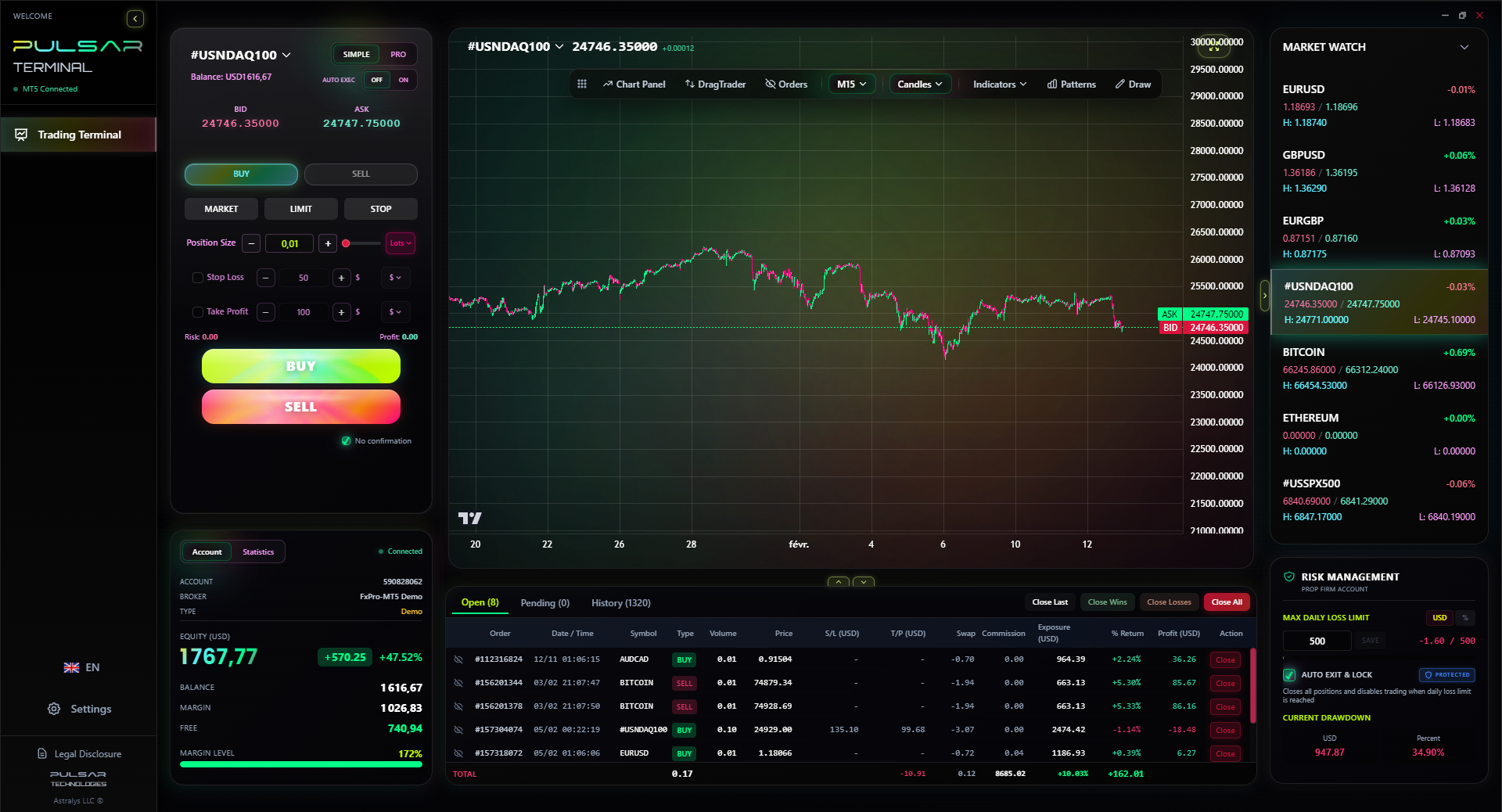
Manually moving stop losses to breakeven is a chore; Pulsar Terminal automates breakeven and trailing stop functions directly on your MT5 chart, so you can lock in profits without babysitting the trade.
Pulsar Terminal
MT5 올인원 도구: 드래그앤드롭 주문, 다중 TP/SL, 트레일링 스톱, 그리드 트레이딩, 볼륨 프로파일, 프롭펌 보호. 매일 1,000명 이상의 트레이더가 사용.
“A losing trade isn't failure, it's the cost of doing business. If you have a strategy with a 60% win rate, you will lose 4 out of every 10 trades.”
Trading the Cedi against the Dollar is a different beast compared to majors like EUR/USD. It's less liquid, more sensitive to local politics and BoG policy, and the spreads can eat you alive if you're not careful.
Understanding the Drivers
Forget just watching technicals. You need one eye on the news. The quarterly BoG Monetary Policy Committee announcements are huge. Are they raising the policy rate to defend the Cedi? That's typically bullish for GHS. What's the inflation data saying? The balance of trade? I keep a simple calendar with these dates marked in red.
Also, watch the difference between the interbank rate (around GHS 11.00/$) and the forex bureau rate (GHS 11.85/$ as of last check). A widening gap often signals market stress or increased demand for physical dollars, which can precede a move.
A Tactical Approach
Because of the wider spread (sometimes 50-100 pips!), scalping strategy is very difficult. I treat USD/GHS more as a swing trading opportunity. I look for clear technical levels on the daily or 4-hour chart, confirmed by a fundamental catalyst. For instance, if the Cedi has been weakening steadily toward a major psychological resistance (say, GHS 12.50/$) and the BoG is scheduled to announce new dollar liquidity measures, I might look for a selling setup on USD/GHS.
Remember that 5% bank fee on some foreign currency withdrawals? Factor that into your profit calculations if you're moving money out. A 3% gain on a trade can vanish quickly with fees.
💡 윈스턴의 팁
The Cedi doesn't care about your profit target. Always know the date of the next MPC meeting before you swing trade USD/GHS. Policy beats pattern every time.
“A losing trade isn't failure, it's the cost of doing business. If you have a strategy with a 60% win rate, you will lose 4 out of every 10 trades.”
Okay, now we can bring some indicators back in. But not as the main act, as supporting actors. Their job is to filter out bad trades and add confluence to your price action reads.
My Two-Workhorse Combo
I use two indicators 90% of the time: the Moving Average and the RSI.
A simple 50-period and 200-period Exponential Moving Average (EMA) on the daily chart tells me the overall trend. If price is above both, I'm only looking for buy setups. Below both? Only sell setups. In between? The market is choppy, and I might reduce position size or stay out. This one rule saved me from countless losing trades trying to pick tops and bottoms.
The RSI indicator I use not for overbought/oversold signals, but for divergence. If price makes a new high but the RSI makes a lower high, that's bearish divergence and a warning the uptrend is weakening. It's a great heads-up to tighten stops or take partial profits.
A Real Trade Example
In January, on Gold (XAU/USD), price was in a strong uptrend above the 50 EMA. It pulled back to the 50 EMA support, formed a bullish pin bar right on it. That was my price action signal. For extra confirmation, I checked the RSI. It had dipped near 40 but was curling back up, showing the pullback momentum was fading. That confluence gave me the confidence to take the buy. I entered at $2025, stopped out below the pin bar at $2017, and took profit at $2040. The EMA told me the trend context, price action gave the entry, RSI gave a slight edge. Learn more about trading gold with our XAU/USD guide.

Example: Don't use 10 different timeframes. Pick three: one for trend (Daily), one for timing (4-Hour), one for entry (1-Hour). More than that leads to 'analysis paralysis' where every chart tells you something different.
“Trading USD/GHS is a different beast. It's less liquid, more sensitive to local politics, and the spreads can eat you alive if you're not careful.”
You can know all the forex trading techniques in the world, but if your psychology is weak, you'll lose. Trading in Ghana adds unique pressures: power cuts during a trade, family asking why you're 'gambling' on the computer, the pressure to make quick money in a tough economy.
Embrace the Losses
My most profitable year came only after I made peace with losing. A losing trade isn't failure, it's the cost of doing business. If you have a strategy with a 60% win rate, you will lose 4 out of every 10 trades. If you get emotional and start doubling down after two losses (the 'martingale' trap), you'll blow up. I keep a trading journal. Writing down my reasoning for a loss helps me see if it was a good trade that just didn't work, or a stupid mistake.
The 'Momo' Mentality Trap
We're used to instant results with mobile money. Trading isn't like that. It's a grind. The desire for a quick 'Momo' flip can lead to overtrading - taking low-quality setups just to be in the market. Some days, the best trade is no trade. I had to learn that the hard way, paying spreads over and over for trades that had no real edge.
Create a Ritual
This sounds silly, but it works. Have a pre-market routine. Check the economic calendar. Look at your charts without any positions on. Decide your plan before the market opens. This separates you from the reactive crowd who are just chasing price.
💡 윈스턴의 팁
Your first profit goal isn't a fancy car. It's to survive 100 trades without blowing up your account. Consistency before Lamborghinis.
“Trading USD/GHS is a different beast. It's less liquid, more sensitive to local politics, and the spreads can eat you alive if you're not careful.”
For a Ghanaian trader, your broker choice is critical. It's not just about who has the tightest spread on EUR/USD. You need to think about deposits, withdrawals, and local support.
Deposit and Withdrawal Reality
Many international brokers accept deposits via Visa/Mastercard or bank wire. But consider the costs. A bank wire might cost you $30 plus your bank's forex conversion fees. Some brokers, like Exness, have localized deposit options that can be cheaper. Always check the actual net amount that lands in your trading account after all fees.
Withdrawals are key. How long do they take? Are there fees? I prioritize brokers with a track record of smooth, fast withdrawals. Reading reviews from other African traders is essential here. Brokers like XM have a strong presence across the continent and understand these logistical needs.
Regulation and Safety
Since there's no local BoG license for these platforms, you must rely on international regulation. Look for brokers regulated by the UK's FCA, Australia's ASIC, Cyprus's CySEC, or South Africa's FSCA. This gives you some recourse if something goes wrong. Avoid unregulated 'offshore' brokers offering crazy bonuses and 1:1000 use. That's a fast track to losing your money.
Platform Stability
During volatile news events (like BoG announcements), platforms can slow down or freeze. You need a broker with strong servers. Test their demo server during peak London or New York session hours to see if it holds up. A few pips' difference in spread means nothing if you can't close a trade when you need to.
“Your broker's terms are part of your risk management. Understand what a margin call means with them before you deposit a single cedi.”
Here’s how to stitch these forex trading techniques into a simple, repeatable process. This is the template I wish I had when I started.
Step 1: The Trend Filter (Daily Chart)
- Are the 50 EMA and 200 EMA stacked bullishly or bearishly? Or is price chopping between them?
- This decides my bias: Long, Short, or Neutral/Reduced Size.
Step 2: The Zone (4-Hour Chart)
- Where is price relative to recent swing highs and lows (support/resistance)?
- I only look for trades where my bias aligns with price approaching a key level.
Step 3: The Signal (1-Hour Chart)
- At that key level, do I see a clear price action signal (pin bar, inside bar breakout)?
- Is there any divergence on the RSI to add confluence?
- If yes, I move to step 4. If no, I wait.
Step 4: The Execution & Risk
- Calculate my position size so my stop loss (placed beyond the signal candle) risks 0.5-1% of my account. Use a calculator.
- Set my take-profit target at a minimum 1.5 times my risk (a 1:1.5 risk/reward ratio).
- Enter the trade, set the orders, and walk away. No micromanaging.
This isn't sexy. It won't make you rich in a week. But it's sustainable. It turns trading from a stressful guessing game into a boring, mechanical process where your edge plays out over dozens of trades. Start on a demo account, track your results for 100 trades, and only then go live with small capital. For mastering a major pair like the Euro, this systematic approach is detailed in our EUR/USD guide.
FAQ
Q1Is forex trading legal in Ghana?
Yes, forex trading is legal for individuals in Ghana. However, there's no specific local license for online retail forex brokers. The Bank of Ghana regulates the broader financial system and foreign exchange transactions through banks and bureaus, but not speculative trading platforms. You'll be using internationally regulated brokers. Always ensure any company offering investment services in Ghana is licensed by the Securities and Exchange Commission (SEC).
Q2How much money do I need to start forex trading in Ghana?
You can start with surprisingly little. Many international brokers offer accounts with minimum deposits as low as $5 (like XM) or $10 (like Exness), which is about GHS 65-130. I strongly recommend you start with a demo account to practice first. When you go live, start with an amount you can afford to lose completely - think of it as tuition fees for your trading education, not a get-rich-quick scheme.
Q3How are my forex trading profits taxed in Ghana?
Profits from forex trading are generally considered income by the Ghana Revenue Authority (GRA) and are subject to personal income tax, which can range from 0% to 35%. If you trade through a registered business, corporate tax rates (around 25%) may apply. It's your responsibility to declare this income. Keep clear records of all your trades, deposits, and withdrawals.
Q4What's the best time to trade forex from Ghana?
The most liquid and volatile sessions are the London session (8 AM to 5 PM GMT) and the overlap with the New York session (1 PM to 5 PM GMT). For Ghana, this is roughly 8 AM to 5 PM local time (GMT). This is when spreads are tightest and you get the cleanest moves. Trading during slow hours (like late New York or Asian session) often leads to choppy, frustrating price action with wider spreads.
Q5Should I trade USD/GHS or major pairs like EUR/USD?
Beginners should absolutely start with major pairs like EUR/USD or GBP/USD. The spreads are much tighter (often under 1 pip vs. 50+ for USD/GHS), liquidity is enormous, and price moves are generally smoother and easier to analyze with standard techniques. USD/GHS is a specialist market influenced heavily by local news and liquidity; it's better tackled once you have solid experience and a deeper understanding of macroeconomics.
Q6What's a pip, and how much is it worth?
A pip is the smallest price move a currency pair can make. For most pairs, it's 0.0001. So if EUR/USD moves from 1.0850 to 1.0851, it moved 1 pip. Its value in cash depends on your trade size (lot size). On a standard lot (100,000 units), 1 pip is usually about $10. On a mini lot (10,000 units), it's $1. You must understand this to calculate your risk. We have a full breakdown in our pip definition guide.
Q7I keep losing money. What am I doing wrong?
The most common mistakes are: 1) Risking too much per trade (break the 1% rule), 2) Overtrading (taking setups without a clear edge), 3) Not using a stop loss, and 4) Letting losses run and cutting profits short. Go back to basics. Trade a demo account with strict rules for 2 months. Journal every trade. You'll likely see your own bad habits clearly. Psychology is 80% of the game.
윈스턴 교수의 수업
핵심 요약:
- ✓Master price action before adding a single indicator.
- ✓Never risk more than 1% per trade (0.5% on USD/GHS).
- ✓Use EMAs to define trend; only trade in its direction.
- ✓Factor in local bank fees (like the 5% withdrawal fee) into profit targets.
- ✓Psychology and routine are 80% of long-term success.
이 기사가 얼마나 유용했나요?
별을 클릭하여 평가
주간 트레이딩 인사이트
무료 주간 분석 & 전략. 스팸 없음.
저자 소개
Olumide Adeyemi
서아프리카 트레이딩 선구자
나이지리아에서 가장 활발한 외환 트레이딩 교육자 중 한 명. 라고스에서 8년간 트레이딩 경험. 아프리카 트레이더를 위한 소자본 전략과 프롭 펌 챌린지 전문.
댓글
위험 고지
금융 상품 거래에는 상당한 위험이 수반되며 모든 투자자에게 적합하지 않을 수 있습니다. 과거 성과가 미래 수익을 보장하지 않습니다. 이 콘텐츠는 교육 목적으로만 제공되며 투자 조언으로 간주되어서는 안 됩니다. 거래 전에 항상 직접 조사를 수행하십시오.
이 기사도 읽어보세요

Cara Trading Forex Sukses: 7 Prinsip dari Trader Profesional
Cara trading forex sukses dengan 7 prinsip trader pro: manajemen modal, disiplin, journal trading, backtest. Data nyata, bukan janji profit palsu.
Jam Trading Forex Terbaik untuk Trader Indonesia: Panduan Lengkap dengan Tabel Waktu
Panduan jam trading forex untuk trader Indonesia. Tabel 4 sesi dunia, jam emas 20:00-00:00, sesi mana yang harus dihindari. Data akurat + tips dari trader berpengalaman.
Top 5 Sàn Forex Uy Tín Nhất 2026: Review Jujur dari Trader Indonesia
Top 5 sàn forex uy tín 2026 untuk trader Indonesia. Review jujur: spread, deposit, withdraw, dukungan lokal. Exness, XM, IC Markets & lebih.
