


I lost NGN 450,000 in 48 hours trading Bitcoin in 2018.

Olumide Adeyemi
서아프리카 트레이딩 선구자 ·  Nigeria
☕ 8 분 소요
배울 내용:
- 1The Core Difference: What Are You Actually Trading?
- 2Volatility & Liquidity: Where the Money Is Made (And Lost)
- 3The Nigerian Context: Access, Funding, and Regulation
- 4Strategy Showdown: What Works Where?
- 5Risk Management: Your Survival Kit
- 6So, Which One Is For You, O Naija Trader?
- 7First Steps: Your Action Plan

I lost NGN 450,000 in 48 hours trading Bitcoin in 2018. I got greedy, ignored every rule, and watched a 20% dip turn into a full-blown margin call because I was treating crypto like it was just another forex pair. That's the mistake. They're different beasts. In Nigeria, you've got guys making millions on Binance P2P and others quietly building consistent income on EUR/USD. This isn't about which is 'better.' It's about which one fits your personality, your risk tolerance, and your bank account. Let's cut through the hype.
Forex is the granddaddy. You're trading national currencies, like the US Dollar (USD) against the Naira (NGN) in a pair like USD/NGN, or major pairs like EUR/USD. The market is massive, with over $7 trillion traded daily. It's driven by central banks, interest rates, economic data, and geopolitics. It's old-school, institutional, and frankly, a bit more predictable.
Crypto is the wild west. You're trading digital assets like Bitcoin (BTC) or Ethereum (ETH). The total market cap is a fraction of forex. Prices swing on Elon Musk's tweets, regulatory rumors from the SEC, and memes. It's a 24/7 market - no closing bell on Friday to save you from a weekend dump.
For a Nigerian trader, the access is different. With forex, you're typically using an international broker like Exness or IC Markets to access global liquidity. With crypto, you're often on a centralized exchange like Binance or a local P2P platform. The underlying asset - a government's promise vs. a line of code - defines everything that follows.
“Crypto volatility is a different sport. A 10% daily move is Tuesday.”
This is where your heart rate gets tested.
Forex Volatility
Forex pairs have measured volatility. A big day for EUR/USD might be a 1% move. Exotic pairs involving the Naira can be wilder, but majors are relatively tame. This suits strategies like swing trading where you hold for days or weeks. Liquidity is insane, especially during London and New York overlap. That means tight spreads (the difference between buy and sell price) and instant order execution. You can move serious money without moving the price.
Crypto Volatility
Crypto volatility is a different sport. A 10% daily move is Tuesday. I've seen altcoins pump 100% and crash 80% in the same week. This creates massive opportunities for short-term plays like scalping, but the risk is proportionally insane. Liquidity varies wildly. Bitcoin and Ethereum are deep, but try moving a large sum on a small-cap altcoin and you'll get slaughtered by slippage.

Warning: High crypto volatility is a double-edged sword. That 5x use on Binance Futures can turn a 10% move against you into a 50% loss of your capital before you can blink. Always use a position size calculator.
My own lesson? In 2021, I scalped Ethereum. Bought at $3,200, target $3,350. Hit my profit in 20 minutes. Got cocky, re-entered without a new signal. A whale dumped, price fell to $3,050 in 5 minutes. I was over-leveraged. Lost the entire first profit plus 30% more. Forex rarely punishes you that fast for a single mistake.

💡 윈스턴의 팁
Your first NGN 100,000 profit is the most dangerous. It convinces you you're a genius. That's when you stop using stops. That's when the market takes it all back, plus more.
“The biggest risk in Nigeria isn't market risk, it's platform risk.”
This is the practical stuff that blogs often ignore.
Funding Your Account:
- Forex: You fund your international broker account in USD. This means going through your bank, dealing with CBN restrictions, and paying wire transfer fees. It's a hassle. Some brokers offer local deposit options, but you need to verify them thoroughly.
- Crypto: This is where crypto shines for Nigerians. You use Binance P2P or a similar platform to buy USDT with Naira from another person. It's fast, avoids the official banking bottleneck, and is how most people here get started. You then transfer that USDT to your trading exchange.
Regulation & Safety:
- Forex: Your broker should be regulated (like ASIC, CySEC, FCA). Your funds should be in segregated accounts. There's a framework, even if it's offshore. If XM or Pepperstone goes under (unlikely), there's a process.
- Crypto: Mostly unregulated. If Binance decides to freeze your account (it happens), your recourse is limited. "Not your keys, not your crypto" is the mantra for a reason. The CBN's stance has been hostile, creating constant uncertainty.
Taxes: Let's be real. Most retail traders in Nigeria aren't filing taxes on trading profits. But technically, you should. The government is looking harder at crypto P2P transactions. Forex profits from an offshore broker are less visible, for now.
“The biggest risk in Nigeria isn't market risk, it's platform risk.”
You can't use the same playbook for both markets.
Forex-Friendly Strategies:
- Swing Trading & Position Trading: Perfect for forex. You're riding macroeconomic trends. You analyze interest rate differentials, use the MACD indicator on the daily chart, and can hold for weeks. The lower volatility means you're not stopped out by noise as easily.
- Carry Trade: A classic. Borrow a low-yielding currency (like JPY), buy a high-yielding one (historically, the Naira had high rates). You profit from the interest rate differential. This is a pure forex play.
Crypto-First Strategies:
- Momentum Scalping: Crypto's 24/7 nature and volatility are made for this. You're chasing pumps, using the RSI indicator on 5-minute charts, and taking 2-5% profits repeatedly.
- News & Sentiment Trading: A tweet can move Bitcoin 5%. You learn to trade the rumor, sell the news. This is less reliable in forex where news is more structured (e.g., NFP reports).
What I Use: I swing trade gold (XAU/USD) like a forex pair, using daily charts. For crypto, I only day trade Bitcoin, never holding overnight because a weekend gap can ruin you. Different tools, different mindsets.
💡 윈스턴의 팁
In Nigeria, your biggest edge isn't a secret indicator. It's patience. While everyone else is chasing the next shitcoin pump, you can build real wealth in the slow, boring forex majors.
“High use is the fastest way to turn a small account into zero.”
This is non-negotiable. How you manage risk in forex vs crypto is your lifeline.
Forex Risk Controls:
- Stop-Losses: They work. The market is liquid enough that your stop gets filled at or near your price. A 50-pip stop on EUR/USD is a standard risk unit.
- use: Offered by brokers, often up to 1:500. This is a trap for newbies. I never use more than 1:20 for swing trades. use amplifies losses faster than gains.
Crypto Risk Nightmares:
- Stop-Loss Liquidation: In a flash crash, liquidity vanishes. Your stop-loss becomes a "market order" that fills way below your intended price. I had a stop at $58,000 on BTC that filled at $56,200 during a mini-flash crash. That's a bigger loss than you planned for.
- use Deathtrap: Crypto exchanges offer 10x, 50x, even 100x use. This is for degenerates and professionals with iron stomachs. At 50x, a 2% move wipes you out. Period.

Pro Tip: Regardless of the market, define your risk per trade as a percentage of your capital. 1% is standard. If you have a NGN 500,000 account, risk NGN 5,000 per trade. This single rule has saved me more times than any indicator. Use a position size calculator religiously.
The biggest risk in Nigeria isn't market risk, it's platform risk. Your crypto could be stuck on a frozen exchange. Your forex broker might have withdrawal delays. Always start small to test the entire process - deposit AND withdrawal.
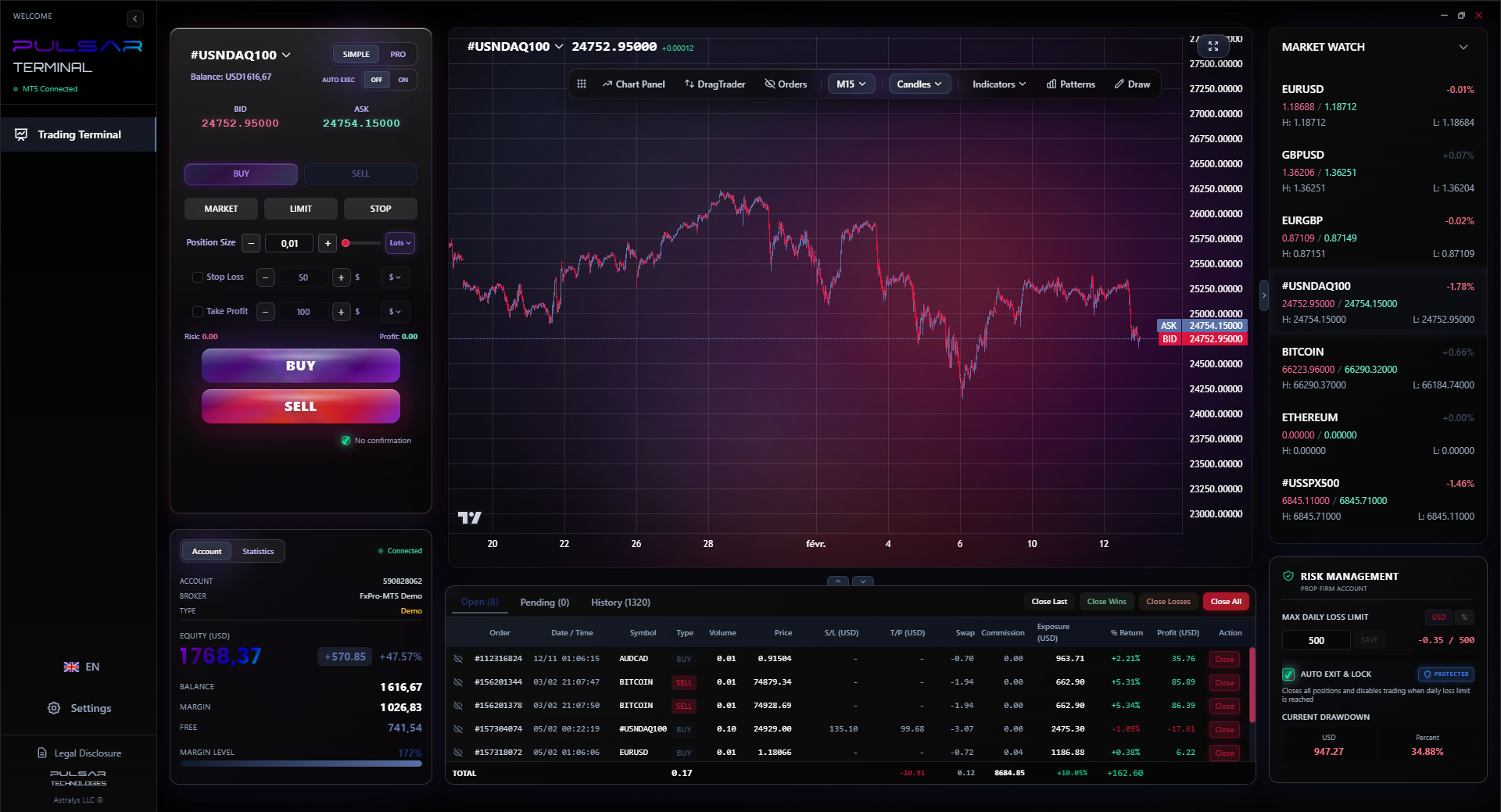
Managing multiple trades and complex stop-loss strategies across volatile markets is a headache; Pulsar Terminal's drag-and-drop order tools and multi-TP/SL system let you execute precise risk management directly on your MT5 charts.
Pulsar Terminal
MT5 올인원 도구: 드래그앤드롭 주문, 다중 TP/SL, 트레일링 스톱, 그리드 트레이딩, 볼륨 프로파일, 프롭펌 보호. 매일 1,000명 이상의 트레이더가 사용.
“High use is the fastest way to turn a small account into zero.”
Let's make this personal. Ask yourself these questions:
Choose FOREX if you:
- Want more predictable, slower-paced markets.
- Are interested in global economics and central bank policy.
- Prefer a regulated environment (even if offshore).
- Have the patience for swing trades that develop over days.
- Can navigate the hassle of international wire transfers.
Choose CRYPTO if you:
- Thrive on adrenaline and fast-paced action.
- Are tech-savvy and understand blockchain basics.
- Want easy Naira on/off ramps via P2P.
- Can accept extreme volatility and the potential for total loss on a single trade.
- Are comfortable with minimal regulatory protection.
My Hybrid Approach (What I Actually Do): My core portfolio is built on forex swing trades. It's my "steady business." I use about 70% of my capital here. The other 30% is my "crypto speculation fund." I trade it aggressively, knowing it could go to zero. This way, the crypto moonshots don't bankrupt me, and the forex consistency pays the bills. In 2023, my forex account was up 22%. My crypto fund was up 65% (but was down 40% at one point in the year). The emotional rollercoaster of that crypto portion is not for everyone.
You can learn both, but master one first. Trying to learn scalping on crypto while learning swing trading on forex will split your focus and you'll fail at both.
💡 윈스턴의 팁
If you can't explain your trade setup in one sentence before you enter, you're gambling. 'Buy EUR/USD because the daily MACD crossed bullish at support' is a plan. 'Buy Bitcoin because it feels low' is a prayer.
“You can learn both, but master one first. Trying to learn scalping on crypto while learning swing trading on forex will split your focus and you'll fail at both.”
Enough theory. Here's what to do tomorrow.
- Educate with Demo Accounts: Open a demo with a forex broker like IC Markets AND a demo futures account on Binance or Bybit. Paper trade for at least 3 months. Don't touch real money.
- Start Small: When you go live, start with an amount you can afford to lose completely. For forex, maybe $200 (NGN 300k-ish). For crypto, even less - $50 in USDT.
- Document Everything: Keep a trading journal. Entry, exit, reason, emotion. I review mine every Sunday. My biggest improvements came from analyzing my losses, not my wins.
- Ignore the Noise: Nigerian WhatsApp groups are full of "signal sellers" promising 100% weekly returns. It's all scams. Your education is your only real signal.
- Master One Pair/Coin: Don't jump around. Master EUR/USD or Bitcoin first. Understand its pip value, its average daily range, its personality.
Remember, this is a marathon. The guy blowing up his account on use in week one is a statistic. The guy who survives 100 trades by managing risk is on his way to being a professional. Choose your market, build your process, and for heaven's sake, keep your day job until your trading consistently pays more.
FAQ
Q1Which is more profitable, forex or crypto trading?
Profitability depends on the trader, not the market. Crypto offers higher potential percentage returns due to volatility, but also carries a much higher risk of total loss. Forex offers more consistent, lower-volatility returns for disciplined traders. A skilled forex trader might aim for 20-30% annual returns, while a crypto trader might see 100% gains or 100% losses in a year.
Q2Is crypto trading banned in Nigeria?
No, crypto trading is not banned for individuals. The Central Bank of Nigeria (CBN) in 2021 banned regulated financial institutions from dealing in or facilitating crypto transactions. This made bank transfers to exchanges difficult. However, individuals can and do trade using peer-to-peer (P2P) platforms on exchanges like Binance, which is the primary method used in Nigeria today.
Q3Can I trade forex with Naira?
Not directly on major international platforms. You trade forex in currency pairs (e.g., USD/NGN, EUR/USD). To fund an international forex broker account, you typically convert your Naira to USD and send a wire transfer. Some brokers may offer local deposit options via payment processors, but you'll be trading in USD, EUR, or other major currencies.
Q4Do I pay tax on forex or crypto trading profits in Nigeria?
According to Nigerian law, yes, all income is taxable. The Federal Inland Revenue Service (FIRS) has stated that profits from crypto trading are subject to Capital Gains Tax. In practice, enforcement on retail traders is currently limited, but this is changing. For forex profits from offshore brokers, it's less visible but still technically taxable income. Consult a local tax professional.
Q5Which market is easier for beginners?
Neither is "easy," but forex is generally more beginner-friendly due to its lower volatility, structured trading sessions, and abundance of established educational resources. Crypto's 24/7 market, extreme volatility, and prevalence of scams make it a tougher environment to learn risk management. Start with a forex demo account to learn the absolute basics of charts and orders.
Q6What use should a Nigerian beginner use?
As little as possible. For forex, do not exceed 1:10. For crypto, avoid use entirely until you have at least a year of profitable spot trading. High use is the fastest way to turn a small account into zero. I've seen too many Nigerians blow NGN 1 million accounts using 1:100 use on a single bad trade.
Q7Can I trade both forex and crypto?
Absolutely, and many experienced traders do. The key is to treat them as separate businesses with separate strategies and separate risk allocations. Don't use your forex swing trading strategy on a Bitcoin chart. Have different accounts, different mental frameworks, and never let a loss in one market cause you to overtrade in the other.
윈스턴 교수의 수업
핵심 요약:
- ✓Risk max 1% of capital per trade, in any market.
- ✓Forex for steady strategy, crypto for speculative moonshots.
- ✓Test withdrawals before depositing large amounts.
- ✓Master one instrument before adding others.
이 기사가 얼마나 유용했나요?
별을 클릭하여 평가
주간 트레이딩 인사이트
무료 주간 분석 & 전략. 스팸 없음.
저자 소개
Olumide Adeyemi
서아프리카 트레이딩 선구자
나이지리아에서 가장 활발한 외환 트레이딩 교육자 중 한 명. 라고스에서 8년간 트레이딩 경험. 아프리카 트레이더를 위한 소자본 전략과 프롭 펌 챌린지 전문.
댓글
위험 고지
금융 상품 거래에는 상당한 위험이 수반되며 모든 투자자에게 적합하지 않을 수 있습니다. 과거 성과가 미래 수익을 보장하지 않습니다. 이 콘텐츠는 교육 목적으로만 제공되며 투자 조언으로 간주되어서는 안 됩니다. 거래 전에 항상 직접 조사를 수행하십시오.
이 기사도 읽어보세요

Cara Trading Forex Sukses: 7 Prinsip dari Trader Profesional
Cara trading forex sukses dengan 7 prinsip trader pro: manajemen modal, disiplin, journal trading, backtest. Data nyata, bukan janji profit palsu.
Jam Trading Forex Terbaik untuk Trader Indonesia: Panduan Lengkap dengan Tabel Waktu
Panduan jam trading forex untuk trader Indonesia. Tabel 4 sesi dunia, jam emas 20:00-00:00, sesi mana yang harus dihindari. Data akurat + tips dari trader berpengalaman.
Top 5 Sàn Forex Uy Tín Nhất 2026: Review Jujur dari Trader Indonesia
Top 5 sàn forex uy tín 2026 untuk trader Indonesia. Review jujur: spread, deposit, withdraw, dukungan lokal. Exness, XM, IC Markets & lebih.
