


Most traders think forex working hours are just a schedule to follow.

David van der Merwe
신흥시장 트레이더 ·  South Africa
☕ 10 분 소요
배울 내용:

Most traders think forex working hours are just a schedule to follow. I used to think that too. I was wrong. Knowing the market's rhythm isn't about convenience, it's about survival and finding your edge. For a South African trader, our time zone is a unique advantage if you know how to use it. This isn't a boring timetable. This is a map of when the market breathes, sleeps, and explodes with opportunity. I'll show you exactly how to trade it, the mistakes I made by ignoring it, and why getting this right is more important than any fancy indicator.
The forex market runs 24 hours a day, five days a week. That's the sales pitch. What they don't tell you is that it's not a constant 24-hour buzz. It's more like a wave, with powerful surges and deadly calm periods. For us in South Africa, the week kicks off at 10 PM SAST on Sunday when the Sydney session opens. It all wraps up at 10 PM SAST on Friday when New York closes.
The key is understanding the four major trading sessions: Sydney, Tokyo, London, and New York. Their opening and closing times create overlaps, and these overlaps are where 70% of the real action happens. Your location in SAST puts you in a fascinating spot. You're perfectly positioned to catch the tail end of one session and the opening of another, especially if you're a night owl or an early riser.
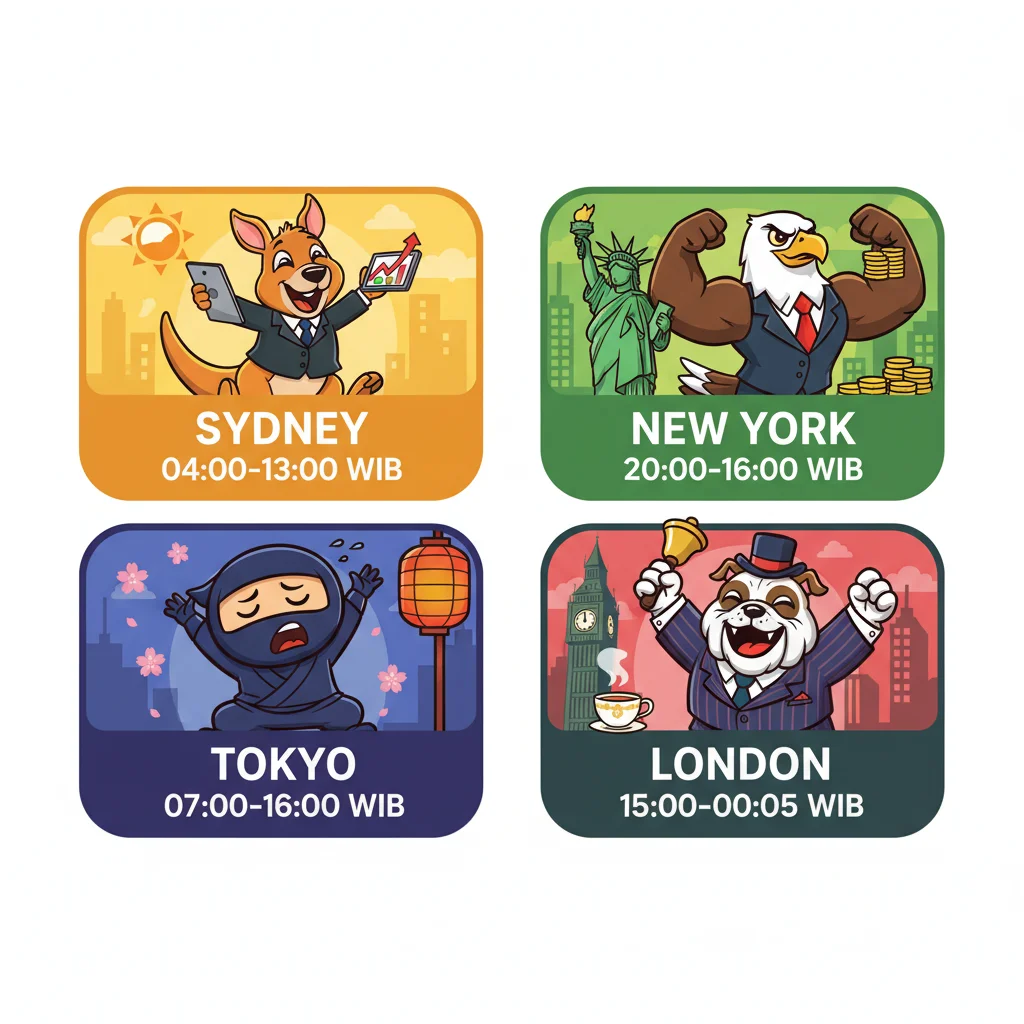
Here’s the practical SAST schedule you need to burn into your memory:
| Trading Session | Opens (SAST) | Closes (SAST) | Key Characteristics |
|---|---|---|---|
| Sydney | 10:00 PM | 7:00 AM | Often quiet, sets the tone for Asia. AUD, NZD pairs active. |
| Tokyo | 12:00 AM (Midnight) | 9:00 AM | Asian market heart. JPY pairs come alive. Can be range-bound. |
| London | 9:00 AM | 6:00 PM | The big one. Highest liquidity. All majors, especially EUR, GBP. |
| New York | 3:00 PM | 10:00 PM | Massive volume, often defines daily trend. USD pairs dominant. |
The magic - and the danger - happens when these sessions overlap.

Warning: Trading during the dead zone between New York close and Sydney open (10 PM SAST to 10 PM SAST Sunday) is asking for trouble. Spreads widen massively, liquidity evaporates, and a small news headline can cause a ridiculous spike that wipes out stops. I learned this the hard way holding a GBP/USD position over a weekend. The Sunday open gapped 40 pips against me before I could even blink.
“Knowing the market's rhythm isn't about convenience, it's about survival and finding your edge.”
This is the core of trading forex working hours. The overlaps are where banks, funds, and all the big players are most active. More activity means tighter spreads, smoother price action, and real trends you can actually trade.
The London-New York Overlap (3 PM - 6 PM SAST)
This is the king of all trading windows. For three glorious hours, the two largest financial centers in the world are both open. I plan my entire day around this period. The volume is insane. This is when major economic data from both the US and Europe hits the wire. Trends that start here often carry through the US session.
My most consistent profits come from this window. A classic setup? Watching for a breakout during the early London session (9 AM - 12 PM SAST), then waiting for a pullback. If the price holds during the lull before New York opens, I'll enter on the momentum as the US volume floods in. Using a tool like the MACD indicator on a 15-minute chart here can help confirm momentum shifts as the big money moves.
The Sydney-Tokyo Overlap (12 AM - 7 AM SAST)
This is the early bird special. If you're up between midnight and 7 AM, you're trading the Asian session heart. It's generally lower volatility than London, but it offers clean, technical moves. Pairs like AUD/USD, NZD/USD, and USD/JPY get their direction here. This session often sets the range for the day. If you're a scalping strategy fan, the predictable ranges here can be a playground - just mind the lower liquidity compared to later.

Pro Tip: Don't just trade during the overlap. Watch the 30 minutes before the London or New York open. Price often coils in a tight range. The initial burst of volume at the open frequently breaks that range, giving you a clear, low-risk entry if you're quick. I've caught 20-30 pip moves in the first 15 minutes of London open more times than I can count.

💡 윈스턴의 팁
Your most important tool isn't an indicator, it's a clock. If you wouldn't open a physical store in a deserted mall at midnight, don't open a trade in a dead market session.
“The London-New York overlap is the king of all trading windows. I plan my entire day around this period.”
This is where being South African gives you a subtle advantage. Trading USD/ZAR, EUR/ZAR, or GBP/ZAR? Their most active trading hours aren't just during London or New York. They're specifically during South African business hours (8 AM - 5 PM SAST) when the JSE is open and local banks and corporations are actively hedging and moving money.
I used to treat USD/ZAR like any other exotic, trading it during London hours. My results were mixed. Then I started focusing on the local session, particularly around 9 AM SAST when local liquidity hits and again just before the JSE closes. The price action made more sense. You're trading when the actual underlying economy for that currency is most active.
A painful lesson: In 2023, I was short USD/ZAR during a quiet Asian session. A major local mining company announced a huge dollar-bond issue at 8:30 AM SAST. The demand for USD from that single event spiked USD/ZAR by over 150 pips in minutes. I was obliterated. Had I been aware that major local corporate flows happen in my morning, I would have been flat or positioned differently. Always check the JSE corporate calendar if you're trading the Rand.
For other majors like EUR/USD, your local hours (9 AM - 6 PM SAST) perfectly capture the entire London session and the first half of New York. That's the best 9-hour trading window in the world. You don't need to stay up all night. Your workday is the prime trading day.
“Your location in South Africa isn't a disadvantage. We have a natural rhythm to follow.”
Let me be brutally honest about where I've bled money by ignoring forex working hours. This isn't theoretical.
Mistake 1: Chasing Ghosts in the Dead Zone. As mentioned, I once held a 0.5 lot GBP/USD position over a weekend, expecting a Sunday gap in my favor based on some political news. The gap happened - but against me. It opened 38 pips below my stop loss. My broker (IC Markets, in this case) executed the stop at the first available price, which was deep in the gap. A R1,900 lesson in why you close risky positions before Friday 10 PM SAST.
Mistake 2: Trading Against the Session Tide. I used to love fading breakouts. During the low-volatility Tokyo session (say, 3 AM SAST), I'd see EUR/USD poke above a resistance level on low volume. I'd short it, thinking it was a false breakout. Often, it would trickle back down. Then London would open at 9 AM SAST. If that same level broke again on London volume, my short was a disaster. The same price move in a different session context meant completely different things. I lost count of the times I was right on the direction but annihilated by the timing.
Mistake 3: Ignoring the Economic Calendar Clock. US Non-Farm Payrolls is at 3:30 PM SAST. That's during the London-New York overlap. It's pure volatility chaos. I once thought I could be clever and place tight orders just before the news. The resulting spike was so fast it skipped my take-profit order by 5 pips, reversed, and hit my stop loss. I ended up with a loss on a trade where the price briefly went 25 pips in my favor. Now, I either trade the news with very wide stops (50+ pips) or I don't trade at all for the 15 minutes before and after. Tools that help you manage risk in these moments are non-negotiable.
💡 윈스턴의 팁
The spread is the first cost of every trade. Trading during peak hours (London/NY overlap) minimizes this tax. A 0.5 pip difference might seem small, but over 100 trades it's a new trading laptop.
“Your location in South Africa isn't a disadvantage. We have a natural rhythm to follow.”
So, what does a practical week look like? It depends entirely on your style.
For the Day Trader (My primary style):
- 8:30 AM SAST: Coffee. Scan charts. Did the Asian session set a clear range? Any gaps? Plan for London open.
- 9:00 AM - 12:00 PM SAST: London open. High alert. This is for executing pre-planned setups. I'm looking for the first real momentum of the day.
- 12:00 PM - 3:00 PM SAST: Often a lull. Review trades, manage positions, plan for US data. Not a great time for new entries.
- 3:00 PM - 6:00 PM SAST: London-New York overlap. The main event. This is when I take most of my trades. If I haven't made my daily target by 5:30 PM, I start winding down.
- After 6:00 PM SAST: I'm done. New York can do its thing without me. I might set a trailing stop or breakeven on any remaining winners, but no new risk.
For the Early Bird / Scalper: Focus on the 12 AM - 9 AM SAST window (Sydney/Tokyo). Trade AUD/USD, NZD/USD ranges. Keep targets small (10-15 pips). Use a tight position size calculator because lower liquidity can mean slightly wider spreads.
For the Swing Trader: Your life is easier. You care less about intraday sessions. However, you should always place your entries and exits during high-liquidity hours. Placing a market order to enter a swing trading position at 2 AM SAST is a great way to get a terrible fill. Place limit orders during the London or overlap sessions instead.

Example: Let's say your position size calculator tells you to risk R500 on a trade. If you trade during the London-New York overlap, your spread cost on EUR/USD might be 0.8 pips (R80 on a standard lot). If you trade the same setup at 4 AM SAST, that spread could be 2.5 pips (R250). You've just eaten half your risk budget before the trade even moves. Time is money, literally.
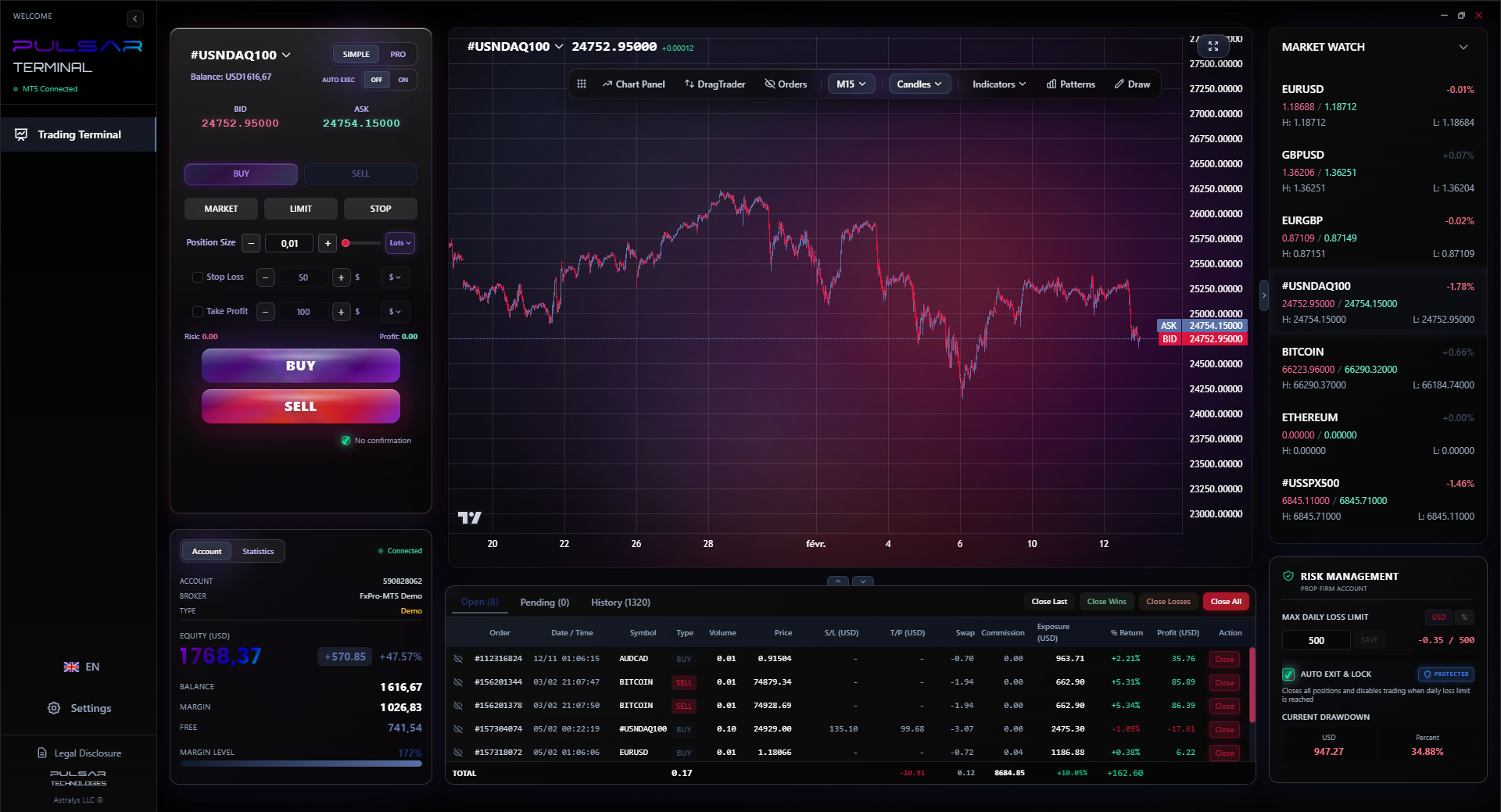
Sticking to a disciplined schedule is one thing, but managing multiple trades during volatile overlap sessions requires precise tools. Pulsar Terminal's drag-and-drop orders and multi-TP/SL management let you execute your session-based plan on MT5 without frantic clicking.
Pulsar Terminal
MT5 올인원 도구: 드래그앤드롭 주문, 다중 TP/SL, 트레일링 스톱, 그리드 트레이딩, 볼륨 프로파일, 프롭펌 보호. 매일 1,000명 이상의 트레이더가 사용.
“I lost count of the times I was right on the direction but annihilated by the timing.”
Knowing the schedule is one thing. Sticking to it requires discipline. Here’s what helps me:
- Use a Session Indicator: Most platforms have them. They visually shade the different sessions on your chart. It’s a constant reminder of what market you’re in.
- Set Trading Hours on Your Platform: Many brokers let you set ‘Allow Trading’ hours. I have mine set to only allow new orders from 8:45 AM to 5:45 PM SAST. It stops me from doing something stupid late at night.
- The Economic Calendar is Your Bible: Not just the event, but the time. Align high-impact events (red news) with high-liquidity sessions. Trading a US news release during London hours is normal. Trading a UK news release in the middle of the Tokyo session is messy.
, understanding forex working hours transformed my trading from reactive to proactive. It helped me identify which of my strategies actually worked and which were just lucky during a volatile period. It forced me to specialize. Am I a London session breakout trader? An Asian range scalper? You can't be both at once.
Your location in South Africa isn't a disadvantage. With the prime London session happening during our workday and the crucial overlaps accessible, we have a natural rhythm to follow. Stop fighting the market's clock. Start syncing your watch to it. The market opens and closes with or without you. Your job is to be there, ready and focused, when it matters most.
💡 윈스턴의 팁
Your edge isn't just your strategy, it's your strategy *applied at the right time*. A breakout strategy that fails in Tokyo may print money in London. Backtest by session, not just by pair.

FAQ
Q1What are the best forex working hours to trade in South Africa?
The absolute best hours are the London-New York overlap from 3 PM to 6 PM SAST. This period has the highest liquidity and volatility. For day traders, the entire London session (9 AM - 6 PM SAST) is superb, as it captures this overlap. For ZAR pairs, also focus on South African business hours (8 AM - 5 PM SAST).
Q2Is forex trading legal in South Africa and who regulates it?
Q3What is the worst time to trade forex for South Africans?
The worst time is between 10 PM SAST Friday and 10 PM SAST Sunday when the market is officially closed, and during the low-liquidity 'dead zone' between the New York close (10 PM SAST) and the Sydney session properly ramping up (after midnight SAST). Spreads are wide, and price can be erratic.
Q4How do I convert international forex market times to SAST?
South African Standard Time (SAST) is UTC+2. The key sessions in SAST are: Sydney opens 10 PM, Tokyo opens 12 AM, London opens 9 AM, New York opens 3 PM. The major closes are New York at 10 PM SAST on Friday, marking the weekly close.
Q5Does the South African Rand (ZAR) trade 24 hours a day?
While you can get a quote 24/5, the ZAR's most liquid and 'true' trading hours are during the South African business day when the JSE is open and local banks are active. Trading USD/ZAR at 3 AM SAST will come with much wider spreads and thinner liquidity compared to 10 AM SAST.
Q6What use can I use when trading forex in South Africa?
The FSCA limits use to a maximum of 30:1 for retail traders. Some brokers may offer lower. Professional clients who meet specific criteria (large portfolio, experience) can apply for higher use. Never max out your allowed use; it's the fastest path to a margin call.
Q7Can I trade successfully only during South African daytime hours?
Absolutely. In fact, it's recommended. Your 9 AM - 5 PM SAST workday captures the entire London session and the first few hours of New York. This is the most active and liquid period of the entire 24-hour cycle. You don't need to trade at night to be successful.
윈스턴 교수의 수업
핵심 요약:
- ✓Trade the London-New York overlap (3-6 PM SAST) for maximum liquidity.
- ✓Avoid trading ZAR pairs outside SA business hours (8 AM-5 PM SAST).
- ✓Never hold risky positions over the weekend market close (10 PM SAST Fri).
- ✓Align your strategy style (scalping, swing) with the appropriate session volatility.
이 기사가 얼마나 유용했나요?
별을 클릭하여 평가
주간 트레이딩 인사이트
무료 주간 분석 & 전략. 스팸 없음.
저자 소개
David van der Merwe
신흥시장 트레이더
요하네스버그 기반 트레이더로 신흥시장 통화 11년 경력. ZAR 통화쌍, FSCA 규제 거래, 남아공 시장 분석 전문.
댓글
위험 고지
금융 상품 거래에는 상당한 위험이 수반되며 모든 투자자에게 적합하지 않을 수 있습니다. 과거 성과가 미래 수익을 보장하지 않습니다. 이 콘텐츠는 교육 목적으로만 제공되며 투자 조언으로 간주되어서는 안 됩니다. 거래 전에 항상 직접 조사를 수행하십시오.
이 기사도 읽어보세요

Cara Trading Forex Sukses: 7 Prinsip dari Trader Profesional
Cara trading forex sukses dengan 7 prinsip trader pro: manajemen modal, disiplin, journal trading, backtest. Data nyata, bukan janji profit palsu.
Jam Trading Forex Terbaik untuk Trader Indonesia: Panduan Lengkap dengan Tabel Waktu
Panduan jam trading forex untuk trader Indonesia. Tabel 4 sesi dunia, jam emas 20:00-00:00, sesi mana yang harus dihindari. Data akurat + tips dari trader berpengalaman.
Top 5 Sàn Forex Uy Tín Nhất 2026: Review Jujur dari Trader Indonesia
Top 5 sàn forex uy tín 2026 untuk trader Indonesia. Review jujur: spread, deposit, withdraw, dukungan lokal. Exness, XM, IC Markets & lebih.
