


I lost R8,400 in a single morning back in 2019.

David van der Merwe
신흥시장 트레이더 ·  South Africa
☕ 11 분 소요
배울 내용:
- 1What Exactly Is the "Forex Zone" in South Africa?
- 2The Non-Negotiable Rules of the Zone
- 3The Real Costs: Spreads, Fees, and Minimums
- 4Trading the ZAR: Local Knowledge is Power
- 5Picking Your Broker in the SA Forex Zone
- 6Classic SA Trader Mistakes (I've Made Most)
- 7Building a Strategy That Works Here
- 8What's Next for the SA Forex Zone?
I lost R8,400 in a single morning back in 2019. I was trading USD/ZAR on an unregulated offshore broker, chasing a 100-pip move. The spread widened to 15 pips out of nowhere, my stop-loss got skipped, and the platform froze during a SARB announcement. The support desk? A Gmail address that never replied. That loss wasn't just bad luck; it was a tuition fee for ignoring the rules of the South African forex zone. Trading here isn't the wild west - it's a regulated financial market with specific pitfalls and massive opportunities if you know how to operate within the lines.
Forget vague metaphors. In South Africa, the 'forex zone' is the specific legal, regulatory, and practical environment where trading happens. It's defined by three hard borders: the FSCA's rulebook, the SARB's exchange controls, and the real-world mechanics of trading ZAR pairs.
You're not just trading charts; you're operating within a system. The FSCA caps your use at 30:1 for a reason. SARB limits how much you can send offshore (R1 million discretionary, R10 million investment allowance with tax clearance) for a reason. Brokers like IC Markets and Pepperstone offer FSCA-regulated entities here for a reason. Ignoring these boundaries is how you get burned.
The zone also has its own unique rhythm. Your most active trading window is 3 PM to 7 PM SAST when London and New York overlap. The most liquid instruments for locals aren't just EUR/USD, but USD/ZAR, EUR/ZAR, and GBP/ZAR - pairs with a volatility that can make majors look sleepy. Understanding this zone means knowing which battles to fight, and with what tools.

Warning: Trading with an unregulated broker might offer 500:1 use, but it also offers zero protection. If they vanish with your deposit, the FSCA can't help you. Your money is just gone.
The FSCA's use Hammer
Since 2021, the FSCA has set the retail use limit at 30:1 for major forex pairs. That's not a suggestion. For a standard lot (100,000 units), that means you need roughly $3,333 in margin. It feels restrictive, especially if you remember the old 100:1 days. I hated it at first. But after blowing a $5,000 account using 100:1 on a single GBP/JPY trade, I get it. The limit forces you to size properly. It makes a margin call less likely to sneak up on you. Some brokers offer higher use (like 100:1 or more) through their international entities, but you then forfeit FSCA protection. It's a trade-off you need to consciously make.
SARB and Your Money
This is where most traders get a nasty surprise. You can't just wire R500,000 to your broker in Cyprus. Exchange controls are real. As a resident, you have a Single Discretionary Allowance (SDA) of R1 million per year. Need to send more? You'll need a Tax Compliance Status (TCS) pin from SARS to access the Foreign Investment Allowance of R10 million. This isn't broker red tape; it's South African law. The smart move? Use a broker that offers a local ZAR account for deposits and withdrawals. It cuts out international wire fees and simplifies the paper trail.
Broker Legitimacy Check
Always verify the FSP number on the FSCA's website. Don't just trust the badge on a broker's homepage. A legit FSCA-licensed broker must segregate client funds, provide negative balance protection (so you can't owe more than you deposited), and give clear pricing. I only consider brokers like XM or Exness when they're operating under their local, regulated entity here.

💡 윈스턴의 팁
Your first R10,000 in the market isn't capital. It's tuition. Expect to pay it to learn the rules of the zone. The goal is to not have to pay it twice.
“A 30-pip spread on USD/ZAR means you're down R300 on a standard lot the moment you click buy.”
Let's talk numbers, because this is where your profit gets eaten. The 'forex zone' has a price of admission.
| Cost Factor | What It Is | Typical South African Range (2026) |
|---|---|---|
| EUR/USD Spread | The bid/ask difference | 0.0 - 0.8 pips (Raw/ECN vs. Standard) |
| Commission (if applicable) | Fee per lot traded | $3 - $7 per round turn (per 100k) |
| Minimum Deposit | To open an account | $0 - $250 (R0 - ~R4,600) |
| USD/ZAR Spread | Cost to trade the local pair | 25 - 50 pips during active hours |
| Inactivity Fee | Charged if you don't trade | $5 - $15 per month after 3-12 months |
Here's my experience: I used a 'commission-free' account with a 1.2 pip spread on EUR/USD. I was scalping, doing 20 trades a day. That's 24 pips in pure cost daily. Switching to a raw spread account at IC Markets with a 0.1 pip spread and $3.50 commission saved me over 0.8 pips per trade. For my volume, that was over $1,200 saved in a quarter. The math is non-negotiable.

Example: Trade 10 lots of EUR/USD monthly.
- Standard Account: 1.0 pip spread. Cost = 10 lots * 1.0 pip * $10/pip = $100
- Raw/ECN Account: 0.1 pip spread + $7 commission. Cost = (10 lots * 0.1 pip * $10) + (10 lots * $7) = $10 + $70 = $80 You save $20 monthly with the ECN account on this volume. Scale that up.
Also, note the USD/ZAR spread. It's huge compared to majors. A 30-pip spread means you're down R300 on a standard lot the moment you click buy. Your trade needs to move 30 pips just to break even. This massively affects your scalping strategy viability on ZAR pairs.
This is our home-field advantage. While everyone stares at EUR/USD, you can develop a real feel for the Rand. Pairs like USD/ZAR, EUR/ZAR, and GBP/ZAR are incredibly liquid but also prone to sharp, news-driven moves.
What Moves the Rand?
- SARB Interest Rate Decisions: The big one. A hike typically strengthens the ZAR (lowers USD/ZAR). I got caught short in 2022 expecting a 50bps hike; they did 75bps. USD/ZAR dropped 200 pips in minutes. I lost 1.5% of my account.
- Political & Economic Headlines: Load-shedding announcements, budget speeches, credit rating reviews. These cause gap risk over weekends.
- Commodity Prices: As a major exporter of gold, platinum, and coal, a rise in these often supports the ZAR. I often cross-reference the XAU/USD guide when trading ZAR pairs.
A Practical ZAR Strategy
I don't recommend scalping USD/ZAR because of the wide spread. Instead, I use a swing trading approach on the 4-hour chart. I wait for a clear trend, identified by higher highs/higher lows. I then wait for a pullback to a key Fibonacci level (like the 50% or 61.8% retracement) with a confirming signal from the RSI indicator coming out of oversold/overbought territory.
Real Trade Example (March 2026): USD/ZAR was in an uptrend. It pulled back from 18.9000 to 18.5500 (roughly a 50% Fib). The 4-hour RSI dipped to 35 and started curling up. I entered long at 18.5800. Stop loss at 18.4800 (100 pips). Take profit at 19.0000. The trade ran for a week and hit TP, netting 420 pips (less the 30-pip spread). That's a 4.2% move captured.
The key is patience. The ZAR rewards those who wait for the setup and respect the wider spread definition.
💡 윈스턴의 팁
A wide spread is the market's admission fee for volatility. On USD/ZAR, if you're not planning to capture at least 100 pips, you're just paying the ticket taker.
“Your edge comes from your own discipline and system, not from a Telegram channel.”
Your broker is your gateway. Choosing wrong adds friction, cost, and risk to every single trade. Here’s my blunt breakdown of what matters for a South African trader.
Regulation is the First Filter. FSCA license, full stop. Check the register. After that, prioritize these features:
- ZAR Account & Local Payment Methods: Can you deposit/withdraw in Rands via EFT, without international fees? This is a huge quality-of-life and cost-saving feature.
- Pricing on ZAR Pairs: What's the typical spread on USD/ZAR? Compare this between brokers. A 10-pip difference is a massive edge.
- Platform & Tools: MT4/MT5 are standard. But does the broker offer additional tools for analysis or risk management? This is where a platform environment matters.
- Customer Support: Call them. Ask a technical question about SARB reporting. See how long it takes to get a competent answer in your timezone.
I've traded with several. For pure raw spreads and execution, the FSCA entity of IC Markets is hard to beat. For beginners, XM's $5 minimum deposit and extensive educational resources are a gentler start. But you must do your own homework. A broker's marketing is designed to attract you; your job is to look past it to the cold, hard terms and conditions.

Pro Tip: Open a demo account with your top 2-3 choices. Trade the same USD/ZAR position on each at the same time for a week. Compare the fills, the spreads at 5 PM SAST, and the platform stability. This real-world test tells you more than any review.
Let me save you some money and frustration by listing the errors I see (and have committed) repeatedly.
Pitfall 1: Over-leveraging on ZAR Pairs. You see USD/ZAR moving 500 pips a day and think, "A small account with high use will get me rich." Wrong. The volatility will destroy you. With a 30-pip spread and 30:1 use, a 35-pip move against you can trigger a margin call. Use a position size calculator religiously. For ZAR pairs, I use half the position size I would for a major.
Pitfall 2: Ignoring SAST Trading Hours. Trying to trade the Tokyo session on USD/ZAR is like watching paint dry. The liquidity is terrible, spreads are wider, and moves are random. Focus your active trading day on the London open (10:00 SAST) through the London/NY overlap (15:00-19:00 SAST). Schedule your analysis for earlier, but place your trades when the market is alive.
Pitfall 3: Chasing "Signal Sellers" and Guru Nonsense. The FSCA issued warnings about these clowns for a reason. No one selling WhatsApp signals for R500 a month has a secret edge. I paid for two such services early on. One was just repackaged free news. The other was sending reckless 200-pip stop-loss trades. I lost more following them than I ever did on my own. Your edge comes from your own discipline and system, not from a Telegram channel.
Pitfall 4: Not Accounting for Total Cost. It's not just the spread. It's the commission, the potential currency conversion fee on your deposit, and the bank fee for an EFT. Add it all up. A trade that nets you a 50-pip win might only be 35 pips after all costs. Know your break-even, precisely.
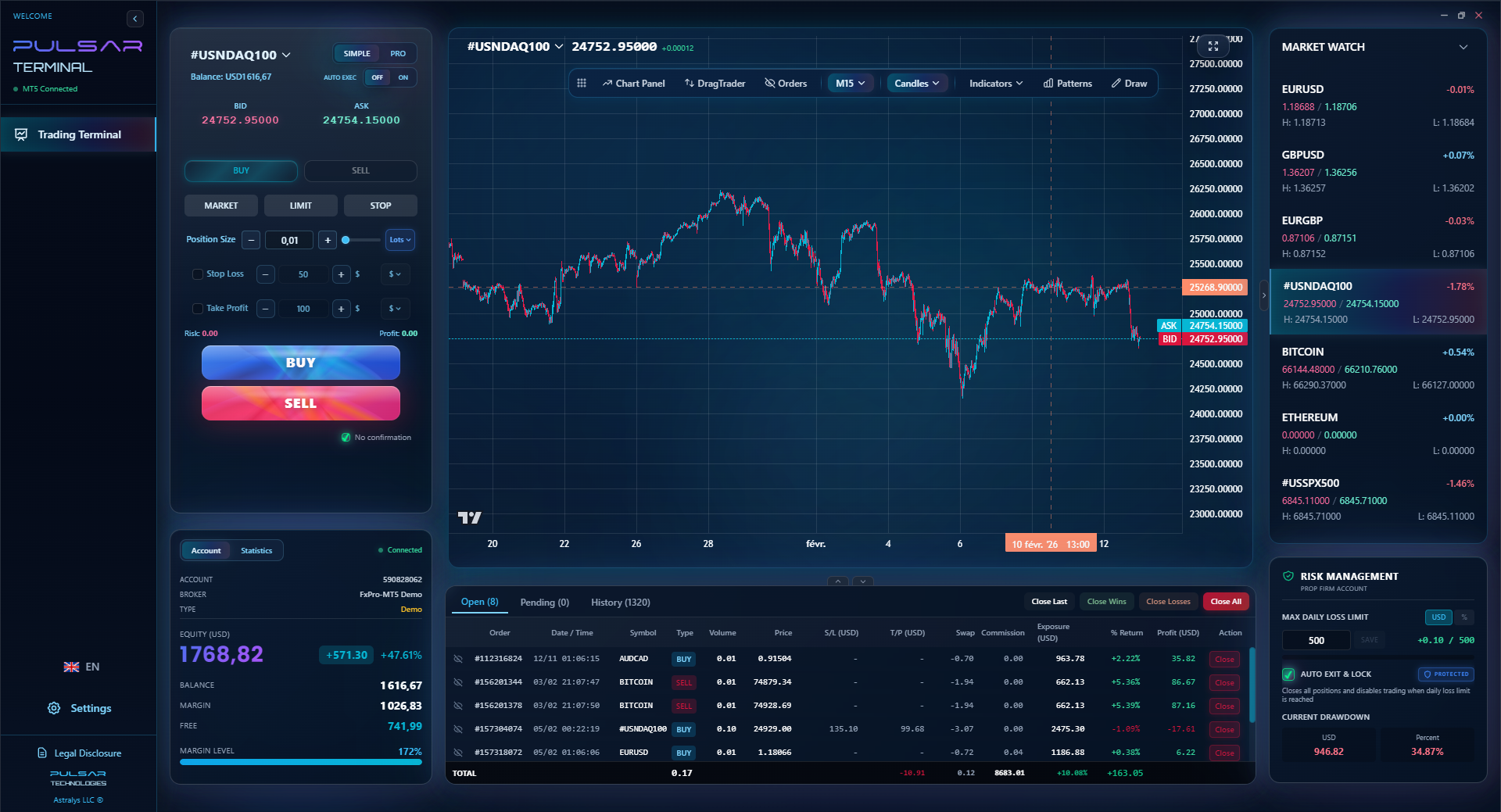
When trading volatile ZAR pairs, managing multiple take-profit levels and a trailing stop manually is stressful; Pulsar Terminal automates this entire process on your MT5 chart with drag-and-drop ease.
Pulsar Terminal
MT5 올인원 도구: 드래그앤드롭 주문, 다중 TP/SL, 트레일링 스톱, 그리드 트레이딩, 볼륨 프로파일, 프롭펌 보호. 매일 1,000명 이상의 트레이더가 사용.
“The South African forex zone is becoming a more serious, more regulated, and more sophisticated marketplace.”
Surviving in the forex zone long-term means building a process that fits its unique conditions.
Step 1: Define Your Timeframe. Given the ZAR's volatility and spread costs, I found 4-hour and daily charts most effective for directional bias. Use the 1-hour or 15-minute for precise entry. This aligns with the swing nature of the market.
Step 2: Use Confirmation, Not Prediction. Don't guess where USD/ZAR is going. Wait for the market to show you. I combine a trend filter (like a 50-period EMA on the 4H) with a momentum oscillator like the MACD indicator. I only look for trades in the direction of the 4H trend. When the MACD histogram crosses the zero line in that direction on the 1-hour chart, that's my signal to start looking for an entry. This keeps me from trying to pick tops and bottoms.
Step 3: Ruthless Risk Management. This is the core of your edge. My rule: Never risk more than 1% of my account on a single trade. For USD/ZAR, I often risk 0.5% because of the higher volatility. I set my stop-loss FIRST, based on technical levels, not on how much money I'm willing to lose. Then I use my position size calculator to determine the lot size that equates to my 0.5-1% risk.
Step 4: Journal Everything. Not just "bought USD/ZAR, won." Log the time, the spread, the economic news out, your emotional state, the chart pattern. I review my journal every Sunday. This is how I learned that my Tuesday afternoon trades had a 60% failure rate, likely because I was tired. I stopped trading on Tuesdays. Your journal tells you what works in your version of the forex zone.
💡 윈스턴의 팁
The FSCA's 30:1 use limit isn't a cage. It's a seatbelt. You'll only appreciate it when you would have otherwise crashed.
The landscape is maturing, fast. The FSCA's ODP (Over-the-Counter Derivatives Provider) regime is raising capital requirements for brokers, pushing out the cowboys. This is good for us - it means more stability and professionalization.
Crypto integration is the next frontier. The regulatory clarity from the FSCA means more brokers will offer crypto pairs alongside forex. We'll see more South Africans trading Bitcoin and Ethereum through the same platforms they use for USD/ZAR. The lines are blurring.
Technologically, MT5 is slowly becoming the standard over MT4, offering more timeframes, depth of market, and a better economic calendar. Traders who adapt to these new tools will have an advantage.
The bottom line? The South African forex zone is becoming a more serious, more regulated, and more sophisticated marketplace. The days of easy, reckless money are over. The opportunity for disciplined, informed traders who understand the rules of the game? That's just getting started. Your job is to know the rules better than anyone else at the table.
FAQ
Q1Is forex trading legal and safe in South Africa?
Yes, it's completely legal when done through a Financial Sector Conduct Authority (FSCA) licensed broker. The 'safety' depends on you. Using an FSCA-regulated broker provides crucial protections like client fund segregation and negative balance protection. The activity itself is safe; reckless trading is not.
Q2What is the maximum use I can use?
For retail traders, the FSCA mandates a maximum use of 30:1 on major currency pairs. Some brokers may offer higher use (e.g., 100:1 or 500:1) through their international entities, but you will not be protected by South African regulations if you choose that route.
Q3How much money do I need to start trading forex in South Africa?
Technically, you can start with as little as $5 (about R92) with some brokers like XM. However, practically speaking, starting with such a small amount under the 30:1 use limit severely limits your trade sizing and risk management. A more realistic starting capital for meaningful practice is between R5,000 and R20,000.
Q4Which currency pairs should a South African beginner trade?
Start with major pairs like EUR/USD or GBP/USD. They have the tightest spreads (often below 1 pip) and are less volatile than ZAR pairs. Avoid USD/ZAR initially - the wide spreads (25-50 pips) and high volatility make it a difficult and expensive pair to learn on.
Q5How do I withdraw profits from my forex trading account?
If your broker offers a ZAR account, you can withdraw directly to your South African bank account via EFT, usually within 1-3 business days. If your account is in USD, the broker will convert it to ZAR, and the funds will be subject to the normal bank processing and exchange rates. Larger amounts may attract attention regarding the source of funds, so keep your trading records.
Q6Do I pay tax on forex trading profits in South Africa?
Yes. The South African Revenue Service (SARS) views forex trading profits as income if you're trading frequently (seen as a revenue-generating activity). You are required to declare this income in your annual tax return. It's crucial to keep detailed records of all trades, deposits, and withdrawals. Consult a tax professional for advice specific to your situation.
Q7What's the best time of day to trade forex in South Africa?
The most active and liquid time is between 3:00 PM and 7:00 PM SAST. This is when the London and New York trading sessions overlap, creating the highest volume and best trading conditions. The London session alone (from 10:00 AM SAST) is also very good.
윈스턴 교수의 수업
핵심 요약:
- ✓FSCA regulation is your primary shield; never trade without it.
- ✓SARB exchange controls limit annual offshore transfers to R1m (R10m with tax clearance).
- ✓USD/ZAR spreads are 25-50 pips, making scalping nearly impossible.
- ✓The optimal trading window is 3 PM to 7 PM SAST.
- ✓Maximum retail use is 30:1; treat it as a risk-management tool.
이 기사가 얼마나 유용했나요?
별을 클릭하여 평가
주간 트레이딩 인사이트
무료 주간 분석 & 전략. 스팸 없음.
저자 소개
David van der Merwe
신흥시장 트레이더
요하네스버그 기반 트레이더로 신흥시장 통화 11년 경력. ZAR 통화쌍, FSCA 규제 거래, 남아공 시장 분석 전문.
댓글
위험 고지
금융 상품 거래에는 상당한 위험이 수반되며 모든 투자자에게 적합하지 않을 수 있습니다. 과거 성과가 미래 수익을 보장하지 않습니다. 이 콘텐츠는 교육 목적으로만 제공되며 투자 조언으로 간주되어서는 안 됩니다. 거래 전에 항상 직접 조사를 수행하십시오.
이 기사도 읽어보세요

Cara Trading Forex Sukses: 7 Prinsip dari Trader Profesional
Cara trading forex sukses dengan 7 prinsip trader pro: manajemen modal, disiplin, journal trading, backtest. Data nyata, bukan janji profit palsu.
Jam Trading Forex Terbaik untuk Trader Indonesia: Panduan Lengkap dengan Tabel Waktu
Panduan jam trading forex untuk trader Indonesia. Tabel 4 sesi dunia, jam emas 20:00-00:00, sesi mana yang harus dihindari. Data akurat + tips dari trader berpengalaman.
Top 5 Sàn Forex Uy Tín Nhất 2026: Review Jujur dari Trader Indonesia
Top 5 sàn forex uy tín 2026 untuk trader Indonesia. Review jujur: spread, deposit, withdraw, dukungan lokal. Exness, XM, IC Markets & lebih.
