


You want to trade gold (XAU/USD) from Nigeria, but your trades keep getting stopped out during dead hours.

Olumide Adeyemi
서아프리카 트레이딩 선구자 ·  Nigeria
☕ 11 분 소요
배울 내용:
- 1Why Timing Gold is Everything (And Why You're Probably Wrong)
- 2The Best Time to Trade Gold from Nigeria (It's a 3-Hour Window)
- 3The Full 24-Hour Gold Session Breakdown (What Really Happens)
- 4Nigerian Broker Realities: Spreads, Fees & The Naira Problem
- 5Practical Strategies for Each Time Window
- 6The 3 Biggest Mistakes Nigerian Gold Traders Make
- 7Your Gold Trading Setup for 2026: What You Actually Need
You want to trade gold (XAU/USD) from Nigeria, but your trades keep getting stopped out during dead hours. You're watching the chart move, but your P&L isn't. The problem isn't your strategy - it's your timing. Most Nigerian traders blow their accounts because they trade gold when it's asleep, then panic when it finally wakes up. I lost over $1,200 in 2018 figuring this out the hard way. Let's break down the exact clock you should be watching.
Gold isn't like EUR/USD. It doesn't just follow economic calendars blindly. It's a moody, macro beast that sleeps for 18 hours and then erupts in a 6-hour frenzy. If you're trading it like a currency pair, you're already behind.
My first major gold loss taught me this. Back in 2018, I saw a perfect pin bar setup on the 4-hour chart during the Asian session (around 3 AM WAT). I went long at $1,298, placed a tight stop, and went to bed feeling clever. I woke up to a stop-out at $1,295. The price then rallied exactly as I predicted, hitting my original target of $1,310. I was right on direction, but dead wrong on timing. The market needed to shake out weak hands like mine before the real London players showed up.
That's the core lesson: Gold has specific liquidity windows. Outside those windows, the price action is often meaningless noise designed to trap retail traders. The big banks and funds aren't actively moving the metal at 2 AM Lagos time. You're just trading against other retail punters and algos, which creates choppy, unpredictable moves. For a detailed look at the instrument itself, our XAU/USD guide breaks down its unique drivers.

Warning: Trading gold during low-liquidity sessions (Asian, early European) dramatically increases your risk of getting ‘whipsawed’ - stopped out right before a big move in your intended direction. Your analysis can be perfect, but your timing can still bankrupt you.

💡 윈스턴의 팁
The market pays you to be patient, not to be busy. If you're placing more than 2-3 gold trades a week, you're trading the noise, not the trend.
“The London-New York overlap isn't just a good time to trade gold; it's the only real time for a retail trader to have a consistent edge.”
For a trader in Lagos, Abuja, or Port Harcourt, there is one undisputed king of gold forex trading time: the London-New York overlap. This runs from 2:00 PM to 5:00 PM West Africa Time (WAT).
Why is this window so critical?
Liquidity and Volatility Converge
During this period, the two largest financial centers in the world are both open. The London bullion market (the physical gold hub) is in full swing, and the New York futures market (COMEX) opens. This creates a massive surge in real volume. We're not talking about broker volume indicators, but actual institutional orders moving billions of dollars worth of metal.
This translates to two things you care about:
- Tighter Spreads: The bid-ask spread compresses. Instead of paying 50-80 cent spreads (common with some local brokers off-peak), you might see spreads as low as 20-30 cents. That directly saves you money on every entry and exit. You can check typical costs in our spread definition guide.
- Cleaner Price Action: With so many participants, the market moves with more conviction. False breakouts are less common, and trends have more momentum. This is when your technical analysis - support/resistance, trendlines - actually has a higher probability of working.
The News Catalyst
Most top-tier US economic data (CPI, NFP, Fed decisions) is released at 1:30 PM or 2:00 PM WAT. This means the news drops right at the start or just before this golden overlap. The market's reaction to news during high liquidity is more sustainable. The same news released during the Asian session often leads to a sharp, fake spike that reverses completely by London open.

Example: Let's say the US CPI comes out hot at 1:30 PM WAT, suggesting higher inflation. Gold (a hedge against inflation) might spike $15 in 5 minutes. During the London-New York overlap, that move is likely to hold and trend further. At 4 AM WAT, that same spike would often get completely retraced within the hour.
“If you can't name the macro driver for your gold trade, you're not investing in a hedge - you're gambling on squiggles.”
Let's walk through a typical trading day for XAU/USD, through the eyes of a Nigerian trader. This isn't broker marketing fluff; this is what the order flow actually looks like.
| Session (WAT) | Time (WAT) | Who's Active? | What Happens to XAU/USD | Should You Trade? |
|---|---|---|---|---|
| Asian Session | 12:00 AM - 7:00 AM | Asian banks, Retail traders (AU, JP). | Choppy, range-bound. Often reacts to late US news. Low volatility. | NO. Set alerts, plan trades, but avoid entries. Price often reverses London open. |
| Early European | 7:00 AM - 2:00 PM | European banks, funds. Liquidity builds. | Direction starts to form. Good for confirming Asian session ranges. | CAUTIOUSLY. Can look for setups anticipating the London open. Avoid chasing. |
| London-New York Overlap | 2:00 PM - 5:00 PM | EVERYONE. Institutional peak. | High volatility, strong trends. Real moves happen here. News reactions are true. | YES. This is your primary trading window. Execute your best setups. |
| New York Close | 5:00 PM - 10:00 PM | US funds, some late Europe. | Volatility slows but can have late US-driven moves. | Maybe, for swing holds. Good time to manage existing positions. |
| Dead Zone | 10:00 PM - 12:00 AM | Very thin markets. | Erratic, prone to spikes on minimal volume. | ABSOLUTELY NOT. Step away from the charts. |
A personal rule I've stuck to for 5 years: I don't place any new gold trades between 10 PM and 10 AM WAT. That discipline alone saved me from countless nonsense losses. This session-based approach is a core part of a successful swing trading mindset.

Pro Tip: Use the Asian and Early European sessions to do your homework. Mark your key levels on the chart, set price alerts, and plan your trades. Then, be patient. Wait for the 2 PM WAT overlap to confirm your bias before hitting the buy or sell button. Let the market come to you.
“If you can't name the macro driver for your gold trade, you're not investing in a hedge - you're gambling on squiggles.”
Here's a harsh truth your broker won't tell you: the advertised 'from 0.0 spread' on gold is almost never available to a retail trader in Nigeria during your most important trading hours. Let's get real about costs.
When volatility spikes during the London-New York overlap, broker spreads widen. It's a simple risk management tactic on their end. That '5 cent' spread can blow out to 80 cents or more in a flash. I've seen it happen during a Fed announcement where my intended entry price was completely skipped due to spread expansion.
Broker Models Matter:
- Commission-Based Accounts (Raw Spread): Brokers like IC Markets or Pepperstone offer raw spreads from 0.0 but charge a commission per lot (e.g., $3.50 per side). Your total cost = spread + commission. This is often cheaper for gold trading during high volatility, as the spread stays tight. Calculate your true cost with our position size calculator.
- Spread-Only Accounts: Brokers like XM or Exness bake their cost into the spread. During calm markets, it looks great. During news, the spread widening can murder a scalper's profit. For a fast-paced approach, understand the mechanics in our scalping strategy guide.
The Naira & Tax Headache: If you're funding in Naira, you have a hidden currency risk. Your broker converts your deposit to USD. If the Naira weakens further, your next deposit buys fewer dollars. More critically, the 10% Capital Gains Tax on profits is real. You must factor this into your profit targets. A trade that nets a 5% return before tax becomes a 4.5% return after tax - it changes your risk-reward math completely.
My advice? If you're serious about trading gold, use a broker with a transparent commission structure. Know your all-in cost per trade before you enter. And always, always assume spreads will be at their worst when you most need to get in or out.
💡 윈스턴의 팁
Your most important tool isn't an indicator; it's the clock on your wall. Sync your trading activity to the market's heartbeat, not your boredom.
“A move of $10 in gold can happen in minutes. Using a EUR/USD position size for XAU/USD is how accounts get deleted.”
Your strategy must adapt to the clock. Here’s how I approach different parts of the day.
The Asian Session (12 AM - 7 AM WAT): The Planning Phase Don't trade. Just plan. Identify the previous day's high and low, major Fibonacci levels, and volume profile points of control. Use this time to run your MACD indicator or RSI indicator scans on higher timeframes (4H, Daily). Place pending orders at key levels if you must, but use wide stops expecting a possible London-open fakeout.
The London-New York Overlap (2 PM - 5 PM WAT): The Execution Phase This is go-time. Two strategies work consistently here:
- Breakout Trading: After the initial 30-60 minutes of the overlap, gold often establishes a range. A break above the high or below the low of this first hour range has a high chance of running. I caught a beautiful $25 move in March 2025 using this. Price consolidated between $4,210 and $4,225 from 2-2:45 PM, then broke north. Entry on the retest of $4,225, target at $4,250.
- News Fade/Follow: If major news drops at 1:30 PM, wait for the initial spike. If the spike fails to break a major daily level and the RSI indicator shows overbought/oversold on the 15-minute chart, a fade during the overlap can work. The key is waiting for the institutional order flow to show exhaustion.
Managing Overnight Positions If you hold a swing trade overnight, you must be aware of the 'Dead Zone' (10 PM - 12 AM WAT). Liquidity evaporates. A $5 move against you here is meaningless but can trigger your stop. Either use a ridiculously wide stop (based on Daily ATR) or move your stop to breakeven before this period. Tools that automate this, like trailing stops, are useful. Managing this risk is crucial to avoid a margin call.
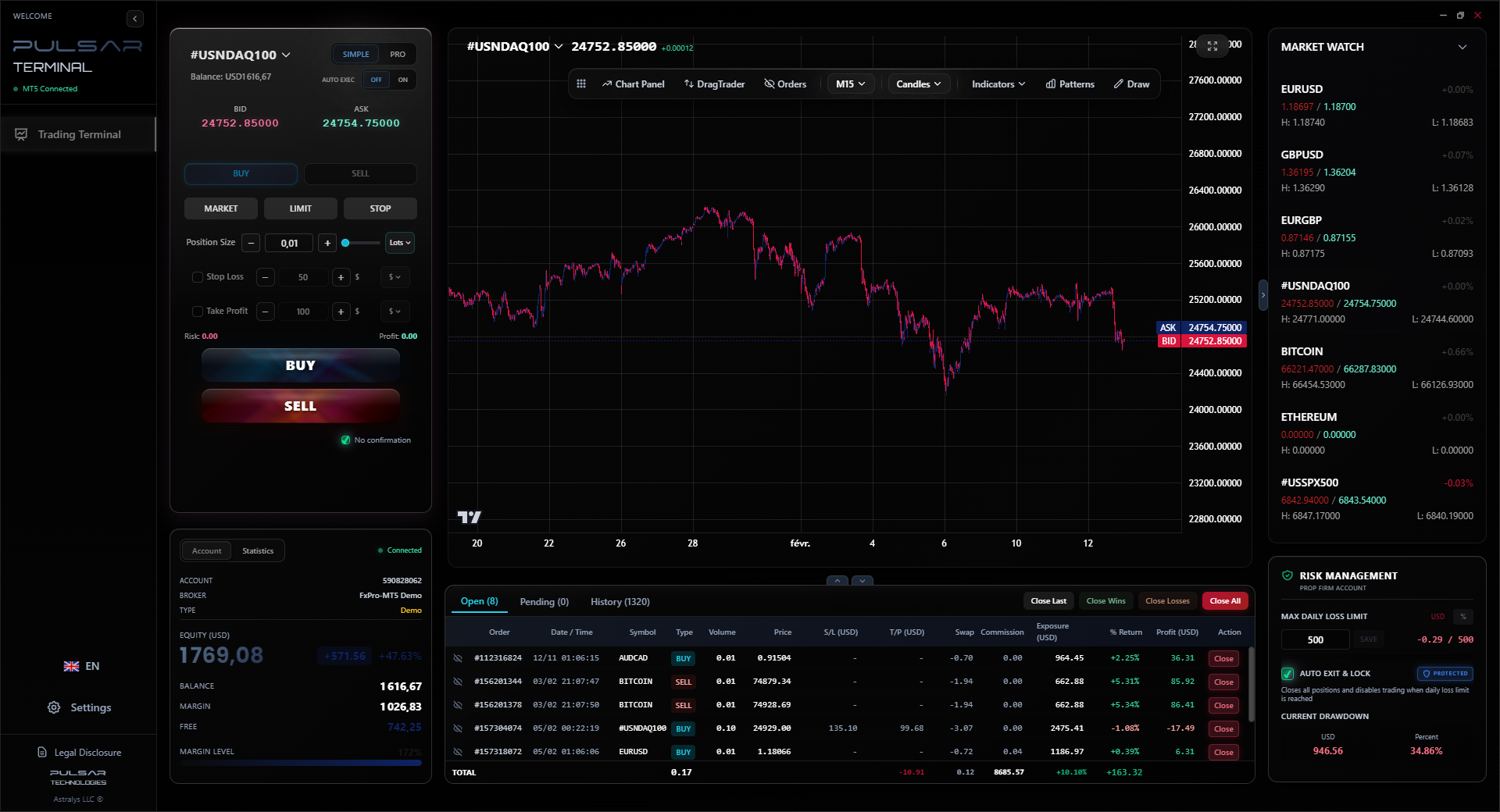
Managing precise stop-losses and taking partial profits during gold's volatile spikes is nearly impossible manually, which is why tools like Pulsar Terminal that automate these actions directly on your MT5 chart are essential.
Pulsar Terminal
MT5 올인원 도구: 드래그앤드롭 주문, 다중 TP/SL, 트레일링 스톱, 그리드 트레이딩, 볼륨 프로파일, 프롭펌 보호. 매일 1,000명 이상의 트레이더가 사용.
“A move of $10 in gold can happen in minutes. Using a EUR/USD position size for XAU/USD is how accounts get deleted.”
I've coached dozens of traders here, and the blow-up patterns are always the same.
1. Chasing the Asian Session Ghost: You see a nice 15-minute candle move at 4 AM and jump in. The move stalls, you get bored, you reverse, and then the real move begins at 2 PM in your original direction. You're now in a losing counter-trend trade with real momentum against you. Solution: Turn off your charts before bed.
2. Ignoring the True Cost of a Pip: A move of 100 pips in EUR/USD is roughly $1000 on a standard lot. A move of $10 (1000 points) in gold is $1000 on a standard lot (1 lot = 100 oz). But the volatility is different. Gold can move $10 in minutes during overlap; EUR/USD might take hours. Traders use the same position size for both and get vaporized by gold's speed. You must size smaller for gold.
3. Trading Without a Macro Catalyst: Gold needs a story. Is the dollar weakening? Is there geopolitical fear? Are real yields falling? If you can't name the macro driver for your trade, you're just gambling on squiggles. In 2025, the driver was inflation and central bank buying. In early 2026, the story shifted to a stronger dollar. Trading against the dominant macro story is a fast track to losses.
Warning: The most expensive lesson is believing you can outsmart the market's opening hours. You can't. The market opens for business at 2 PM WAT. If you're trading before then, you're not trading the market - you're trading your broker's internal order book against other retail clients. The house always wins that game.
💡 윈스턴의 팁
A losing trade entered at 2:30 PM WAT is smarter than a winning trade entered at 3:30 AM. One is a strategic error; the other is a disciplinary failure.
“The market opens for business at 2 PM WAT. Trading before that is just paying for your broker's new car.”
Forget the fancy indicators. Here's the minimalist setup that works.
Platform & Hardware:
- MT5 over MT4: MT5 has better built-in tools for commodities and deeper timeframes. Most serious brokers support it, like IC Markets.
- A Reliable Internet Connection: This is non-negotiable. A dropout during the 2 PM overlap can cost you thousands. Have a mobile hotspot as a backup.
- Two Monitors: One for the chart, one for your economic calendar and trade journal. Trying to do it all on a laptop screen leads to missed context.
Critical Chart Tools:
- Volume Profile (or Market Profile): This shows you where most trading activity happened. The 'Point of Control' (POC) is a massive magnet for price during the London session. I won't take a trade without checking where the previous day's POC is.
- Simple Moving Averages: The 50 and 200-period EMA on the 1-hour chart define the medium-term trend. During the overlap, pullbacks to these averages offer high-probability entries in the direction of the trend.
- An Economic Calendar: Filter for 'High' impact events only. You need to know when the Fed speaks, when CPI drops. Plan to be flat or have very wide stops 5 minutes before and during these events.
The Mental Tool: A trading journal. After every trade, note:
- Entry/Exit Time (WAT)
- Session (Asian, Overlap, etc.)
- The macro catalyst (or lack thereof)
- Result After 20 trades, you'll see the pattern: your winning trades will overwhelmingly cluster between 2 PM and 5 PM WAT. That's not a coincidence; it's evidence.
FAQ
Q1Can I trade gold (XAU/USD) 24 hours a day from Nigeria?
Technically, yes. The market is open from Sunday evening to Friday night. But practically, no. The only time with reliable, trend-following liquidity for a retail trader is during the London-New York overlap (2 PM - 5 PM WAT). Trading outside this window is highly risky, with wider spreads and choppy price action that often reverses.
Q2What is the best timeframe to trade gold from Nigeria?
During the active overlap session (2 PM - 5 PM WAT), the 15-minute and 1-hour charts are most effective. They capture the intraday momentum without the noise of lower timeframes. For analysis and planning, use the 4-hour and Daily charts. Never base a trade solely on a 1-minute or 5-minute chart.
Q3Do spreads on gold get wider for Nigerian traders?
Spreads are determined by global liquidity and your broker's model, not your location. However, when you trade matters. Spreads are widest during low-liquidity periods (Asian session, around news events) and tightest during the high-liquidity London-New York overlap. A Nigerian trader trading at 3 AM will face much wider spreads than one trading at 3 PM.
Q4Is it better to use a commission-based or spread-only account for gold?
For active trading during volatile periods, a commission-based (raw spread) account is usually cheaper and more predictable. You pay a fixed fee per trade. On a spread-only account, the spread can widen dramatically during news, increasing your cost unpredictably. Always calculate the total cost (spread + commission) per lot before choosing.
Q5How does the 10% Capital Gains Tax in Nigeria affect my gold trading?
It directly reduces your net profit. You must account for it in your risk-reward calculations. If your trading strategy aims for a 10% return, after tax it's 9%. This means you need to be more precise or adjust your position sizing to meet your financial goals after the tax man takes his share.
Q6What's the biggest mistake beginners make with gold trading times?
They confuse activity for opportunity. Just because the chart is moving at 5 AM doesn't mean it's a good trade. That movement is often low-volume noise. The biggest mistake is not having the discipline to wait for the main trading session (2 PM - 5 PM WAT) to confirm their ideas.
Q7Can I trade gold on weekends?
No. The global spot gold (XAU/USD) market is closed from Friday evening until Sunday evening (WAT). Any "weekend trading" you see offered is either a derivative with massive spreads or a complete scam. The real market is closed.
윈스턴 교수의 수업
핵심 요약:
- ✓Trade gold only between 2 PM and 5 PM WAT.
- ✓Size positions 30-50% smaller than for forex pairs.
- ✓Use raw spread + commission accounts for cost clarity.
- ✓Factor the 10% capital gains tax into all profit targets.
- ✓Let the Asian session be for planning, not trading.
이 기사가 얼마나 유용했나요?
별을 클릭하여 평가
주간 트레이딩 인사이트
무료 주간 분석 & 전략. 스팸 없음.
저자 소개
Olumide Adeyemi
서아프리카 트레이딩 선구자
나이지리아에서 가장 활발한 외환 트레이딩 교육자 중 한 명. 라고스에서 8년간 트레이딩 경험. 아프리카 트레이더를 위한 소자본 전략과 프롭 펌 챌린지 전문.
댓글
위험 고지
금융 상품 거래에는 상당한 위험이 수반되며 모든 투자자에게 적합하지 않을 수 있습니다. 과거 성과가 미래 수익을 보장하지 않습니다. 이 콘텐츠는 교육 목적으로만 제공되며 투자 조언으로 간주되어서는 안 됩니다. 거래 전에 항상 직접 조사를 수행하십시오.
이 기사도 읽어보세요

Cara Trading Forex Sukses: 7 Prinsip dari Trader Profesional
Cara trading forex sukses dengan 7 prinsip trader pro: manajemen modal, disiplin, journal trading, backtest. Data nyata, bukan janji profit palsu.
Jam Trading Forex Terbaik untuk Trader Indonesia: Panduan Lengkap dengan Tabel Waktu
Panduan jam trading forex untuk trader Indonesia. Tabel 4 sesi dunia, jam emas 20:00-00:00, sesi mana yang harus dihindari. Data akurat + tips dari trader berpengalaman.
Top 5 Sàn Forex Uy Tín Nhất 2026: Review Jujur dari Trader Indonesia
Top 5 sàn forex uy tín 2026 untuk trader Indonesia. Review jujur: spread, deposit, withdraw, dukungan lokal. Exness, XM, IC Markets & lebih.
