


Let's be honest, most traders I meet think tax is something you only worry about once you're making millions.

David van der Merwe
신흥시장 트레이더 ·  South Africa
☕ 10 분 소요
배울 내용:
Let's be honest, most traders I meet think tax is something you only worry about once you're making millions. Or worse, they believe some online myth that forex profits are 'tax-free' if you use an offshore broker. That's a fast track to a nasty letter from SARS. The truth is, understanding how do forex traders pay tax in South Africa is one of the most important parts of your trading business. It's not just about compliance; it's about keeping more of your hard-earned profits. I've seen too many guys get a nasty shock come tax season. Let's set the record straight with the real rules, rates, and strategies for 2026.
This is where most of the confusion starts. SARS doesn't just look at what you call your trading; they look at what you actually do. Your trading activity determines if your profits are taxed as ordinary income or as a capital gain, and the difference in your tax bill can be huge.
Income Tax (Trading as a Business) If you're trading frequently, systematically, and with the clear intention of making short-term profits, SARS will likely see you as running a business. Think about it: you have a strategy, you're analyzing charts daily, maybe you're even using a scalping strategy. In their eyes, you're a professional. Your total net profit for the year gets added to your other income (like your salary) and is taxed at the normal progressive rates, which for 2026/27 range from 18% up to 45%.
Capital Gains Tax (CGT) This is for the longer-term investor. Maybe you hold positions for weeks or months, trade infrequently, and it's more of a side activity than a primary focus. If SARS agrees with this classification, only 40% of your net capital gain is included in your taxable income. That 40% slice is then taxed at your marginal rate. So, if you're in the top tax bracket, your effective CGT rate is 45% of 40%, which is 18%. That's a massive saving compared to the full 45%.

Warning: You can't just choose which one you want. SARS looks at the facts: frequency, volume, organization, and financing. I made the mistake early on of assuming my few trades a week would be CGT. My accountant set me straight after reviewing my 300+ trades in a year. It was clearly income.
The key is consistency and documentation. You need to be able to justify your position to SARS if they ask. This isn't a grey area you want to play in.

💡 윈스턴의 팁
Your trading log isn't just for review. It's your first line of defense in a tax audit. If your journal notes match your broker statements, SARS has little to question.
“SARS doesn't just look at what you call your trading; they look at what you actually do.”
Here's the good news. If your trading is classified as a business (income tax), you can deduct all your "wholly and exclusively" incurred expenses. This is how you legally shrink your taxable profit. You need receipts and records for everything.
Common Deductible Expenses:
- Platform & Data Fees: Monthly subscriptions for TradingView, extra data feeds, or premium features on your broker's platform.
- Broker Commissions & Spreads: The cost of doing business. While the spread isn't a separate line item, your net profit/loss already accounts for it. Keep detailed statements from your broker, like IC Markets or Pepperstone.
- Home Office Costs: A portion of your rent, electricity, and internet. You need to calculate the square meterage of your dedicated trading space.
- Hardware & Software: Your trading computer, monitors, and any specialized software. You can often claim depreciation over a few years.
- Education: Books, courses, and mentorship programs directly related to improving your trading. That R5,000 course on price action? Potentially deductible.
- Professional Fees: Your accountant's bill (a must-have) and legal advice.
- Bank Charges: Fees for international transfers to and from your broker.
A Real Example from My Books: Last tax year, my net trading profit from my main account was R220,000. Sounds great, right? But after deducting R12,000 for platform fees, R8,000 for a new monitor, R15,000 for home office allocation, and R7,000 for accountant fees, my taxable income from trading was reduced to R178,000. That deduction saved me thousands in tax.

Pro Tip: Open a separate business bank account for all trading-related inflows and outflows. It makes tracking these expenses for your accountant a million times easier and looks more professional to SARS.
“Getting your tax right is a boring but critical part of the trading game. It's what separates the hobbyists from the professionals.”
If you expect to owe more than R1,000 in tax for the year (which you will if you're profitable), you must register as a provisional taxpayer with SARS. This means you don't pay your tax in one lump sum at year-end; you pay it in advance in installments.
The Tax Year: March 1 to February 28/29.
Key Deadlines You Can't Miss:
- First Provisional Payment: Due by the end of August. You estimate your total year's tax liability and pay at least half.
- Second Provisional Payment: Due by the end of February. You settle up based on a more accurate estimate.
- Top-Up Payment (if needed): Six months after the year-end (end of August) if you still underpaid.
- Annual Return (ITR12): For provisional taxpayers, this is typically due by the end of January. Mark it in your calendar!
How to Estimate: This is the tricky part, especially when your income is volatile. You base it on your most recent actual taxable income. If this is your first year, you estimate. If you underestimate by too much, SARS can charge penalties and interest. I learned this the hard way in my second year. I had a great Q1 and estimated high, then the market turned. My actual profit was lower, but I'd already overpaid my provisional tax. Getting that refund was a slow process.
The Golden Rule: Keep a simple spreadsheet updated monthly. Track your net profit/loss, your expenses, and run a rough tax calculation. A good position size calculator helps you manage risk; a simple profit/loss tracker helps you manage your tax liability. Don't let this admin slide.
💡 윈스턴의 팁
Never estimate your provisional tax based on your best month. Use a rolling 12-month average of your net profit. It's conservative and keeps you out of penalty territory.
“Choose your broker based on trading conditions, not a false hope of tax avoidance.”
Short answer: For tax purposes, no.
Longer answer: South Africa taxes its residents on their worldwide income. It doesn't matter if your broker is in Cyprus, the Seychelles, or Sandton. All your trading profits, regardless of where the broker is based, must be declared to SARS.
However, your choice of broker does have other practical implications:
FSCA-Regulated Brokers (Local or International): Brokers like CM Trading or the South African entities of Exness or XM that are regulated by the Financial Sector Conduct Authority (FSCA) offer a layer of local recourse. Deposits and withdrawals in ZAR are usually easier and cheaper. Some may even issue a tax certificate (IT3), though this is rare for trading profits. Don't rely on it.
International Brokers: You might get better spreads, like the raw 0.1 pips on EUR/USD from IC Markets, or higher use. The trade-off is dealing with currency conversion. You must convert all your profits and losses to ZAR at the official SARS average exchange rate for the tax year. Your bank statements showing the FX conversions are crucial proof.

Example: You withdraw $1,000 profit from your broker. The SARS average USD/ZAR rate for the year is 18.50. You declare R18,500 as income. You must keep the broker statement showing the $1,000 profit and your bank statement showing the ZAR deposit as proof of the conversion.
The bottom line? Choose your broker based on trading conditions, not a false hope of tax avoidance. SARS is getting very good at tracking international financial flows.
“Choose your broker based on trading conditions, not a false hope of tax avoidance.”
Once you're consistently profitable, it's worth thinking about the structure you trade through. Trading in your personal name is fine to start, but there might be better options.
Trading as a Sole Proprietor (You): Simple. All profits are your personal income. You get the personal expenses deductions we talked about. The downside? Your personal assets are on the line if you somehow get into debt (unlikely with sensible trading, but still).
Trading Through a Private Company (Pty Ltd): This is where it gets interesting for serious traders. As of 2026, companies pay a flat tax rate of 27% on taxable profits. Compare that to the top personal rate of 45%.
Let's run some numbers: Say you make a net profit of R500,000 from trading.
- As an Individual (Top Bracket): Tax = ~R185,000 (45% on R500k less some deductions). You keep R315,000.
- Through a Company: Company tax = R135,000 (27% of R500k). The company keeps R365,000.
Now, that R365,000 in the company isn't in your pocket yet. To get it out as a salary, you'd pay personal income tax. But you can leave it in the company to grow your trading capital, invest in other assets, or pay it out as dividends (which have different tax implications). It offers flexibility and potential deferral.
Other Options:
- Tax-Free Savings Account (TFSA): You can't trade forex directly in a TFSA. But you can use your trading profits to max out your annual TFSA contribution (R46,000 for 2026/27). The growth inside the TFSA is tax-free forever. It's a great way to park some of your profits.
- Retirement Annuity (RA): Contributions are tax-deductible. Again, you can't trade forex in an RA, but you can use trading profits to make a deductible contribution, lowering your taxable income for the year.
Structuring is a conversation for a qualified tax professional. Don't try to figure this out from a blog post. But know that options exist beyond just trading from your personal account.
💡 윈스턴의 팁
Deductions are a right, not a privilege. That high-speed internet you need for trading? Calculate the percentage of use for business and claim it. Every rand deducted is a rand not taxed.
“A good accountant who understands trading will save you more in tax and stress than they cost.”
I've made mistakes, seen friends make them, and helped clients fix them. Here are the big ones.
1. Not Keeping Proper Records. This is the number one failure. You need a clear, month-by-month audit trail.
- Broker statements (PDFs, not just screenshots).
- Bank statements showing all deposits and withdrawals.
- Receipts for every single expense you plan to deduct.
- A trading journal that ties your strategy to your activity. Use a simple spreadsheet or a dedicated journal. Tools like Pulsar Terminal can help log trades, but you still need the official statements.
2. Ignoring Provisional Tax. Thinking "I'll just pay it all at the end" will get you penalized. SARS charges interest on late provisional payments. Register as soon as you start trading with real money.
3. Mixing Personal and Trading Money. That R500 withdrawal for groceries from your trading account? It muddies the waters. It makes expense tracking a nightmare and can raise red flags. Use separate accounts.
4. Assuming Trading Losses Are "Written Off". If you're taxed as a business, your net loss for the year can be offset against other income (like your salary), reducing your overall tax bill. Or, it can be carried forward to offset future trading profits. Don't just shrug off a bad year; it has a tax silver lining. Document those losses carefully.
5. Going It Alone Without an Accountant. This is false economy. A good accountant who understands trading will save you more in tax and stress than they cost. They know the latest SARS interpretations, can help with structuring, and are your advocate if SARS ever queries your return. I pay mine R10,000 a year, and he's saved me at least triple that every single time.
Getting your tax right is a boring but critical part of the trading [game]. It's what separates the hobbyists from the professionals who build lasting wealth.
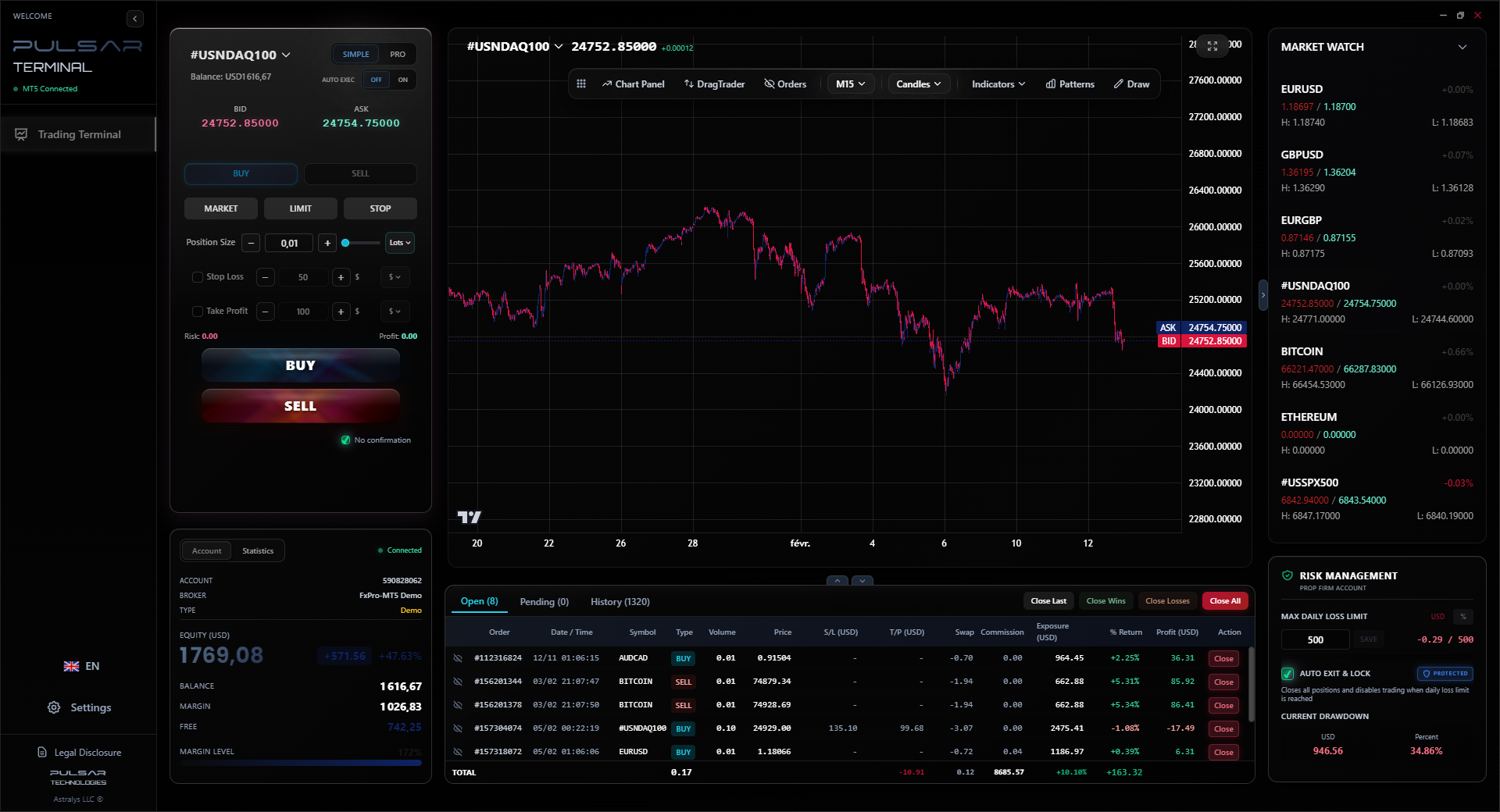
Keeping a precise, automated trade journal is the foundation of tax compliance, and Pulsar Terminal logs every entry, exit, and modification directly on your MT5 charts for effortless record-keeping.
Pulsar Terminal
MT5 올인원 도구: 드래그앤드롭 주문, 다중 TP/SL, 트레일링 스톱, 그리드 트레이딩, 볼륨 프로파일, 프롭펌 보호. 매일 1,000명 이상의 트레이더가 사용.
FAQ
Q1Do I pay tax on every single winning trade?
No, you pay tax on your net profit for the entire tax year (March to February). You add up all your winning trades, subtract all your losing trades and your deductible expenses. You pay tax on that final number.
Q2What if I use an international broker like IC Markets or Pepperstone?
It makes no difference for tax liability. You are a South African tax resident, so you must declare all worldwide income to SARS. You will need to convert all your profits and losses to ZAR using the official SARS average exchange rates for the year and keep all your foreign bank statements as proof.
Q3How do I prove my trading losses to SARS?
With detailed, chronological records. Your broker's monthly and annual statements are the primary proof. These should clearly show your opening/closing trades, profits, losses, and running balance. A well-kept trading journal that aligns with these statements adds further credibility.
Q4When should I register as a provisional taxpayer?
As soon as you start trading with real money and reasonably expect your tax liability for the year to be over R1,000. It's better to register early and make a small first payment than to be late and face penalties.
Q5Can I deduct the cost of a trading course or mentorship?
Yes, if your trading is classified as a business (income tax). The cost of education directly related to improving your trading skills and generating income is generally a deductible expense. Keep the invoice and receipt.
Q6What is the single most important thing for forex tax compliance?
careful, organized, and permanent record-keeping. Assume SARS will ask to see your documents for the last 5 years. If you have broker statements, bank records, and expense receipts neatly filed (digitally is fine), you can handle any query.
윈스턴 교수의 수업
핵심 요약:
- ✓Trading frequency determines tax type: income or capital gains.
- ✓Keep every receipt; deductions are your legal tax shield.
- ✓Register for provisional tax immediately to avoid penalties.
- ✓Use separate bank accounts for trading and personal funds.
- ✓A qualified accountant is a necessary business expense, not a luxury.
이 기사가 얼마나 유용했나요?
별을 클릭하여 평가
주간 트레이딩 인사이트
무료 주간 분석 & 전략. 스팸 없음.
저자 소개
David van der Merwe
신흥시장 트레이더
요하네스버그 기반 트레이더로 신흥시장 통화 11년 경력. ZAR 통화쌍, FSCA 규제 거래, 남아공 시장 분석 전문.
댓글
위험 고지
금융 상품 거래에는 상당한 위험이 수반되며 모든 투자자에게 적합하지 않을 수 있습니다. 과거 성과가 미래 수익을 보장하지 않습니다. 이 콘텐츠는 교육 목적으로만 제공되며 투자 조언으로 간주되어서는 안 됩니다. 거래 전에 항상 직접 조사를 수행하십시오.
이 기사도 읽어보세요

Cara Trading Forex Sukses: 7 Prinsip dari Trader Profesional
Cara trading forex sukses dengan 7 prinsip trader pro: manajemen modal, disiplin, journal trading, backtest. Data nyata, bukan janji profit palsu.
Jam Trading Forex Terbaik untuk Trader Indonesia: Panduan Lengkap dengan Tabel Waktu
Panduan jam trading forex untuk trader Indonesia. Tabel 4 sesi dunia, jam emas 20:00-00:00, sesi mana yang harus dihindari. Data akurat + tips dari trader berpengalaman.
Top 5 Sàn Forex Uy Tín Nhất 2026: Review Jujur dari Trader Indonesia
Top 5 sàn forex uy tín 2026 untuk trader Indonesia. Review jujur: spread, deposit, withdraw, dukungan lokal. Exness, XM, IC Markets & lebih.
