


If you're in Nigeria and thinking about forex, you've probably heard two things: it's a quick way to make millions, or it's a surefire way to lose everything.

Olumide Adeyemi
서아프리카 트레이딩 선구자 ·  Nigeria
☕ 11 분 소요
배울 내용:
If you're in Nigeria and thinking about forex, you've probably heard two things: it's a quick way to make millions, or it's a surefire way to lose everything. Both are wrong. The truth is, learning how do you trade forex is like learning a skilled profession. It's legal, it's growing fast here, but it's not a magic money machine. I've been trading for over a decade, and I've made every mistake you can think of. Let me walk you through the real deal, from the CBN rules to the actual numbers on your screen, so you can start on solid ground.
First things first: is this even allowed? Yes, absolutely. Forex trading is legal for individuals in Nigeria. But you need to know who's watching and what they care about.
The Central Bank of Nigeria (CBN) is the big boss for anything involving currency movement. Their main job is monetary stability. They don't stop you from trading, but they regulate how currency flows in and out. Then there's the Securities and Exchange Commission (SEC). They oversee the capital markets. Here's where it gets a bit fuzzy for us retail traders. While the SEC considers online forex trading a securities activity, the specific rules for retail CFD trading are still being figured out. Their main focus right now is cracking down on unregulated platforms and those Ponzi schemes promising "guaranteed returns."
What does this mean for you? You are perfectly within your rights to open an account with an international broker. Almost all of us do. These brokers are regulated elsewhere - places like the FSCA in South Africa, CySEC in Cyprus, or the FSA in Seychelles. That's the standard setup.
And yes, you have to pay tax. The government wants its share. Any profit you make is subject to a 10% Capital Gains Tax on your gross profits. Keep a clean record of your trades; it makes life easier later.

“A realistic starting point is between $500 and $1,000. This gives you enough capital to trade small lots and actually learn without being wiped out by one bad trade.”
Let's talk numbers, because this is where dreams meet reality. The biggest myth is that you can start with $10 and turn it into a Lamborghini. You can't. Well, you could, but the odds are worse than winning the lottery.
The True Cost of Trading: Spreads & Commissions
Your main fee is the spread. That's the difference between the buy and sell price. For the EUR/USD, a decent spread is around 0.6 to 0.9 pips. Some brokers offer "raw" spreads from 0.0 pips, but they charge a commission per trade instead (e.g., $2.25 per $100,000 traded). It's a trade-off. For beginners, a simple commission-free account is easier to manage.
The Minimum Deposit Trap
Brokers advertise tiny minimum deposits - $1, $5, even $0. It's a marketing trick. Technically, you can start. Practically, you shouldn't. With $10, a single pip movement in a micro lot might only be $0.10. You'll be chasing pennies, and the spreads will eat you alive. You can't practice proper risk management.
From my experience, a realistic starting point is between $500 and $1,000. This gives you enough capital to trade small lots (0.01 or 0.02) and actually learn how price moves without being wiped out by one bad trade. It also lets you use a proper position size calculator to manage your risk.
My Early Mistake with Capital
I started with $200 back in 2014, convinced I was the next big thing. I put $50 on a GBP/USD trade with a 20-pip stop loss. The spread was 2 pips, and my broker had a horrible slippage policy. The market moved 18 pips against me, but with slippage, I was stopped out for a $35 loss on one trade. I lost over 15% of my account in minutes. I learned the hard way that your starting capital needs to absorb these real-world costs. Start small with your trades, but fund your account with enough to breathe.

💡 윈스턴의 팁
The market's job is to find the most people wrong. If a trade feels too obvious and 'crowded,' be very cautious. The easy money is rarely easy.
“High use is the fastest path to a margin call. I never use more than 1:30, even on a small account.”
Picking your broker is your most important first decision. It's not just about who has the flashiest ads on Instagram.
Look for international regulation (FSCA, CySEC, ASIC) and a track record of serving Nigerian clients. You want a broker that offers Naira (NGN) as a base currency for your account. This saves you from double conversion fees. Brokers like Exness and HFM are popular here for this reason.
Funding is its own adventure. Naira debit cards can be blocked for large international transactions. The workaround? Many of us use fintech wallets or e-wallets like Neteller or Skrill. You fund the e-wallet with your Naira card or bank transfer, then fund your trading account from the e-wallet. It adds a step, but it's more reliable.
Here’s a quick comparison of some brokers that work well in Nigeria:
| Broker | Min. Deposit (Approx.) | NGN Account? | Avg. EUR/USD Spread | Key Regulation |
|---|---|---|---|---|
| Exness | ₦17,500 / $10 | Yes | 0.1-0.2 pips (Raw) | FSA, FSCA |
| XM | $5 | Yes | From 0.8 pips | CySEC, ASIC |
| Pepperstone | $0 | No | From 0.0 pips (+comm) | ASIC, FCA |
| IC Markets | $200 | No | From 0.0 pips (+comm) | ASIC, CySEC |
use is a double-edged sword. Offshore brokers might offer 1:1000 or even "unlimited." It sounds exciting, but it's incredibly dangerous. I never use more than 1:30, even on a small account. High use is the fastest path to a margin call.

Pro Tip: Before you deposit real money, open a demo account with 2-3 different brokers. Test their platform speed during London open (8 AM GMT), see how their spreads behave, and practice executing trades. It's the best free research you can do.
“High use is the fastest path to a margin call. I never use more than 1:30, even on a small account.”
Let's make this concrete. You've got your broker, you've funded your account with $500. Now what? Here’s exactly how do you trade forex, step by step.
Step 1: Analyse the Market. Don't just guess. Let's say you're looking at EUR/USD. You check the economic calendar and see the US inflation data is coming out in an hour. You know volatility will spike. Maybe you decide to wait until after the news. You pull up your charts on MT5 and look for key levels. You see the price is bouncing off a support level at 1.0850 and the RSI indicator is showing oversold conditions below 30. This gives you a hypothesis: a bounce might be coming.
Step 2: Plan Your Trade.
- Direction: You decide to BUY (go long) EUR/USD.
- Entry Price: 1.0855 (just above the support, waiting for a slight confirmation).
- Stop Loss: You place it at 1.0830, 25 pips below your entry. This is your "I'm wrong" exit.
- Take Profit: You set it at 1.0890, 35 pips above your entry. This gives you a positive risk-reward ratio (35/25 = 1.4:1).
- Position Size: You use a position size calculator. With a $500 account, you're willing to risk 1% ($5) on this trade. A 25-pip stop loss on EUR/USD means each pip is worth $0.20 for a micro lot (0.01). To risk $5, you can trade 0.02 lots. ( $5 risk / 25 pips = $0.20 per pip. $0.20 per pip = 0.02 standard lots).
Step 3: Execute and Manage. You place the order. The price moves up to 1.0870, then pulls back. It's nerve-wracking, but it holds above your entry. You don't move your stop loss. Eventually, it climbs and hits your take profit at 1.0890. Profit: 35 pips x $0.20 per pip = $7. A modest, disciplined win.
This is the essence of it. It's not glamorous. It's a process of analysis, planning with clear numbers, and sticking to the plan. The skill is in repeating this consistently, not in hitting one huge, lucky trade.
💡 윈스턴의 팁
Your first profit target should always be to protect your capital. Making money is the secondary goal. Survive today to trade tomorrow.
“You will lose. A lot. A good trader might only win 40-50% of the time. The profits come from letting your winners run and cutting your losers short.”
You don't need a complicated system. In fact, simple is usually better. Here are two approaches that work well with the lifestyle and market access we have here.
Swing Trading
This is my bread and butter. You hold trades for days or weeks, aiming to catch bigger market moves. It's perfect if you have a day job. You don't need to stare at screens all day. You analyse on the weekend or in the evening, set your orders, and check in once a day.
I use daily and 4-hour charts. I look for key support/resistance levels and combine them with trend-following indicators like the MACD indicator. For example, in early 2025, I saw USD/NGN breaking above a key consolidation zone on the daily chart. The MACD was crossing bullish on the weekly. I entered a long position and rode it for several weeks, closing out for a 1200-pip gain. It required patience, not speed. You can learn more about this approach in our guide on swing trading.
News Trading (The High-Risk Option)
This is for the more experienced. You trade around major economic data releases like US Non-Farm Payrolls or our own CBN MPC meetings. Volatility is huge, spreads widen, and slippage is common. I only use a tiny portion of my capital for this.
My method: I place pending orders on both sides of the current price just before the news, with very tight stops. Whichever order gets triggered, I quickly manage the trade. It's stressful and not for beginners. More often than not, the whipsaw will take out both stops for a loss. It's a casino if you don't know what you're doing.

Example: On a high-impact news day, the EUR/USD spread can blow out from 0.8 pips to 15 pips instantly. If your stop loss is only 10 pips away, you could be stopped out before the market even moves in your intended direction. This is why news trading requires wide stops and small size.
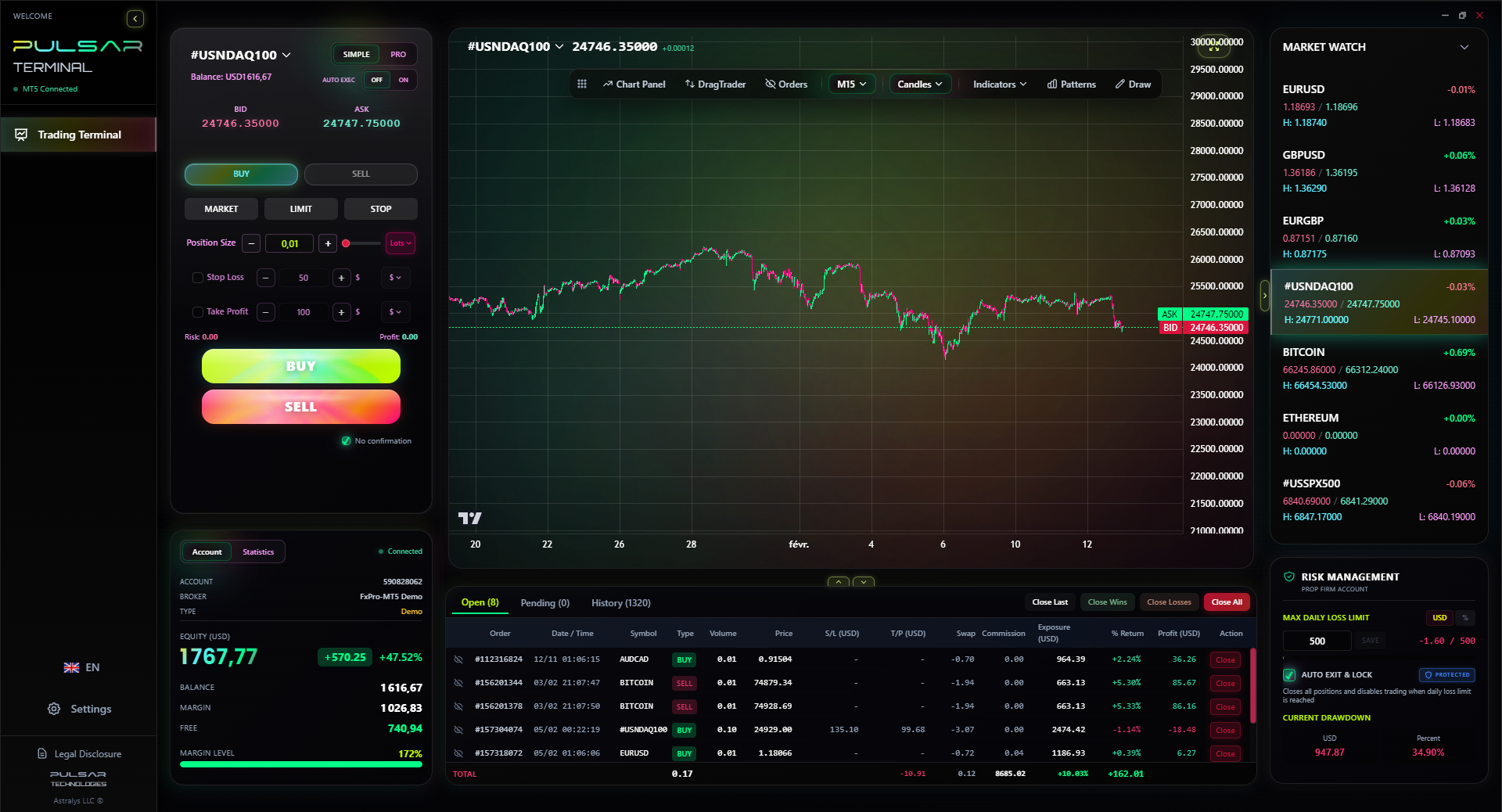
Managing multiple take-profit levels and a trailing stop manually on a volatile news trade is nearly impossible, which is why automation tools are essential.
Pulsar Terminal
MT5 올인원 도구: 드래그앤드롭 주문, 다중 TP/SL, 트레일링 스톱, 그리드 트레이딩, 볼륨 프로파일, 프롭펌 보호. 매일 1,000명 이상의 트레이더가 사용.
“You will lose. A lot. A good trader might only win 40-50% of the time. The profits come from letting your winners run and cutting your losers short.”
This is the part nobody wants to talk about, but it's 80% of the game. You can have the best strategy in the world and still blow up your account if your head isn't right.
Rule #1: Risk a Fixed Percentage. Never, ever risk more than 1-2% of your account on a single trade. With a $500 account, that's $5-$10 max. This means a string of 10 losses won't destroy you. I have a rule written on a sticky note on my monitor: "1% Max." It has saved me from myself more times than I can count.
Rule #2: Embrace Losses. You will lose. A lot. A good trader might only win 40-50% of the time. The profits come from letting your winners run and cutting your losers short. The moment you start moving your stop loss further away because "it'll come back," you've lost control. I've broken this rule. In 2019, I turned a $200 loss on Gold (XAU/USD) into a $1,200 loss by refusing to admit I was wrong. It took me months to recover.
Rule #3: Avoid Overtrading. Boredom is a killer. You don't need to be in a trade all the time. Sometimes the best trade is no trade. If the market is flat or choppy, step away. Go watch a movie. Chasing action leads to stupid, impulsive trades with no edge.
Your psychology is your biggest asset and your biggest liability. The market doesn't care about your rent or your dreams. It's your job to manage your emotions so they don't manage your trades.
💡 윈스턴의 팁
A complex strategy is often just a simple one dressed in insecurity. Master price action and support/resistance before adding five lagging indicators.
“The market doesn't care about your rent or your dreams. It's your job to manage your emotions so they don't manage your trades.”
You now know the basics of how do you trade forex. But this is just the beginning. Trading is a continuous education.
1. Journal Religiously. After every trade, write it down. Entry, exit, lot size, why you took it, how you felt. Review it weekly. This is how you find your personal weaknesses. Do you always cut winners short? Do you trade better in the morning? Your journal will tell you.
2. Master One Pair. Start with a major pair like EUR/USD. Learn its personality, what times it's most active (London and New York overlaps), and what news moves it. Don't jump around between Gold, Bitcoin, and 10 different forex pairs. Get really good at one thing first.
3. Upgrade Your Tools. As you progress, you'll want more from your charts. Basic MT5 is fine, but tools that help you visualize order flow or automate trade management can give you an edge. This is where dedicated trading software comes in.
4. Connect with Others (Carefully). Find a community of serious traders, not a Telegram group full of "signal sellers." Discuss ideas and market perspectives. But remember, you are responsible for your own decisions.
The market in Nigeria is booming, with turnover hitting $8.6 billion recently. The opportunity is real. But the only way to grab it is through discipline, patience, and a relentless focus on protecting your capital. Good luck, and trade safe.
FAQ
Q1Is forex trading legal and taxable in Nigeria?
Yes, it is legal for individuals to trade forex in Nigeria. The CBN and SEC oversee the broader framework. You are allowed to use internationally regulated brokers. Profits from trading are subject to a 10% Capital Gains Tax, which you are required to report and pay.
Q2What is the realistic minimum amount to start forex trading in Nigeria?
While brokers may allow deposits as low as $5, a realistic and practical starting amount is between $500 and $1,000. This allows for proper risk management, lets you trade small positions (like 0.01 lots), and absorb costs like spreads without being wiped out by a single trade.
Q3Which broker is best for Nigerian traders?
There's no single "best" broker, but good choices for Nigerians include brokers that offer Naira (NGN) account funding, have solid international regulation, and offer competitive spreads. Popular options are Exness, XM, and HFM. Always test a broker with a demo account first.
Q4What is a pip and how much is it worth?
A pip is the smallest price move a currency pair can make. For most pairs, it's 0.0001. Its monetary value depends on your trade size (lot size). For a standard lot (100,000 units), one pip is typically $10. For a mini lot (10,000 units), it's $1, and for a micro lot (1,000 units), it's $0.10. You can learn more in our detailed pip definition guide.
Q5Can I trade forex on my phone in Nigeria?
Absolutely. Mobile trading is huge in Nigeria due to high smartphone penetration. MetaTrader 4 (MT4) and MetaTrader 5 (MT5) have excellent mobile apps. Many brokers also have their own proprietary apps. Just ensure you have a stable internet connection, especially when managing open trades.
Q6What's the difference between a demo account and a live account?
A demo account uses virtual money, allowing you to practice trading risk-free. A live account uses your real money. The key difference is psychology. The fear and greed you feel with real money can drastically affect your decisions, which is why proper risk management is non-negotible when you switch to live trading.
Q7How many hours a day do I need to trade forex?
It depends on your strategy. A swing trader might only need 30-60 minutes a day to check charts and manage positions. A scalping strategy requires hours of focused screen time during volatile market sessions. Start with a style that fits your schedule and personality.
윈스턴 교수의 수업
핵심 요약:
- ✓Start with at least $500, not $10.
- ✓Never risk more than 1% per trade.
- ✓Use use below 1:30.
- ✓Pay your 10% capital gains tax.
- ✓Master one currency pair first.
이 기사가 얼마나 유용했나요?
별을 클릭하여 평가
주간 트레이딩 인사이트
무료 주간 분석 & 전략. 스팸 없음.
저자 소개
Olumide Adeyemi
서아프리카 트레이딩 선구자
나이지리아에서 가장 활발한 외환 트레이딩 교육자 중 한 명. 라고스에서 8년간 트레이딩 경험. 아프리카 트레이더를 위한 소자본 전략과 프롭 펌 챌린지 전문.
댓글
위험 고지
금융 상품 거래에는 상당한 위험이 수반되며 모든 투자자에게 적합하지 않을 수 있습니다. 과거 성과가 미래 수익을 보장하지 않습니다. 이 콘텐츠는 교육 목적으로만 제공되며 투자 조언으로 간주되어서는 안 됩니다. 거래 전에 항상 직접 조사를 수행하십시오.
이 기사도 읽어보세요

Cara Trading Forex Sukses: 7 Prinsip dari Trader Profesional
Cara trading forex sukses dengan 7 prinsip trader pro: manajemen modal, disiplin, journal trading, backtest. Data nyata, bukan janji profit palsu.
Jam Trading Forex Terbaik untuk Trader Indonesia: Panduan Lengkap dengan Tabel Waktu
Panduan jam trading forex untuk trader Indonesia. Tabel 4 sesi dunia, jam emas 20:00-00:00, sesi mana yang harus dihindari. Data akurat + tips dari trader berpengalaman.
Top 5 Sàn Forex Uy Tín Nhất 2026: Review Jujur dari Trader Indonesia
Top 5 sàn forex uy tín 2026 untuk trader Indonesia. Review jujur: spread, deposit, withdraw, dukungan lokal. Exness, XM, IC Markets & lebih.
