


I once lost R8,000 in under an hour trying to short USD/ZAR during a SARB announcement.

David van der Merwe
신흥시장 트레이더 ·  South Africa
☕ 12 분 소요
배울 내용:
- 1Forex 101: What You're Actually Buying and Selling
- 2The Legal Lowdown: FSCA Rules You Can't Ignore
- 3The Real Costs: Where Your Money Actually Goes
- 4Picking Your Weapon: Brokers and Platforms in SA
- 5The Moment of Truth: How to Actually Execute a Trade
- 6Strategies That Work (And Don't) With the ZAR
- 7The Mind Game: Psychology and Risk Management for Survival
- 8Your Action Plan: First Steps to Start Trading
I once lost R8,000 in under an hour trying to short USD/ZAR during a SARB announcement. I thought I had the 'sell' part of 'how to buy and sell forex' figured out. I was wrong. The rand didn't just move, it gapped through my stop-loss like it wasn't even there. That lesson, paid for in hard cash, taught me that trading here isn't just about clicking buttons. It's about understanding a unique, volatile market with its own rules, costs, and psychological traps. Let's get you trading smarter than I did that day.
Forget the fancy terms for a second. When you buy and sell forex, you're betting on the value of one country's money against another's. In South Africa, you're usually betting with or against the rand.
Think of it like this: EUR/USD is the price of one Euro in US Dollars. USD/ZAR is the price of one US Dollar in South African Rands. If you buy USD/ZAR, you're buying Dollars and selling Rands, betting the Dollar will get stronger against the Rand. If you sell it, you're doing the opposite.
Your profit or loss comes from the change in that price, measured in pips. One pip is typically a 0.0001 move for most pairs, but for USD/ZAR, it's 0.0010 because of how the rand is quoted. A move from 18.5000 to 18.6000 is 100 pips. If you're confused about pips, our pip definition breaks it down simply.
The first mental shift you need to make is that there's no 'good' or 'bad' price, only direction. You can make money whether the rand is strengthening or collapsing, as long as you're on the right side of the move. The second shift is accepting that you're trading against the entire world's view of an economy's health, in real time.

💡 윈스턴의 팁
The rand doesn't care about your opinion. It only cares about price. Trade the chart in front of you, not the story in your head.
Trading forex is legal here, but it's not the wild west. The Financial Sector Conduct Authority (FSCA) calls the shots, and they've tightened the screws in recent years. Ignoring their rules is a surefire way to get burned.
The 30:1 use Cap
This is the big one. Since 2021, retail traders like you and me are capped at 30:1 use on major forex pairs. That means for every R1,000 in your account, you can control a position worth R30,000. It sounds restrictive, but honestly, it probably saved a thousand accounts from blowing up last year alone. Before this, brokers offered 500:1 or even 1000:1, which was like giving a learner driver a Formula 1 car.
Broker Licensing is Non-Negotiable
Only use an FSCA-licensed broker. This isn't a suggestion, it's your primary shield. A licensed broker must segregate your client funds from their company money. If they go bust (it happens), your trading capital is protected and should be returned. An unlicensed offshore broker? You might as well send your money via courier to a stranger. Check our Exness review and IC Markets review for examples of brokers with solid FSCA presence.
Taxes and Allowances
SARS wants its share. Your net profit from trading (profits minus losses, minus allowable expenses) is taxable as income. Keep careful records. Also, remember your single discretionary allowance of R1 million per year for moving funds abroad. If you're trading with a big international broker, you'll need this.
“If your strategy needs a 20-pip move to break even, but your total costs equal 15 pips, you're fighting a steep uphill battle.”
The spread isn't the only fee. If you don't account for all the costs, you'll wonder why your brilliant trade only netted you lunch money.
Let's break down a typical R10,000 trade on USD/ZAR with a reputable broker:
1. The Spread: This is the difference between the buy and sell price. It's your immediate cost of entry. On USD/ZAR, a good raw spread might be 50 pips (0.0050). On a 1 mini-lot (10,000 units), that's a R5 cost right off the bat.

Example: You buy USD/ZAR at 18.5000. The sell price quoted to you is 18.4950. That 0.0050 (50 pip) difference is the spread, the broker's fee for the transaction.
2. Overnight Financing (Swap): Hold a trade past 10 PM SA time? You'll pay or earn a swap rate. It's based on the interest rate difference between the two currencies. If you're long USD/ZAR (holding Dollars, which have a higher interest rate than Rands), you might earn a small credit. If you're short, you'll pay. These rates change and can triple around Wednesdays (covering the weekend). On a 1-lot position, it can be a few dollars credit or debit per night.
3. The Hidden Killer: Currency Conversion. This one catches everyone. Your broker account is in USD, but your bank account is in ZAR. When you deposit R15,000, your bank converts it to USD at their rate, which often includes a 1-2% markup. When you withdraw $1,000 profit, they convert it back to ZAR with another markup. I've had profits eroded by over 3% just from these two conversions. Always check your bank's 'retail rate' versus the 'interbank rate' they use – the difference is their fee.
4. Commissions. Some accounts offer raw spreads (near 0) but charge a commission per lot. E.g., $7 per 100,000 units traded. This is often cheaper for high-volume traders.
Bottom line: If your strategy needs a 20-pip move to break even, but your total costs (spread + potential swap) equal 15 pips, you're fighting a steep uphill battle. This is why understanding your position size calculator is critical – it helps you factor in costs before you enter.
Your broker and platform are your cockpit. A bad setup will crash you before the market does.
What to Look for in an SA-Friendly Broker
- FSCA License: Already covered. Non-negotiable.
- ZAR Account Option: Some brokers, like XM, offer ZAR-denominated accounts. This eliminates the bank conversion fee nightmare. Your deposit, trades, and profit/loss are all in Rands. It's a game-simplifier.
- Local Deposit Methods: Instant EFTs via Ozow, PayFast, or SID. If they only take international wire transfers, you're adding days and hundreds of Rands in bank fees.
- Customer Support in SA Time: Try calling their support at 8 PM SA time. If you get a call center in another hemisphere, good luck solving a margin issue quickly.
Trading Platforms: MT4, MT5, and Beyond
MetaTrader 4 (MT4) is the old reliable. Everyone uses it, it's stable, and there are a million indicators. MetaTrader 5 (MT5) is its more powerful younger sibling, offering more timeframes, an economic calendar, and a better depth of market. For most forex traders starting out, MT4 is plenty.
Then there are proprietary platforms like cTrader (offered by brokers like Pepperstone), known for slick execution and great charting. Your choice depends on your style. Are you a technical chartist? MT4/5. A scalper obsessed with order book flow? cTrader might be better.
My advice? Open demo accounts with two different brokers on two different platforms. Trade them for a week. You'll feel which one 'fits' your brain.
💡 윈스턴의 팁
Your first R10,000 in the market is tuition, not investment. If you can keep most of it after six months of live trading, you're passing the course.
“Moving your stop-loss further away because the trade is going against you is the number one cause of account blow-ups.”
This is where theory meets the ledger. Let's walk through a live example.
Scenario: You believe the Euro will strengthen against the US Dollar. You want to buy EUR/USD.
- Analyze & Decide: You've done your analysis (maybe using the MACD indicator and some price action). You decide to enter.
- Open Order Window: On your platform (MT4), you right-click the EUR/USD chart and select 'New Order'.
- Set Your Parameters:
- Volume: This is your position size. 1.00 = 1 standard lot (100,000 units). 0.10 = 1 mini lot (10,000 units). 0.01 = 1 micro lot (1,000 units). With a R20,000 account and 30:1 use, a 0.10 lot size is a sensible, responsible start. Never max out your use.
- Stop Loss (SL): YOU MUST SET THIS. I don't care what your strategy is. This is the price at which your trade will automatically close to prevent further loss. If you're buying at 1.0850, you might place your SL at 1.0820, risking 30 pips. Use our position size calculator to make sure this risk is a small percentage of your account (e.g., 1-2%).
- Take Profit (TP): This is your target. Maybe you set it at 1.0910, aiming for 60 pips. A 1:2 risk-to-reward ratio.
- Click 'Buy': The order executes. You are now 'long' EUR/USD. Your platform will show an open position with a floating P&L.
To close the trade: You can either wait for it to hit your TP or SL, or you can right-click the position and select 'Close Order' at any time.

Warning: The 'Sell' button in the order window is for opening a short trade (betting the price will fall). To close a long trade, you don't click 'Sell' again in a new order, you close the existing buy position. Mixing this up has caused many a rookie panic attack.
Order Types
- Market Order: Buy/sell right now at the current price.
- Pending Order: Set an order to buy/sell in the future if the price hits a certain level. A 'Buy Limit' is an order to buy below the current price. A 'Buy Stop' is an order to buy above the current price (for breakouts).
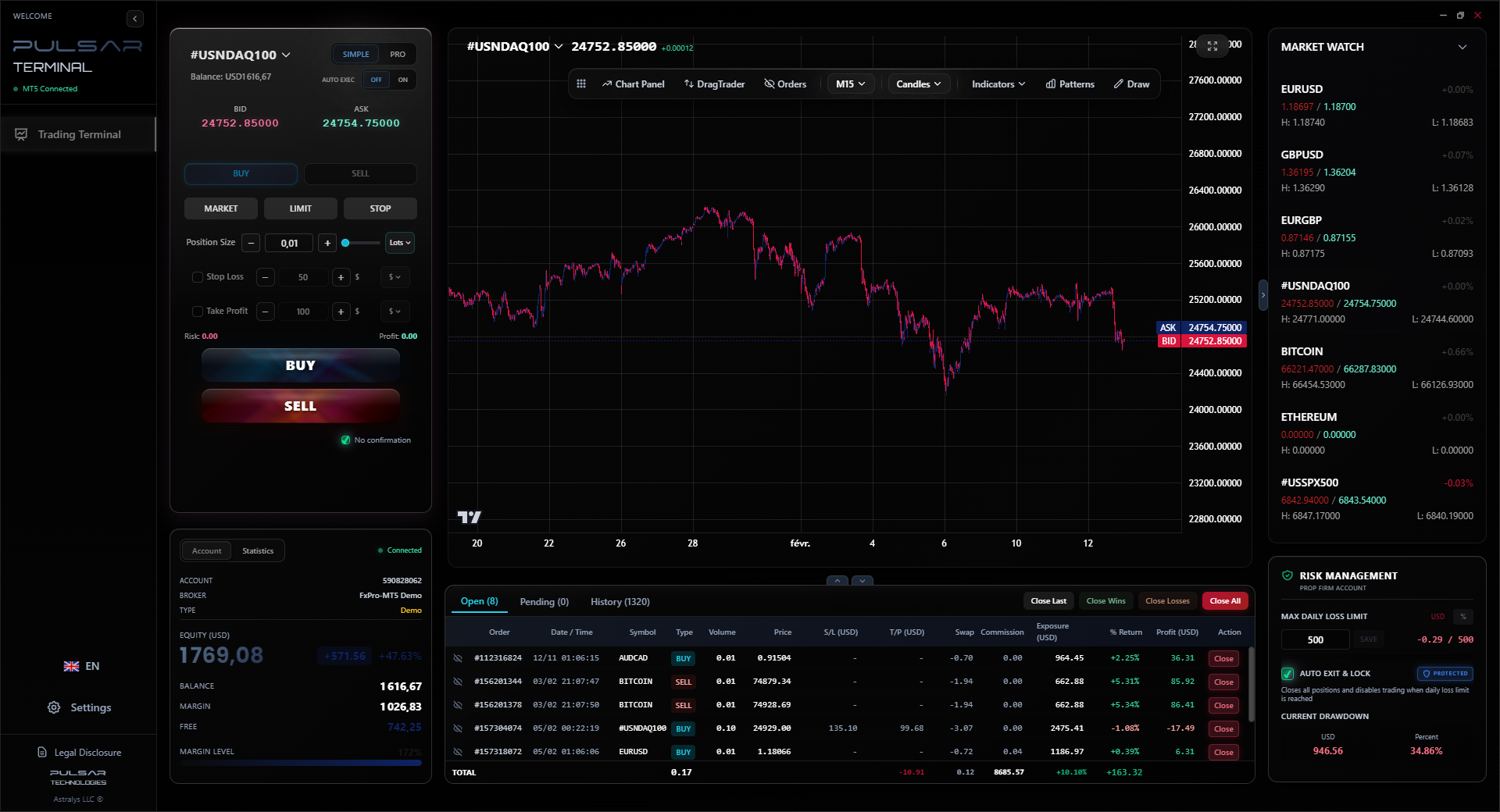
Manually moving stop-losses to breakeven or setting multiple take-profit levels is clunky in MT5, but tools like Pulsar Terminal automate this with drag-and-drop ease.
Pulsar Terminal
MT5 올인원 도구: 드래그앤드롭 주문, 다중 TP/SL, 트레일링 스톱, 그리드 트레이딩, 볼륨 프로파일, 프롭펌 보호. 매일 1,000명 이상의 트레이더가 사용.
The rand's personality changes your playbook. It's a liquid but often sentiment-driven currency.
What Can Work
Swing Trading ZAR Pairs: This is my bread and butter. USD/ZAR, EUR/ZAR, GBP/ZAR have beautiful, tradable swings driven by commodity prices, risk sentiment, and local politics. You're looking for 200-500 pip moves over days or weeks. It requires patience and a stomach for volatility. I once caught a 420-pip swing on GBP/ZAR over 8 days, entering at 21.80 and exiting at 22.22. The key was ignoring the intraday noise and holding through a few scary retracements. This aligns well with a swing trading mindset.
Trading Majors Around SA Time: The 9 AM - 5 PM SA time slot overlaps with the European session. EUR/USD, GBP/USD are highly active. This is great for strategies based on the RSI indicator or other momentum tools during peak liquidity.
What's a Tough Slog
Scalping USD/ZAR During News: Trying to scalp the rand around SARB rates or CPI data is like trying to sip water from a firehose. The spreads widen massively, and the price can jump 100 pips in a second, hitting your stop-loss before your intended entry even fills. I've been on the wrong side of that. It's a specialist's game.
Carry Trading with ZAR: This strategy involves selling a low-interest currency and buying a high-interest one to collect the swap. The rand has traditionally had high rates, making it a buy for carry. But the volatility often wipes out the small daily swap gains. The risk/reward is usually poor.
Focus on the pairs and timeframes that match the market's rhythm, not the ones you wish were calm.
“The path to knowing how to buy and sell forex profitably is a marathon of disciplined learning.”
You can have the best strategy in the world, but if you can't manage your own head and risk, you'll lose. This is the most important section.
Rule 1: Define Your Risk Before You Enter. Never ask "how much can I make?" Ask "how much can I lose?" Decide that number, in Rands, before you click buy. For most, risking more than 2% of your account on a single trade is reckless. On a R10,000 account, that's R200. If your stop-loss is 40 pips away, your position size must be small enough that a 40-pip loss equals R200.
Rule 2: Your Stop-Loss is Sacred. Moving your stop-loss further away because the trade is going against you is called 'widening your stop.' It's the number one cause of account blow-ups. It's admitting your original analysis was wrong, but instead of taking the small loss, you're gambling on a reversal. It turns a R200 loss into a R2,000 loss. I've done it. It feels horrible.
Rule 3: Embrace Being Wrong. You will be wrong. Often. A 40% win rate with good risk management can be wildly profitable. A 60% win rate with poor risk management will destroy you. Take your small losses gracefully. They are the cost of doing business.
The South African Trap: We see the rand weaken and feel a patriotic urge to 'buy ZAR' or a greedy urge to 'short the doomed rand.' Trading is not about national pride or headlines. It's about price action and probabilities. Leave your emotions at the login screen.

Pro Tip: After placing a trade, write down your reason for entry, your stop-loss, and your take-profit in a journal. If the price moves and you feel the urge to change your plan, re-read your original reason. If the reason is no longer valid, close the trade. If it's still valid, leave it alone.
💡 윈스턴의 팁
The most important level on your chart isn't support or resistance. It's the price of your stop-loss. Know it, set it, and leave it alone.
Let's get you from zero to your first controlled trade.
- Education, Not Deposit: Don't put in a single cent yet. Read. Understand what a margin call is. Learn about spreads. Watch webinars from reputable sources (not 'gurus' promising guaranteed returns).
- Open a Demo Account: Go to the website of an FSCA-regulated broker like IC Markets or Pepperstone. Open a demo account. It gives you virtual money (usually $10,000 or $50,000) to practice with real prices in real time.
- Develop a Simple Plan: On demo, test one thing. Maybe: "I will look for the RSI to go below 30 on the EUR/USD 1-hour chart, then wait for a bullish candle to close. I will enter with a 20-pip stop loss and a 40-pip target. I will only do this once a day." Stick to that exact plan for 20 trades. Record the results.
- Fund a Live Account: Only if your demo trading is consistently disciplined and you understand your win rate and average loss. Start small. That R1,500-R5,000 minimum deposit? Use it. Trade micro lots (0.01). Your goal in the first R10,000 of live trading is not to get rich. It's to not lose money while experiencing the psychology of real risk.
- Review and Adapt: Every Sunday, review your trades. Why did the winners work? Why did the losers fail? Tweak your plan slowly. The market is a mirror, and it's showing you who you are as a trader. Pay attention.
The path to knowing how to buy and sell forex profitably is a marathon of disciplined learning. It's hard, but for those who respect the market, manage risk, and keep their ego in check, it's a viable skill. Now go practice.
FAQ
Q1Is forex trading legal and safe in South Africa?
Yes, it's legal and regulated by the FSCA. The 'safety' depends entirely on you. Trading through an FSCA-licensed broker provides legal protection for your funds (client money segregation). However, the trading itself is high-risk. You can lose all your capital, and most retail traders do. Safety comes from your own education, risk management, and using regulated brokers.
Q2What is the minimum amount I need to start trading forex in South Africa?
Technically, some brokers allow accounts with as little as R70. Practically, that's useless. To trade responsibly with proper position sizing and room for error, a minimum of R1,500 to R5,000 is a realistic starting point. For meaningful trading that can withstand a few losses, R10,000+ is better. Remember, the minimum isn't about what you can deposit, but what you can afford to lose completely.
Q3Why is the use in South Africa limited to 30:1?
The FSCA imposed this cap in 2021 to protect retail traders from themselves. High use (like 500:1) amplifies both profits and losses. It allows traders to control huge positions with little capital, which often leads to rapid, total account losses during normal market movements. The 30:1 cap forces more sensible position sizing and reduces the systemic risk of traders blowing up constantly.
Q4Which currency pairs should a South African beginner trade?
Start with the major pairs that don't involve the ZAR, like EUR/USD or GBP/USD. They have the tightest spreads, highest liquidity, and most predictable trading hours. Avoid exotic pairs and ZAR pairs initially. The volatility of USD/ZAR can be overwhelming. Learn the basics of order execution and risk management on a stable pair first. Once comfortable, you can explore EUR/USD strategies in depth.
Q5How are my forex trading profits taxed in South Africa?
SARS views forex trading profits as income (unless you qualify as a trader of a different category). You must declare your net profit (total profits minus total losses, minus any allowable trading expenses) in your annual tax return. It's taxed at your applicable marginal income tax rate. Keep detailed records of all trades, statements, and related expenses (like data subscriptions).
Q6What's the biggest mistake new South African forex traders make?
Two tied for first: 1) Using excessive use and position size, turning a small market move into a catastrophic loss. 2) Trading based on emotion or news headlines about the rand, rather than a tested technical or fundamental plan. They try to 'save' the ZAR or bet against it out of frustration, which is a sure path to losses.
Q7Can I trade gold (XAU/USD) with a South African forex broker?
Absolutely. Most FSCA-regulated brokers offer CFDs on commodities like gold (XAU/USD). It's a popular asset that often moves inversely to the US Dollar and is considered a safe-haven. The trading mechanics are similar to forex, but be aware that the volatility and margin requirements can be different. Do your homework on XAU/USD specifically before trading it.
윈스턴 교수의 수업
핵심 요약:
- ✓FSCA 30:1 use is a protective cage, not a limit.
- ✓Real costs include spread, swap, and brutal bank conversion fees.
- ✓Risk a maximum of 2% of your capital per trade.
- ✓Trade majors first, ZAR pairs only after mastering volatility.
- ✓Your stop-loss is a pre-paid insurance policy. Never cancel it.
이 기사가 얼마나 유용했나요?
별을 클릭하여 평가
주간 트레이딩 인사이트
무료 주간 분석 & 전략. 스팸 없음.
저자 소개
David van der Merwe
신흥시장 트레이더
요하네스버그 기반 트레이더로 신흥시장 통화 11년 경력. ZAR 통화쌍, FSCA 규제 거래, 남아공 시장 분석 전문.
댓글
위험 고지
금융 상품 거래에는 상당한 위험이 수반되며 모든 투자자에게 적합하지 않을 수 있습니다. 과거 성과가 미래 수익을 보장하지 않습니다. 이 콘텐츠는 교육 목적으로만 제공되며 투자 조언으로 간주되어서는 안 됩니다. 거래 전에 항상 직접 조사를 수행하십시오.
이 기사도 읽어보세요

Cara Trading Forex Sukses: 7 Prinsip dari Trader Profesional
Cara trading forex sukses dengan 7 prinsip trader pro: manajemen modal, disiplin, journal trading, backtest. Data nyata, bukan janji profit palsu.
Jam Trading Forex Terbaik untuk Trader Indonesia: Panduan Lengkap dengan Tabel Waktu
Panduan jam trading forex untuk trader Indonesia. Tabel 4 sesi dunia, jam emas 20:00-00:00, sesi mana yang harus dihindari. Data akurat + tips dari trader berpengalaman.
Top 5 Sàn Forex Uy Tín Nhất 2026: Review Jujur dari Trader Indonesia
Top 5 sàn forex uy tín 2026 untuk trader Indonesia. Review jujur: spread, deposit, withdraw, dukungan lokal. Exness, XM, IC Markets & lebih.
