


Most people telling you how to make money on forex are lying to you.

Olumide Adeyemi
서아프리카 트레이딩 선구자 ·  Nigeria
☕ 11 분 소요
배울 내용:

Most people telling you how to make money on forex are lying to you. They're selling a dream of overnight Lamborghinis funded by magical signals, and it's pure nonsense. The truth is, making consistent money is a grind - it's a skill you build, not a lottery you win. I've traded through bull markets, crashes, and CBN policy chaos since 2012. In this guide, I'll show you the real framework: what's legal, how you actually get paid, the strategies that work for Nigerians, and the expensive mistakes I made so you don't have to.
Before you dream of profits, you need to know the rules of the game here. Getting this wrong can wipe out your gains faster than a bad trade.
Is Forex Trading Legal in Nigeria?
Yes, trading forex as an individual is completely legal. The confusion comes from the Central Bank of Nigeria (CBN) trying to control the official exchange rate and stop naira speculation. They aren't coming after you for trading EUR/USD on an international platform. The key point? Nigeria doesn't have its own regulatory body for retail forex brokers like the UK's FCA. So, you won't find a 'CBN-licensed' forex broker. You must use an international broker that accepts Nigerian clients. I've used several over the years, and you can read my detailed reviews of platforms like Exness and IC Markets to see which ones handle Nigerian verification and withdrawals smoothly.
The 10% Tax You Cannot Ignore
Here's the part most 'gurus' forget to mention: the taxman. All your trading profits are subject to a 10% Capital Gains Tax. It doesn't matter if your broker is in Cyprus or the Seychelles. If you're a Nigerian resident and you make money, that income is taxable. I learned this the hard way early on. I had a great quarter, withdrew $5,000, and didn't set anything aside. Come tax season, I owed ₦500,000 (at the time) that I hadn't budgeted for. It hurt. Plan for this from day one. Treat 10% of every profitable withdrawal as already spent.

Warning: Ignoring your tax liability is a great way to turn a successful trading career into a financial and legal headache. Keep simple records of your deposits and withdrawals; that's your starting point for calculating gains.
“High use isn't a tool for making more money; it's a tool for blowing up faster.”
Your broker is your gateway to the market, and your choice here makes or breaks you. For Nigerians, three things are critical: use, spreads, and reliability of withdrawals.
The use Trap (And How to Use It)
Nigerian traders are often targeted with insane use offers - 1:1000, 1:2000, even 'unlimited'. This is a double-edged sword. Yes, it means you can control a $10,000 position with just $10 of your own money (at 1:1000). But it also means a 10-pip move against you wipes out that $10. I blew up my first two accounts because I used maximum use on every trade, treating it like free money. Now, I rarely go above 1:30, even if my account allows 1:500. High use isn't a tool for making more money; it's a tool for blowing up faster. Use a position size calculator for every single trade to force discipline.
Understanding Spreads & Commissions
The spread is the broker's fee, built into the price. It's the difference between the buy (ask) and sell (bid) price. If the EUR/USD bid is 1.0850 and the ask is 1.0851, the spread is 1 pip. This is your immediate cost. Some brokers offer 'raw spread' accounts with spreads from 0.0 pips but charge a commission per lot. Others have wider spreads but no commission. You need to do the math for your style.
| Trading Style | Recommended Account Type | Why |
|---|---|---|
| Scalping | Raw Spread/ECN (Commission-based) | You're in and out fast. A 0.1 pip spread vs. a 1.5 pip spread saves you money on every trade. |
| Swing Trading | Standard (Spread-only) | You hold trades for days. The wider spread is a smaller percentage of your target profit. |
For example, a scalper making 20 trades a day on a pair with a 1.5-pip spread pays 30 pips in costs daily. On a 0.1-pip raw spread account with a $3.50 commission per lot, the cost might be only 2 pips + $70 in commissions. For high volume, the raw account wins. For my scalping strategy, I only use ECN-type accounts now.
“You haven't made money until it's in your Nigerian bank account.”
Forget indicators for a second. Your psychology is 80% of this game. The market is designed to trigger every fear and greed impulse you have.
You Are the Problem
My biggest losing streak ever didn't happen because my analysis was wrong. It happened because I was right too early. I shorted the GBP/USD at 1.4200, expecting a drop. It rallied to 1.4300. My analysis said hold, but my brain saw the red -100 pips and screamed 'FAILURE!' I closed the trade. The very next day, it crashed 300 pips. I had the right idea but the wrong stomach. The market will test your patience and conviction constantly. Profitable trading is often just sitting quietly, doing nothing, while your trade works.
Risk Management is Not Optional
This is the only holy grail. You must define your risk before every trade. My rule is simple: I never risk more than 1% of my account balance on a single trade. If I have a $1,000 account, my maximum loss per trade is $10. This means my stop-loss distance and position size are calculated together. If I want to buy EUR/USD and place a stop-loss 20 pips away, my position size must be small enough that a 20-pip loss equals $10. This one habit alone saved my career. It lets you be wrong repeatedly without getting a margin call or blowing up.

Pro Tip: Write down your trading plan, including your max daily loss (mine is 3%). When you hit it, shut down the platform. Go for a walk. The market will be there tomorrow. Chasing losses is how $500 losses become $5,000 disasters.

💡 윈스턴의 팁
Your first profit target should always be your risk per trade. Get to breakeven on a trade as fast as possible. It changes the entire psychology.
“You haven't made money until it's in your Nigerian bank account.”
Let's talk about what you actually do. I'm not giving you a 'secret system'. I'm giving you frameworks that have paid my bills.
Price Action & Key Levels (Swing Trading)
This is my bread and butter. I ignore the news noise and look at the chart. Where has the price reversed before? Those are your support and resistance levels. I wait for the price to approach these levels and look for a rejection - a pin bar, a bearish engulfing pattern. Then I enter, with a stop-loss just beyond the level.
Real Trade Example (2023): USD/JPY was in a strong uptrend. It pulled back to a previous resistance level near 147.50, which had now become support. The price formed a bullish pin bar right on that level. I entered long at 147.62. My stop was at 147.25 (37 pips). My target was the next swing high near 149.00. I risked 0.8% of my account. The trade ran for a week and hit target, netting 138 pips. This is classic swing trading: high probability, patient entries.
Using the RSI for Momentum Confirmation
I use the RSI indicator, but not how most people do. I don't buy just because RSI is below 30 (oversold). In a strong trend, RSI can stay oversold for weeks. Instead, I use it for divergence. If the price makes a new high, but the RSI makes a lower high, that's bearish divergence - a sign the uptrend is weakening. It's a warning, not a signal. I then look for a price action sell signal at a resistance level. Combining these two things - price at a key level and momentum divergence - gives you a much stronger case for a trade.
“The market is designed to trigger every fear and greed impulse you have.”
I've made these. My friends have made these. Let's save you the money.
Chasing 'Too Good to Be True' Signals
WhatsApp and Telegram groups are flooded with 'ROI gurus' promising 100% monthly returns. They'll show you fake screenshots of profits. They often use a tactic called 'mirror trading' - they give 100 people a buy signal and 100 people a sell signal on the same pair. Whichever side wins, they show that as 'proof' to the 50% who got the right signal and ask for payment. If you pay, you'll get wrong signals until you quit. Real education doesn't come in daily signal blasts.
Ignoring the Time Zone Difference
The London session (8 AM - 5 PM WAT) and the New York session overlap (1 PM - 10 PM WAT) are when the market has the most volume and movement. Trading the EUR/USD at 2 AM WAT is often a waste of time - the spreads widen, and the price just chops around. I used to sit up all night trying to force trades, only to lose money to boredom and wide spreads. Schedule your analysis for the London open and trade during the active hours.
Not Accounting for Withdrawal Realities
You haven't made money until it's in your Nigerian bank account. Test withdrawals with a small amount first. How long does it take? 24 hours? 5 days? What are the fees? Some brokers use third-party payment processors that can be flagged by Nigerian banks. Stick with brokers known for reliable withdrawals to Nigeria, like XM or Pepperstone. Also, remember the CBN's rules on foreign exchange inflows. Large, frequent forex profits might attract questions from your bank. Start small, build a history.
💡 윈스턴의 팁
If you can't explain your trade setup in one simple sentence, you don't have a setup. Complexity is the enemy of execution.
“The market is designed to trigger every fear and greed impulse you have.”
A system isn't a random collection of indicators. It's a repeatable process for finding, entering, managing, and exiting trades.
The Checklist
Your system should answer these questions:
- Market Condition: Is the market trending or ranging? (Use higher timeframes like H4 or Daily).
- Key Level: Is price approaching a clear support or resistance zone?
- Entry Signal: Is there a specific candlestick pattern or indicator trigger at that level? (My trigger is a 2-candle reversal pattern).
- Risk: Where is my stop-loss? (Always beyond the key level).
- Reward: Where is my take-profit? (Aim for a risk-to-reward ratio of at least 1:2).
- Position Size: How many lots am I trading based on my 1% risk rule?
If you can't answer all six, you have no business entering the trade. Period.
Backtesting & Journaling
You don't need fancy software to start. Open a chart, go back 6 months, and start scrolling forward bar by bar. At each key level, ask: did my setup trigger? If you entered, where would your stop and target be? Did it win or lose? Write it down in a spreadsheet. Track your win rate and average win/loss. This is how you gain confidence in your edge before risking real money. I journal every trade I take, including a screenshot and a note on my emotional state. It's the most valuable tool I have.

Example: After 100 backtested trades, your system shows a 45% win rate. Your average winning trade is +80 pips, your average loser is -35 pips. That's a profit factor of (45 wins * 80) / (55 losses * 35) = 3600 / 1925 ≈ 1.87. That's a solid, profitable edge.
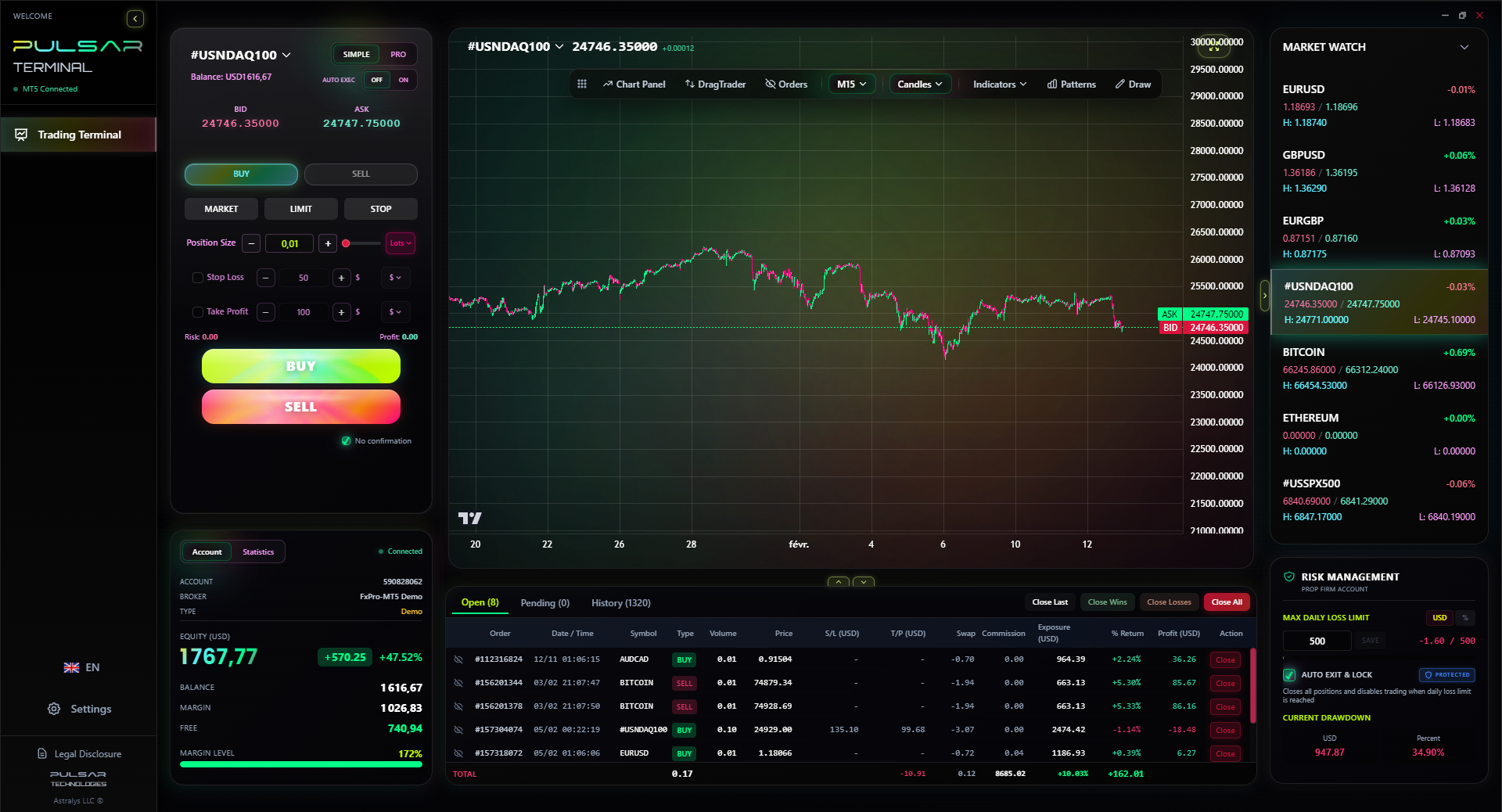
Manually moving stop-losses to breakeven and setting multiple take-profit levels is tedious, but Pulsar Terminal automates it all directly on your MT5 chart.
Pulsar Terminal
MT5 올인원 도구: 드래그앤드롭 주문, 다중 TP/SL, 트레일링 스톱, 그리드 트레이딩, 볼륨 프로파일, 프롭펌 보호. 매일 1,000명 이상의 트레이더가 사용.
“Profitable trading is often just sitting quietly, doing nothing, while your trade works.”
Here's the step-by-step I wish someone had given me.
Phase 1: Education & Paper Trading (Months 1-3) Don't deposit a single naira. Learn the basics: what a pip is, how use works, what a spread is. Open a demo account and practice executing trades. Get comfortable with the platform. Test the simple price action strategy I mentioned. Your goal is consistency on demo, not profits.
Phase 2: Micro-Live Account (Months 4-6) Deposit the absolute minimum - maybe $50 or ₦50,000. The goal is to feel real risk. Your hands will sweat. Your goal here is not to grow the account to a million. Your goal is to execute 50 trades following your checklist and risk management rules perfectly. If you blow the account, you lost a night out's worth of money, not your rent. Re-deposit the minimum and try again.
Phase 3: Scaling Up (Month 6+) Only after you have a proven, journaled track record of following your rules on a live micro account should you add more capital. Add money in increments, and each time you do, recalculate your 1% risk in dollar terms. This slow, boring process is how you build a real, sustainable trading business. There are no shortcuts.
💡 윈스턴의 팁
The best trade you'll take all month is often the one you don't take. Preserving capital is a positive action.
FAQ
Q1What is the minimum amount I need to start forex trading in Nigeria?
Technically, you can start with as low as $1 on some brokers like Exness. But realistically, that's useless for learning proper risk management. I recommend a minimum of $50-$100 (₦60,000 - ₦120,000) for a micro-live account. This is enough money for the psychology to feel real, but not so much that a total loss ruins you.
Q2How do I withdraw my forex profits to my Nigerian bank account?
Most international brokers offer bank wire transfers or local transfers via payment processors. The process is: 1) Request withdrawal from your broker's portal, 2) They process it (usually 1-3 business days), 3) Funds arrive in your naira account. You'll get the prevailing interbank or transfer rate, minus any fees. Always do a small test withdrawal first to confirm the process and timing.
Q3Can I trade forex with my phone in Nigeria?
Absolutely, and most of us do. All major brokers have strong mobile apps for MT4/MT5. You can analyze charts, place trades, and manage orders. However, for serious analysis and backtesting, a computer with a larger screen is far superior. I use my phone for monitoring open trades and my laptop for finding new setups.
Q4Is forex trading a scam in Nigeria?
The forex market itself is not a scam; it's the largest financial market in the world. However, the industry around it in Nigeria is riddled with scams - fake investment schemes, signal seller frauds, and 'account managers' who disappear with your deposit. The trading is legitimate if you learn the skill yourself, use a reputable international broker, and manage your own risk.
Q5Which currency pairs are best for beginners in Nigeria?
Stick to the major pairs, especially the EUR/USD. They have the tightest spreads (lowest trading costs), the most available analysis, and move in predictable patterns during liquid market hours. Exotic pairs or even minors like GBP/JPY can be extremely volatile and costly to trade. Master one major pair first.
Q6How many hours a day do I need to trade forex to make money?
Less than you think. You don't need to be glued to the screen. As a swing trader, I spend about 1-2 hours in the evening (around London close/New York open) analyzing the daily charts and setting up orders for the next day. Sometimes I don't trade at all for a week. It's about quality of analysis, not quantity of screen time. Scalping requires more time, but it's also much harder.
Q7Do I need to pay tax on forex profits if I use a foreign broker?
Yes. Your tax liability in Nigeria is based on your residency and the source of the income (your trading activity), not the location of your broker. You are required by law to declare your capital gains and pay the 10% tax. Keep records of all your withdrawals as a baseline for your profit calculation.
윈스턴 교수의 수업
핵심 요약:
- ✓Never risk more than 1% of your account per trade.
- ✓The 10% capital gains tax is non-negotiable. Plan for it.
- ✓Trade major pairs during London & New York overlap.
- ✓Backtest 100 trades before risking real money.
- ✓A demo account teaches mechanics; a micro account teaches psychology.
이 기사가 얼마나 유용했나요?
별을 클릭하여 평가
주간 트레이딩 인사이트
무료 주간 분석 & 전략. 스팸 없음.
저자 소개
Olumide Adeyemi
서아프리카 트레이딩 선구자
나이지리아에서 가장 활발한 외환 트레이딩 교육자 중 한 명. 라고스에서 8년간 트레이딩 경험. 아프리카 트레이더를 위한 소자본 전략과 프롭 펌 챌린지 전문.
댓글
위험 고지
금융 상품 거래에는 상당한 위험이 수반되며 모든 투자자에게 적합하지 않을 수 있습니다. 과거 성과가 미래 수익을 보장하지 않습니다. 이 콘텐츠는 교육 목적으로만 제공되며 투자 조언으로 간주되어서는 안 됩니다. 거래 전에 항상 직접 조사를 수행하십시오.
이 기사도 읽어보세요

Cara Trading Forex Sukses: 7 Prinsip dari Trader Profesional
Cara trading forex sukses dengan 7 prinsip trader pro: manajemen modal, disiplin, journal trading, backtest. Data nyata, bukan janji profit palsu.
Jam Trading Forex Terbaik untuk Trader Indonesia: Panduan Lengkap dengan Tabel Waktu
Panduan jam trading forex untuk trader Indonesia. Tabel 4 sesi dunia, jam emas 20:00-00:00, sesi mana yang harus dihindari. Data akurat + tips dari trader berpengalaman.
Top 5 Sàn Forex Uy Tín Nhất 2026: Review Jujur dari Trader Indonesia
Top 5 sàn forex uy tín 2026 untuk trader Indonesia. Review jujur: spread, deposit, withdraw, dukungan lokal. Exness, XM, IC Markets & lebih.
