


I remember staring at my screen on the 15th of March last year, watching the USD/ZAR climb past R19.20.

David van der Merwe
신흥시장 트레이더 ·  South Africa
☕ 11 분 소요
배울 내용:
- 1The SA Forex Landscape: Rules You Can't Ignore
- 2The Real Costs of Trading in South Africa
- 3Building a Profitable Mindset, Not Just a Strategy
- 4Choosing Your Weapons: Brokers and Tools
- 5From Theory to Practice: Executing Trades
- 6Common Pitfalls (And How I Fell Into Them)
- 7Putting It All Together: Your Profit Path
I remember staring at my screen on the 15th of March last year, watching the USD/ZAR climb past R19.20. My heart was pounding. I had a short position from R18.95, and the news was all about a potential US rate hike. For a moment, I thought about cutting my loss. That moment, right there, is where most profits are made or lost. It's not about some secret indicator. Making a consistent profit in forex, especially here in SA, is about navigating a specific set of rules, costs, and psychological traps. Let's talk about what actually works.
Trading forex from South Africa isn't the wild west. We have a clear, if sometimes frustrating, framework. The main player is the Financial Sector Conduct Authority (FSCA). They're the ones who make sure your broker isn't running a Ponzi scheme from a Sandton office park.
The biggest rule they've dropped on us retail traders is the use cap of 30:1. It came in back in 2021. Before that, you'd see brokers offering 500:1 or even 1000:1. I used those, and I blew up my first two accounts because of them. The FSCA's cap is actually a gift in disguise. It forces you to use proper position size calculator and stops you from wiping out your account on one bad ZAR trade.
You also need to know about the SARB allowances. You can send up to R10 million abroad per year for investing (the foreign capital allowance), plus another R1 million for general spending. This is crucial if you're using an international broker. And yes, SARS wants their share. Your trading profits are taxable income. Keep a detailed log of every trade; your future self will thank you when tax season rolls around.

Warning: Trading with an unregulated offshore broker might offer higher use, but you have zero protection from the FSCA if things go wrong. Your funds are not segregated, and you can't complain to the ombud. It's just not worth the risk.
A local FSCA-licensed broker like AvaTrade or an international one with a local license like IC Markets is the only sensible starting point. They have to keep your money separate from theirs. That peace of mind is part of your profit strategy.

💡 윈스턴의 팁
A R500 loss on a R20,000 account is a 2.5% setback. A R500 loss on a R5,000 account is a 10% catastrophe. Your starting capital dictates your survival time. Choose it wisely.
“The FSCA's 30:1 use cap is actually a gift in disguise. It forces you to use proper position sizing.”
Your profit is what's left after all costs. Most beginners only see the potential gain, not the guaranteed expenses eating away at it.
Let's break down the numbers you'll actually face:
The Spread: This is the broker's cut. On EUR/USD, a good raw spread account might show 0.1 pips, but then they charge a commission. A common setup is $3 per side per standard lot. So, you pay to get in and you pay to get out. On a standard lot (100,000 units), that's $6 total. On a major pair, that's about 0.6 pips in cost. On a ZAR pair like USD/ZAR, the spread is naturally wider, often 50-100 pips because it's less liquid. You need a much bigger move just to break even.
The Swap: Holding a trade overnight? You'll pay or earn a swap fee based on interest rates. I learned this the hard way shorting AUD/JPY (a classic carry trade) years ago. I was right on direction for a week, but the daily swap charges completely erased my paper profits. Check your broker's swap rates before holding a trade for multiple days.
The Bank Fees: This one stings. Funding your international broker account from your SA bank account isn't free. As of now, you're looking at around R250-R500 to send money out via an international wire. If you make a profit and withdraw, the receiving fee is another R250-R350. If you're making small, frequent withdrawals, these fees will destroy you. I structure my withdrawals to be less frequent and larger for this exact reason.

Example: Let's say you make a 50 pip profit on USD/ZAR. On a mini lot (10,000 units), that's about R100 profit (1 pip ≈ R2). If you paid a 80 pip spread to enter and exit, you're already at a loss before any other fees. This is why understanding the spread definition and trading costs is non-negotiable.
“Your trading journal isn't a diary; it's a mirror showing you your own stupid patterns. Review it weekly.”
Here's the uncomfortable truth: the strategy is maybe 30% of the battle. The other 70% is your head. I've seen traders with brilliant systems fail, and traders with simple methods succeed. The difference is psychology.
Embrace the Grind, Not the Get-Rich-Quick Dream: You won't make R50,000 in your first month. If you start with R10,000, a 5% return in a good month is R500. That's realistic. A beginner might average R0 to R500 on profitable days, and many days will be losses. An intermediate trader with more capital and discipline might aim for R500 to R2,000 on good days. The YouTube gurus showing Lamborghinis are selling a dream, not a reality.
Your Trading Journal is Your Best Teacher: Every trade. Every one. Write down the pair, entry, exit, profit/loss, and most importantly, why you took the trade. Was it a signal from your RSI indicator? A news event? Or were you just bored and itching to press the button? Review this weekly. I still do. My biggest leaps came from spotting my own stupid patterns in the journal.
Risk Management is Your Safety Net: This is non-negotiable. Never, ever risk more than 1-2% of your account on a single trade. On a R20,000 account, that's R200-R400 max risk. This means your stop loss distance and your lot size are calculated before you enter. If you don't do this, one string of losses will trigger a margin call and you're done. This single habit is the line between being a gambler and a trader.

Pro Tip: Have a daily loss limit. Mine is 3% of my account. If I hit that, I shut down the platform and walk away. No 'revenge trading'. Tomorrow is another day. This rule has saved me from turning a bad day into a catastrophic month.
“Your trading journal isn't a diary; it's a mirror showing you your own stupid patterns. Review it weekly.”
Your broker and tools are your connection to the market. A slow, expensive connection will kill your profit potential.
Broker Selection for SA Traders
You want a broker that is either FSCA-regulated or a top-tier international broker that accepts SA clients smoothly. Look for:
- Low, transparent costs (compare their EUR/USD spread + commission).
- Reliable and fast deposit/withdrawal in ZAR.
- A platform you like (MT4/MT5, cTrader, or their own).
For example, XM has a tiny $5 minimum deposit, which is great for starting small. Pepperstone is renowned for its razor-thin spreads on its Raw account. Exness is popular for its flexible account types. Do your homework. Don't just sign up for the one with the flashiest ad.
Essential Trading Tools
You don't need 20 indicators clogging your chart. You need a few, understood deeply.
- Price Action & Support/Resistance: The chart itself is the best indicator. Learn to read candlestick patterns and identify key price levels.
- One Momentum Oscillator: The RSI indicator or Stochastic can help identify overbought/oversold conditions. I use RSI, but only as a secondary confirmation.
- One Trend-Following Tool: The MACD indicator or simple moving averages (like the 50 and 200 EMA) can help define the trend's direction.
My main chart for swing trading is clean: just price, a 50 EMA, and horizontal lines for support/resistance. The noise is distracting.
💡 윈스턴의 팁
The best trade you'll ever make is the one you don't take. If your setup isn't perfect, preserve your capital. The market will open again tomorrow.
“Profit in forex isn't about being right all the time. It's about losing small when you're wrong and winning bigger when you're right.”
Let's walk through a real example from last quarter. This is where the rubber meets the road.
The Setup: I was watching EUR/USD. It had been in a steady downtrend, but it approached a major support level that had held firm three times before over the past year (around 1.0720). The RSI indicator on the 4-hour chart was dipping into oversold territory (<30). This presented a potential bounce play.
The Plan (Made in Advance):
- Entry: Wait for a bullish reversal candlestick pattern (like a hammer or bullish engulfing) to form on that support level. My entry would be just above that candle.
- Stop Loss: Place my stop loss 20 pips below the support level, at 1.0700. This was a clear invalidation point.
- Take Profit: My first target was the recent swing high, about 70 pips away at 1.0790. I would take 50% of my position off there. I'd then move my stop loss to breakeven on the remainder and see if it could run further.
- Position Size: My account was R50,000. My 1% risk rule meant I could risk R500 on this trade. My stop loss was 20 pips. On EUR/USD, 1 pip on a standard lot is about $10 (roughly R180). So, I could trade a position size where 20 pips = R500 risk. That worked out to a 0.14 lot size. I used my position size calculator to get this exact figure.
The Execution: The hammer candle formed. I entered at 1.0742. My stop at 1.0700. My first target at 1.0790. The trade hit my first target two days later. I banked R350 on half the position. I moved my stop to breakeven. The trade then reversed and took out my breakeven stop on the remainder. Total profit: R350. Not life-changing, but it was a clean, disciplined trade where I managed my risk perfectly. That's the blueprint.
This kind of structured approach is what separates hope from a plan. Tools that help you manage these multi-part orders efficiently are a huge advantage.
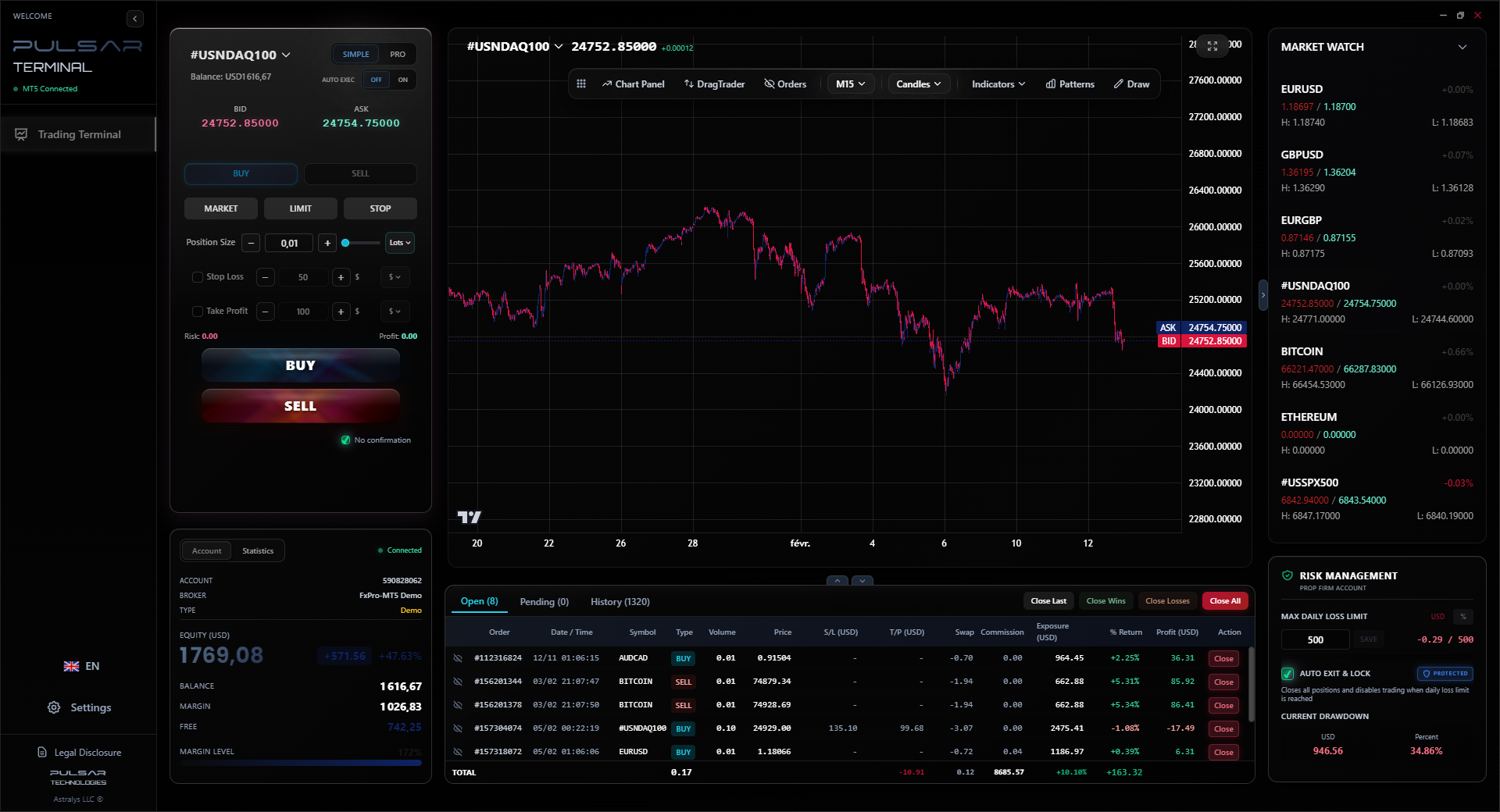
Managing complex trade plans with multiple take-profit levels and moving stops to breakeven is much easier with a tool that automates these actions directly on your MT5 platform.
Pulsar Terminal
MT5 올인원 도구: 드래그앤드롭 주문, 다중 TP/SL, 트레일링 스톱, 그리드 트레이딩, 볼륨 프로파일, 프롭펌 보호. 매일 1,000명 이상의 트레이더가 사용.
“Profit in forex isn't about being right all the time. It's about losing small when you're wrong and winning bigger when you're right.”
Let me save you some time and money by sharing my classic mistakes.
Overtrading: This is the #1 account killer for beginners. You don't need to be in a trade every day. Some of my most profitable months had fewer than 10 trades. I used to sit at my desk feeling like I had to 'find' a trade. That's how you take low-probability setups that nibble away at your capital. Now, if my setup isn't there, I do nothing. It's a valid action.
Chasing the Market: You see USD/ZAR ripping higher, you fear missing out (FOMO), and you buy at the very top. The price then reverses, and you're instantly in a loss. I've done this more times than I care to admit. Wait for the pullback, wait for your setup. The market will always give you another opportunity.
Ignoring Economic Events: Trading around major SA or US news (like SARB interest rate decisions or US Non-Farm Payrolls) without a plan is gambling. The spreads widen massively, and price can spike violently. Either have a specific news-trading strategy, or just stay out until the volatility settles. I learned this by getting stopped out on a good trade minutes before a Fed announcement.
Not Adapting Your Strategy: What works in a strong trending market will fail in a ranging market. A scalping strategy that works in the London session might be suicide in the thin Asian session. You need to read the market context. I stubbornly tried to force my trend-following system during a prolonged period of consolidation and gave back two months of profits.
Profit in forex isn't about being right all the time. It's about losing small when you're wrong, winning bigger when you're right, and having the discipline to follow your rules even when it's emotionally difficult.
“Your only goal for the first six months with real money is to survive without blowing up. If you can do that, you're in the top 20%.”
So, how do you actually make a profit in forex trading from South Africa? You build a system, brick by brick.
Phase 1: The Foundation (Months 1-6)
- Educate yourself on the basics: pips, lots, orders.
- Open a demo account with a reputable broker. Treat it like real money.
- Learn one simple strategy (like price action bounce from support/resistance) and practice it relentlessly on the demo.
- Start your trading journal. The goal here isn't profit, it's consistency and discipline.
Phase 2: The Real Start (Months 6-12)
- Fund a live account with money you can afford to lose completely. I'm talking R5,000 - R10,000.
- Your only goal is to survive for 6 months without blowing up. Seriously. If you can do that, you're in the top 20%.
- Focus on risk management above all else. Perfect your use of the position size calculator.
- Aim for small, consistent gains. A 2-5% return per month on this small account is a massive success.
Phase 3: Scaling Up (Year 2+)
- Once you have 6-12 months of consistent, profitable results (verified in your journal), you can consider adding more capital.
- You might explore other instruments like XAU/USD (gold) which often moves differently to currencies.
- Refine your strategy. Maybe add one more confluence filter to your entries.
- This is where your earnings can potentially grow to the R10,000-R50,000 per month range, but only if you've built a rock-solid foundation.
Remember, this is a marathon. The market will be here tomorrow. Your job is to make sure you are too, with your capital intact and your mind clear. That's the only real way to learn how to make a profit in forex trading.
FAQ
Q1Is forex trading legal and profitable in South Africa?
Yes, it's completely legal and regulated by the FSCA. Is it profitable? It can be, but it's a high-skill profession, not a quick money scheme. Most beginners lose money. Consistent profitability requires significant education, discipline, and strong risk management over a long period of time.
Q2What is the maximum use I can use in South Africa?
For retail traders, the FSCA has capped maximum use at 30:1. This applies to all FSCA-regulated brokers. While it might seem restrictive, it's a protective measure that prevents you from taking on catastrophic risk with a small account.
Q3How much money do I need to start forex trading in South Africa?
You can start with very little. Some brokers like XM have a minimum deposit of $5 (about R90). However, starting with a very small amount makes it hard to implement proper position sizing. A more practical starting amount for serious practice is between R5,000 and R10,000. Never start with money you can't afford to lose.
Q4How are my forex trading profits taxed in South Africa?
Profits from forex trading are considered ordinary income by SARS and are fully taxable. You must declare them on your annual tax return. It's crucial to keep detailed records of all your trades, including entries, exits, profits, losses, and broker statements.
Q5Can I use international brokers like IC Markets or Pepperstone?
Yes, many South Africans use top international brokers like IC Markets and Pepperstone. They accept SA clients and offer ZAR accounts. However, ensure you understand the process and costs for depositing and withdrawing Rands via international bank transfer. They are not FSCA-regulated, but they are regulated by other respected authorities like ASIC (Australia).
Q6What's a realistic daily or monthly profit target for a beginner?
For a beginner, a realistic target is simply to not lose money for the first 6 months. In terms of rand amounts, a beginner with a R10,000 account might aim for a 2-5% return per month (R200-R500). Focus on the percentage, not the rand value. Chasing R5000 a month from a small account usually leads to excessive risk and account blow-ups.
Q7What's the most important skill for a profitable forex trader?
Discipline. More than analysis, more than strategy. The discipline to follow your trading plan, the discipline to use strict risk management (never risk more than 1-2% per trade), and the discipline to close the platform after a loss instead of revenge trading. This mental control is what separates the consistent winners from the rest.
윈스턴 교수의 수업
핵심 요약:
- ✓Risk only 1-2% of your capital per trade.
- ✓The FSCA's 30:1 use protects you from yourself.
- ✓Bank fees can destroy small, frequent profits.
- ✓A trading journal is your most important tool.
- ✓Discipline beats a brilliant strategy every time.
이 기사가 얼마나 유용했나요?
별을 클릭하여 평가
주간 트레이딩 인사이트
무료 주간 분석 & 전략. 스팸 없음.
저자 소개
David van der Merwe
신흥시장 트레이더
요하네스버그 기반 트레이더로 신흥시장 통화 11년 경력. ZAR 통화쌍, FSCA 규제 거래, 남아공 시장 분석 전문.
댓글
위험 고지
금융 상품 거래에는 상당한 위험이 수반되며 모든 투자자에게 적합하지 않을 수 있습니다. 과거 성과가 미래 수익을 보장하지 않습니다. 이 콘텐츠는 교육 목적으로만 제공되며 투자 조언으로 간주되어서는 안 됩니다. 거래 전에 항상 직접 조사를 수행하십시오.
이 기사도 읽어보세요

Cara Trading Forex Sukses: 7 Prinsip dari Trader Profesional
Cara trading forex sukses dengan 7 prinsip trader pro: manajemen modal, disiplin, journal trading, backtest. Data nyata, bukan janji profit palsu.
Jam Trading Forex Terbaik untuk Trader Indonesia: Panduan Lengkap dengan Tabel Waktu
Panduan jam trading forex untuk trader Indonesia. Tabel 4 sesi dunia, jam emas 20:00-00:00, sesi mana yang harus dihindari. Data akurat + tips dari trader berpengalaman.
Top 5 Sàn Forex Uy Tín Nhất 2026: Review Jujur dari Trader Indonesia
Top 5 sàn forex uy tín 2026 untuk trader Indonesia. Review jujur: spread, deposit, withdraw, dukungan lokal. Exness, XM, IC Markets & lebih.
