


I remember staring at the MT4 chart on my old laptop in Pretoria back in 2014.

David van der Merwe
신흥시장 트레이더 ·  South Africa
☕ 10 분 소요
배울 내용:
I remember staring at the MT4 chart on my old laptop in Pretoria back in 2014. The EUR/USD was at 1.3500, and I'd just clicked 'buy' on my first real trade with R2,000. My hands were sweating. Ten minutes later, I was down R150. That gut-punch feeling? That's the first real lesson no 'how to trade forex for beginners pdf' can ever give you. Let's skip the fluff and talk about what starting out in South Africa actually looks like in 2026 - the real costs, the FSCA rules you can't ignore, and how to build a plan that doesn't blow up your account before you've even figured out what a pip really means.
Look, I get it. You want a simple 'how to trade forex for beginners pdf' to download, read, and magically know what to do. I wanted that too. The truth is, a static document can't teach you how to react when the Rand gaps 200 pips overnight because a gold mine shut down. It can't warn you about which local brokers have sneaky inactivity fees in Rands. A PDF gives you theory. Trading needs practice, context, and a plan built for our market.
Your real starting point isn't a document. It's three things: a regulated broker, a demo account, and a commitment to learn the mechanics before you risk a single cent. The best brokers, like the ones we review such as XM or Exness, offer free demo accounts that mirror live markets. Use them. For six months, I traded a demo account every day after work. I lost virtual money, learned how orders worked, and only then funded a live account. That patience saved me thousands.

Warning: Any 'guide' or broker that promises guaranteed profits or downplays risk is a scam, full stop. The FSCA publishes alerts about these companies. If it sounds too good to be true in our high-unemployment economy, it is.

💡 윈스턴의 팁
A demo account is for testing your strategy, not your luck. If you wouldn't take the trade with real money, don't take it on demo. You're building habits.
“Your real starting point isn't a document. It's a regulated broker, a demo account, and a commitment to learn the mechanics before you risk a single cent.”
Trading here isn't the wild west. We have strong rules to protect you, and ignoring them is the fastest way to lose your money.
The FSCA is Your Best Friend
The Financial Sector Conduct Authority (FSCA) is the main regulator. A broker holding an FSCA license must segregate your client funds from their own company money. This means if the broker goes under (it happens), your money should be safe and returned. They also enforce strict conduct rules. Always, always verify a broker's FSCA license number on the FSCA's website before you deposit a cent.
The use Cap: 30:1
This is a big one for beginners. Since 2021, the FSCA has capped use for retail traders at 30:1. That means with R10,000 in your account, you can control a position worth up to R300,000. Some offshore brokers might flash offers of 500:1 or even 2000:1. Sounds great, right? It's a trap. Higher use magnifies both profits and losses. At 500:1, a mere 0.2% move against you wipes out your entire account. The 30:1 cap forces discipline. It's a protective barrier, not a limitation.
Taxes and the SARB
Profits from trading are considered taxable income by SARS. You need to keep careful records of all your trades. Also, the South African Reserve Bank (SARB) has exchange controls. While individual trading through a locally regulated broker is generally fine, moving large sums offshore can require approval. Using an FSCA broker with a ZAR account simplifies this immensely.
“Higher use magnifies both profits and losses. At 500:1, a mere 0.2% move against you wipes out your entire account.”
Choosing a broker isn't about who has the flashiest ads on the rugby broadcast. It's about cold, hard numbers that chip away at your capital every single trade. Here’s what to scrutinize.
| Cost Factor | What to Look For | South African Specifics |
|---|---|---|
| Spreads | The difference between buy & sell price. Tighter is better. | On EUR/USD, look for <1.6 pips on standard accounts. Raw accounts can be 0.0 pips + commission. |
| Commissions | A fee per lot traded. | Often $3-$6 per lot, per side. Calculate the 'effective spread' (spread + commission cost). |
| Deposit/Withdrawal | Fees for adding/removing your money. | Use brokers with free ZAR EFTs or low-fee e-wallets like Skrill. Avoid $25 wire fees. |
| Inactivity Fees | Charged if you don't trade for a period. | Can be ~R1500 per year! Read the fee schedule. |
| Swap/Overnight Fees | Interest for holding a position past 5pm NY time. | Can add up if you're a swing trader. Check the broker's rate table. |
My mistake? I started with a broker offering 'zero spread' but a huge $10 commission. For my small position size, I was basically just paying commissions. I switched to a broker with a 0.8 pip spread and no commission, and my costs dropped by 60% overnight.
Look for brokers that offer local ZAR accounts. This lets you deposit and withdraw in Rands, avoiding the 1-2% currency conversion fee most international brokers slap on. Brokers like IC Markets and Pepperstone have solid local support, though always check their latest FSCA status.

Pro Tip: Open demo accounts with 2-3 shortlisted brokers. Execute the same trade on each and note the exact entry/exit price. The difference is your real cost, and it will shock you.
💡 윈스턴의 팁
The spread isn't just a cost; it's a headwind. If your average profit per winning trade is 8 pips, but the spread is 3 pips, you've given away 37.5% of your potential gain before you even start. Choose your broker and your pairs wisely.
“Higher use magnifies both profits and losses. At 500:1, a mere 0.2% move against you wipes out your entire account.”
Let's make this concrete. Say it's March 2026, and you've done your homework. You're using a demo account from an FSCA broker.
The Setup: You notice USD/ZAR has been in a steady downtrend (Rand strengthening), but it's just hit a key support level at 18.20 that's held before. The RSI indicator is showing oversold conditions below 30. You think it might bounce.
The Trade Plan:
- Instrument: USD/ZAR
- Direction: BUY (betting the Rand will weaken/USD will strengthen)
- Entry: 18.21
- Stop Loss: 18.10 (Risking 11 cents or ~110 pips)
- Take Profit: 18.45 (Targeting 24 cents)
- Risk/Reward Ratio: 1:2.2 (You're aiming for more than double what you're risking)
The Math with Real Money: Let's say you have a R20,000 account. A good rule for beginners is to risk no more than 1% per trade. That's R200.
- Your risk per trade is R200.
- Your stop loss distance is 0.11 ZAR (18.21 - 18.10).
- To calculate your position size: R200 / 0.11 = ~1,818 units of USD/ZAR.
In lot terms, that's a micro lot (0.02 lots). You place the trade. If it hits your stop at 18.10, you lose R200. If it hits your take profit at 18.45, you gain R436. The spread might be 50 pips (0.05), so you're down R9 the moment you enter. That's your cost of doing business.
I once broke my own 1% rule on a 'sure thing' in GBP/ZAR. I risked 5%. The trade went against me, and I lost R1,000 in an afternoon - a week's salary at the time. The rule is there for a reason.
“Clicking buttons based on a feeling is a donation to the market.”
Clicking buttons based on a feeling is a donation to the market. You need a repeatable process. For beginners, I suggest starting simple.
Price Action & One Indicator
Forget loading your chart with 10 squiggly lines. Learn to read candlestick patterns - doji, engulfing bars, pin bars. These show market sentiment. Then, add ONE momentum indicator to help. The MACD indicator is a good start. Look for when the MACD line crosses above the signal line for a potential buy, and below for a sell, especially if it coincides with a key price level.
The Two Timeframe Rule
Always look at a higher timeframe for context. If you're trading on the 1-hour chart, check the 4-hour trend first. Never buy into a strong downtrend on the 4-hour just because the 1-hour looks good for a bounce. The higher timeframe usually wins.
Journal Everything
This is non-negotiable. For every trade, write down: entry/exit reason, price, position size, outcome, and most importantly, your emotion. Did you panic and close early? Did you get greedy and move your stop loss? My journal showed me I was terrible at letting winners run. I'd close a trade for a R50 profit only to watch it go to R300. Seeing it in writing forced me to change.

Example: Your journal entry might look like: "8 Apr 2026, BUY EUR/USD @ 1.0820. Reason: Bullish engulfing on 1H at previous support, MACD turning up. SL: 1.0790. TP: 1.0860. Size: 0.05 lots. Result: Stopped out at 1.0790. Loss: $15. Emotion: Felt rushed before work, shouldn't have traded."
“Clicking buttons based on a feeling is a donation to the market.”
We have unique challenges here. Knowing them is half the battle.
1. Chasing 'Lobola Money' Trades: The pressure to make life-changing money quickly is real. This leads to over-leveraging and blowing accounts. Forex is a skill-building marathon, not a lottery.
2. Ignoring Commodity Links: The Rand is a commodity currency. It moves with gold, platinum, and coal prices. In early 2026, a drop in gold prices smacked the Rand. If you're trading ZAR pairs, you must watch commodity news. It's as important as local politics.
3. Underestimating Costs in Rands: A $5 commission might not sound like much. But that's nearly R100 at today's rates. Do a few trades a day, and you've spent a grocery bill on fees before you've even made a profit.
4. Prop Firm Hype: Passing a prop firm challenge to trade with 'someone else's money' is tempting. But these challenges have strict drawdown rules (like 5% daily loss limits). Without rock-solid discipline and tools to manage that risk automatically, you'll fail. It's a tough game.
5. Platform Paralysis: MT4/MT5 can look like a spaceship cockpit. Don't try to learn everything. Learn how to place a market order, a pending order, set a stop loss and take profit. That's it for the first month. The fancy tools like Volume Profile can come later.
💡 윈스턴의 팁
Your trading journal is your most important tool. It's the mirror that shows you who you really are as a trader. The market doesn't lie, and neither should your journal.
“Your goal for the first three months is not to get rich. It's to execute your plan under real psychological pressure.”
When your demo trading is consistently profitable over 3-6 months (I mean your equity curve is steadily rising, not just one lucky trade), you can consider going live. But it changes everything.
Start Small, Painfully Small. Fund your live account with the absolute minimum you're willing to lose completely. For many brokers, that's $100 or about R1,800. Your goal for the first three months is not to get rich. It's to execute your plan under real psychological pressure and not violate your risk rules. If you can grow that R1,800 to R2,000, you're a success.
The Psychology is Real. On demo, a R500 loss is a number. On a live R10,000 account, a R500 loss is 5%. You'll feel it in your chest. You'll want to revenge trade. This is where most fail. You must have the discipline to walk away after hitting your daily loss limit (I suggest 2-3%).
Automate What You Can. Emotional decisions are your enemy. Use tools that help you stick to your plan. For example, setting a trailing stop to lock in profits as a trade moves your way, or using a breakeven function to remove risk once a trade is in profit by a certain amount. These features stop you from making panicked, manual decisions.
My first live account was R5,000. I traded 0.01 lots (micro lots) exclusively for four months. The gains were tiny - sometimes R30 a day. But it taught me discipline with real money on the line. That boring foundation let me scale up confidently later.
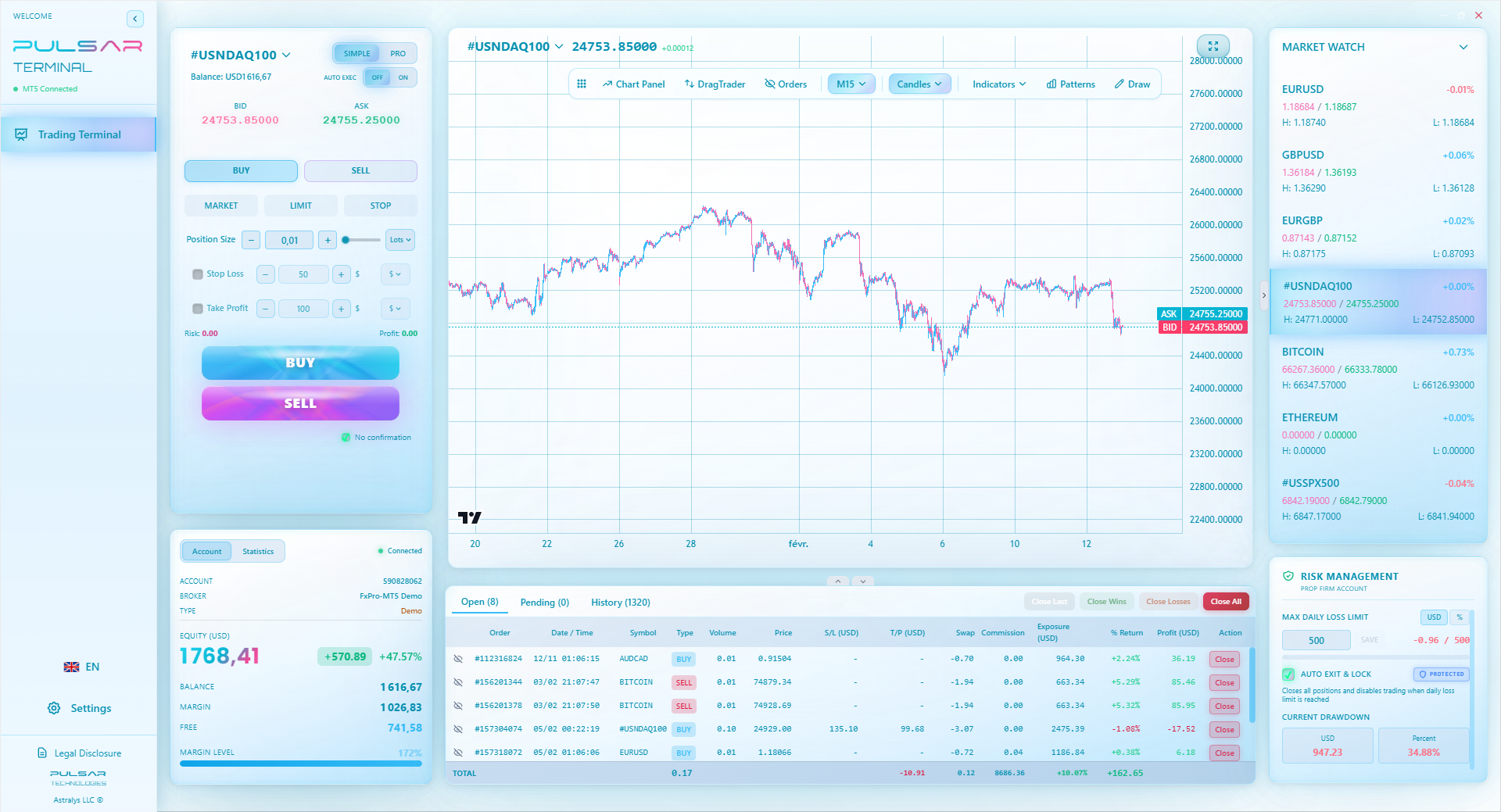
Sticking to a disciplined exit strategy is the hardest part of live trading, which is why tools like Pulsar Terminal that automate trailing stops and breakeven orders directly on your MT5 chart are game-changers for new traders.
Pulsar Terminal
MT5 올인원 도구: 드래그앤드롭 주문, 다중 TP/SL, 트레일링 스톱, 그리드 트레이딩, 볼륨 프로파일, 프롭펌 보호. 매일 1,000명 이상의 트레이더가 사용.
FAQ
Q1Is forex trading legal in South Africa?
Yes, it's completely legal and regulated by the Financial Sector Conduct Authority (FSCA). The key is to use an FSCA-licensed broker to ensure your funds are protected and you're trading within the legal framework, including the 30:1 use cap for retail clients.
Q2How much money do I need to start trading forex in South Africa?
You can start with very little. Many reputable FSCA brokers have minimum deposits of $100 (roughly R1,800). However, I strongly advise you to start with a demo account for several months first. When you go live, only risk capital you can afford to lose completely. Your initial focus should be on preserving capital and learning, not making profits.
Q3What is the best trading platform for beginners?
MetaTrader 4 (MT4) is still the gold standard for beginners in South Africa. It's ubiquitous, stable, and there's a mountain of free educational content and custom indicators for it. Most local brokers offer it. Learn MT4 inside out on a demo account before even looking at other platforms.
Q4Why is a ZAR-denominated account important?
It saves you money and hassle. If your account is in USD and you deposit in Rands, the broker converts it, often at a poor rate with a 1-2% fee. With a ZAR account, your deposits, withdrawals, profits, and losses are all in Rands. It's simpler for accounting and you avoid hidden conversion costs on every transaction.
Q5Can I make a living trading forex in South Africa?
A very small percentage of traders do. It requires significant capital (so losses don't force you to over-use), years of disciplined practice, and treating it like a serious business, not a side hustle. For 99% of beginners, a more realistic goal is to generate supplemental income or grow a savings pot slowly and consistently. Expecting to replace a full-time salary immediately is a sure path to significant losses.
Q6What's the single biggest mistake beginners make?
Risking too much money on a single trade. They see a 'sure thing' and bet 10%, 20%, or even 50% of their account. One loss can then cripple them. The golden rule is to never risk more than 1-2% of your account balance on any single trade. This is how you survive long enough to learn and become profitable.
Q7Do I need to pay tax on my forex profits?
Yes. According to SARS, profits from trading are generally considered income and are taxable. You must keep detailed records of all your trades (profits and losses) for your annual tax return. It's wise to consult with a tax professional who understands trading income.
윈스턴 교수의 수업
핵심 요약:
- ✓Start with a demo account for 3-6 months minimum.
- ✓Never risk more than 1% of your capital per trade.
- ✓Always verify your broker's FSCA license.
- ✓Use a ZAR account to avoid conversion fees.
- ✓Journal every trade, especially the losers.
이 기사가 얼마나 유용했나요?
별을 클릭하여 평가
주간 트레이딩 인사이트
무료 주간 분석 & 전략. 스팸 없음.
저자 소개
David van der Merwe
신흥시장 트레이더
요하네스버그 기반 트레이더로 신흥시장 통화 11년 경력. ZAR 통화쌍, FSCA 규제 거래, 남아공 시장 분석 전문.
댓글
위험 고지
금융 상품 거래에는 상당한 위험이 수반되며 모든 투자자에게 적합하지 않을 수 있습니다. 과거 성과가 미래 수익을 보장하지 않습니다. 이 콘텐츠는 교육 목적으로만 제공되며 투자 조언으로 간주되어서는 안 됩니다. 거래 전에 항상 직접 조사를 수행하십시오.
이 기사도 읽어보세요

Cara Trading Forex Sukses: 7 Prinsip dari Trader Profesional
Cara trading forex sukses dengan 7 prinsip trader pro: manajemen modal, disiplin, journal trading, backtest. Data nyata, bukan janji profit palsu.
Jam Trading Forex Terbaik untuk Trader Indonesia: Panduan Lengkap dengan Tabel Waktu
Panduan jam trading forex untuk trader Indonesia. Tabel 4 sesi dunia, jam emas 20:00-00:00, sesi mana yang harus dihindari. Data akurat + tips dari trader berpengalaman.
Top 5 Sàn Forex Uy Tín Nhất 2026: Review Jujur dari Trader Indonesia
Top 5 sàn forex uy tín 2026 untuk trader Indonesia. Review jujur: spread, deposit, withdraw, dukungan lokal. Exness, XM, IC Markets & lebih.
