


Let's cut through the hype right now.

David van der Merwe
신흥시장 트레이더 ·  South Africa
☕ 8 분 소요
배울 내용:
- 1What IM Academy Actually Is (And Isn't)
- 2The Real Price Tag: Breaking Down the Costs in ZAR
- 3What You Actually Learn (The Good, The Bad, The Fluff)
- 4The Elephant in the Room: The MLM Structure and Its Pitfalls
- 5A South African Trader's Cheaper, Better Alternatives
- 6My Final Verdict: Is It Worth It for a South African?
Let's cut through the hype right now. IM Academy isn't a magic bullet for forex riches, and anyone selling it as one is lying to you. I spent three years inside their environment, watched friends lose money on the promise of a 'system,' and had to unlearn half of what they taught to become profitable. This isn't a hit piece. It's a breakdown of what IM Academy Forex actually is for a South African trader: a very expensive library with a heavy dose of motivational fluff. I'll show you the real price tag in Rands, what skills are genuinely useful, and the critical gaps they don't tell you about.
IM Academy, formerly known as iMarketsLive, is a multi-level marketing (MLM) company that provides financial education, primarily focused on forex. They sell monthly subscriptions for access to video lessons, live trading sessions, and proprietary indicators.
Here's the crucial distinction most promoters blur: IM Academy is an education platform, not a broker. You cannot place trades through them. You pay them for learning material, then you must go and open an account with a separate broker like Exness or IC Markets to actually trade. This separation is vital. Their income comes from your recurring subscription and from recruiting others, not from your trading success.
The core product is their "IMM" software, a suite of custom indicators that plot zones on a chart. The education revolves around learning to trade using these zones. It looks clean and simple in their presentations. The reality of applying it to a live EUR/USD or XAU/USD chart, with real spreads and slippage, is a different story.

Warning: The MLM structure creates an inherent conflict of interest. Your 'educator's' primary incentive is often to retain you as a subscriber or recruit you into their downline, not necessarily to ensure you become a consistently profitable trader. I've seen this lead to overly optimistic guidance, especially for newbies.
“IM Academy is an education platform, not a broker. Their income comes from your recurring subscription, not from your trading success.”
This is where they lose most South Africans. The advertised price is just the start. Let's talk real numbers.
When I joined, the basic "IMMFX" package was around $249 USD per month. At an exchange rate of roughly R18/USD, that's R4,482 per month. Just to watch videos. That's more than a premium DStv subscription and a decent internet bundle combined. They have other tiers (IMMPro, Crypto) that cost more.
But wait, there's more. To practice, you need a demo account. To trade live, you need capital. The platform's indicators are designed for MetaTrader, so you're looking at using a broker's MT4/MT5 platform. You'll also encounter:
- Broker Spreads & Commissions: Your real cost of trading. On a major pair like EUR/USD, this could be 0.1 to 1.5 pips. It eats into the tight profit margins their strategies often target. Understanding pips and spreads is non-negotiable.
- Capital Risk: This is the big one. No one talks about the R10,000, R50,000, or R100,000 you need to risk to make the education 'worth it.' I foolishly funded a $500 (R9,000) account early on, following a 'sure thing' setup from a live session. I was stopped out in 20 minutes, losing R1,800. The educator's response? "Risk management is key. Try again." I hadn't truly learned position sizing, just how to draw a zone.

Example: A R4,500 monthly subscription over a year is R54,000. For that price, you could have funded a small live account, taken a few focused courses from independent mentors, and learned through real, controlled practice. The opportunity cost is massive.

💡 윈스턴의 팁
A R4,500 monthly fee is a 22.5 pip cost on a standard EUR/USD lot before you even make a trade. Your edge must be enormous just to break even.
“The MLM structure creates an inherent conflict of interest. Your educator's primary incentive is to retain you as a subscriber.”
The Useful Foundations
I'll be fair. IM Academy introduced me to concepts I'd never considered. Their basic forex education modules explain currency pairs, use, and long/short positions in a digestible way. The constant exposure to charts in the live sessions did help me learn to see price action, even if I was overly reliant on their colored zones. It sparked my initial interest, which led me to seek deeper knowledge elsewhere.
The Over-Reliance on Indicators
This is the core flaw. The entire system is built around their proprietary indicators. You're taught to wait for price to hit a blue 'buy zone' or red 'sell zone' and then enter. It creates a passive, reactive mindset. You stop learning to read the raw chart - the candle structures, the momentum, the actual auction happening. You're just watching for a light to turn green. When I later studied pure price action and market structure, I realized how much context those indicators were filtering out.
The Motivational Overload
A huge portion of the content isn't about charts. It's about mindset, positivity, and the 'lifestyle.' There are videos on buying luxury cars, interviews with top earners (who earn from recruitment, not trading), and pep talks. For some, this helps. For me, it became noise that distracted from the hard, boring work of backtesting and journaling. Trading isn't about motivation; it's about discipline and a strong process.

Pro Tip: The single best skill I took from IM Academy was learning to watch live market analysis without immediately trading. It taught me patience. I now apply that to watching sessions from independent analysts, which costs me nothing.

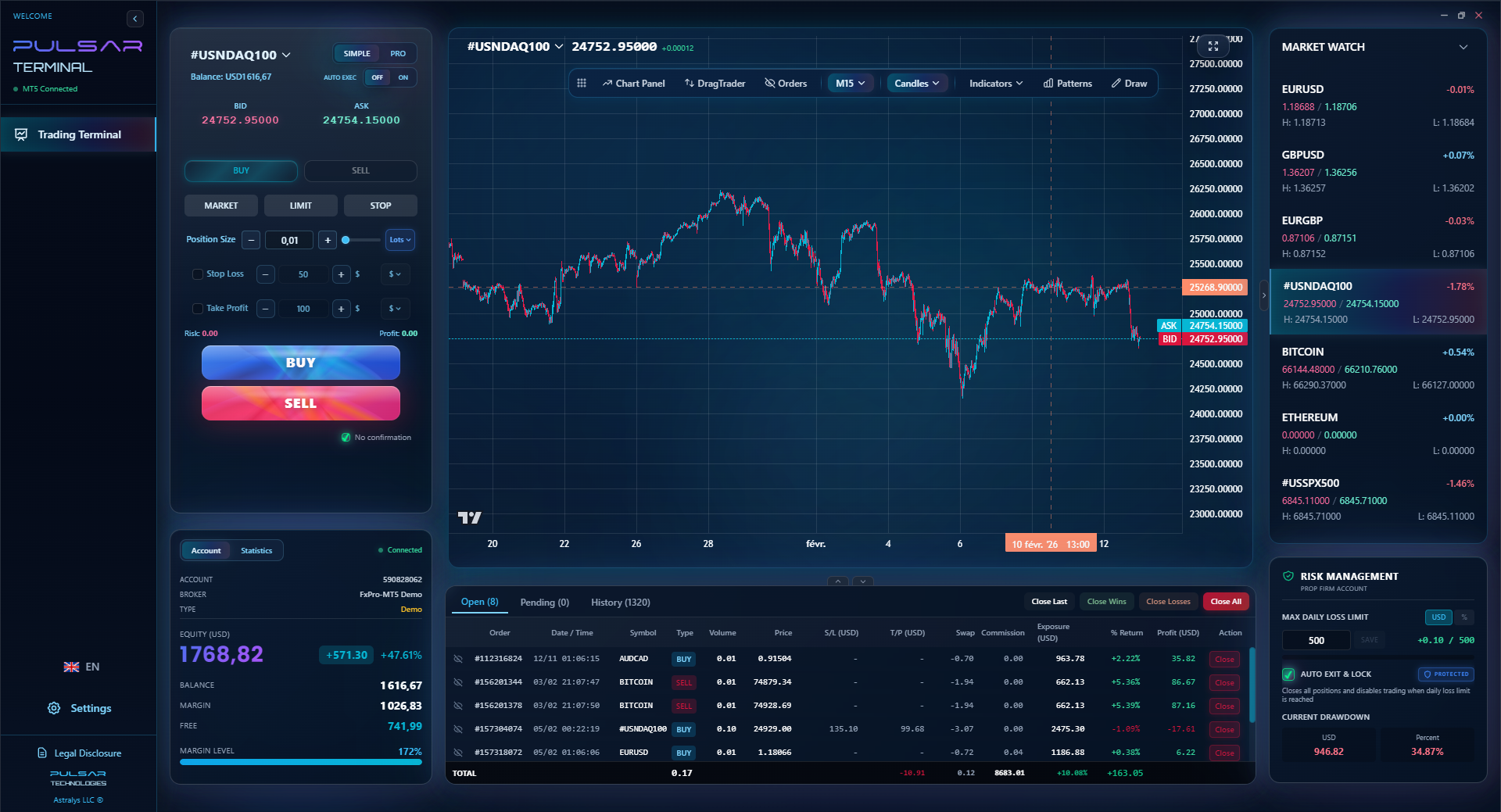
When I moved away from relying on IM Academy's indicators, I needed clean charts and precise tools; Pulsar Terminal's advanced drawing tools and Volume Profile on MT5 were essential for my new price-action approach.
Pulsar Terminal
MT5 올인원 도구: 드래그앤드롭 주문, 다중 TP/SL, 트레일링 스톱, 그리드 트레이딩, 볼륨 프로파일, 프롭펌 보호. 매일 1,000명 이상의 트레이더가 사용.
“For that R54,000 annual subscription, you could have funded a live account and learned through real, controlled practice.”
This aspect is impossible to ignore and fundamentally shapes the experience. The Multi-Level Marketing model means members are encouraged - sometimes heavily - to recruit others. Compensation plans are shown, focusing on the potential for passive income from your 'team.'
This creates several toxic dynamics for a trader:
- Conflicted Mentorship: Your primary mentor's success is tied to your continued subscription and your recruitment activity, not your trading P&L. I've seen losing traders be encouraged to 'focus on building the business' instead of addressing their flawed strategy.
- Echo Chamber Effect: The community can become an echo chamber where the system is never questioned. Critical discussion about losses is often reframed as a 'mindset issue' rather than a potential flaw in the methodology.
- Distraction from Trading: The pressure to recruit and attend business-building meetings pulls time and mental energy away from the charts. You start thinking about 'your team' instead of your equity curve.
My biggest mistake was spending 6 months trying to 'build the business' after my initial trading failures, convinced it was the smarter path. All it did was drain more money and delay my actual trading education. True trading income comes from the markets, not from a downline.
💡 윈스턴의 팁
If your mentor's income relies on your subscription, their advice is a sales pitch, not a trading lesson. Find a mentor who only profits when you profit.
“For that R54,000 annual subscription, you could have funded a live account and learned through real, controlled practice.”
If you're in Cape Town, Johannesburg, or Durban and want to learn forex, you have options that won't cost R4,500 a month. Here’s a path I wish I’d taken from the start.
Phase 1: Free Foundation (Months 1-2)
- Babypips School of Pipsology: Completely free. It will give you a stronger foundational knowledge than IM Academy's basics.
- Broker Education: Reputable brokers like Pepperstone and XM offer extensive, free educational libraries and webinars. Use them.
- YouTube (Critically): Follow independent traders who explain concepts like support/resistance, market structure, and risk management. Don't follow 'signal' channels.
Phase 2: Low-Cost Specialization (Months 3-6)
- Focus on One Strategy: Instead of a generic system, deeply learn one approach. Maybe it's scalping the London open or swing trading daily charts. Buy one well-reviewed course from a proven trader (often a one-time cost of R1,500 - R7,000).
- Master Your Tools: Learn one or two classic indicators inside out. Truly understand the RSI or MACD, how they work, and their limitations. This is far more valuable than leaning on a black-box indicator suite.
Phase 3: Practice with Purpose
- Demo Trade: But do it properly. Treat a R100,000 demo account as real. Use a realistic position size calculator. Keep a detailed journal.
- Fund a Micro Account: When you're consistently profitable on demo for 3 months, fund a live account with money you can afford to lose - maybe R2,000. The psychological shift is the real teacher. The goal here is to learn, not to withdraw profits.
This entire 6-month path could cost you less than R5,000 total (mostly for one good course), compared to over R25,000 in IM Academy subscriptions alone.

“Your greatest trading asset is your own judgment. Don't outsource it to a monthly subscription.”
For 99% of South Africans starting out, no, IM Academy Forex is not worth the extreme monthly cost in Rands.
You are paying a massive premium for the MLM structure and the motivational packaging. The core technical education can be found for a fraction of the price, or even free, if you're disciplined and know where to look. The risk of becoming a 'professional subscriber' instead of a trader is very real.
Who might it suit? Perhaps someone with significant disposable income who values the structured, community-driven learning path and isn't bothered by the MLM aspect. Even then, I'd advise treating it as a very expensive introductory course with a strict exit plan. Subscribe for 3 months, extract every bit of foundational knowledge, learn how they use their tools, and then cancel. Do not get sucked into the long-term dream.
My journey only truly began when I cancelled my subscription. The silence was deafening at first - no more daily live sessions, no more hype videos. It forced me to sit with a naked chart, learn real price action, and develop my own edge. That's when I stopped being a customer and started becoming a trader.
If you take one thing from this review, let it be this: Your greatest trading asset is your own judgment. Don't outsource it to a monthly subscription, no matter how glossy the presentation. The market doesn't care what indicator you paid for. It only cares if you're right or wrong, and by how much you risked.
💡 윈스턴의 팁
The best indicator you'll ever own is your own tested trading journal. It's free, it's honest, and it can't be sold as part of an MLM.
FAQ
Q1Can I make money with IM Academy's trading system?
It's possible, but not because of a 'secret system.' Their indicators are just tools. Making money depends entirely on your skill in using them, your risk management, and market conditions. Many who promote success are earning more from MLM commissions than live trading. The system itself is no guarantee.
Q2What is the minimum cost to start with IM Academy in South Africa?
The cheapest monthly subscription package is typically around $249 USD, which is roughly R4,500 per month at current exchange rates. This is just for education. You need separate capital for a demo or live trading account with a broker.
Q3Do I need to recruit people to succeed with IM Academy?
No, you don't need to recruit to access the education. However, the business model heavily incentivizes recruitment. The people earning the high incomes shown in presentations are almost always doing so through building large downlines, not solely from trading profits.
Q4Are IM Academy's indicators better than free MT4/MT5 indicators?
Not necessarily 'better,' just different and packaged. They repackage common concepts like supply/demand zones. Many skilled traders achieve better results using simple free tools they fully understand, like horizontal lines and volume, rather than relying on proprietary colored zones.
Q5Is IM Academy a scam?
It's not a scam in the illegal sense - they provide the educational content they promise. However, the marketing can be misleading, blurring the lines between educational success and financial success, and downplaying the extreme difficulty of becoming a profitable trader. The value proposition is poor for most South Africans relative to the cost.
Q6What's the biggest risk for a beginner joining IM Academy?
The biggest risk is financial bleed from two sides: the high recurring subscription fee (R4,500+/month) AND losing your live trading capital because you've overestimated your skills. This double loss can happen quickly. You also risk developing a passive, indicator-dependent trading mindset that's hard to break later.
Q7If I cancel IM Academy, can I still use the indicators?
No. The IMM indicators are licensed software. Once your subscription lapses, you lose access to them. This creates a dependency, making it hard to leave even if you're not profitable, because you feel you need the tools to trade 'the system.'
윈스턴 교수의 수업
핵심 요약:
- ✓Subscription costs must be justified by live profits.
- ✓MLM incentives corrupt trading education.
- ✓Proprietary tools create dependency, not skill.
- ✓Foundational knowledge is free or cheap.
이 기사가 얼마나 유용했나요?
별을 클릭하여 평가
주간 트레이딩 인사이트
무료 주간 분석 & 전략. 스팸 없음.
저자 소개
David van der Merwe
신흥시장 트레이더
요하네스버그 기반 트레이더로 신흥시장 통화 11년 경력. ZAR 통화쌍, FSCA 규제 거래, 남아공 시장 분석 전문.
댓글
위험 고지
금융 상품 거래에는 상당한 위험이 수반되며 모든 투자자에게 적합하지 않을 수 있습니다. 과거 성과가 미래 수익을 보장하지 않습니다. 이 콘텐츠는 교육 목적으로만 제공되며 투자 조언으로 간주되어서는 안 됩니다. 거래 전에 항상 직접 조사를 수행하십시오.
이 기사도 읽어보세요

Cara Trading Forex Sukses: 7 Prinsip dari Trader Profesional
Cara trading forex sukses dengan 7 prinsip trader pro: manajemen modal, disiplin, journal trading, backtest. Data nyata, bukan janji profit palsu.
Jam Trading Forex Terbaik untuk Trader Indonesia: Panduan Lengkap dengan Tabel Waktu
Panduan jam trading forex untuk trader Indonesia. Tabel 4 sesi dunia, jam emas 20:00-00:00, sesi mana yang harus dihindari. Data akurat + tips dari trader berpengalaman.
Top 5 Sàn Forex Uy Tín Nhất 2026: Review Jujur dari Trader Indonesia
Top 5 sàn forex uy tín 2026 untuk trader Indonesia. Review jujur: spread, deposit, withdraw, dukungan lokal. Exness, XM, IC Markets & lebih.
