


If you think an introduction to forex trade is just about buying low and selling high, you're already set up to fail.

Olumide Adeyemi
서아프리카 트레이딩 선구자 ·  Nigeria
☕ 11 분 소요
배울 내용:
- 1What Is Forex, and Why Is Nigeria Hooked?
- 2The Legal Rules You Absolutely Cannot Ignore
- 3Real Costs: Brokers, Spreads, and The use Trap
- 4Your First Practical Steps to Setting Up
- 5The Common Mistakes I Made (So You Don't Have To)
- 6One Simple Strategy to Start With (And Actually Test)
- 7Managing Your Mind and Your Money
If you think an introduction to forex trade is just about buying low and selling high, you're already set up to fail. I lost my first $500 thinking that way. The real story for us in Nigeria involves navigating CBN rules, understanding why your card gets declined, and calculating your true profit after the 10% tax man comes knocking. Let's set the record straight with the gritty details they leave out of the shiny ads.
Forex is simply the exchange of one currency for another. You're betting that one will get stronger or weaker against the other. It's the largest financial market in the world, open 24 hours a day from Monday to Friday. For us in Nigeria, it's more than just trading. It's a direct window into the health of our own economy.
Our massive import-driven economy and the constant headlines about the Naira's value against the Dollar make forex feel personal. When you trade USD/NGN, you're not just looking at charts, you're reacting to CBN policies, oil prices, and political news. It's this connection that draws so many Nigerians in. We live the currency volatility every day.
But here's the first hard lesson: living it doesn't mean you can trade it. I learned this in 2020. I saw the Naira was weakening, so I shorted USD/NGN (betting the Naira would strengthen). Seemed obvious, right? I entered at 410. It kept going up. And up. It hit 460 before I finally swallowed my pride and closed for a $300 loss. The market can stay irrational longer than you can stay solvent, especially when trading your home currency. Emotional attachment is a terrible trading strategy.

Warning: Trading USD/NGN with a strong opinion about the Naira's "true value" is a fast track to blowing your account. The market doesn't care about your patriotism or your economic analysis. It only cares about price.

💡 윈스턴의 팁
Your first investment shouldn't be in a trade, it should be in a journal. A £1 notebook to log your emotions is more valuable than a $1000 signal service.
“use isn't a tool to make you rich; it's a test to see how fast you can go bankrupt.”
This is the most critical part of your introduction to forex trade in Nigeria. Getting it wrong can freeze your funds.
Forex trading itself is legal for individuals. The regulators are the Central Bank of Nigeria (CBN) and the Securities and Exchange Commission (SEC). But there's a huge, dangerous gap in understanding. While you can trade, the CBN prohibits using official foreign exchange windows (like the one you'd access through your bank for business travel) to fund your trading account. They call that economic sabotage.
The Brokerage Loophole
This is why almost all serious Nigerian traders use international brokers regulated offshore (like in Seychelles, Cyprus, or South Africa). You won't be opening an account with "CBN-regulated" forex brokers in the classic sense. You're using global firms that accept Nigerian clients. Your deposit becomes an international transaction.
The Banking Hurdle
And here's where it gets frustrating. Many Nigerian banks have limits on international transactions with your Naira cards. You might try to deposit $100 to your broker and get a declined transaction. It's not the broker's fault. It's your bank enforcing CBN-inspired liquidity controls. The workaround? You often need to use digital payment processors or cryptocurrencies. Brokers like Exness and XM have integrated local payment solutions for this exact reason.
The Tax Reality
Nobody likes to talk about this when they're boasting about profits. In Nigeria, forex trading profits are subject to a 10% Capital Gains Tax. That's 10% of your gross profits, payable to the Federal Inland Revenue Service (FIRS). If you make a 50% return on your $1,000 account ($500 profit), you owe $50 in tax. You must declare this. I learned this the hard way after a good month in 2022 and had to scramble during tax season. Factor this into your profit calculations from day one.
“The 10% tax on profits is the most honest teacher you'll have - it forces you to calculate real net gains, not fantasy returns.”
Let's talk numbers. The advertised "minimum deposit" is a marketing trick. The real cost is in the spread and the use.
Broker Spreads in Naira Terms
The spread is the difference between the buy and sell price. It's your immediate cost of entering a trade. Look at EUR/USD. A "tight spread" might be 0.7 pips. A pip for a standard lot is $10. So, on a 0.7 pip spread, you start a 1-lot trade $7 in the hole. You need the market to move 0.7 pips just to break even.
Here’s a quick comparison of what Nigerian traders actually use (data is dynamic, always check live accounts):
| Broker | Typical Min. Deposit | Avg. EUR/USD Spread (Raw) | Key Feature for Nigerians |
|---|---|---|---|
| Exness | ~$10 | 0.0 - 0.1 pips + commission | NGN accounts, huge local adoption |
| XM | $5 | From 0.0 pips + commission | Very low entry point |
| IC Markets | $200 | 0.1 pips + commission | Excellent execution, popular for scalping |
| Pepperstone | $0 | 0.4 pips (Razor account) | Strong CMA regulation, good platform |

Example: On a $500 account, a 2-pip spread on GBP/USD for a 0.1 lot trade costs you $2 instantly (1 pip = $1 for a 0.1 lot). If your average winning trade only makes 5 pips, that spread just ate 40% of your potential profit.
The use Double-Edged Sword
use is borrowed money from your broker. 1:100 use means you control $10,000 with $100 of your own money. Nigerian brokers often offer up to 1:1000 or more. It sounds like a shortcut.
It's a trap for beginners. My most painful lesson came with use. I deposited $200, used 1:500 use, and bought 1 lot of Gold (XAU/USD). That's controlling $100,000+ with $200. A normal $10 move against me would wipe out half my account. Gold moved $5 against me in minutes, and I got a margin call. I lost $100 in under an hour. use amplifies losses faster than gains. I now never use more than 1:30 on my main account, no matter what the broker offers. Start with a position size calculator and treat use with extreme caution.
“The 10% tax on profits is the most honest teacher you'll have - it forces you to calculate real net gains, not fantasy returns.”
Here's my blunt, step-by-step guide to starting without getting scammed or confused.
- Choose a Regulated International Broker: Don't chase the one with the highest use. Look for one with a solid international license (like CySEC, FSCA, ASIC) that accepts Nigerians and has good reviews. IC Markets and Pepperstone are solid starting points for research. Open a demo account first. Live with it for a month.
- Fund Your Account: Expect hiccups. Have a backup payment method. Local bank transfer to the broker's local partner (if they have one), a verified digital wallet like Skrill, or USDT (Tether) are the most reliable ways. The $10 minimum deposit brokers offer is real, but start with an amount you are 100% willing to lose completely. I suggest $100 as a true learning minimum.
- Download a Platform: MetaTrader 4 (MT4) or MetaTrader 5 (MT5) are the industry standards. Every broker supports them. They might look outdated, but they're reliable. Learn one platform deeply before trying others.
- Learn the Basic Order: You need to understand a Market Order (buy/sell now), a Limit Order (buy/sell at a specific better price), and a Stop Loss (close trade at a specific loss to protect yourself). 80% of my early losses were from not using a stop loss, thinking "it'll come back." It didn't.
- Practice on a Demo, Then Go Micro: Demo trading feels like a video game. There's no emotion. Once you're consistently not blowing up your demo account for 2-3 months, switch to a live account with micro lots (0.01). The moment real money is on the line, your psychology changes. This is where the real introduction to forex trade begins.
💡 윈스턴의 팁
If you can't explain your trade setup in one simple sentence, you don't have a strategy. You have a hope.
“A stop loss isn't admitting you're wrong. It's confirming you have a plan.”
Let me be the cautionary tale.
Mistake 1: Trading Without a Stop Loss. I entered a swing trading buy on EUR/USD at 1.1250 in 2021, aiming for 1.1350. I didn't set a stop. It dropped to 1.1150. I thought, "It's the Euro, it'll bounce." It fell to 1.1000. I finally panicked and sold at 1.1050, locking in a 200-pip loss (-$200 on a 0.1 lot). A simple 50-pip stop loss would have saved me $150.
Mistake 2: Over-trading. Boredom is a killer. On slow days, I'd take low-probability trades just to "be in the market." I'd scalp the 1-minute chart for 2-pip gains, only to give it all back plus more on spreads. I once took 47 trades in a single day. My net profit was -$12.50 after commissions. Activity is not achievement.
Mistake 3: Chasing Losses. After that big EUR/USD loss, I felt I had to get it back immediately. I jumped into a GBP/JPY trade with triple my usual size. I was emotional, not analytical. I lost another $150 in 20 minutes. One bad trade turned into a catastrophic day because I broke my own rules.
Mistake 4: Ignoring Fundamentals. I was a pure chart guy. In April 2023, I was nicely long on USD/NGN based on my technical setup. Then the CBN announced a major FX reform. The Naira gapped stronger overnight, and my position was slaughtered. You must have an economic calendar open. For Nigerians, CBN policy meeting dates are as important as any MACD indicator crossover.

Pro Tip: Keep a trading journal. Write down every trade: entry, exit, reason, and most importantly, your emotional state. Review it weekly. You'll see your stupid patterns emerge, I promise.
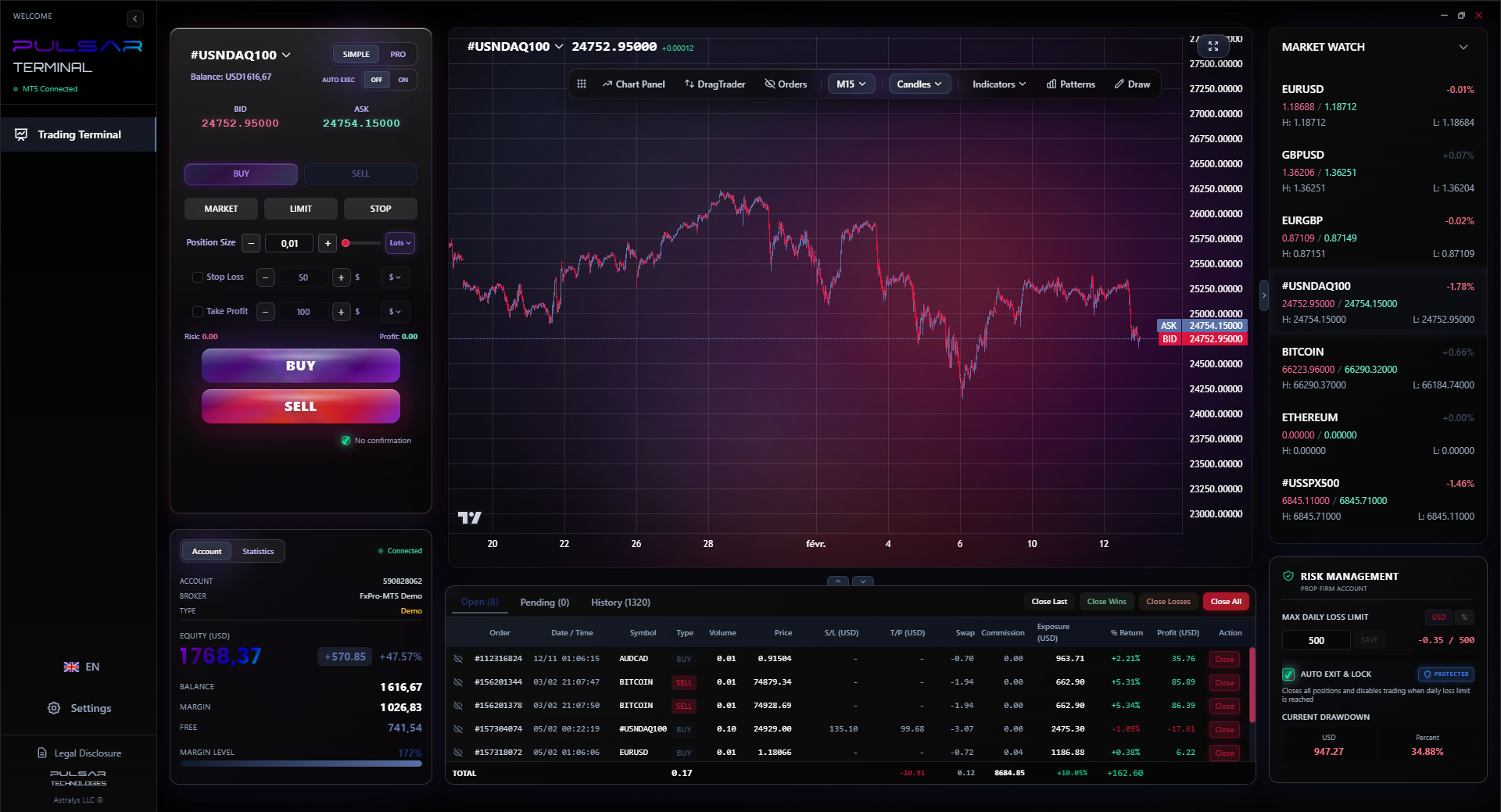
Managing multiple trades and stop losses manually is where mistakes happen; Pulsar Terminal automates partial closures and trailing stops directly on your MT5 charts.
Pulsar Terminal
MT5 올인원 도구: 드래그앤드롭 주문, 다중 TP/SL, 트레일링 스톱, 그리드 트레이딩, 볼륨 프로파일, 프롭펌 보호. 매일 1,000명 이상의 트레이더가 사용.
“A stop loss isn't admitting you're wrong. It's confirming you have a plan.”
Forget complex systems. Start with price action and one indicator. Here's what I used to stop the bleeding and finally see consistency.
I call it the "4-Hour Floor & Ceiling."
- Timeframe: Use the 4-hour chart (H4). It filters out market noise and gives you clearer trends. This isn't for getting rich quick, it's for learning discipline.
- The Tool: Use the 20-period and 50-period Exponential Moving Average (EMA). Add the RSI indicator set to 14 periods.
- The Rule: Only look for buys when the price is above BOTH the 20 and 50 EMA, and the 20 EMA is above the 50 EMA (a basic uptrend). Only look for sells when the price is below both, and the 20 is below the 50 (downtrend).
- The Trigger: Wait for the price to pull back to the 20 EMA. For a buy in an uptrend, wait for the price to touch or come near the 20 EMA, then look for a bullish candlestick pattern (like a pin bar or engulfing candle) to form. The RSI should be above 50, but not above 80 (overbought).
- Execution: Enter on a break of the high of that trigger candle. Place your stop loss 10-15 pips below the low of that candle. Your take profit should be at least 1.5 to 2 times your risk.
I tested this on XAU/USD (Gold) for 3 months on a demo account. Out of 22 trades, 14 were winners, 6 losers, 2 breakeven. The win rate wasn't amazing (~64%), but the risk-to-reward was solid. A typical trade risked $50 to make $85-$100. It forced me to be patient and wait for the setup. It's not glamorous, but it teaches you the core of trading: trend, pullback, confirmation, managed risk.
💡 윈스턴의 팁
The market's job is to find the price where you will be most wrong. Your job is to have a plan for when that happens, before it does.
“Your most profitable trade will be the one you don't take out of boredom.”
This is the final, most important chapter of your introduction to forex trade. Psychology and risk management are everything.
Risk Per Trade: Never, ever risk more than 1-2% of your trading account on a single trade. On a $1,000 account, that's $10-$20 max risk. This means if your stop loss is 20 pips away, you can only trade a position size where 20 pips = $20 loss. That's a 0.1 lot on most pairs. This rule alone will keep you in the game long enough to learn.
The 5% Rule: A bad day? A bad week? If your account drops 5% from its peak value in a day or a week, stop trading. Close all positions and walk away for 24 hours. Emotional drawdown leads to reckless recovery attempts. I've broken this rule and paid for it every single time.
Have a Life Outside Charts: Forex can consume you. The screens are always on. You'll check your phone in the middle of dinner. Set trading hours. Maybe you only trade the London session (1 PM - 4 PM Nigerian time). Then you shut it down. Your brain needs to reset. Some of my best trading decisions came after I stepped away for a full weekend.
This journey is a marathon of self-discipline, not a sprint to a Lamborghini. The market will humble you repeatedly. The goal isn't to be right every time, it's to be profitable over a hundred trades by managing your losses and letting your winners run. Start small, learn relentlessly, and protect your capital like your trading life depends on it - because it does.
FAQ
Q1Is forex trading legal and safe in Nigeria?
Yes, forex trading is legal for individuals in Nigeria. However, it's not 'regulated' in the way you might think. The CBN prohibits using official FX windows to fund accounts, so Nigerians primarily use international brokers regulated by foreign authorities (like CySEC, FSCA). Safety comes from choosing a reputable, well-regulated international broker, not from a local Nigerian license.
Q2How much money do I need to start forex trading in Nigeria?
Technically, you can start with as little as $5-$10 with some brokers. Practically, I recommend a minimum of $100. This allows you to trade micro lots (0.01) and properly implement risk management (risking 1-2% per trade) without your account being wiped out by a couple of small losses. Remember, the minimum deposit is not your trading capital strategy.
Q3How do I fund my forex trading account from Nigeria?
Due to bank restrictions on international transactions, direct Naira card deposits often fail. Reliable methods include: local bank transfers to the broker's Nigerian partner (if available), digital wallets (Skrill, Neteller), and cryptocurrencies like USDT (Tether). Brokers like Exness and XM have integrated specific local payment solutions for Nigerian clients.
Q4Do I pay tax on forex trading profits in Nigeria?
Yes. The Federal Inland Revenue Service (FIRS) requires a 10% Capital Gains Tax on your gross forex trading profits. You are responsible for declaring this income and paying the tax. It is a legal obligation, so factor it into your profit calculations from the beginning.
Q5What is the best time to trade forex in Nigeria?
The most volatile and liquid sessions overlap from 1:00 PM to 4:00 PM Nigerian Time (when the London session is fully open and the US session is beginning). This is when spreads are often tightest and price movement is strongest. Avoid the late Asian session (early morning in Nigeria) if you're looking for major trends, as markets are typically quieter.
Q6Which currency pairs should a beginner in Nigeria trade?
Start with the major pairs like EUR/USD, GBP/USD, and USD/JPY. They have the tightest spreads, highest liquidity, and the most available analysis. Avoid exotic pairs and even USD/NGN initially. Trading your home currency adds emotional bias, and exotics have wide, unpredictable spreads that can eat your profits.
Q7Can I make a living from forex trading in Nigeria?
It's possible, but it's an extremely high-risk goal, especially for beginners. Most traders lose money. To even consider it, you need years of consistent profitable demo trading, then live trading with a verified track record, a substantial capital base (not just $500), and rock-solid risk management. Treat it as a skill to develop over years, not a quick income replacement.
윈스턴 교수의 수업
핵심 요약:
- ✓Risk a maximum of 2% per trade, no exceptions.
- ✓Factor the 10% capital gains tax into all profit targets.
- ✓Use international brokers, not unregulated 'local' platforms.
- ✓Master one currency pair before adding a second.
- ✓A trading journal is non-negotiable for growth.
이 기사가 얼마나 유용했나요?
별을 클릭하여 평가
주간 트레이딩 인사이트
무료 주간 분석 & 전략. 스팸 없음.
저자 소개
Olumide Adeyemi
서아프리카 트레이딩 선구자
나이지리아에서 가장 활발한 외환 트레이딩 교육자 중 한 명. 라고스에서 8년간 트레이딩 경험. 아프리카 트레이더를 위한 소자본 전략과 프롭 펌 챌린지 전문.
댓글
위험 고지
금융 상품 거래에는 상당한 위험이 수반되며 모든 투자자에게 적합하지 않을 수 있습니다. 과거 성과가 미래 수익을 보장하지 않습니다. 이 콘텐츠는 교육 목적으로만 제공되며 투자 조언으로 간주되어서는 안 됩니다. 거래 전에 항상 직접 조사를 수행하십시오.
이 기사도 읽어보세요

Cara Trading Forex Sukses: 7 Prinsip dari Trader Profesional
Cara trading forex sukses dengan 7 prinsip trader pro: manajemen modal, disiplin, journal trading, backtest. Data nyata, bukan janji profit palsu.
Jam Trading Forex Terbaik untuk Trader Indonesia: Panduan Lengkap dengan Tabel Waktu
Panduan jam trading forex untuk trader Indonesia. Tabel 4 sesi dunia, jam emas 20:00-00:00, sesi mana yang harus dihindari. Data akurat + tips dari trader berpengalaman.
Top 5 Sàn Forex Uy Tín Nhất 2026: Review Jujur dari Trader Indonesia
Top 5 sàn forex uy tín 2026 untuk trader Indonesia. Review jujur: spread, deposit, withdraw, dukungan lokal. Exness, XM, IC Markets & lebih.
