


Let's get this out of the way: if you're reading this hoping to find a secret, low-spread Investec trading account to scalp USD/ZAR, you're about to be disappointed.

David van der Merwe
신흥시장 트레이더 ·  South Africa
☕ 9 분 소요
배울 내용:
Let's get this out of the way: if you're reading this hoping to find a secret, low-spread Investec trading account to scalp USD/ZAR, you're about to be disappointed. The truth most South African trading "gurus" won't tell you is that using a local bank like Investec for active forex speculation is either impossible or a terrible idea. Their forex services are built for wealth management and international payments, not for placing 50 pip stop losses. I'll break down exactly what Investec forex rates really mean for you, the legal minefield of trading ZAR pairs, and where you should actually be putting your trading capital.
When you hear 'Investec forex rates,' you're not talking about a broker's bid/ask spread. You're talking about a private bank's conversion rate for moving large sums of money. It's a completely different beast.
For their Private Banking clients, Investec offers Foreign Currency Call Deposit accounts (USD, GBP, EUR) and their newer multi-currency 'pockets.' The rates they give you are for converting your Rands into these currencies to hold or send abroad. There's always a markup. They might call it 'competitive,' but it's baked into the rate you see. I once helped a client move a £200,000 property payment. The rate offered was about 1.5% away from the true interbank mid-rate. That's a R6,700 cost on that single transaction, hidden in the exchange rate.

Warning: Don't confuse a bank's conversion service with a trading platform. You can't set limit orders, use use, or short currencies with these accounts. They're for saving and spending in foreign currency, not speculation.
The real tool for corporate clients is their e-clipse platform. This web-based system lets you book spot, forward, and swap contracts. It's for hedging business exposure, like a mining company locking in a USD rate for future equipment purchases. As a retail trader, you won't get access to this.
The bottom line? Investec forex rates are about wealth preservation and international finance, not technical analysis. If you're checking their rates thinking they'll help you time a EUR/ZAR trade, you're looking in the wrong place.

💡 윈스턴의 팁
A bank's 'competitive rate' is a marketing term for a managed margin. Your real benchmark is the interbank mid-rate, which they will never give you.
“Investec forex rates are about wealth preservation and international finance, not technical analysis.”
This is the part that causes so much confusion. Under South African exchange control, governed by the South African Reserve Bank (SARB), direct forex trading for speculative purposes is generally not allowed. Let me translate the legalese.
You, as a resident, have allowances: R1 million Single Discretionary Allowance (SDA) and R10 million Foreign Capital Investment Allowance (FIA) per year. You can use these to send money offshore legally. What you cannot do is use a South African bank account or card to fund an offshore broker with the sole intent of trading forex, especially against the Rand. The platforms offering this are typically not registered here.

Pro Tip: The loophole everyone uses? You legally transfer your allowance to a personal bank account you hold overseas (like in Mauritius or the UK). Then, you fund your international broker from that account. The broker isn't South African, and your trading capital is already offshore. This is how most serious local traders operate.
Trying to use your Investec account to directly fund an MT5 account with a broker like IC Markets or Pepperstone will likely get your transaction declined and could raise flags with your bank. They know the rules.
Why This Matters for Your Strategy
This legal framework shapes everything. It means:
- You're probably trading USD-based pairs (like EUR/USD or Gold) on an international platform, not ZAR pairs.
- Your profit and loss are in USD, and you'll need to bring them back as foreign investment proceeds, which has its own paperwork.
- The exciting USD/ZAR moves you see on TV are largely off-limits for direct speculation from within SA. You'd need to use CFDs or other derivatives from an offshore broker, which carries its own risks.
I learned this the hard way early on. I deposited R50,000 with an unregulated 'bucket shop' broker advertising local ZAR trading. When I tried to withdraw profits, they vanished. Stick to well-regulated international brokers you fund via legitimate offshore transfers.
“The loophole everyone uses? You legally transfer your allowance to a personal bank account you hold overseas.”
Investec's big 2025 launch was multi-currency pockets within your Private Banking account. You can now hold USD, GBP, and EUR 'pockets' alongside your ZAR. For a trader, this is useful, but not for executing trades.
Here’s how I use mine: as a settlement account. When I withdraw profits from my main offshore trading account at XM, I send the USD to my Investec USD pocket. There's no immediate conversion fee. I can then decide when to convert those dollars to Rands on my terms, potentially waiting for a better USD/ZAR rate. It saves the 2-3% cross-border fee my normal credit card would charge if I spent USD directly.

Example: Let's say I withdraw $10,000 in profits. If I let my bank auto-convert it at point-of-sale, a 2.5% fee costs me $250. Holding it in the USD pocket and converting later via Investec's rate might only have a 1% markup, saving me $150.
The catch? You need to be a Private Banking client, which has significant minimum relationship requirements. And you must keep minimum balances (like $1,000 for a USD Call Deposit). For holding trading capital, the interest rates are negligible. This is a cash management tool for your winnings, not a trading tool.
If you're not at that Private Banking level, don't sweat it. A normal USD account with another South African bank can serve a similar purpose, though with potentially higher fees.
💡 윈스턴의 팁
The first rule of trading from a regulated market like SA is: know how to get your money out legally before you put it in. The paperwork is part of the cost of doing business.
“Comparing Investec to a forex broker is like comparing a cargo ship to a speedboat. They're for different journeys.”
Comparing Investec to a broker like Exness is like comparing a cargo ship to a speedboat. They're for different journeys.
| Cost Factor | Investec (Private Banking) | International Forex Broker (e.g., Pepperstone) |
|---|---|---|
| Primary Purpose | Currency Conversion & Holding | Speculative Trading with use |
| Fee Structure | Markup on exchange rate (e.g., 1-1.5%) | Spread (e.g., 0.1 pips on EUR/USD) & Commission |
| USD/ZAR Spread | Not a traded spread; a conversion margin. | Can be as low as 0.00667 points on raw accounts. |
| use | None. 1:1. | Up to 500:1 (on professional accounts, subject to regulation). |
| Trading Platform | Online banking / e-clipse for corporates | MetaTrader 4/5, cTrader, proprietary platforms. |
| Can You Short? | No. | Yes. |
Let's put this in perspective. A 1% markup on a R1,000,000 conversion is R10,000 gone instantly. On a broker's platform, a 1-pip spread on a standard USD/ZAR lot (100,000 units) costs you about R60. The cost structures are orders of magnitude apart.
For active trading, the broker wins every time on cost. But remember, the broker's cost is for trading, while Investec's cost is for converting and moving money. You might use both: a broker to generate profits in USD, and a bank like Investec to receive and manage those USD profits efficiently before bringing them home.
Your biggest risk with a broker isn't the spread; it's use and poor risk management leading to a margin call. With a bank, the 'risk' is overpaying on conversion.
“Comparing Investec to a forex broker is like comparing a cargo ship to a speedboat. They're for different journeys.”
So, with the Investec myth busted, how do you actually trade forex from South Africa? Here's a step-by-step, legally-conscious approach.
- Education First, Money Later. Understand what a pip is, how use works, and have a tested strategy. Start with a scalping strategy demo or study swing trading principles.
- Choose a Regulated International Broker. Do not use an unregulated 'SA-focused' bucket shop. Go with globally recognized names with strong regulation (ASIC, FCA, CySEC). My go-to reviews are for IC Markets and Pepperstone. They offer tight spreads on MT5.
- Legally Transfer Seed Capital. Use your annual R1 million SDA. Contact your bank (yes, even Investec), fill out the form for a 'foreign investment transfer,' and send the money to your verified personal offshore account. Then fund your broker from there. Keep all your paperwork.
- Trade USD-Denominated Pairs. Focus on the major pairs like EUR/USD or commodities like XAU/USD. This avoids the ZAR regulatory gray area.
- Manage Risk Like a Pro. Use a position size calculator. Never risk more than 1-2% of your capital on a single trade. I once got cocky and risked 5% on a 'sure thing' in GBP/JPY. A surprise news spike wiped out two weeks of profits in minutes. Lesson learned.
- Repatriate Profits Properly. When you withdraw, you'll bring the money back as 'foreign investment proceeds.' You may need to provide proof of the original transfer and trading statements. This is where having a clean paper trail from step 3 is crucial.
This process respects the rules while giving you access to the real, global forex market.
💡 윈스턴의 팁
Your edge doesn't come from accessing a market. It comes from managing your trades within it better than the other guy. Focus on execution, not just entry.
“The edge used to be in finding a cheap broker. Now, the edge is in superior trade execution.”
The landscape is shifting, slowly. The COFI Bill, expected around 2026, might clarify some regulations. The massive growth in digital payments (up 45% in 2025) and platforms like MetaTrader 5 shows the demand is here.
Algorithmic trading is improving liquidity on local exchanges, which could eventually trickle down. Some analysts think 2026 might see low volatility, which could favor carry trades (borrowing in a low-interest currency to invest in a higher-yielding one).
But don't hold your breath for SARB to suddenly allow leveraged ZAR speculation from your lounge. The Rand is considered a volatile currency, and protecting it is a national priority. The future for South African traders will remain in sophisticated use of offshore brokers and smart management of repatriated funds.
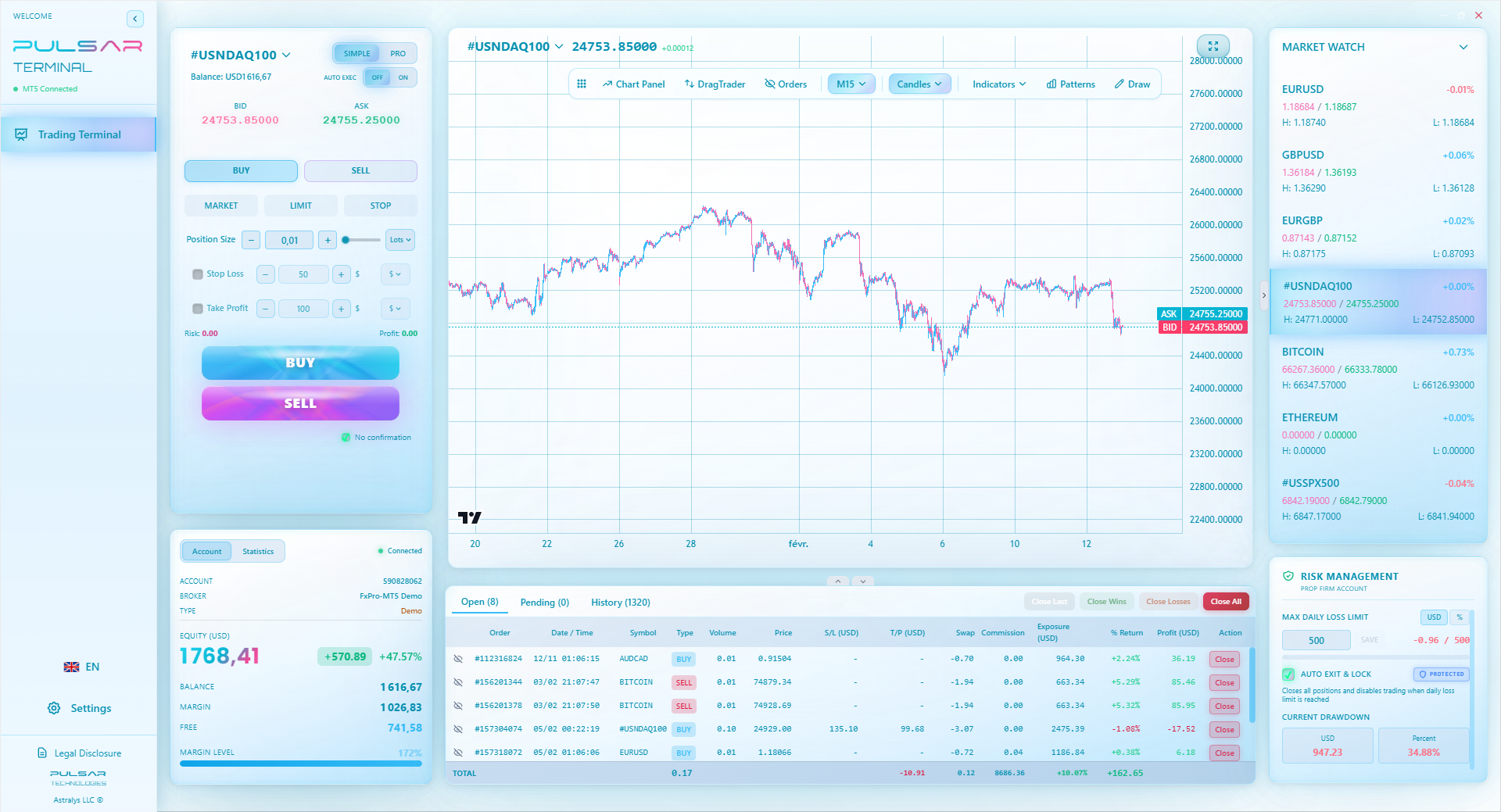
Tools are evolving too. Professional traders aren't just staring at MT5 charts anymore. They're using advanced companion apps that plug into MT5, offering features like drag-and-drop orders, automated trailing stops, and sophisticated trade management for multiple take-profit levels. This is the level you need to compete globally.
The edge used to be in finding a cheap broker. Now, the edge is in superior trade execution and risk management technology. The banks aren't providing that. The tech companies are.
Managing complex trades on pairs like EUR/USD requires precision; Pulsar Terminal's drag-and-drop orders and multi-TP/SL tools on MT5 give you that professional execution edge.
Pulsar Terminal
MT5 올인원 도구: 드래그앤드롭 주문, 다중 TP/SL, 트레일링 스톱, 그리드 트레이딩, 볼륨 프로파일, 프롭펌 보호. 매일 1,000명 이상의 트레이더가 사용.
FAQ
Q1Can I trade forex directly with my Investec Private Banking account?
No. Investec does not offer a leveraged, speculative forex trading platform to retail clients. Their forex services are for currency conversion, holding foreign currency, and making international payments. For active trading, you need a dedicated forex broker.
Q2Is it illegal for South Africans to trade forex?
It's nuanced. Trading forex for speculative purposes directly from South Africa, especially against the ZAR using a local platform, is generally not allowed under exchange control. The common legal method is to use your annual foreign investment allowance to send funds to an offshore account, then trade with an international broker from there.
Q3What are Investec's multi-currency pockets, and are they good for traders?
Launched in 2025, they are sub-accounts within your Investec Private Banking account that hold USD, GBP, or EUR. They are excellent for managing trading profits you've withdrawn from an offshore broker, as you can hold foreign currency without immediate conversion fees. They are not for executing trades.
Q4How do Investec's forex rates compare to broker spreads?
They're not comparable. Investec's rate includes a markup (often 1%+) for converting your money. A broker's spread is the cost to enter a trade, often a fraction of a percent. A 1% bank markup on R100,000 is R1,000. A 1-pip broker spread on a standard lot might cost R60.
Q5What is the best way to fund an international forex broker from SA?
Use your annual Single Discretionary Allowance (R1 million) or Foreign Capital Investment Allowance (R10 million). Formally request a foreign transfer from your South African bank to your own verified overseas bank account. Once the funds are offshore, deposit them into your chosen regulated international broker.
Q6Can I trade USD/ZAR with an international broker?
Yes, many international brokers offer USD/ZAR as a CFD or forex pair. However, you will be trading it from your offshore-funded account, not from within South Africa's regulatory jurisdiction. Always check your broker's specific terms and the regulations of their licensing authority.
윈스턴 교수의 수업
핵심 요약:
- ✓Banks convert, brokers trade. Know the difference.
- ✓Use your R1m SDA to fund an offshore account legally.
- ✓Trade major USD pairs (EUR/USD) to avoid ZAR regulatory issues.
- ✓A 1% bank markup can cost 100x more than a broker's spread.
이 기사가 얼마나 유용했나요?
별을 클릭하여 평가
주간 트레이딩 인사이트
무료 주간 분석 & 전략. 스팸 없음.
저자 소개
David van der Merwe
신흥시장 트레이더
요하네스버그 기반 트레이더로 신흥시장 통화 11년 경력. ZAR 통화쌍, FSCA 규제 거래, 남아공 시장 분석 전문.
댓글
위험 고지
금융 상품 거래에는 상당한 위험이 수반되며 모든 투자자에게 적합하지 않을 수 있습니다. 과거 성과가 미래 수익을 보장하지 않습니다. 이 콘텐츠는 교육 목적으로만 제공되며 투자 조언으로 간주되어서는 안 됩니다. 거래 전에 항상 직접 조사를 수행하십시오.
이 기사도 읽어보세요

Cara Trading Forex Sukses: 7 Prinsip dari Trader Profesional
Cara trading forex sukses dengan 7 prinsip trader pro: manajemen modal, disiplin, journal trading, backtest. Data nyata, bukan janji profit palsu.
Jam Trading Forex Terbaik untuk Trader Indonesia: Panduan Lengkap dengan Tabel Waktu
Panduan jam trading forex untuk trader Indonesia. Tabel 4 sesi dunia, jam emas 20:00-00:00, sesi mana yang harus dihindari. Data akurat + tips dari trader berpengalaman.
Top 5 Sàn Forex Uy Tín Nhất 2026: Review Jujur dari Trader Indonesia
Top 5 sàn forex uy tín 2026 untuk trader Indonesia. Review jujur: spread, deposit, withdraw, dukungan lokal. Exness, XM, IC Markets & lebih.
