


You're checking the latest forex news right now, aren't you? Watching the USD/ZAR ticker, scanning headlines about SARB rates, feeling that mix of opportunity and anxiety.

David van der Merwe
신흥시장 트레이더 ·  South Africa
☕ 10 분 소요
배울 내용:
- 1Why News Hits ZAR Pairs Harder (And What That Means For You)
- 2The Real Costs of Trading News in South Africa
- 3Your News Trading Routine: A Step-by-Step Plan
- 4Three Brutally Common Mistakes (I've Made Them All)
- 5Essential Tools & Resources for South African Traders
- 6Putting It All Together: A 2026 Case Study
You're checking the latest forex news right now, aren't you? Watching the USD/ZAR ticker, scanning headlines about SARB rates, feeling that mix of opportunity and anxiety. Here's the hard truth: 90% of traders use news wrong. They react to headlines instead of planning for them, turning information into losses. I've blown accounts doing exactly that. This isn't about what happened; it's about what happens next. Let's break down how to actually trade the news from South Africa, with real numbers from our market and the blunt lessons I learned the expensive way.
The Rand isn't the Euro. It's an emerging market currency, which means it reacts to news like a cat on a hot tin roof. While EUR/USD might shrug off a mid-tier data release, USD/ZAR can move 100 pips in minutes. That volatility is why you're here, but it's also what wipes out accounts.
Here's the local context most guides miss. South Africa's economy has specific pressure points: load-shedding updates, mining sector reports, political stability whispers from the Union Buildings, and of course, every single word from the SARB. These aren't just background noise; they're the primary drivers for our currency. A 0.25% rate decision from the Fed might move the Dollar, but a similar move from the SARB, combined with the governor's tone, can send the Rand reeling.

Warning: Don't confuse high volatility with high probability. Just because the market can move 150 pips doesn't mean your trade will be right. I learned this in 2023 trading a SARB announcement. I was correct on the hold, but the dovish forward guidance caused a sharper selloff than I'd planned for. My stop-loss was based on normal volatility, not news volatility. Poof. There went 3% of my account.
The key is understanding the hierarchy of news. For ZAR pairs, it looks like this:
- SARB Interest Rate Decisions & MPC Statements (The king)
- CPI & Inflation Data (The queen)
- Budget Speeches & Political Events (The wild card)
- Commodity Prices (Platinum, Gold) (The underlying current)
- Global Risk Sentiment (The tide that lifts all boats)
Focus your energy on the top three. The rest is often just chatter. If you want to manage the wild swings these events cause, a solid position size calculator is non-negotiable. You must trade smaller when news is due.

💡 윈스턴의 팁
The market's first reaction to news is often an overreaction. The real money is made by those who can identify when that emotional spike has exhausted itself.
Let's talk about money. Trading the latest forex news isn't free, and the costs here are unique. You might get the direction right, but sneaky fees can turn a winning trade into a break-even mess.
First, the spreads. During major news, brokers widen them. It's not a scam; it's their risk management. I've seen the typical USD/ZAR spread of 25-30 pips on a standard account blow out to 80+ pips right as a CPI print hits. On a R100,000 trade, that's an immediate R800 hole you start in. Some brokers like Exness or IC Markets offer raw spread accounts with commissions, which can be cheaper for high-frequency news trading. You pay $3.50 per lot but get a 0.0 pip spread. Do the math for your style.
The Hidden Killer: Currency Conversion
This one catches every new South African trader. If your trading account is in USD but you fund it with Rands, you pay twice: when you deposit and when you withdraw. Brokers or your bank take a cut, often around 1-2%. On a R50,000 deposit, that's R1,000 gone before you place a trade. The fix? Use a broker offering a ZAR-denominated account. XM and FP Markets do this well. It eliminates this specific cost.
Overnight Fees (Swap Rates) on News Trades
You see a great opportunity post-news and hold it for a few days. Check the swap. For ZAR pairs, the overnight interest can be significant, especially if you're going against the central bank's rate differential. I once held a USD/ZAR short for a week. I made 220 pips, but the negative swap ate 35 of them. It still profited, but it hurt the return.
| Cost Type | Typical Impact on USD/ZAR Trade | How to Mitigate |
|---|---|---|
| Spread Wideness | Can increase 200-300% at news time | Use Raw/ECN accounts; avoid trading the exact second of release. |
| Currency Conversion | 1-2% of deposit/withdrawal amount | Use a ZAR-denominated trading account. |
| Overnight Swap | Can be 0.5-2 pips per night cost or credit | Factor it into your profit target; consider shorter-term scalping strategy around news. |
The bottom line: your news trade needs to account for these costs in its profit target. A 50-pip target might only be 30 pips after all is said and done.
“The Rand reacts to news like a cat on a hot tin roof. That volatility is why you're here, but it's also what wipes out accounts.”
Winging it doesn't work. Here's the exact routine I follow, built from years of mistakes.
The Week Ahead (Sunday Night): I open my economic calendar. I don't just look for red "high impact" icons. I ask: "Does this data point matter to the SARB's mandate?" Inflation, growth, employment? Yes. Business confidence in Germany? Less so for ZAR. I mark 2-3 key events for the week. That's it. You cannot trade every release.
The Day Before: I check consensus forecasts. What are the big banks expecting for SA CPI? Is it 4.5% or 5.0%? The deviation from expectation matters more than the number. I also look at the price action. Is USD/ZAR already trending up into a potentially hawkish event? That might mean "buy the rumor, sell the news."
The Hour Before: I do nothing. No new trades. I adjust stops on existing trades to breakeven if possible, or I accept I'm taking the news risk. I decide my plan: Am I fading the initial spike (a common strategy) or trading the follow-through? I set alerts 5 minutes before. Then I walk away from the screen. Staring at a countdown timer makes you impulsive.
The 5 Minutes After: This is the chaos zone. Spreads are wide, price is spiking. My rule: I do not enter here. I watch. I wait for the first pullback and look for a consolidation pattern. Is the market absorbing the news? I'm looking for a 1 or 5-minute candle to close back inside the initial spike's range. That's often your signal. This requires patience most don't have.

Pro Tip: Trade the reaction to the news, not the news itself. The initial spike is often algos and panic. The move that happens 15-45 minutes later is the real market direction. Use the MACD indicator on a 5-minute chart to gauge momentum after the initial volatility settles.
The Aftermath: If I'm in a trade, I move my stop to breakeven as soon as I'm 10-15 pips in profit. News trades can reverse violently. I also set a reasonable target. Trying to catch the entire 150-pip move is greedy. Aim for 40-60% of the initial impulse move. Book the profit and live to trade another day.
Let me save you some money by showing you my old losing trade receipts.
Mistake 1: Trading the Headline, Not the Revision. In January 2025, SA CPI came out at 5.2% vs. 5.3% expected. "Lower inflation! Short USD/ZAR!" I jumped in. What I missed was the prior month's number was revised upwards from 5.1% to 5.3%. The market focused on the hotter revision, not the slight miss. The pair rallied. I got stopped out. The lesson: Read the entire report. The devil is in the details and revisions.
Mistake 2: Ignoring Confluence. A news event rarely exists in a vacuum. In late 2025, a slightly dovish SARB statement coincided with a sudden spike in the US Dollar Index (DXY) due to a strong US jobs report. I only focused on the local news. The global tide (a strong Dollar) drowned out the local ripple (a slightly weak Rand). USD/ZAR soared. Now, I always check the DXY and key pairs like EUR/USD for confluence. If the global move contradicts your local thesis, stay out.
Mistake 3: No Pre-News Price Context. Where is the price before the news? If USD/ZAR has already fallen 300 pips in the week leading to a SARB meeting, much of the hawkish expectation might be "priced in." Even a mildly hawkish result could trigger a "sell the fact" reversal. I used to think news was a binary trigger. It's not. It's the final piece of a puzzle the market has already been building. Always analyze the weekly and daily trend first. A strong trend can swallow a minor news surprise whole.
💡 윈스턴의 팁
If you can't articulate in one sentence *why* a specific news event should move a currency pair, you have no business trading it. Noise is not a thesis.
“90% of traders use news wrong. They react to headlines instead of planning for them, turning information into losses.”
You don't need a Bloomberg terminal. You need the right free tools.
Economic Calendars:
- ForexFactory: The classic. Set your timezone to GMT+2 (SAST). Filter for "ZAR" and "High Impact."
- MyFXBook Calendar: Cleaner interface. Good for seeing historical data comparisons.
News Sources:
- SARB Website: Go straight to the source. Their Monetary Policy Committee (MPC) statements are published here first.
- Moneyweb & BusinessLive: For local economic context and analysis that global sites miss.
- Reuters & Bloomberg EMEA Desk: For the global picture affecting risk sentiment.
Charting Tools: Your platform's built-in news feed is usually delayed. Don't rely on it. Use your broker's platform (like MT5) for execution, but have your calendar and news sources open separately in a browser. For analyzing gold's impact on the Rand, having a clean chart of XAU/USD is crucial.
The Most Important Tool: A Trading Journal. After every news trade, write down:
- The expected vs. actual result.
- The price action 30 minutes before and after.
- Your emotional state (were you frantic? calm?).
- The outcome and why you think it worked/failed.
I review my journal every month. Patterns emerge. You'll see you're bad at trading CPI but good at trading SARB statements. Then, you trade less and focus more. This is how you build an edge.
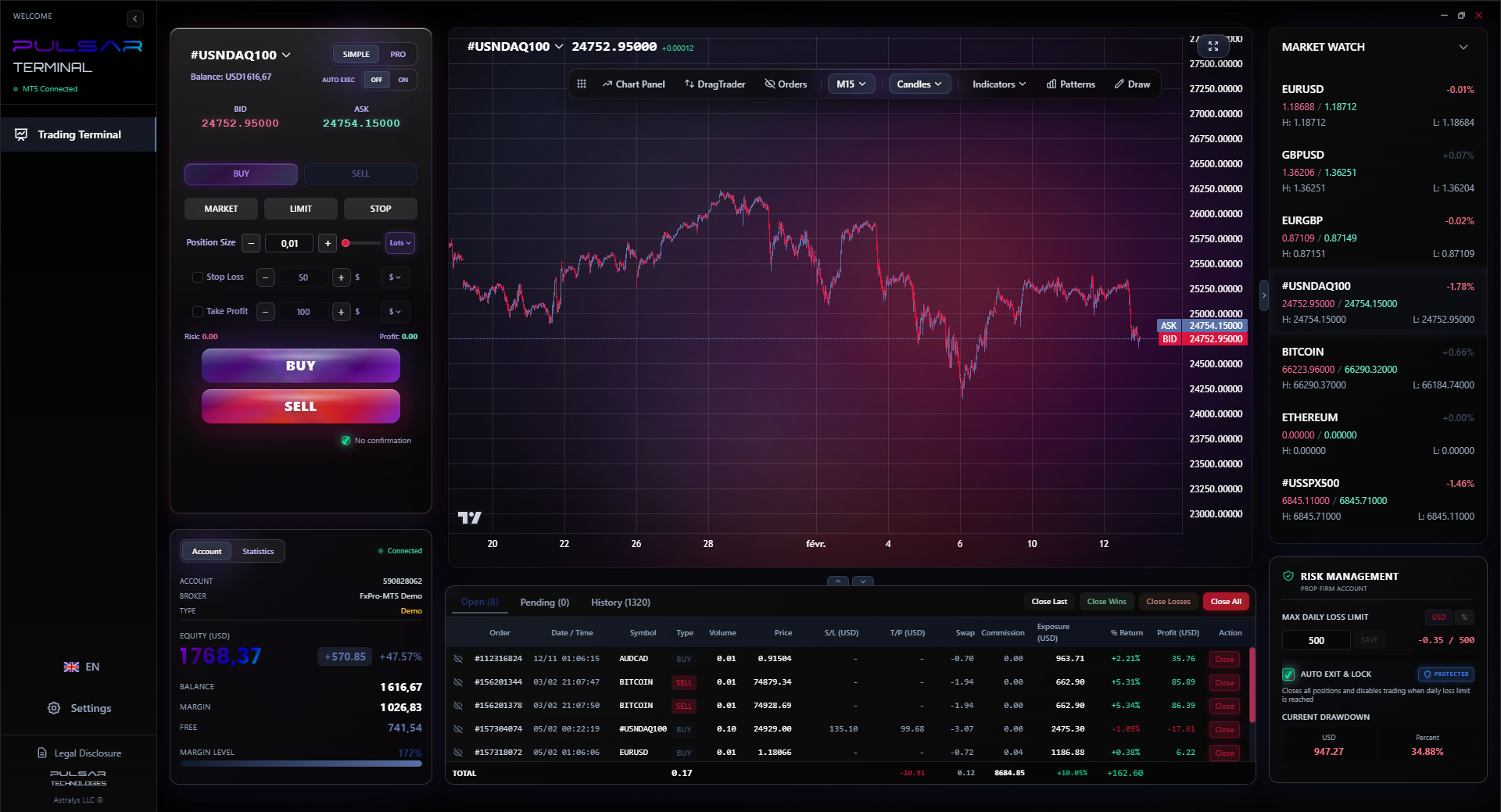
Executing a precise news trade plan requires quick, accurate order management, which is where a tool like Pulsar Terminal's drag-and-drop orders and multi-take-profit features on MT5 become indispensable.
Pulsar Terminal
MT5 올인원 도구: 드래그앤드롭 주문, 다중 TP/SL, 트레일링 스톱, 그리드 트레이딩, 볼륨 프로파일, 프롭펌 보호. 매일 1,000명 이상의 트레이더가 사용.
Let's walk through a hypothetical, but realistic, scenario for Q2 2026.
The Setup: SARB Interest Rate Decision. Consensus expects a hold at 6.75%. CPI is at 3.5%, within target. However, the Rand has been strong for months (up ~14% YTD), giving the SARB room to sound slightly more dovish about future hikes.
My Pre-News Analysis (Day Before): USD/ZAR is in a downtrend on the daily chart, trading near 16.50. The market seems to be pricing in a neutral-to-dovish hold. I decide my plan: If the statement is explicitly dovish (talking about potential future cuts), I will look to sell any initial spike in USD/ZAR (a "sell the news" play on dovishness). My reasoning: a dovish tone in a strong ZAR environment could be the cue for a continuation of the trend.
News Release: SARB holds at 6.75%. The statement says "the disinflationary process is more entrenched" and "the risks to the inflation outlook are now more balanced." That's dovish code.
The Trade:
- Initial Spike: USD/ZAR jumps 70 pips from 16.5000 to 16.5700. Algos buying the "hold." I wait.
- Reaction: Price starts fading. A 5-minute candle closes back below 16.5400. This is my signal the spike is failing.
- Entry: I sell at 16.5350.
- Stop Loss: I place it at 16.5850, 50 pips above my entry, respecting the initial spike high.
- Take Profit: I set two targets. TP1 at 16.4850 (50 pips), TP2 at 16.4350 (100 pips). I'll move my stop to breakeven after TP1 is hit.
The Outcome: The dovish interpretation takes over. The pair sells off steadily over the next 4 hours. TP1 is hit. I move stop to entry. TP2 is hit by the US session close. A 100-pip gain, executed with a plan, not a panic.
This works because it combined: 1) Understanding the news context, 2) Reading price action, 3) Having a predefined plan with managed risk. This is how you use the latest forex news, not as a gambler, but as a planner.
FAQ
Q1What's the best time to trade forex news in South Africa?
The most volatile and consequential times are during South African market hours (7am-5pm SAST) when local data drops, especially around 11am-2pm SAST for major releases. However, also watch the London/European overlap (10am-1pm SAST) and US open (3:30pm SAST) for global risk sentiment that impacts ZAR.
Q2Can I trade forex news with a small account in South Africa?
Yes, but you must be militant. The FSCA's 30:1 use limit helps. With a R5,000 account, your position size should be tiny - think 0.01 lots on USD/ZAR. The wide spreads on news will eat a huge percentage of a small account if you trade normal sizes. Use a position size calculator religiously. Consider starting with a broker like XM that has a $5 minimum to practice the routine with minimal risk.
Q3Why does the USD/ZAR spread get so wide during news?
Brokers aren't charities. During news, the actual interbank market liquidity dries up as big players pause. The broker's risk of getting filled at a bad price skyrockets. They widen the spread definition to protect themselves from that slippage risk, effectively passing the cost and risk onto you. It's a cost of doing business during high volatility.
Q4How do I know if news is already 'priced in'?
Look at the price action in the days and hours leading up to the event. Has the currency been steadily moving in the direction the expected news would suggest? If everyone expects a hawkish SARB and USD/ZAR has already fallen 200 pips that week, the news might be priced in. A 'buy the rumor, sell the fact' reversal is common. The actual statement would need to be even more hawkish than expected to push it further.
Q5Is it better to trade before or after the news release?
For most retail traders, after is far safer. Trading before is speculation, gambling on the outcome. Trading after is reaction, trading the market's interpretation. The initial 2-5 minutes are messy. Wait for the first clear rejection or breakout after the initial spike. Let the algos fight it out first, then step in.
Q6What's the biggest risk with news trading?
Slippage and failed liquidity. You might get your order filled 20 pips worse than you wanted, or your stop-loss might trigger at a catastrophic price during a flash spike. This can lead to a margin call much faster than you anticipated. Always use guaranteed stop losses if your broker offers them for news events, even if they cost a premium.
윈스턴 교수의 수업
핵심 요약:
- ✓Hierarchy matters: SARB decisions trump all other ZAR news.
- ✓Costs are real: Account for spread widening & conversion fees.
- ✓Trade the reaction, 5-15 minutes after the initial chaos.
- ✓Always check for global confluence (e.g., DXY movement).
- ✓Journal every news trade to find your personal edge.
이 기사가 얼마나 유용했나요?
별을 클릭하여 평가
주간 트레이딩 인사이트
무료 주간 분석 & 전략. 스팸 없음.
저자 소개
David van der Merwe
신흥시장 트레이더
요하네스버그 기반 트레이더로 신흥시장 통화 11년 경력. ZAR 통화쌍, FSCA 규제 거래, 남아공 시장 분석 전문.
댓글
위험 고지
금융 상품 거래에는 상당한 위험이 수반되며 모든 투자자에게 적합하지 않을 수 있습니다. 과거 성과가 미래 수익을 보장하지 않습니다. 이 콘텐츠는 교육 목적으로만 제공되며 투자 조언으로 간주되어서는 안 됩니다. 거래 전에 항상 직접 조사를 수행하십시오.
이 기사도 읽어보세요

Cara Trading Forex Sukses: 7 Prinsip dari Trader Profesional
Cara trading forex sukses dengan 7 prinsip trader pro: manajemen modal, disiplin, journal trading, backtest. Data nyata, bukan janji profit palsu.
Jam Trading Forex Terbaik untuk Trader Indonesia: Panduan Lengkap dengan Tabel Waktu
Panduan jam trading forex untuk trader Indonesia. Tabel 4 sesi dunia, jam emas 20:00-00:00, sesi mana yang harus dihindari. Data akurat + tips dari trader berpengalaman.
Top 5 Sàn Forex Uy Tín Nhất 2026: Review Jujur dari Trader Indonesia
Top 5 sàn forex uy tín 2026 untuk trader Indonesia. Review jujur: spread, deposit, withdraw, dukungan lokal. Exness, XM, IC Markets & lebih.
