


Most lists of major forex pairs you find online are useless for a Nigerian trader.

Olumide Adeyemi
서아프리카 트레이딩 선구자 ·  Nigeria
☕ 12 분 소요
배울 내용:
- 1What Actually Makes a 'Major' Pair? (It's Not What You Think)
- 2The Core Three: EUR/USD, GBP/USD, USD/JPY
- 3The Commodity & Cross Majors: AUD, CAD, CHF, NZD
- 4The Naira Problem: Why USD/NGN Isn't On This List
- 5How to Pick Your First Major Pair (A Practical Plan)
- 6Brokers, Spreads, and Getting a Fair Deal in Nigeria
- 7Mistakes I Made (So You Don't Have To)
Most lists of major forex pairs you find online are useless for a Nigerian trader. They parrot the same seven pairs without context, ignoring the reality of our market, our spreads, and the constant dance with the Naira. I've lost money following generic advice that didn't account for the fact I'm trading from Lagos, not London. This isn't just a list. It's a survival guide, broken down by what actually moves, what you can realistically trade, and how to navigate the unique liquidity traps we face every day.
Forget the textbook definition. In the real world, a major forex pair isn't just about the US Dollar. It's about three things: liquidity, tight spreads, and whether your broker in Cyprus or Australia can actually get you a decent fill on it at 2 AM Nigerian time.
Liquidity is king. It means the difference between your stop-loss getting hit at your exact price versus slipping 5 pips in a flash crash because no one was buying. The majors have deep, deep pools of money behind them. Central banks, multinational corporations, hedge funds – they're all trading these pairs 24/5. That volume protects you (somewhat) from the wildest manipulations.
The spread is your silent enemy. Every time you enter a trade, you start in the red by the spread amount. On a major like EUR/USD, that might be 0.8 pips on a good ECN account from a broker like IC Markets. On an exotic involving the Naira? You could be looking at 50 pips or more before you even start. That's not a trade; it's a donation.
The Nigerian Reality Check
Here's where most guides fail. They'll list GBP/JPY as a major cross. And technically, it is. But have you tried trading it during Asian session lulls from Abuja? The spread can widen to 5 pips easily. For a scalping strategy, that's a death sentence. Your edge gets eaten before the trade has a chance. A true 'major' for us is one that maintains relatively sane spreads through most market sessions on the brokers available to us.
I learned this the hard way early on. I was obsessed with AUD/USD because of commodity news. I'd set alarms for Australian data releases. One time, I got a perfect signal on the 5-minute chart. Entered a 2-lot buy at 0.6750. The spread was normal at 1.2 pips. The news hit, and the pair spiked... but my order filled at 0.6745. A 5-pip negative slippage. The price then reversed and took out my stop-loss. I lost not because my analysis was wrong, but because the liquidity at that exact millisecond for that pair, from my location, wasn't there. The 'major' failed me because I didn't respect the timezone liquidity flow.
“A true 'major' for us is one that maintains relatively sane spreads through most market sessions on the brokers available to us.”
These are the bedrock. If you're new, you should live on these charts for your first six months. Don't even look at anything else.
EUR/USD (The Euro / US Dollar) This is the most traded financial instrument on the planet. For us, it's a gift. The spread is almost always tight, often below 1 pip. It trends beautifully, reacts predictably (mostly) to US and EU news, and has clear daily ranges. It's the perfect pair to learn technical analysis. My most consistent profits have come from simple support/resistance plays on the EUR/USD daily chart. It's also the pair I use to test any new broker. If their EUR/USD spread is consistently above 1.5 pips on a standard account, I walk away.

Example: A standard lot (100,000 units) trade on EUR/USD. Each pip movement is worth $10. With a 0.9 pip spread, you're down $9 the moment you enter. You need the price to move just under 1 pip in your favor just to break even. On an exotic, that break-even move could be 50 pips.
GBP/USD (The Pound / US Dollar) Also known as 'Cable'. It's like EUR/USD's more volatile cousin. It moves faster and can have sharper, news-driven spikes. UK economic data, Bank of England speeches, and Brexit aftershocks (they're still happening) can cause chaos. This is great for momentum traders but dangerous for beginners. The spread is usually slightly wider than EUR/USD, maybe 1.2 to 1.8 pips. I use GBP/USD for swing trading setups more than intraday, as the daily trends can be powerful.
USD/JPY (The US Dollar / Japanese Yen) This is the interest rate pair. It's heavily influenced by the difference between US Treasury yields and Japanese Government Bond yields. When the US Federal Reserve is hiking rates and Japan is holding at zero, USD/JPY tends to rise. It's also a classic 'risk-off' currency. When global markets panic, traders buy the Yen, and USD/JPY falls. The spread is tight, but you must watch the Tokyo session open (around 1 AM our time) for gaps. A key lesson: never leave a USD/JPY trade unprotected over a Japanese holiday. I once got gapped 40 pips against me on a bank holiday Monday. It was a brutal reminder that the market doesn't care about my stop-loss if it's not trading.

💡 윈스턴의 팁
The market's favorite trick is to make the obvious trade fail first. If everyone is buying EUR/USD at 1.0800, it will likely dip to 1.0780 to sweep stops before rallying. Patience is a position.
“Trying to 'trade' the Naira's volatility directly on a retail platform is a specialist's game, and a dangerous one.”
This is the next tier. They're still highly liquid but come with their own personalities and quirks. You need to understand what drives them.
AUD/USD & NZD/USD (The 'Aussie' and 'Kiwi') These are China's proxies. When China's economy is humming, demanding iron ore (AUD) and milk powder (NZD), these pairs rally. When China sneezes, they collapse. They are also 'carry trade' favorites due to historically higher interest rates in Australia and New Zealand. The spreads are good, but liquidity can thin out during the late New York/early Asian session overlap. Don't trade them based on US news alone; always have one eye on Chinese commodity demand data.
USD/CAD (The 'Loonie') This is the oil pair. Canada is a massive oil exporter. Generally, when oil prices go up, the Canadian Dollar strengthens, and USD/CAD goes down. Simple, right? Not always. Sometimes broader USD strength overwhelms the oil correlation. You need to watch both the WTI crude oil chart and the general Dollar Index (DXY). The spread is excellent. This pair can trend for months in a beautiful channel. I missed a huge one in 2022 because I was overcomplicating my analysis. The trend was obvious on the weekly chart, but I was looking for reversals on the hourly.
Pairs with the Swiss Franc (USD/CHF, EUR/CHF) The Swiss Franc is a 'safe-haven'. In a market storm, money flows into CHF. USD/CHF and EUR/CHF will drop. The Swiss National Bank (SNB) is the wildcard. They hate a strong Franc (it hurts their exports) and have been known to intervene directly in the markets without warning. This creates sudden, violent spikes. I treat CHF pairs with extreme caution. The spreads are tight, but the intervention risk adds a layer of unpredictability that's hard to model. It's better to trade the Euro or Dollar's safe-haven flows through USD/JPY, in my opinion.
“Trying to 'trade' the Naira's volatility directly on a retail platform is a specialist's game, and a dangerous one.”
You might be wondering: where is USD/NGN? Isn't that the most important pair for a Nigerian? For your personal finances, absolutely. For trading as an individual retail trader? Almost impossible and incredibly risky.
The official USD/NGN rate is set in the Nigerian Foreign Exchange Market (NFEM) by 'authorised dealers' – the banks. The CBN's new FX Code and revised NFEM guidelines from late 2024 are aimed at this institutional, wholesale market. They're trying to bring transparency and ethics to how banks and large corporations trade FX.
This has zero direct impact on you trying to buy or sell USD/NGN on MetaTrader 5. The rate you see on your broker's platform is a derivative, often based on the Naira futures contract or an offshore consensus. The spread is monstrous – I've seen it at 100 pips or more. The liquidity is a joke. It's a great way to watch your capital evaporate through spreads and slippage.

Warning: Any broker offering tight spreads on USD/NGN to retail clients is likely operating a bucket shop or a completely synthetic market. You're not trading the real rate; you're trading against the broker's quote. The CBN's regulations don't protect you here.
Our reality is that we trade global majors to make USD profits (or losses). Getting those profits back into Naira is a separate challenge involving your domiciliary account, wire transfers, and sometimes crypto gateways. Don't confuse the two. Trying to 'trade' the Naira's volatility directly on a retail platform is a specialist's game, and a dangerous one. Focus on mastering the global list of major forex pairs first. Build your capital in a stable currency, then worry about conversion.
💡 윈스턴의 팁
Your first loss is often your smallest. The real danger is the 'revenge trade' you take immediately after, where emotion overrules your plan. After a loss, close the platform. Go for a walk.
“Your choice of broker is more important than your choice of pair.”
Don't trade them all. Pick one. Master it. Here's a simple decision tree based on your personality and schedule.
If you're a complete beginner and scared of volatility: Start with EUR/USD. Trade it on the 1-hour or 4-hour chart. Ignore the 5-minute. Your goal is to learn how price moves, reacts to round numbers, and forms trends. Use a demo account and practice for at least three months. Track every trade in a journal. Why did you enter? Where did you place your stop? What was the spread? This builds discipline.
If you're more experienced and can trade during London/New York overlap (2 PM - 5 PM our time): GBP/USD offers more action. The moves are bigger, the rewards (and risks) are higher. This is where you can apply more advanced concepts like order flow or news trading. But you must be disciplined with your position size calculator. A 50-pip stop-loss on GBP/USD costs more than a 50-pip stop on EUR/USD because the pip value is higher.
If you're a night owl and trade the Asian session (late night to early morning): USD/JPY and AUD/USD are your plays. Focus on how they react to Japanese or Australian data releases. The volatility is lower than the London session, which can be good for methodical, range-based strategies. But beware of the 'lull' – periods where nothing happens and price just chops around.
My biggest mistake was jumping from pair to pair looking for the 'hot' setup. I'd see EUR/USD in a tight range, so I'd switch to GBP/JPY because it was moving. I didn't know GBP/JPY's personality, its average daily range, its common support levels. I got chopped up. Sticking to one pair lets you learn its rhythm. You start to recognize that EUR/USD often hesitates at 50-pip intervals, or that USD/JPY tends to reverse at the previous day's high or low. This intimate knowledge is an edge.
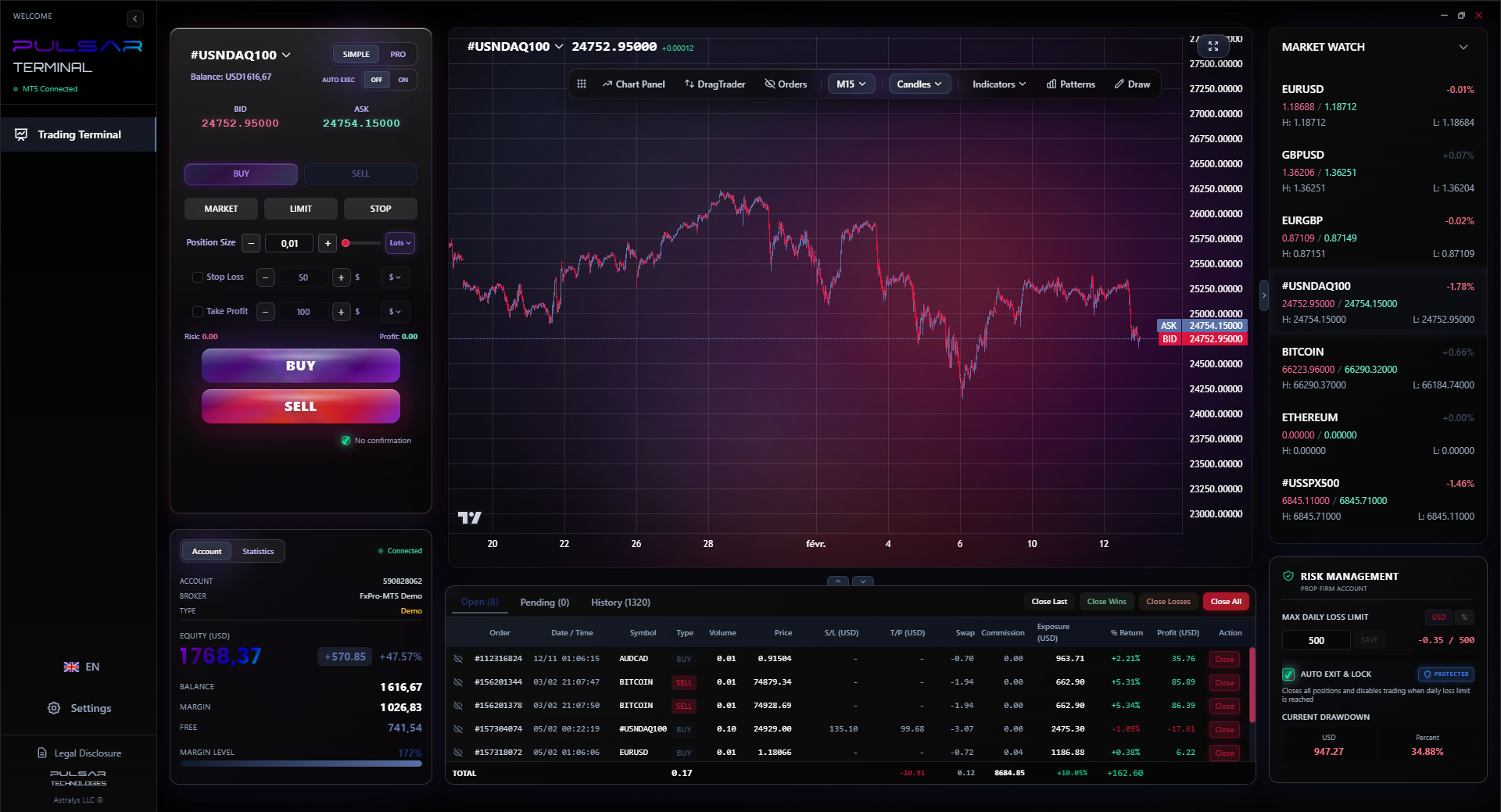
Mastering one pair means managing multiple trades within its trend, and Pulsar Terminal's drag-and-drop order grids make scaling in and out on MT5 charts intuitive and fast.
Pulsar Terminal
MT5 올인원 도구: 드래그앤드롭 주문, 다중 TP/SL, 트레일링 스톱, 그리드 트레이딩, 볼륨 프로파일, 프롭펌 보호. 매일 1,000명 이상의 트레이더가 사용.
“Your choice of broker is more important than your choice of pair.”
Your choice of broker is more important than your choice of pair. A bad broker will widen spreads on the majors during news events, reject your orders, or have slow execution speeds that guarantee slippage.
Nigerian traders primarily use internationally regulated brokers. The local SEC doesn't license retail forex brokers, so we rely on offshore regulation from Cyprus (CySEC), Australia (ASIC), South Africa (FSCA), or the Seychelles (FSA). There's a trade-off. Stricter regulators (like ASIC) often mean better client fund security but might have lower use. Lighter regulators might offer higher use, which is a double-edged sword.
You must prioritize raw execution quality. Look for brokers offering True ECN or Raw Spread accounts. These accounts charge a small commission per trade but give you spreads that start at 0.0 pips. This is almost always cheaper than a 'zero spread' account that bakes a huge markup into the price. Brokers like Pepperstone and Exness are popular here for a reason – they generally offer reliable access to deep liquidity.
Funding and Withdrawal Reality
This is the final hurdle. Funding your account with Naira can be a hassle due to CBN restrictions on international card transactions. The most common solutions:
- Domiciliary Account Transfer: Fund your domiciliary account with USD, then wire to the broker. Slow but reliable.
- E-Wallets: Using services like Skrill, Neteller, or even cryptocurrency (USDT) as a middleman. Faster, but check your broker's deposit/withdrawal policies and fees for each method.
Always factor in these funding costs and time delays. They are part of your trading overhead. Withdrawing profits is the same process in reverse. Plan for it to take 1-5 business days. Never trade with money you need for rent or school fees next week. The market doesn't care about your deadlines.
💡 윈스턴의 팁
Liquidity is your only true friend in a storm. A wide stop-loss in a major pair is safer than a tight stop in an exotic. The market can always go further than you think, but it respects deep pools of money.
“I came crawling back to the majors, humbled. Master the majors first. The money is there. It's just not as flashy.”
Let's get painfully honest. I've blown up accounts. Here are the major-pair-specific blunders that cost me real money.
Mistake 1: Trading the News on the Wrong Pair. I used to trade Non-Farm Payrolls (NFP) on GBP/USD. Why? No good reason. The US employment report is a USD event. The cleanest, most liquid pair to express a USD view is EUR/USD. Trading it on GBP/USD added an unnecessary variable – the Pound's own reaction. One NFP, the number was great for the USD. EUR/USD sold off cleanly 60 pips. GBP/USD? It sold off 20 pips, then reversed and rallied 80 because a UK Brexit headline crossed the wires at the same time. My short stop was annihilated. I was right on the dollar, wrong on the pair.
Mistake 2: Ignoring the Session. Trying to scalp EUR/USD during the Asian session is like trying to surf on a calm pond. The average range is tiny, the spreads are stable, but there's no momentum. You'll get frustrated, overtrade, and get whipsawed by meaningless 5-pip moves. I wasted months trying to force trades when the market was asleep. Save your energy for the London open (8 AM our time) and the London/New York overlap.
Mistake 3: Not Understanding Correlation. I once had a long EUR/USD trade and a long GBP/USD trade on at the same time. I thought I was diversified. I wasn't. These pairs are positively correlated over 80% of the time. When a strong USD news hit, both trades lost. It was effectively one oversized position. I doubled my risk without realizing it. Now, I use a correlation matrix. If I'm long EUR/USD, I'll avoid going long GBP/USD, or I'll drastically reduce the position size on the second trade.
Mistake 4: Chasing Exotics Too Soon. After a few good months on EUR/USD, I got bored. I thought I was a genius. I moved to EUR/TRY (Euro/Turkish Lira) for the 'big moves'. The spread was 30 pips. The volatility was insane. I made 200 pips in a day... and lost 300 the next. The commission and spread ate any theoretical profit. I came crawling back to the majors, humbled. Master the majors first. The money is there. It's just not as flashy.
FAQ
Q1What are the 7 major forex pairs?
The traditional list is EUR/USD, GBP/USD, USD/JPY, USD/CHF, AUD/USD, USD/CAD, and NZD/USD. However, for a Nigerian trader, focus first on the core three with the tightest spreads and most predictable behavior: EUR/USD, GBP/USD, and USD/JPY.
Q2Can I trade USD/NGN on MetaTrader?
You might see it listed, but I strongly advise against it. The spreads are extremely wide (often 50-100+ pips), liquidity is poor for retail traders, and you're not trading the official CBN-influenced rate. It's a synthetic market prone to massive slippage. Focus on the global majors to build capital in USD.
Q3Which major pair is best for beginners in Nigeria?
EUR/USD, without a doubt. It has the smallest average spread, the highest liquidity (which means less slippage), and moves in clear trends. It's the best pair to learn basic technical analysis and risk management without being destroyed by unpredictable volatility or costs.
Q4How does the CBN's new FX Code affect my forex trading?
The Nigerian Foreign Exchange (FX) Code regulates 'authorised dealers' like banks in the wholesale institutional market. It does not directly regulate or protect individual retail traders using international online brokers. Your protection comes from the broker's offshore regulator (e.g., ASIC, CySEC). The Code aims to stabilize the official Naira market, which indirectly affects the economy, but not your MT5 trading platform spreads.
Q5Why is the spread so important when choosing a major pair?
The spread is your immediate cost. A 2-pip spread means the price must move 2 pips in your favor just to break even. On a low-volatility day, that could be the entire move. Tight spreads on majors like EUR/USD (often <1 pip) preserve your trading capital and make strategies like scalping feasible. Always check a broker's average spread on your chosen pair before funding an account.
Q6Should I trade during a specific time of day for the majors?
Yes. The most volatility and best liquidity for EUR/USD, GBP/USD, and USD/JPY occur during the London session (8 AM - 5 PM Nigerian time) and especially the London/New York overlap (2 PM - 5 PM). Avoid the Asian session (late night to early morning) for these pairs unless you're specifically trading USD/JPY around Tokyo open.
Q7What's the biggest risk when trading major pairs from Nigeria?
Beyond normal market risk, the two biggest are 1) Poor broker execution (slippage, widened spreads) due to using an unreliable broker, and 2) Funding/withdrawal challenges. Using a reputable international broker solves the first. For the second, have a clear plan using domiciliary accounts or approved e-wallets to move money, and always account for transfer time and fees.
윈스턴 교수의 수업
핵심 요약:
- ✓Start with EUR/USD. Master one pair before adding a second.
- ✓A spread over 2 pips on a major is a tax on your profits.
- ✓Never trade a major pair during its off-session (e.g., EUR/USD in Asia).
- ✓USD/NGN is not a retail trading instrument. Avoid it.
- ✓Fund your trading account with a clear, tested withdrawal method.
이 기사가 얼마나 유용했나요?
별을 클릭하여 평가
주간 트레이딩 인사이트
무료 주간 분석 & 전략. 스팸 없음.
저자 소개
Olumide Adeyemi
서아프리카 트레이딩 선구자
나이지리아에서 가장 활발한 외환 트레이딩 교육자 중 한 명. 라고스에서 8년간 트레이딩 경험. 아프리카 트레이더를 위한 소자본 전략과 프롭 펌 챌린지 전문.
댓글
위험 고지
금융 상품 거래에는 상당한 위험이 수반되며 모든 투자자에게 적합하지 않을 수 있습니다. 과거 성과가 미래 수익을 보장하지 않습니다. 이 콘텐츠는 교육 목적으로만 제공되며 투자 조언으로 간주되어서는 안 됩니다. 거래 전에 항상 직접 조사를 수행하십시오.
이 기사도 읽어보세요

Cara Trading Forex Sukses: 7 Prinsip dari Trader Profesional
Cara trading forex sukses dengan 7 prinsip trader pro: manajemen modal, disiplin, journal trading, backtest. Data nyata, bukan janji profit palsu.
Jam Trading Forex Terbaik untuk Trader Indonesia: Panduan Lengkap dengan Tabel Waktu
Panduan jam trading forex untuk trader Indonesia. Tabel 4 sesi dunia, jam emas 20:00-00:00, sesi mana yang harus dihindari. Data akurat + tips dari trader berpengalaman.
Top 5 Sàn Forex Uy Tín Nhất 2026: Review Jujur dari Trader Indonesia
Top 5 sàn forex uy tín 2026 untuk trader Indonesia. Review jujur: spread, deposit, withdraw, dukungan lokal. Exness, XM, IC Markets & lebih.
