


I remember staring at my screen in 2015, watching the Swiss Franc (CHF) tear through my stop loss.

David van der Merwe
신흥시장 트레이더 ·  South Africa
☕ 8 분 소요
배울 내용:

I remember staring at my screen in 2015, watching the Swiss Franc (CHF) tear through my stop loss. I was short EUR/CHF, thinking the peg was solid. The SNB removed it without warning, and the pair dropped over 2000 pips in minutes. My account? Wiped out. That painful lesson taught me that knowing the major currencies in forex isn't just about names, it's about understanding the central banks, politics, and sheer power behind them. You're not just trading symbols, you're trading the economic might of nations.
When we talk about the major currencies in forex, we're referring to the most liquid and widely traded currencies in the world. They're the backbone of the $7.5 trillion daily market. The core group is often called the 'Majors,' and they're all paired against the US Dollar (USD).
Think of them as the blue-chip stocks of the currency world. High liquidity means tighter spreads, which is crucial for your bottom line, especially if you're into scalping strategy. The big seven are: the US Dollar (USD), Euro (EUR), Japanese Yen (JPY), British Pound (GBP), Swiss Franc (CHF), Canadian Dollar (CAD), and Australian Dollar (AUD).

Example: The EUR/USD pair alone accounts for roughly 24% of all daily forex volume. That's massive liquidity, often resulting in spreads as low as 0.1 pips on some brokers like IC Markets.
Beyond the Majors, you have 'commodity currencies' (AUD, CAD, NZD) and 'safe-havens' (JPY, CHF, USD in times of crisis). Each has a personality, a set of economic drivers, and a central bank with its own unique style. Getting to know them is your first step to trading them well.
“You're not just trading symbols, you're trading the economic might of nations.”
The USD isn't just a major currency, it's the reserve currency. About 60% of global foreign exchange reserves are held in dollars. This gives it a unique status. When global panic hits, money often flows into the USD, not out of it. It's a paradox I learned the hard way.
What Moves the Dollar?
Forget just looking at US data. You need to watch the Federal Reserve (the Fed) like a hawk. Their interest rate decisions and 'dot plot' forecasts are the main events. I once made a nice 150-pip profit on USD/JPY simply by positioning for a more hawkish-than-expected Fed statement. The key driver is the interest rate differential. If US rates are rising faster than others, the dollar typically strengthens.
Global risk sentiment is the other big one. In a 'risk-off' environment (stocks falling, fear high), the dollar often gains as investors seek safety. In a 'risk-on' environment, they might sell dollars to buy higher-yielding assets elsewhere. Trading the dollar means you're indirectly trading global confidence.

Warning: Don't assume a strong US economy always means a strong dollar. Sometimes, if growth is too hot, it sparks inflation fears and market chaos, which can be dollar-negative. It's about the relative pace and policy response compared to other majors.

💡 윈스턴의 팁
Don't just watch the price. Listen to the central bank governors. Their tone in speeches often telegraphs policy shifts months before they happen.
“The USD isn't just a major currency, it's *the* reserve currency.”
These two are the USD's primary counterparts and they couldn't be more different.
The Euro (EUR) is a political project as much as an economic one. Trading the EUR/USD guide means watching the European Central Bank (ECB), but also keeping one eye on political fractures. Debt crises in member states (like Greece) can flare up and slam the euro. The ECB tends to move slower and signal more than the Fed, which can create long, drawn-out trends.
The Japanese Yen (JPY) is the ultimate funding currency. For years, Japan has had near-zero interest rates. This makes it cheap for traders to borrow yen to buy higher-yielding assets elsewhere (the 'carry trade'). When markets are calm and steady, yen tends to weaken as this trade flourishes.
But here's the flip side, and it's critical: the yen is a premier safe-haven. When panic strikes, all those carry trades unwind at once. Everyone sells their risky assets and buys back yen to repay their loans. This causes the yen to surge violently. I've seen USD/JPY drop 300 pips in a day on a geopolitical tweet. Trading JPY pairs requires a constant read on global risk appetite. A good RSI indicator reading can be useless if a risk-off wave hits.
“The USD isn't just a major currency, it's *the* reserve currency.”
If you want to trade global growth, look here. The Australian Dollar (AUD) and Canadian Dollar (CAD) are tied directly to their country's main exports.
The AUD is often a proxy for Chinese economic health (China buys Australia's iron ore and coal) and global risk sentiment. Strong commodity prices and a 'risk-on' mood are good for the Aussie. The Reserve Bank of Australia's (RBA) statements are key, but often the price of iron ore tells you more.
The CAD, or 'Loonie,' is married to oil. As a major oil exporter, when WTI crude rises, USD/CAD typically falls (CAD strengthens). I once held a USD/CAD short for a swing trading move from 1.3350 to 1.3050, banking on an OPEC+ production cut rumor that played out. It's not a perfect correlation every day, but the trend is undeniable. Watch the Bank of Canada (BoC), but keep a crude oil chart open at all times.
Their downside? In a global recession or market crash, commodity prices plummet, and these currencies get hit hard. They're cyclical.
💡 윈스턴의 팁
When trading AUD or CAD, keep a simple chart of their key commodity (iron ore, oil) next to your currency chart. The correlation isn't daily gospel, but it's the long-term truth.

“Trading JPY pairs requires a constant read on global risk appetite.”
The British Pound (GBP) and Swiss Franc (CHF) are famous for their volatility and unique quirks.
The Pound is a political currency. Brexit taught us that. It can swing wildly on parliamentary votes and political headlines. The Bank of England (BoE) matters, but often politics shouts louder. GBP pairs like GBP/USD or GBP/JPY can offer huge moves, but the stop losses need to be wide. It's not for the faint of heart.
The Swiss Franc is the quiet safe-haven. The Swiss National Bank (SNB) has a history of intervention. They don't like a too-strong franc (it hurts their exporters). Remember my story from the intro? That was the SNB. They can be unpredictable. Trading CHF pairs means accepting that a central bank might step in directly, especially around the 1.0500-1.1000 level in EUR/CHF. It's a low-yield, stable currency that can suddenly become a hurricane.

Pro Tip: With GBP and CHF, news trading is a high-risk game. Use an economic calendar and consider widening your stops around major UK political events or SNB speeches. A tight stop will get taken out by the noise.
“Trading JPY pairs requires a constant read on global risk appetite.”
Knowing the personalities is one thing. Putting it into practice is another. Here’s a framework I’ve settled on after years of trial and error.
First, follow the central bank cycle. This is the single biggest driver of multi-month trends. Are the Fed, ECB, BoE, etc., hiking, holding, or cutting rates? Who is the most hawkish? That currency often leads. Create a simple table to track it.
| Central Bank | Current Rate | Bias (Hawkish/Dovish) | Next Meeting |
|---|---|---|---|
| Fed (USD) | 5.50% | Holding | May 1 |
| ECB (EUR) | 4.50% | Dovish | April 11 |
| BoJ (JPY) | 0.10% | Ultra-Dovish | April 26 |
Second, match your strategy to the currency's personality. Don't try to scalp GBP/JPY during London open if you can't handle 50-pip whipsaws. Maybe use a longer-term trend-following approach on AUD/USD if commodities are in a clear bull market. For steady EUR/USD, range strategies or breakout plays around ECB events can work.
Third, always know what's 'in the price'. If everyone expects the Fed to hike, and they do, the dollar might not move much (or even sell off on 'buy the rumor, sell the fact'). The surprise is what moves markets. I got caught on the wrong side of a CAD move once because I didn't realize how many rate hikes were already priced in.
Finally, risk management is non-negotiable. The majors might be liquid, but they can gap over weekends on political news. Never risk more than 1-2% of your capital on a single trade. Use a position size calculator religiously. A margin call doesn't care if you were trading the mighty USD or an exotic pair.
💡 윈스턴의 팁
Your first job in any major pair is to identify if the market is in 'risk-on' or 'risk-off' mode. That single context will guide your bias for JPY, AUD, and even USD trades.

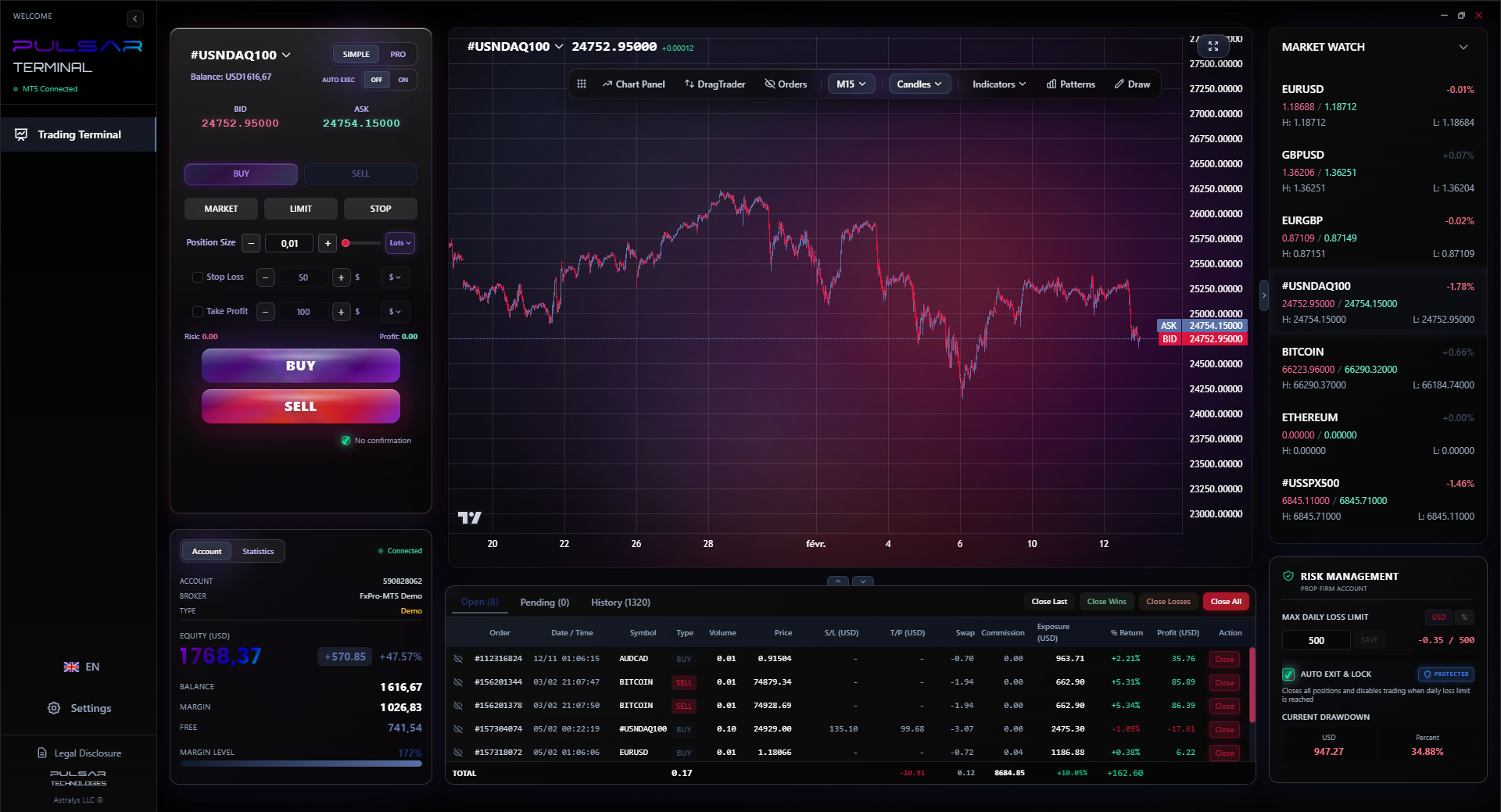
Managing multiple trades across volatile majors is complex, but tools like Pulsar Terminal let you set multi-level take-profits and trailing stops on MT5 with a simple drag-and-drop.
Pulsar Terminal
MT5 올인원 도구: 드래그앤드롭 주문, 다중 TP/SL, 트레일링 스톱, 그리드 트레이딩, 볼륨 프로파일, 프롭펌 보호. 매일 1,000명 이상의 트레이더가 사용.
“Fighting the Central Bank is the ultimate sin. They have more firepower than you.”
We all make mistakes. Here are the big ones I see (and have made) with the major currencies in forex.
Trading Too Many Pairs at Once. Early on, I had charts open for all seven majors. It was chaos. You can't follow the nuanced stories for each. Pick 2-3, max, and learn them inside out.
Ignoring Correlations. Selling EUR/USD and buying GBP/USD at the same time is often just cancelling yourself out. They are highly correlated. You're doubling your risk, not diversifying. Understand how these pairs move together.
Chasing 'Safe-Haven' Moves Too Late. When the yen is rocketing up in a panic, the easiest 100 pips have already been made. Jumping in late is a great way to get caught in the snap-back reversal when things calm. If you miss the initial move, it's often better to wait.
Overlooking the 'Spread'. While spreads are tight on majors, they still matter. Scalping the EUR/USD with a 1-pip spread is very different from scalping it with a 0.2-pip spread. It directly affects your strategy's profitability. Choose your broker wisely; platforms like Exness and Pepperstone are known for competitive pricing on majors.
Fighting the Central Bank. This is the ultimate sin. If the ECB is openly talking about weakening the euro, don't stubbornly buy it. They have more firepower than you. Your job is to flow with the policy tide, not swim against it.
FAQ
Q1What is the most traded major currency pair?
The EUR/USD is by far the most traded major currency pair, making up about a quarter of all daily forex volume. Its high liquidity means very low spreads, making it a favorite for all types of traders.
Q2Why is the Japanese Yen considered a safe-haven currency?
Two main reasons: Japan has a massive pool of domestic savings invested abroad, which gets repatriated in times of trouble, and it's historically had very low interest rates, making it a popular funding currency for carry trades that get unwound during market stress, causing a surge in demand for JPY.
Q3Can I trade major forex currencies in South Africa?
Absolutely. South African traders have excellent access to global forex markets through international brokers regulated by bodies like the FSCA. You can trade all the major pairs with ZAR-based accounts, though the actual trading is done in the currency of the pair (like USD).
Q4What's the best major pair for beginners?
I usually point beginners to EUR/USD or USD/JPY. They have excellent liquidity, tight spreads, and tons of free analysis available. Their movements are more fundamentally driven by clear central bank policies, which is easier to learn than the political noise of the GBP.
Q5How do commodity prices affect the AUD and CAD?
Directly. The AUD is heavily influenced by iron ore and coal prices (tied to Chinese demand). The CAD is closely linked to the price of oil (WTI crude). A sustained rise in these commodities typically strengthens the respective currency, as it improves the country's trade balance and economic outlook.
Q6What time of day is best to trade major currencies?
The best liquidity and volatility occur during the overlap of major financial centers. The London-New York overlap (roughly 3 PM to 5 PM SAST) is often the most active period for pairs like EUR/USD and GBP/USD. The Tokyo-London overlap is key for JPY pairs.
윈스턴 교수의 수업
핵심 요약:
- ✓Central bank policy is the primary driver of major currency trends.
- ✓Always know the 'risk-on' or 'risk-off' market context before trading.
- ✓Never risk more than 2% of your capital on a single major pair trade.
- ✓Liquidity in majors like EUR/USD allows for spreads under 0.2 pips.
이 기사가 얼마나 유용했나요?
별을 클릭하여 평가
주간 트레이딩 인사이트
무료 주간 분석 & 전략. 스팸 없음.
저자 소개
David van der Merwe
신흥시장 트레이더
요하네스버그 기반 트레이더로 신흥시장 통화 11년 경력. ZAR 통화쌍, FSCA 규제 거래, 남아공 시장 분석 전문.
댓글
위험 고지
금융 상품 거래에는 상당한 위험이 수반되며 모든 투자자에게 적합하지 않을 수 있습니다. 과거 성과가 미래 수익을 보장하지 않습니다. 이 콘텐츠는 교육 목적으로만 제공되며 투자 조언으로 간주되어서는 안 됩니다. 거래 전에 항상 직접 조사를 수행하십시오.
이 기사도 읽어보세요

Cara Trading Forex Sukses: 7 Prinsip dari Trader Profesional
Cara trading forex sukses dengan 7 prinsip trader pro: manajemen modal, disiplin, journal trading, backtest. Data nyata, bukan janji profit palsu.
Jam Trading Forex Terbaik untuk Trader Indonesia: Panduan Lengkap dengan Tabel Waktu
Panduan jam trading forex untuk trader Indonesia. Tabel 4 sesi dunia, jam emas 20:00-00:00, sesi mana yang harus dihindari. Data akurat + tips dari trader berpengalaman.
Top 5 Sàn Forex Uy Tín Nhất 2026: Review Jujur dari Trader Indonesia
Top 5 sàn forex uy tín 2026 untuk trader Indonesia. Review jujur: spread, deposit, withdraw, dukungan lokal. Exness, XM, IC Markets & lebih.
