


Here's a fact that might sting: over 80% of new traders in Nigeria lose their first account within six months.

Olumide Adeyemi
서아프리카 트레이딩 선구자 ·  Nigeria
☕ 11 분 소요
배울 내용:
- 1What Makes a Forex Pair "Predictable"? (It's Not What You Think)
- 2The Top 5 Most Predictable Pairs for Nigerian Traders
- 3Pairs to Avoid (Especially as a Nigerian Trader)
- 4When to Trade: Predictability is on a Schedule
- 5How Broker Choice in Nigeria Affects Predictability
- 6A Simple Framework for Trading Predictable Pairs
- 7Why Nigerian Traders Get This Wrong (And How to Fix It)
Here's a fact that might sting: over 80% of new traders in Nigeria lose their first account within six months. I've seen it happen a hundred times. The biggest reason isn't a lack of skill, it's a lack of discipline in choosing the right battlefield. You're trying to fight in a chaotic market when you should be learning in a predictable one. This guide isn't about finding a magic pair that prints money. It's about identifying the most predictable forex pairs that give you a clean, readable chart so you can actually apply your strategy without getting blindsided by nonsense volatility.
Let's clear this up right now. 'Predictable' doesn't mean you can guess tomorrow's price. If you think that, you should close this tab and go do something else. In the real world, a predictable pair has three things: high liquidity, clear reactions to news, and established historical behavior patterns.
High liquidity is king. It means millions of transactions are happening every second. This creates smoother price movements and tighter spreads. You get in and out where you want, not where the market decides to spit you out. A tight spread on a major pair like EUR/USD can be under 1 pip during the London session. On an exotic pair involving the Naira? You might be looking at 50 pips or more just to break even. That's not trading, that's donating to your broker.
Predictable pairs also react to economic data in a way that makes sense. A strong US jobs report usually boosts the USD. A dovish speech from the ECB typically weakens the Euro. With exotic pairs or crosses, the reaction can be illogical and whippy, driven by local sentiment or illiquidity.
Finally, they have personality. They respect key technical levels more often than not. I've traded USD/JPY for over a decade. It loves round numbers (like 150.00) and tends to trend for long periods. It's not a wild animal. Compare that to GBP/JPY, which can move 200 pips in an hour on a rumor. That's not a market for a new trader.

Warning: Don't confuse 'predictable' with 'easy money.' No pair is easy. A predictable pair just gives you a fair fight. It removes the variable of chaotic, thin-market price action so you can focus on your own execution, which is where 90% of your mistakes will be.

💡 윈스턴의 팁
Predictability is a function of crowd behavior. Trade the pairs where the crowd is biggest and smartest - the majors. The collective intelligence of the global market creates cleaner charts.
Based on liquidity, spread consistency, and clean technical behavior, here are the pairs where you should spend 95% of your screen time. Forget the exotics until you've mastered these.
1. EUR/USD (The Foundation)
This is your bread and butter. It's the most liquid market in the world. The average daily range is manageable, and it moves in clear waves. For a Nigerian trader, its predictability comes from the sheer volume of analysis available. Every bank, fund, and retail trader is watching it. This creates a consensus on key levels that actually hold. I built my first consistent account trading nothing but EUR/USD on the 4-hour chart using simple support and resistance and the MACD indicator for confluence.
Why it's predictable: Massive liquidity, tight spreads (often below 1 pip on ECN accounts), and clear reactions to Fed/ECB policy. It's the textbook pair.
2. USD/JPY (The Trend Rider)
If EUR/USD is a steady river, USD/JPY is a freight train. When it gets a trend, it can run for weeks or months with beautiful pullbacks to moving averages. Its predictability lies in its strong correlation to US Treasury yields and overall risk sentiment. When US yields rise, USD/JPY usually follows. It's a fundamental driver you can actually see and track.
Why it's predictable: Strong fundamental driver (interest rate differentials), tends to respect technical levels during trends, and is less prone to random spikes than European pairs.
3. GBP/USD (The Volatile Predictable One)
Okay, 'Cable' is the wildcard on this list. It's more volatile, I'll admit that. But its predictability comes from its personality. It often makes sharp, decisive moves and then consolidates. It's famous for 'false breakouts' that actually become reliable reversal signals once you learn its rhythm. The spread is still excellent on major brokers.
Why it's predictable: While volatile, its moves are often technically clean. Breakouts tend to be strong, and it reacts powerfully to UK inflation and Bank of England news, giving clear setup opportunities.
4. AUD/USD (The Commodity Barometer)
This is a great pair for learning how a currency interacts with a single dominant export. The Aussie Dollar is heavily tied to iron ore and coal prices, and by extension, Chinese demand. When China's PMI data is strong, AUD/USD often rallies. This creates a fundamental narrative you can follow. Its movements are generally smoother than GBP's.
Why it's predictable: Has a clear, trackable fundamental story (China/Commodities), and tends to have strong, sustained trends during risk-on periods.
5. USD/CHF (The Safe-Haven Mirror)
Often seen as the inverse of EUR/USD. When risk is off, money flows into the Swiss Franc. This pair is generally lower volatility, making it excellent for longer-term swing trading approaches. Its predictability is in its stability and its role as a funding currency.
Why it's predictable: Low volatility, strong inverse correlation to EUR/USD (which can be used for confirmation), and clear safe-haven flows during market stress.

Example: Let's talk real numbers. On a standard account with a broker like XM, you might see an average spread of 1.7 pips on EUR/USD. On a USD/NGN pair offered by some international brokers, the spread could be 300 pips or more. That means on a $10,000 position (0.1 lot), you're already down $30 on EUR/USD the moment you enter. On USD/NGN, you could be down over $300 before the price even moves. Which fight would you rather pick?
“A predictable pair just gives you a fair fight. It removes the variable of chaotic price action so you can focus on your own execution.”
I need to be blunt here. If you're trading these pairs with a live account under $5,000, you are gambling, not trading. Full stop.
Any Naira (NGN) Crosses: I don't care if your cousin knows a guy at a BDC. The official CBN rate, the parallel market rate, and the rate your international broker shows are three different worlds. The spreads are monstrous, the liquidity is terrible, and the price can gap massively on any CBN announcement. The CBN's re-admission of BDCs in 2026 and the new electronic FX matching system are steps forward, but the retail broker market for Naira pairs is still the wild west. Avoid.
Exotic Pairs (USD/TRY, USD/ZAR, EUR/SEK etc.): These are for seasoned pros with deep pockets who understand local political risk. The spreads will eat you alive. A sudden political tweet in Turkey can move USD/TRY 5% in minutes. That's not a trading opportunity for you; it's a margin call waiting to happen.
Minor Crosses Outside London Hours (e.g., EUR/GBP, AUD/CAD): Liquidity dries up when the main markets close. The spread widens, and price action becomes jerky and unreliable. If you're trading at 2 AM Nigerian time, stick to the majors that still have some liquidity from the US session.
The pair is only half the equation. The time you trade it is the other half. The most predictable price action for these major pairs happens during the London and New York session overlap (2 PM - 5 PM Nigerian Time).
This is when liquidity is at its absolute peak. Banks, hedge funds, and corporations are all actively trading. This results in the tightest spreads, the smoothest price movement, and the most reliable reactions to news. I schedule my most important trades for this window. The difference in chart quality is night and day.
The Asian session (late night/early morning Nigerian time) can be good for USD/JPY and AUD/USD, but ranges are often narrower. The worst time to trade? The dead zone between the New York close and the Asian open. That's when weird, thin-market moves happen that wipe out stops for no reason.

Pro Tip: Don't fight the market's sleep schedule. If you can't trade the London/New York overlap, consider using longer timeframes (like the 4-hour or daily chart). The higher the timeframe, the more it smooths out the noisy, low-liquidity price action from off-hours.
💡 윈스턴의 팁
Your first profitable year should be boring. If you're feeling excitement or panic regularly, you're trading the wrong pairs or using too much size. Profitable trading feels like skilled work, not a casino.
“If you're trading Naira pairs with a live account under $5,000, you are gambling, not trading. Full stop.”
Your broker can make a predictable pair unpredictable through sheer cost and poor execution. Here’s what to watch for in the Nigerian market.
Spreads & Commissions: This is your direct cost. A "predictable" EUR/USD trade becomes a loser if your broker's spread is 3 pips when it should be 0.8. Look for brokers with tight, consistent spreads on the majors. Many Nigerian traders use brokers like Exness or IC Markets because they offer raw spread accounts where you pay a small commission per lot but get spreads near 0.0 pips. Do the math. On 10 trades a day, a 2-pip difference is a huge drain.
Execution & Slippage: During high-impact news (like US NFP), does your broker's platform freeze? Does your market order get filled 5 pips away from where you clicked? That's slippage, and it kills the predictability of your entry. Brokers with true ECN/STP models generally provide better execution.
Local Payment Methods: Predictability also means you can fund and withdraw your profits reliably. Many top international brokers now offer Naira accounts and accept deposits via local bank transfer, cards, and e-wallets like Paga and Opay. This stability is crucial. You don't want your capital stuck in some convoluted withdrawal process for weeks.
A Personal Mistake: Early on, I used a broker with "zero spread" on EUR/USD but a huge hidden commission. I was scalping, thinking my costs were low. After 100 trades, I used a position size calculator to review my statements. The commissions had taken over 60% of my gross profits. I was working for the broker. Now I always calculate the total cost (spread + commission) in dollar terms before I choose an account.
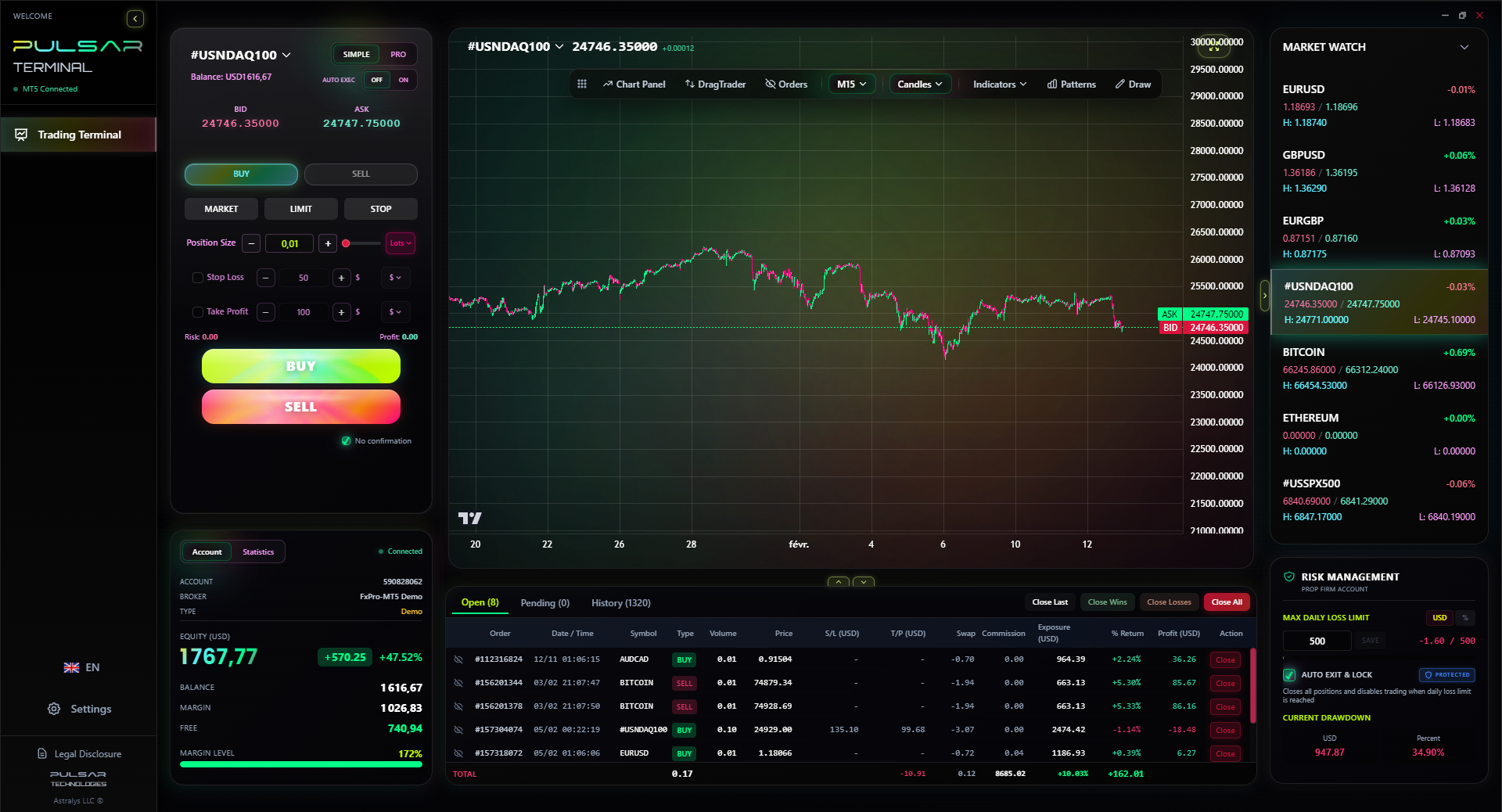
Managing predictable trades requires precision; Pulsar Terminal's drag-and-drop orders and multi-TP/SL tools let you set your entire risk plan on the MT5 chart in seconds, so you can focus on the analysis.
Pulsar Terminal
MT5 올인원 도구: 드래그앤드롭 주문, 다중 TP/SL, 트레일링 스톱, 그리드 트레이딩, 볼륨 프로파일, 프롭펌 보호. 매일 1,000명 이상의 트레이더가 사용.
Here’s a basic, no-nonsense approach to build discipline around these pairs.
- Pick ONE Pair: I mean it. Just EUR/USD. Master it for 3 months. Learn its daily range, how it reacts to news, where it tends to reverse. This focus is how you learn predictability.
- Trade the Right Time: Aim for the first 2-3 hours of the London open (1 PM - 4 PM Nigerian time). This is when the initial direction for the day is often set.
- Use Higher Timeframes for Direction: Start on the 4-hour or daily chart to identify the overall trend. Is price above or below the key moving average (like the 50 EMA)? Only take trades in the direction of this higher-timeframe trend.
- Enter on the Lower Timeframe: Use the 1-hour or 15-minute chart to find a specific entry. Look for price to pull back to a support/resistance level or a moving average in the direction of the larger trend. Use an indicator like the RSI indicator to see if it's oversold in an uptrend (giving you a potential buy opportunity).
- Manage Your Risk Religiously: Your stop-loss should be placed beyond the recent swing high/low that invalidates your trade idea. Your risk should never be more than 1-2% of your account on any single trade. This is non-negotiable.
This framework removes the noise. You're not chasing 20 pairs. You're not trading off rumors. You're applying a mechanical process to the most liquid, predictable market in the world.
“Your broker can make a predictable pair unpredictable through sheer cost and poor execution.”
I've mentored dozens of traders from Lagos to Port Harcourt. The mistakes are painfully consistent.
Pitfall 1: Chasing 'Fast Money' in Exotics. The allure of trading the Naira or the South African Rand is strong. It feels familiar. But familiarity breeds overconfidence, not profits. The terrible liquidity guarantees you'll get poor fills. Fix: Commit to the majors for at least your first year of profitable trading.
Pitfall 2: Overleveraging on Predictable Pairs. "EUR/USD is slow, let's use 1:500 use to make it exciting." This is a death sentence. Predictable pairs are for consistent, smaller gains compounded over time. I once blew a $2,000 account in 2015 because I used 1:100 use on a "sure thing" GBP/USD trade. A routine 50-pip move against me triggered a margin call. The pair was predictable; my risk management was idiotic. Fix: Use sane use (1:10 to 1:30 max) and always use a stop-loss.
Pitfall 3: Ignoring the Economic Calendar. The predictability of these pairs comes from their logical reactions to data. If you don't know when US CPI or ECB rate decisions are, you will get run over. Trading EUR/USD 5 minutes before a Fed announcement is like crossing the Lagos-Ibadan expressway blindfolded. Fix: Have the economic calendar open at all times. Don't open new trades 30 minutes before a major red-news event.
Pitfall 4: Switching Pairs After a Loss. You take a loss on USD/JPY, get frustrated, and jump to gold (XAU/USD) or the DAX index. You're now in an unfamiliar market with different volatility. Fix: Review your loss. Was the analysis wrong? Was the timing bad? Learn from it on the SAME pair. Jumping ship means you never learn a pair's true character.
FAQ
Q1Is forex trading legal in Nigeria?
Yes, forex trading is legal for individuals in Nigeria. However, the online retail forex market is not directly regulated by the Central Bank of Nigeria (CBN). Most Nigerian traders use international brokers regulated overseas (like by the FCA or CySEC). You are required to report any trading profits and pay a 10% capital gains tax.
Q2What is the best time of day to trade forex in Nigeria?
The most predictable time is during the London and New York session overlap, from about 2 PM to 5 PM Nigerian Time. This is when liquidity and volume are highest, leading to tighter spreads and cleaner, more reliable price movements on the major pairs.
Q3Why should I avoid trading Naira (NGN) forex pairs?
You should avoid them because the spreads are extremely wide (often hundreds of pips), liquidity is very low, and prices can gap significantly on local news or CBN policy changes. This makes risk management nearly impossible and turns trading into high-cost speculation. Stick to major pairs like EUR/USD.
Q4Can I start trading forex in Nigeria with a small amount?
Technically, yes. Some brokers like FBS offer accounts with a $1 minimum deposit. But realistically, starting with less than $200-500 is very difficult. You need enough capital to withstand normal market fluctuations without overleveraging. A tiny account often leads to taking excessive risk just to see meaningful gains.
Q5What's more important for predictability, the pair or the strategy?
They are intertwined, but the pair is the foundation. A great strategy will fail on an unpredictable, illiquid pair with huge spreads. Your first job is to pick a predictable pair (a major). Your second job is to apply a disciplined strategy with strict risk management to that pair. The pair gives you a fair chance; the strategy lets you capitalize on it.
Q6How do CBN reforms affect my forex trading?
Recent reforms like the 2024 FX Code and the 2026 re-admission of BDCs aim to bring more transparency and stability to Nigeria's official foreign exchange market. For you as a retail trader using international brokers, the main impact is potentially greater overall economic stability, which can reduce extreme volatility in related assets. However, it doesn't directly regulate or protect your online trading account.
윈스턴 교수의 수업
핵심 요약:
- ✓Stick to EUR/USD, USD/JPY, GBP/USD for cleanest charts
- ✓Trade 2 PM - 5 PM Nigerian Time for peak liquidity
- ✓Avoid Naira & exotic pairs due to massive spreads
- ✓Use use under 1:30 on predictable majors
- ✓Your broker's spread can turn a good trade bad
이 기사가 얼마나 유용했나요?
별을 클릭하여 평가
주간 트레이딩 인사이트
무료 주간 분석 & 전략. 스팸 없음.
저자 소개
Olumide Adeyemi
서아프리카 트레이딩 선구자
나이지리아에서 가장 활발한 외환 트레이딩 교육자 중 한 명. 라고스에서 8년간 트레이딩 경험. 아프리카 트레이더를 위한 소자본 전략과 프롭 펌 챌린지 전문.
댓글
위험 고지
금융 상품 거래에는 상당한 위험이 수반되며 모든 투자자에게 적합하지 않을 수 있습니다. 과거 성과가 미래 수익을 보장하지 않습니다. 이 콘텐츠는 교육 목적으로만 제공되며 투자 조언으로 간주되어서는 안 됩니다. 거래 전에 항상 직접 조사를 수행하십시오.
이 기사도 읽어보세요

Cara Trading Forex Sukses: 7 Prinsip dari Trader Profesional
Cara trading forex sukses dengan 7 prinsip trader pro: manajemen modal, disiplin, journal trading, backtest. Data nyata, bukan janji profit palsu.
Jam Trading Forex Terbaik untuk Trader Indonesia: Panduan Lengkap dengan Tabel Waktu
Panduan jam trading forex untuk trader Indonesia. Tabel 4 sesi dunia, jam emas 20:00-00:00, sesi mana yang harus dihindari. Data akurat + tips dari trader berpengalaman.
Top 5 Sàn Forex Uy Tín Nhất 2026: Review Jujur dari Trader Indonesia
Top 5 sàn forex uy tín 2026 untuk trader Indonesia. Review jujur: spread, deposit, withdraw, dukungan lokal. Exness, XM, IC Markets & lebih.
