


I was staring at the NSE terminal on a Tuesday morning in October 2023.

Rajesh Sharma
수석 외환 애널리스트 ·  India
India
☕ 12 분 소요
배울 내용:
- 1The Global List vs. The Indian Reality
- 2The Undisputed King: USD/INR
- 3The Supporting Cast: EUR/INR, GBP/INR, JPY/INR
- 4The Legal Loophole? Exchange-Traded Cross Currency Pairs
- 5The Real Cost of Trading Forex in India
- 6Adapting Your Strategy for the Indian Market
- 7Choosing a Broker: SEBI vs. Offshore Temptation
- 8The Future: Will It Ever Change?
I was staring at the NSE terminal on a Tuesday morning in October 2023. USD/INR had just gapped up 40 pips on the open to 83.25. My phone was buzzing with messages from a group of traders who'd been quietly building positions in offshore EUR/USD accounts. 'Easy money,' one said. A month later, the RBI issued another public warning about exactly that activity. That's the reality here. Talking about the most traded forex pairs by volume globally is a theoretical exercise. In India, it's a conversation about legality, liquidity, and not getting your bank account frozen. Let's talk about what you can actually trade, where the volume really is, and how to navigate this uniquely restrictive market.
Globally, the most traded forex pairs by volume are a boring, predictable list. EUR/USD is king, taking about 24% of all daily volume. Then you have USD/JPY, GBP/USD, and AUD/USD. These are the majors, traded 24/5 across London, New York, and Tokyo. Their spreads are tight, liquidity is deep, and every broker on the planet offers them.
In India, forget it. If you're a retail trader, that list is irrelevant. Trading those pairs directly on an offshore platform like Exness or IC Markets is illegal under FEMA rules. The Reserve Bank of India (RBI) has been crystal clear: using the Liberalised Remittance Scheme (LRS) to fund speculative forex trading abroad is a violation. I've seen guys try to argue it's a 'capital account transaction for investment.' The RBI doesn't buy it. They've blocked remittances and issued warnings.
So, what's left? The legal market. Your entire universe shrinks to the currency derivatives segment on Indian exchanges like the NSE and BSE. Here, the most traded forex pairs by volume are all INR pairs. This isn't just a regulatory quirk; it defines your strategy, your costs, and your available trading hours.

Warning: I need to be blunt. If you're trading EUR/USD on an offshore broker right now, you're operating in a grey area at best. While enforcement is often inconsistent, the law is clear. A change in banking policy or a flagged transaction can cause serious headaches, including frozen funds. I don't do it, and I advise you to stick to the legal path.

💡 윈스턴의 팁
In USD/INR, the RBI is the ultimate market maker. If you don't know what they're thinking, you're just guessing. Watch for their dollar-buying or selling in the spot market; it telegraphs their comfort zone.
This is it. The main event. In the Indian context, USD/INR isn't just a pair; it's the market. It consistently accounts for over 80% of the trading volume in the currency derivatives segment. If you're trading forex legally in India, you are almost certainly trading this.
Why the Dominance?
It's simple. India's trade deficit, foreign investment flows (FII), and corporate hedging demand are all dollar-denominated. Every oil import, every software export, every billion dollars of foreign investment hitting the Sensex gets converted through this pair. That creates massive, predictable volume.
Trading USD/INR: It's Different
Don't think of it like EUR/USD. The moves are often driven by domestic factors: RBI intervention (they hate volatile, one-way moves), local dollar demand from oil companies, and FII flows. I learned this the hard way in 2022. I saw a clean technical breakdown below 82.00 and went short. What I didn't account for was a massive month-end dollar demand from corporates. The RBI also stepped in, selling dollars to cap the rise. My stop-loss at 82.50 got taken out, and the pair reversed the next day. Cost me about ₹25,000 on a two-lot position. The lesson? In USD/INR, you must watch the domestic news wire and the RBI's hand.
The contract size is USD 1000. So, at 83.00, one contract is worth roughly ₹83,000. Margins are set by the exchange, typically around 2-5% of the contract value. Your broker's position size calculator is useless here; you're dealing with fixed-size contracts.

Pro Tip: The most liquid options are the near-month futures. Don't bother with the back-month contracts unless you're a corporate hedger. The bid-ask spread widens dramatically, killing any short-term trade.
“USD/INR isn't just a pair; it's the market. If you're trading forex legally in India, you are almost certainly trading this.”
After USD/INR, volume drops off a cliff. But these other INR pairs are still tradable, each with its own character.
| Pair | Typical Drivers | Volume & Liquidity Note |
|---|---|---|
| EUR/INR | Eurozone data, ECB policy, but heavily influenced by USD/INR moves. | Second most liquid. Often just a derived rate from EUR/USD and USD/INR. |
| GBP/INR | UK data, BoE policy. More volatile. | Lower volume. Wider spreads. Can gap on UK news. |
| JPY/INR | Driven by USD/JPY moves and risk sentiment. | Lowest volume of the four. Illiquid outside main hours. Slippage risk is real. |
I trade EUR/INR occasionally, but only as a spread trade against USD/INR. If I think the Euro is going to strengthen independently of the dollar, I might go long EUR/INR and short an equivalent amount of USD/INR. It's complex and not for beginners.
The critical thing with these pairs is their dependency. GBP/INR will often move because GBP/USD moved, which then affects USD/INR. You're trading a cross-rate. This makes pure technical analysis trickier. A breakout on your GBP/INR chart might just be a USD/INR move messing with the formula. You need to watch the underlying majors, which brings us back to the legal paradox.
A common mistake is assuming the spread definition is the same as in offshore markets. It's not. On the exchange, you're at the mercy of the order book depth. During slow periods, the spread on JPY/INR can widen to 4-5 pips easily, which is massive for a retail scalping strategy.
Here's a twist a lot of new traders miss. Since 2020, Indian exchanges have offered cross-currency futures and options contracts. We're talking EUR/USD, GBP/USD, and USD/JPY futures, traded in dollars, settled in rupees.
This is the only legal way for an Indian retail trader to get direct exposure to the global most traded forex pairs by volume. No offshore account needed. It's on the NSE, regulated by SEBI.
So, problem solved? Not quite.
The Catch: Liquidity (or Lack Thereof)
The volume on these contracts is pathetic compared to the global spot market or even USD/INR. On a busy day, EUR/USD futures might see a few thousand contracts. On the global spot market, it's billions. This means:
- Wider Spreads: The bid-ask spread is consistently larger.
- Slippage: Getting in and out of a decent-sized position can move the market against you.
- Limited Hours: You can only trade during Indian exchange hours (9 AM to 7:30 PM for these). You miss the London and New York sessions, where the real moves happen.
I tested this for a month. I put on a classic MACD indicator divergence play on EUR/USD futures. The signal was good, but my entry was 3 pips worse than the theoretical spot price because the order book was so thin. I still made a small profit, but the friction cost was undeniable. For swing trading a core view, it's workable. For anything short-term, it's a tough game.

Example: On April 5th, 2026, the spot EUR/USD spread was 0.6 pips on a major international broker. The NSE EUR/USD futures contract had a consistent bid-ask spread equivalent to 2.1 pips. That's 3.5 times the cost, just to enter the trade.
💡 윈스턴의 팁
That ₹20 brokerage fee is a sniper. If you're trading one lot, it's a 2-pip headwind. Don't trade until your edge is at least 4 times that size. Patience isn't a virtue here; it's a survival skill.
“The killer isn't the fees; it's the spread + fees. Your trade is down ₹40 before it even moves.”
Forget the 'zero commission' ads from offshore brokers. Your cost structure on Indian exchanges is transparent but fragmented. It'll eat into your profits if you're not careful.
Let's break down a single trade in USD/INR futures:
- Brokerage: Typically ₹20 per executed order (for most discount brokers).
- Exchange Transaction Charge: Roughly ₹0.05 per lakh of turnover + 18% GST. On one lot (USD 1000), that's about ₹0.5 + GST.
- SEBI Turnover Fee: ₹10 per crore + GST. Negligible for a retail trade.
- Stamp Duty: Depends on your state, usually a small amount.
- GST: 18% on the brokerage and transaction charges.
The killer isn't the fees; it's the spread + fees. On a quiet afternoon, the USD/INR spread might be 0.5 paisa (half a pip). Add your brokerage, and your trade is down ₹40 (brokerage + all charges) before it even moves. To break even on a one-lot trade, the market needs to move about 5 pips in your favor just to cover costs.
This makes high-frequency trading almost impossible. It forces you into a longer-term mindset, looking for 20-50 pip moves to make a trade worthwhile. It completely changes your approach to indicators and entries. That fancy RSI indicator scalp you saw on YouTube? The costs will murder it here.
This cost reality is why volume concentrates so heavily in USD/INR. The liquidity is better, so the spread is tighter. Trading the other pairs amplifies the cost problem.
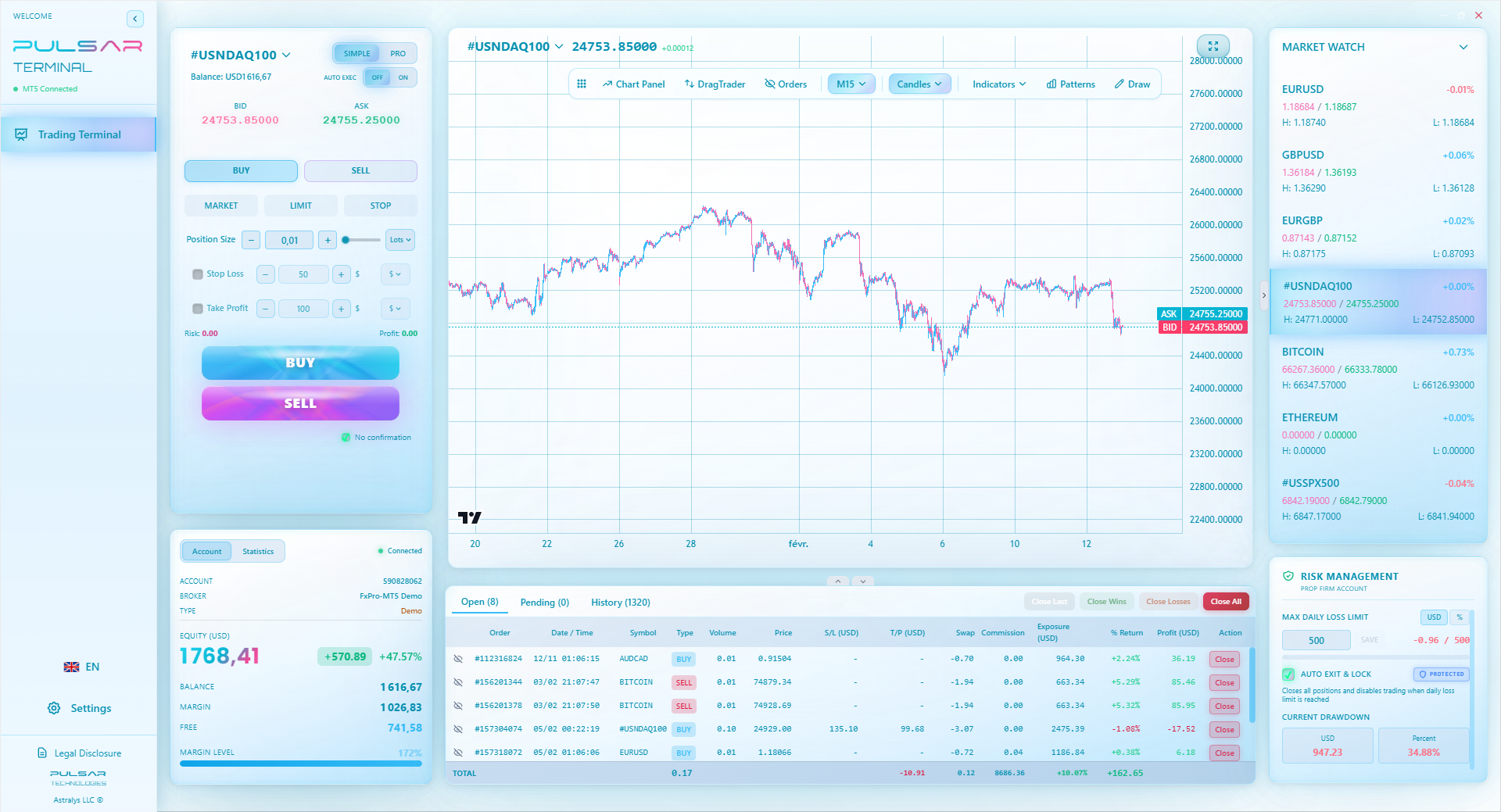
Managing precise entries, stop-losses, and partial profit-taking in the choppy, cost-sensitive Indian forex market requires surgical precision that most basic platforms lack.
Pulsar Terminal
MT5 올인원 도구: 드래그앤드롭 주문, 다중 TP/SL, 트레일링 스톱, 그리드 트레이딩, 볼륨 프로파일, 프롭펌 보호. 매일 1,000명 이상의 트레이더가 사용.
You can't just copy a strategy from a US trader and apply it to USD/INR. The market mechanics are different. Here’s what works (and what doesn’t).
What Works:
- News & Event Trading: RBI policy announcements, US Non-Farm Payrolls (affects USD/INR), and monthly/quarterly corporate dollar demand periods. The moves are sharp and directional. I once caught a 120-pip move in 15 minutes after an RBI policy that was more hawkish than expected. Entry at 82.80, exit at 81.60. That's a ₹12,000 profit on one lot.
- End-of-Day / Swing Trading: Given the costs, holding for a few days to capture a larger trend is more economical. Use daily and 4-hour charts. Follow the broader dollar index (DXY) trend and overlay it with domestic flows.
- Spread Trading Between INR Pairs: As mentioned, playing the relative strength between EUR/INR and USD/INR can isolate a pure Euro view.
What Doesn't Work:
- Scalping: The transaction costs are prohibitive. You'll be a goldmine for your broker and the exchange.
- Overnight Gaps on Global News: Since the exchange is closed when London/NY reacts to major news, USD/INR frequently gaps open. Your stop-loss won't protect you. You must adjust position size for this gap risk or avoid holding positions before major US data releases.
- Complex Multi-Leg Options Strategies: The options market for INR pairs, while existing, lacks the deep liquidity of equities. Filling complex orders is tough.
The key is patience. You might get only 2-3 high-quality setups a week in USD/INR. That's okay. Wait for them. This isn't a casino; it's a specialized market with high barriers to entry (regulatory and cost). Treat it that way.
Managing this requires tools that respect the exchange environment. Using a basic MT5 platform for NSE charts is possible, but order management is clunky.
“Your job is to master USD/INR. It's a niche market, but within that niche, there's consistent opportunity.”
This is the million-rupee question. Let's be honest about the options.
SEBI-Regulated Brokers (Zerodha, Upstox, Angel One):
- Pros: Legal. Secure. Funds in India. Direct exchange access.
- Cons: Only INR pairs and low-liquidity cross-currency futures. Higher per-trade costs. Platforms are often equity-focused, with forex as an afterthought.
International Brokers (Pepperstone, IC Markets, XM):
- Pros: Access to the real global most traded forex pairs by volume. Tighter spreads. 24/5 trading. Advanced platforms like MT4/5.
- Cons: Illegal for you to fund and trade from India for speculative purposes. Your account can be closed, funds frozen, and you risk RBI/SEBI penalties. It's a constant cat-and-mouse game with bank remittances.
I've used both. Early in my career, I funded an account with IC Markets. The trading experience was superior - no question. But the anxiety of moving money and the moral/legal grey area wore me down. I now only trade through my SEBI-regulated account. The peace of mind is worth the limitations.
If you go the legal route, pick a broker known for good F&O platforms. Zerodha's Kite is decent. Check their margin requirements for currency derivatives and their after-hours order management. Can you place a GTC (Good-Till-Cancelled) order? What happens if the exchange disconnects? These are the practical questions that matter more than a ₹10 difference in brokerage.
Warning: Any 'international broker' aggressively marketing to Indian clients for forex trading is operating in a regulatory grey zone. Their Exness review or XM review might be great, but their ability to serve you legally from India is not. The risk is on you, not them.
💡 윈스턴의 팁
The gap risk at the NSE open is real. If you must hold a position overnight, size it so that a 30-pip gap against you won't trigger a margin call or ruin your month. Sleep is cheaper than a ruined account.
The market is projected to grow to nearly USD 70 Billion by 2034. That's huge. But will it open up? The recent RBI actions in April 2026 tell the story: they're tightening norms for banks' forex derivatives to curb speculation, not loosening them for retail.
The discussions about relaxing curbs on exchange-traded derivatives are real, but progress is glacial. The RBI's primary mandate is rupee stability, not creating a vibrant retail forex casino. The best hope is that the volume and liquidity on the NSE's cross-currency futures improve organically, making them a viable alternative.
For now, and for the foreseeable future, the most traded forex pairs by volume for an Indian retail trader are USD/INR, EUR/INR, GBP/INR, and JPY/INR. Full stop. Your job is to master USD/INR. Understand its rhythms - the RBI's invisible hand, the corporate flows, the FII mood.
It's a niche market. But within that niche, there's consistent opportunity. The volume is real, the moves are logical, and you're not competing against Wall Street algos in the same way you are in EUR/USD. It's our market. Learn it, respect its costs, and trade it legally. That's the only sustainable path forward for an Indian trader. Everything else is a shortcut that leads to a dead end, or worse, a margin call from a regulator you can't negotiate with.
FAQ
Q1Is forex trading legal in India?
Yes, but with strict restrictions. Retail traders can only trade currency derivatives (futures and options) involving the Indian Rupee (INR) on SEBI-regulated exchanges like the NSE or BSE. The legal pairs are USD/INR, EUR/INR, GBP/INR, and JPY/INR. Trading non-INR pairs like EUR/USD on offshore platforms is illegal under FEMA rules.
Q2What is the most traded forex pair in India?
By a massive margin, it's USD/INR. It accounts for over 80% of the volume in the legal, exchange-traded currency derivatives market. This is due to India's trade dynamics, foreign investment flows, and corporate hedging demand all being centered on the US dollar.
Q3Can I trade EUR/USD legally from India?
There is one legal way: through EUR/USD futures contracts on the National Stock Exchange (NSE). However, the trading volume is very low compared to the global market, leading to wider spreads, potential slippage, and limited trading hours (9 AM to 7:30 PM IST). Trading EUR/USD on an international broker's platform is not permitted for speculative purposes.
Q4What are the main costs of trading forex on Indian exchanges?
Costs include brokerage (often a flat ₹20 per order), exchange transaction charges (approx. ₹0.05 per lakh + GST), SEBI turnover fees, and GST on these charges. The combined cost means a trade needs to move several pips just to break even, making high-frequency scalping strategies impractical.
Q5Why is the liquidity low for cross-currency futures (EUR/USD, GBP/USD) on NSE?
Liquidity is a chicken-and-egg problem. Traders avoid it because of wide spreads and slippage, which keeps volume low. Volume stays low because traders avoid it. It's primarily used by a few institutional players for specific hedging. Most retail volume stays concentrated in USD/INR.
Q6What happens if I get caught trading with an offshore forex broker?
Potential consequences include your bank blocking further remittances under the LRS scheme, the offshore broker freezing or closing your account due to residency compliance issues, and in severe cases, penalties from the RBI/SEBI for violating FEMA regulations. The financial and legal risk is entirely on you.
Q7What's a good strategy for trading USD/INR?
Given the transaction costs, swing trading or trading around major economic events (RBI policy, US NFP) tends to work better than scalping. Focus on capturing 20-50 pip moves on the daily or 4-hour charts, and always factor in the potential for RBI intervention and domestic corporate dollar demand.
윈스턴 교수의 수업
핵심 요약:
- ✓Legal pairs only: USD/INR, EUR/INR, GBP/INR, JPY/INR.
- ✓USD/INR dominates: Over 80% of domestic volume.
- ✓Costs kill scalping: Minimum ₹40 per trade impact.
- ✓Offshore = Illegal: RBI warnings are not suggestions.
- ✓Trade the RBI's mood: They are the ultimate market maker.
이 기사가 얼마나 유용했나요?
별을 클릭하여 평가
주간 트레이딩 인사이트
무료 주간 분석 & 전략. 스팸 없음.
저자 소개
Rajesh Sharma
수석 외환 애널리스트
인도 및 남아시아 시장에서 10년 이상의 트레이딩 경력. NSE 통화 파생상품으로 시작해 국제 외환시장으로 전향. USD/INR 및 신흥시장 통화쌍 전문.
댓글
위험 고지
금융 상품 거래에는 상당한 위험이 수반되며 모든 투자자에게 적합하지 않을 수 있습니다. 과거 성과가 미래 수익을 보장하지 않습니다. 이 콘텐츠는 교육 목적으로만 제공되며 투자 조언으로 간주되어서는 안 됩니다. 거래 전에 항상 직접 조사를 수행하십시오.
이 기사도 읽어보세요

Cara Trading Forex Sukses: 7 Prinsip dari Trader Profesional
Cara trading forex sukses dengan 7 prinsip trader pro: manajemen modal, disiplin, journal trading, backtest. Data nyata, bukan janji profit palsu.
Jam Trading Forex Terbaik untuk Trader Indonesia: Panduan Lengkap dengan Tabel Waktu
Panduan jam trading forex untuk trader Indonesia. Tabel 4 sesi dunia, jam emas 20:00-00:00, sesi mana yang harus dihindari. Data akurat + tips dari trader berpengalaman.
Top 5 Sàn Forex Uy Tín Nhất 2026: Review Jujur dari Trader Indonesia
Top 5 sàn forex uy tín 2026 untuk trader Indonesia. Review jujur: spread, deposit, withdraw, dukungan lokal. Exness, XM, IC Markets & lebih.
