


I was staring at a $4.27 cost-per-click, my morning coffee turning cold.
James Mitchell
수석 트레이딩 애널리스트 ·  Canada
☕ 11 분 소요
배울 내용:
I was staring at a $4.27 cost-per-click, my morning coffee turning cold. The ad was for a prop firm challenge, and the click came from someone who spent 8 seconds on the landing page before bouncing. That was $4.27 of my own challenge fee money, gone. Poof. Most guides talk about PPC from a marketer's chair. I'm talking about it from the trading desk, where every click feels like a lost trade. If you're thinking of starting a prop firm, your ad budget isn't just marketing - it's capital allocation. Let's talk about how to not burn it.
We're wired for risk and reward, not for patience and subtlety. A trader sees a losing trade and wants to reverse it immediately. In PPC, you see a losing keyword and your instinct is to pause it, kill it, move on. That's how you miss the data. The biggest mistake I made early on? Treating my Google Ads dashboard like a trading terminal. I'd check it every hour, tweak bids based on a handful of clicks, and chase 'hot' keywords that were just expensive noise.
Traders understand concepts like expected value and position sizing better than any MBA grad. But we fail to apply that to ads. You wouldn't risk 10% of your account on one trade based on a hunch (I hope). Yet, I've seen guys blow $500 a day on broad-match keywords like 'make money online' because it feels like it should work. It's emotional. You're spending the money you earned from trading, which makes every wasted click feel personal.

Warning: Your ego is your worst PPC manager. You think you know what a trader searches for because you are one. You're probably wrong. Data beats intuition every single time here.
The parallel to trading is direct. A good scalping strategy has strict rules. A good PPC campaign needs the same: a clear entry (keyword/targeting), a defined risk (max CPC bid), and a profit target (target cost-per-acquisition). You need a position size calculator for your ad spend.

💡 윈스턴의 팁
Your first ad budget is tuition, not investment. Expect to learn, not to profit.
“In PPC, boring and clear makes money. Just like a simple MACD crossover can beat an overcomplicated system.”
You're not advertising to 'traders.' That's like saying you're trading 'the market.' It's too vague. You need to segment. There are at least three distinct groups, and your message needs to be different for each.
The Greenhorn: They've seen the YouTube videos. They search for 'prop firm challenge no time limit' or 'easiest prop firm to pass.' They have a high dream-to-skill ratio. They will click your ads, but their conversion rate is terrible and their failure rate is high. Targeting them is expensive and often unprofitable.
The Grinder: This is your core. They've blown up a personal account or two. They have a basic strategy, maybe even a journal. They search for 'prop firm with lowest spreads' or 'best platform for prop firm challenge.' They compare Exness review to IC Markets review for execution quality. They care about the rules. They can pass.
The Professional: They're already profitable on a small account. They're looking for scale. Their searches are specific: 'prop firm capital allocation split' or 'largest maximum drawdown allowed.' They won't click flashy ads. They'll read the terms page first.
I learned this the hard way. My first campaign targeted 'future prop trading.' I got clicks, but the applications were garbage. Then I switched to longer-tail keywords like 'MT5 prop firm challenge' and 'swing trading prop firm rules.' The click volume dropped by 60%, but the application quality tripled. My cost per qualified lead plummeted. It was a lesson in specificity, just like picking a better entry on a chart.

Pro Tip: Use the 'Grinder' language in your ads. Mention specific instruments ('trade NAS100 with our capital'), or risk terms ('8% max daily drawdown'). It filters out the tourists immediately.
“Your keyword is your trade entry. Your landing page is your trade management and exit.”
This is where most future prop firms fail. They take their $10,000 seed money, allocate $2,000 for 'marketing,' and hope. That's not a budget, it's a donation. You need to work backwards from your unit economics.
Let's break it down with real numbers from my last campaign. I was offering a $100,000 challenge for a $500 fee.
- Know Your Allowable Acquisition Cost (AAC): If 1 in 10 applicants passes the challenge and funds an account, your cost to acquire that funded trader must be less than the lifetime value (LTV) of their fees. If your LTV per trader is $1,500, you can spend up to $1,500 to get one. But you need to be conservative.
- The Funnel Math:
- Click-through Rate (CTR) on search ads: ~4%
- Landing page conversion to application: ~15%
- Application to challenge purchase: ~8%
- Challenge purchase to funded trader: ~10% (this is the hard one)
Multiply those: 1000 clicks * 0.04 * 0.15 * 0.08 * 0.10 = 0.48 funded traders. So, roughly 1,000 clicks to get half a funded trader. If your average CPC is $3, that's $3,000 per funded trader. That's above our $1,500 LTV. You're losing money.
How to fix it: You don't need more clicks, you need better efficiency at every stage. Improve your landing page conversion. Improve your challenge pass rate. Or, ruthlessly lower your CPC by targeting better. When I focused on the 'Grinder' keywords, my CPC dropped to $1.80. My landing page conversion jumped to 22% because the message was relevant. Suddenly the math worked.

Example: Better Targeting: 600 clicks * $1.80 CPC = $1,080 spend. 600 clicks * 0.22 landing page rate * 0.08 app rate * 0.10 fund rate = 1.05 funded traders. Cost per funded trader: ~$1,028. That's profitable.
This is just like adjusting your position size calculator after a string of losses. You don't just keep trading bigger, you fix your edge first.
“Your keyword is your trade entry. Your landing page is your trade management and exit.”
Your keyword is your trade entry. Your landing page is your trade management and exit. A great entry with terrible management still loses.
Choosing Your Keywords
Forget broad match. Start with exact and phrase match. Think like your Grinder:
- Instrument/Platform Specific: 'forex prop firm MT5,' 'trade gold with prop capital'
- Strategy Specific: 'prop firm for swing traders,' 'scalping friendly prop firm'
- Rule Specific: 'prop firm with no daily drawdown,' 'scaling plan prop firm'
Negative keywords are your stop-loss. Add 'free,' 'cheat,' 'hack,' 'get rich quick,' 'job,' 'hire,' 'salary.' I once forgot 'salary' and paid for dozens of clicks from people looking for prop trading jobs. A complete waste.
Building the Landing Page
This is where you separate the serious from the curious. Don't just list features. Address the pain.
Headline: Don't say 'Get Funded.' Say 'Scale Your Swing Trading Strategy Without Risking Your Own Capital.'
Social Proof: This is huge. 'Over 2,300 Traders Passed Our Challenge in Q1' is good. Even better: 'John K. from Toronto scaled to $250,000 after passing our 2-phase challenge.' Use real data (with permission).
Clarity Over Hype: Clearly state the challenge fee, the rules (daily loss, max drawdown, profit target), and the platform. Ambiguity breeds distrust. Include a clear FAQ. Link to your full terms.
The CTA (Call to Action): Make it direct. 'Start Your Challenge - $299.' Not 'Learn More.' You want commitment.
My first landing page had a flashy video and vague promises. Conversion: 7%. My current page is almost boring text, bullet points, and a clear pricing table. Conversion: 23%. In PPC, boring and clear makes money. Just like a simple MACD indicator crossover can beat an overcomplicated system.
💡 윈스턴의 팁
If you wouldn't pass your own challenge, your PPC is just selling a fantasy. Fix your product first.
“Running PPC for a prop firm is a test of patience and data analysis. It's not about being clever.”
If you're not tracking, you're gambling. You need to know which keyword led to which application, which led to a sale, and which led to a funded trader. This requires setup.
Use Google Ads conversion tracking paired with UTM parameters. But more importantly, you need a way to connect the backend. When someone buys a challenge, your system should tag them with the source (e.g., 'google_cpc_prop_challenge_exact').
Then, you watch. Not hourly, but weekly.
Look for:
- Keywords with high clicks, low applications: These are attracting the wrong crowd. Pause them or add negative keywords.
- Keywords with high cost, but zero funded traders: The ultimate losers. Kill them. This is your margin call for a bad ad.
- Keywords with a high funded trader rate: Your winners. Increase your bid on these slightly, and find similar keywords. This is like adding to a winning position.
I had a keyword, 'prop firm challenge Canada,' that cost $5 per click. Expensive. But it had a 15% challenge purchase rate and a 12% funding rate - triple the average. That keyword was a goldmine. I increased its budget and built a whole ad group around Canadian-specific terms. It became my best-performing geo-target.
Optimization is a slow grind. You make small adjustments. You don't rewrite the entire ad copy every day. Let the data run for at least 100-200 clicks before making a judgement. This is the discipline of swing trading applied to marketing: you need to let your 'trade' develop.
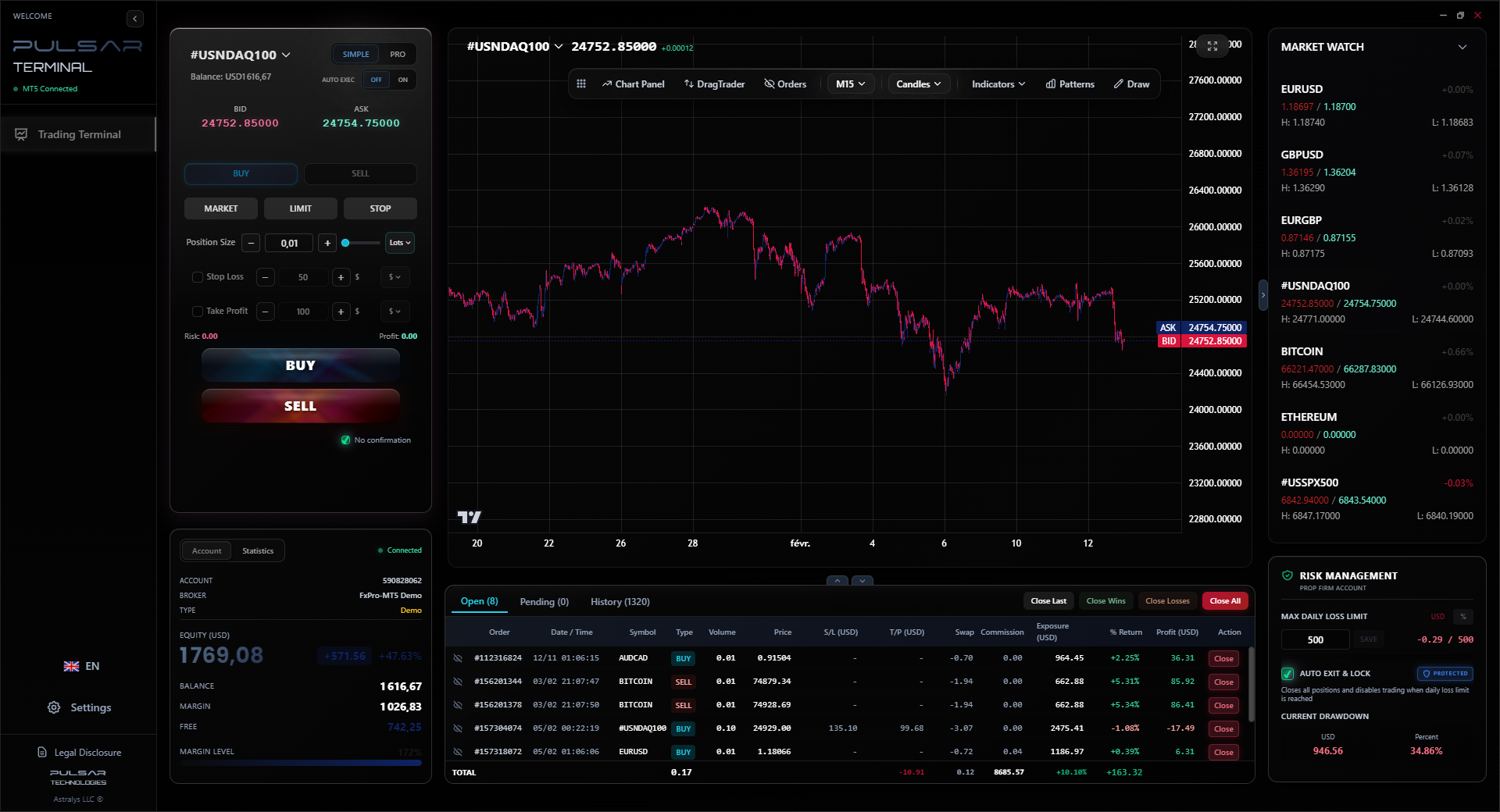
Managing multiple campaigns and tracking their performance requires the same organized, rule-based approach that a tool like Pulsar Terminal brings to managing multiple trades and risk parameters on MT5.
Pulsar Terminal
MT5 올인원 도구: 드래그앤드롭 주문, 다중 TP/SL, 트레일링 스톱, 그리드 트레이딩, 볼륨 프로파일, 프롭펌 보호. 매일 1,000명 이상의 트레이더가 사용.
“Running PPC for a prop firm is a test of patience and data analysis. It's not about being clever.”
Let's save you some money and heartache.
- Ignoring Mobile: Over 60% of my qualified clicks come from mobile devices. If your landing page is slow or clunky on a phone, you're throwing away most of your traffic. Test it.
- Not Using Ad Extensions: Sitelink extensions (links to 'Rules,' 'FAQ,' 'Pricing'), callout extensions ('No Time Limit on Phase 1,' 'Trade Major Forex Pairs'), and structured snippets (list your platforms: 'MT4, MT5, cTrader') increase your ad's real estate and credibility for free. Not using them is lazy.
- Chasing Branded Keywords of Big Firms: Don't bid on 'FTMO' or 'The5ers.' It's expensive, and the searcher already has a brand in mind. You're just helping them with their navigation. It rarely converts for you.
- Forgetting About Remarketing: The guy who visited your pricing page but didn't buy? That's a hot lead. Set up a remarketing campaign to show them a different ad, maybe with a limited-time offer or a new testimonial. This audience has a much higher conversion rate. I once got a 22% conversion on a remarketing ad versus 2% on cold traffic.
- Expecting Immediate ROI: Your first $500-$1000 is for learning. It's your challenge fee to the PPC gods. You will lose it. The goal is to learn what doesn't work so you can scale what does. This is the exact mindset needed to pass a prop challenge itself.
Running PPC campaigns for future prop firms is a test of patience and data analysis. It's not about being clever. It's about being systematic, cutting losers fast, and letting your winners run. Sounds familiar, right?
💡 윈스턴의 팁
The keyword that brings one funded trader is worth more than a hundred that bring clicks. Quality over quantity, always.
“Treat your ad spend with the same respect you treat your trading capital.”
You've found a keyword group that works. The cost per funded trader is below your LTV. Now what? You scale, but carefully.
First, don't just increase the daily budget by 500%. The auction dynamics can change, and your CPC might skyrocket. Increase it in increments of 20-30% every few days and watch the metrics.
Second, look for adjacent opportunities.
- Geographic Expansion: You're crushing it in Canada? Test the UK or Australia. But tailor the ads. Mention local instruments or time zones.
- Audience Expansion: Use your website visitor lists (from your successful campaigns) to create 'lookalike audiences' on platforms like Meta. This tells the algorithm to find more people who resemble your best converters.
- Cross-Sell/Upsell: Once you have a funded trader, that's a new relationship. Your next PPC effort should be to keep them. Consider campaigns for educational content, advanced challenges, or community access. Their LTV is now your focus.
Finally, remember that the market changes. New competitors bid on your keywords. Search trends shift. What worked for PPC campaigns for future prop firms in 2023 might not work in 2025. You need to keep a small portion of your budget (10-15%) always testing new ad copy, new landing page layouts, and new keyword variations. This is your R&D. Without it, your edge will erode, just like a trading strategy that stops working.
The goal isn't to run one perfect campaign. It's to build a repeatable, data-driven system for acquiring traders. When you get that right, the prop firm business transforms from a hopeful venture into a real, scalable operation. It starts with treating your ad spend with the same respect you treat your trading capital.
FAQ
Q1What's a realistic budget to start testing PPC for a prop firm?
Don't touch it with less than $1,000 CAD set aside purely for testing. Your first $500 will likely be a write-off as you learn. The next $500 is where you start to see what might work. It's a learning fee, just like the prop challenge itself.
Q2Which platform is better for prop firm ads: Google Search or Meta/Facebook?
Start with Google Search, 100%. On Google, people are actively searching for 'prop firm' solutions. It's high intent. Facebook is more about awareness - you're interrupting someone scrolling cat videos. The conversion rate and quality on Search is almost always higher for this niche, though the CPC is also higher. Meta can work for broad awareness or remarketing later.
Q3How do I track if a PPC click actually leads to a funded trader?
You need basic marketing tech setup. Use UTM parameters on your ad links. When someone clicks, they're tagged. When they purchase a challenge on your site, that tag should be saved to their user profile in your database. Then, when (if) they become funded, your backend can connect the dots. It requires some setup with a CRM or your custom platform, but it's non-negotiable for real tracking.
Q4What's a good cost-per-click (CPC) for prop firm keywords?
It varies wildly. Broad, cheap keywords like 'online trading' might be $1.50 but convert terribly. Specific, high-intent keywords like 'prop firm challenge MT5' can be $4-$7. Don't fixate on CPC alone. Focus on Cost per Acquisition (CPA) - the cost to get a funded trader. A $6 CPC that converts well is cheaper than a $2 CPC that brings in people who will never pass.
Q5Should I mention the challenge fee in the ads?
Yes, or at least give a strong indication ('Start from $299'). This qualifies your traffic. You don't want clicks from people looking for something free. It lowers your click-through rate but drastically increases your conversion rate and lowers your overall CPA. It's a filter, and a good one.
Q6How long should I run a test before deciding a campaign is a failure?
Give it at least 100-200 clicks and 2-3 weeks. Less data than that is just noise. If after 200 clicks you have zero applications or purchases, the campaign is likely fundamentally flawed (wrong audience, terrible landing page). Tweak one variable at a time and re-test.
Q7Can I run PPC successfully if I'm not a marketing expert?
Yes, if you're a systematic trader. The principles are identical: define your edge (profitable keyword/targeting), manage your risk (budget/CPC), cut losses fast (pause bad keywords), and scale winners. The tools are different, but the disciplined mindset is exactly what you already use at the charts.
윈스턴 교수의 수업
핵심 요약:
- ✓PPC requires trader discipline: define risk, cut losses, scale winners.
- ✓Target the 'Grinder,' not the 'Greenhorn' - specificity is everything.
- ✓Work backwards from your unit economics to set a sane budget.
- ✓Track everything; data beats marketing intuition every time.
- ✓Your landing page is your trade exit; clarity converts, hype fails.
이 기사가 얼마나 유용했나요?
별을 클릭하여 평가
주간 트레이딩 인사이트
무료 주간 분석 & 전략. 스팸 없음.
저자 소개
James Mitchell
수석 트레이딩 애널리스트
뉴욕 기반으로 9년 이상의 트레이딩 경력 보유. 주요 USD 통화쌍, 프롭 펌 챌린지, 미국 규제 환경에 집중.
댓글
위험 고지
금융 상품 거래에는 상당한 위험이 수반되며 모든 투자자에게 적합하지 않을 수 있습니다. 과거 성과가 미래 수익을 보장하지 않습니다. 이 콘텐츠는 교육 목적으로만 제공되며 투자 조언으로 간주되어서는 안 됩니다. 거래 전에 항상 직접 조사를 수행하십시오.
이 기사도 읽어보세요

Cara Trading Forex Sukses: 7 Prinsip dari Trader Profesional
Cara trading forex sukses dengan 7 prinsip trader pro: manajemen modal, disiplin, journal trading, backtest. Data nyata, bukan janji profit palsu.
Jam Trading Forex Terbaik untuk Trader Indonesia: Panduan Lengkap dengan Tabel Waktu
Panduan jam trading forex untuk trader Indonesia. Tabel 4 sesi dunia, jam emas 20:00-00:00, sesi mana yang harus dihindari. Data akurat + tips dari trader berpengalaman.
Top 5 Sàn Forex Uy Tín Nhất 2026: Review Jujur dari Trader Indonesia
Top 5 sàn forex uy tín 2026 untuk trader Indonesia. Review jujur: spread, deposit, withdraw, dukungan lokal. Exness, XM, IC Markets & lebih.
