


Here's a stat that'll make you think: over 90% of traders who fail a prop firm challenge do so in the first two weeks.
James Mitchell
수석 트레이딩 애널리스트
☕ 9 분 소요
배울 내용:

Here's a stat that'll make you think: over 90% of traders who fail a prop firm challenge do so in the first two weeks. They're paying hundreds, sometimes thousands, for a test they're not ready for. A prop firm free trial is your chance to skip that expensive failure. It's not about getting free money; it's about getting a no-cost, no-pressure look at the rules, the platform, and your own readiness. I've blown a few challenges myself before I figured this out. Let's talk about how to use these trials to your real advantage.
Most folks hear 'free trial' and imagine a week of trading a $100,000 account with zero risk. That's a fantasy, and the good firms know it. In reality, a prop firm free trial is a simulation. You're trading on a demo account that's configured with the firm's exact challenge rules: the same profit target, daily loss limits, maximum drawdown, and time limit.
You're not risking their capital, and you're not earning a payout. What you are doing is stress-testing their system against your strategy. I remember trying a trial for a firm with a brutal 5% maximum daily loss. My usual scalping strategy triggered it on my third trade during a news spike. That trial saved me $250 on a challenge I would have instantly failed.

Warning: Be wary of any 'trial' that asks for your credit card upfront for a 'future charge.' A legitimate free trial requires no payment information. It's a marketing tool for them, a reconnaissance tool for you.
The best trials give you full access to their client dashboard, their ruleset, and their support. It’s a dry run for the real deal. If you can’t consistently pass their free trial over multiple attempts, you have zero business buying the actual challenge. That’s the hard truth.

💡 윈스턴의 팁
A free trial isn't a test of the market. It's a test of the firm's rulebook. Your only job is to see if your trading fits inside their box.

“A prop firm free trial is your chance to skip an expensive failure.”
The landscape changes, but a few have consistently offered solid trial programs. Don't just pick the first one you see; match the trial to your trading style.
The Major Players with Consistent Trials
FTMO used to have a great 14-day demo challenge. They've paused it occasionally, but they're a benchmark. Their rules are classic: 10% profit target, 5% daily loss, 10% max overall loss. Their trial mirrored this perfectly.
The5%ers often run a 'Free Evaluation' program. It's a straight-up replica of their first funding step. I found their platform really intuitive during a trial last year.
MyForexFunds (before their regulatory issues) popularized the free trial concept. Newer, reputable firms have picked up the mantle.
What to Look For in a Trial
- Full Rule Transparency: The trial should list every single rule you'd face in the paid challenge.
- Realistic Account Size: A $10,000 trial is more useful than a $200,000 one if the paid challenges start at $10k.
- Dashboard Access: Can you see the simulated drawdown, daily loss, and profit in real-time? This is crucial.

Pro Tip: Don't just test one. Grab trials from 2-3 firms that interest you. Trade the same strategy in each for a week. You'll quickly see which firm's rules best fit your natural trading rhythm. One might have a tighter daily loss that cramps your style, while another's longer time limit gives you the breathing room you need.
Remember, the goal isn't to pass one trial by luck. It's to see if you can operate comfortably within their specific cage. Your success in a trial is a way more reliable indicator than any backtest.
“If you can't consistently pass their free trial, you have zero business buying the actual challenge.”
Okay, you've signed up. Now what? Don't just trade it like a regular demo account. You need a structured audit. Here's my process, honed from wasting a few trials early on.
Phase 1: The Rule Dissection First day, don't place a single trade. Open their rulebook. Calculate the exact dollar amounts for their limits. If it's a $50,000 trial with a 5% daily loss, that's $2,500. What does that mean in terms of your typical position size? If your usual stop-loss is 20 pips on EUR/USD, how many lots can you actually run before hitting that daily wall? Write these numbers down.
Phase 2: The Strategy Stress Test Now, trade your normal plan, but with one twist: track every metric against their limits. I use a simple spreadsheet. Did that winning trade put me 30% toward my daily profit target? Did that loser use up 15% of my max drawdown?
Phase 3: The Platform Check Is the execution laggy during the London open? How easy is it to set a trailing stop? Can you quickly see your running P&L? I once did a trial where the platform didn't show a live daily drawdown figure. I had to calculate it myself. That was an instant deal-breaker for me.

Example: Let's say your trial has a 10% profit target ($5,000 on a $50k account) and a 30-day period. That means you need an average of $167 per trading day. Does your strategy reliably produce that without over-leveraging? If you need to force $500 days to catch up, you'll blow the account.
The trial is a lab, not a lottery. The data you collect is more valuable than a simulated 'pass.' It tells you if the partnership is even possible. If you're constantly brushing against the daily loss limit, maybe a firm with a larger daily buffer (like some programs at FTMO) is a better fit, even if their profit target is slightly higher.
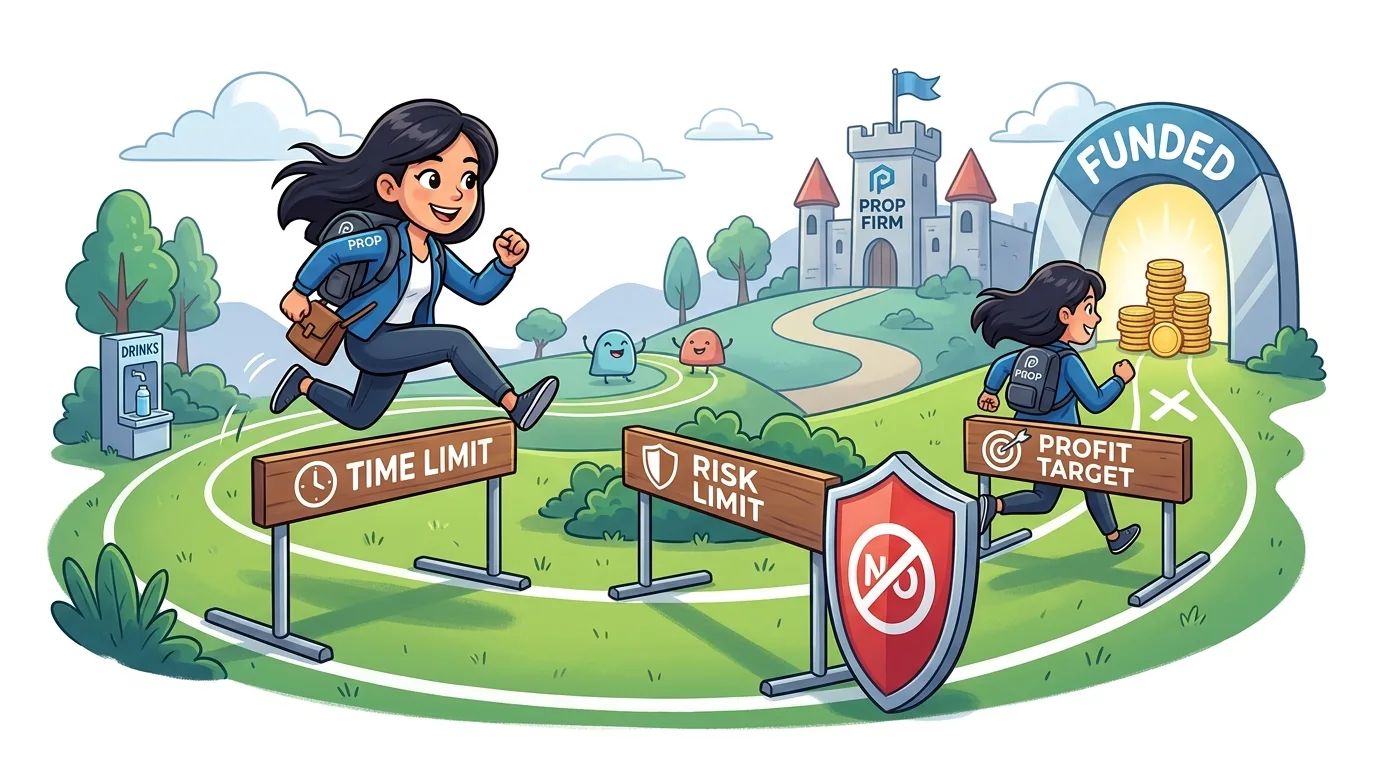
“The data you collect from a trial is more valuable than a simulated 'pass.'”
I've made most of these. Learn from my lost time.
1. Treating it Like a Game. Because it's 'fake money,' there's a temptation to YOLO. You take a massive, reckless trade to hit the profit target in a day. This teaches you nothing. In fact, it builds bad habits. The psychology of a real challenge is different, but the mechanics of risk are identical. Practice discipline here.
2. Ignoring the Time Factor. You have 30 days in the trial. You cruise for 25 days, then realize you need 8% more profit. The ensuing panic trading is a guaranteed failure. Use a calendar. Break the total target into weekly or even daily mini-targets. If you miss a weekly goal, you know you need to adjust, not gamble.
3. Overlooking the 'Consistency' Clauses. Some firms, even in trials, have hidden consistency rules. You might need a certain number of trading days, or a rule that your largest winning trade can't be more than, say, 30% of your total profit. Read every line of the FAQ.
4. Not Testing the Worst-Case Scenario. What happens when you hit the daily loss limit? Does the trial stop you automatically? Does it just warn you? In a real challenge with a firm like IC Markets as the broker, hitting a limit usually means an immediate fail. Know the shutdown procedure.
The biggest pitfall? Passing a trial once and thinking you're ready. You got lucky. Pass it three times in a row with your strategy. That's a signal. One pass is noise. I learned this after 'passing' a trial, buying the challenge, and then blowing it in 4 days because my first trial pass was built on two oversized, lucky winners.
💡 윈스턴의 팁
If you can't explain the firm's daily loss rule in dollar terms for your average trade size within 10 seconds, you haven't done the trial properly. Do the math first.

“The data you collect from a trial is more valuable than a simulated 'pass.'”
You've completed a trial (or three). Now, let's build a bridge to the real thing.
If You Failed the Trial: This is the best outcome if you're smart about it. You just saved money. Analyze your journal. Did you violate your own rules, or did their rules expose a flaw in your strategy? If it's the former, you need more demo work on discipline. If it's the latter, you need to refine your strategy. Maybe your win rate is too low for their profit target, or your average loss is too large for their drawdown limit. This might mean adopting a different approach, like swing trading for larger moves with tighter risk.
If You Passed the Trial Consistently: Don't jump to the biggest challenge. Be tactical.
-
Start Small: Buy the smallest, cheapest challenge the firm offers. The psychology changes with real money on the line, even if it's just a challenge fee. Prove you can do it for real at the lowest stakes.
-
Replicate Exactly: Use the same broker connection (if possible), the same lot sizes, the same daily profit goals you used in the trial. Don't get greedy because it's 'the real thing.'
-
Have a Broker Backup Plan: Is the prop firm's platform stable? If not, know which reputable brokers (like Pepperstone or XM) you'd be comfortable with if you could choose. Some firms let you select from a list.
The trial is your blueprint. The paid challenge is the construction. You wouldn't build a house without a blueprint, so don't fund a trading career without this test. The transition is where tools that manage risk automatically become priceless, because your psychology will be tested.
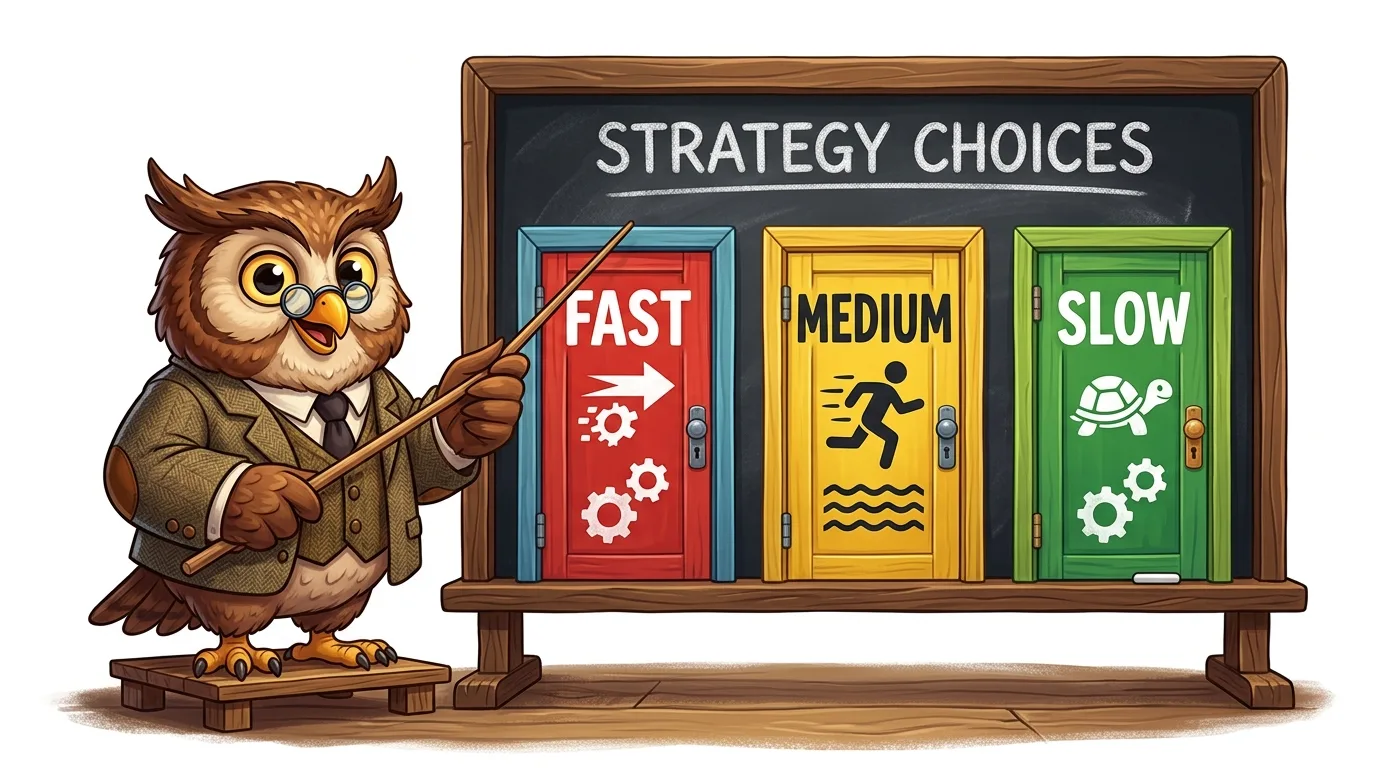
Managing the strict daily loss and drawdown rules of a prop firm challenge is stressful, which is why tools like Pulsar Terminal can automate those protections directly on your MT5 chart, removing emotion from the equation.
Pulsar Terminal
MT5 올인원 도구: 드래그앤드롭 주문, 다중 TP/SL, 트레일링 스톱, 그리드 트레이딩, 볼륨 프로파일, 프롭펌 보호. 매일 1,000명 이상의 트레이더가 사용.
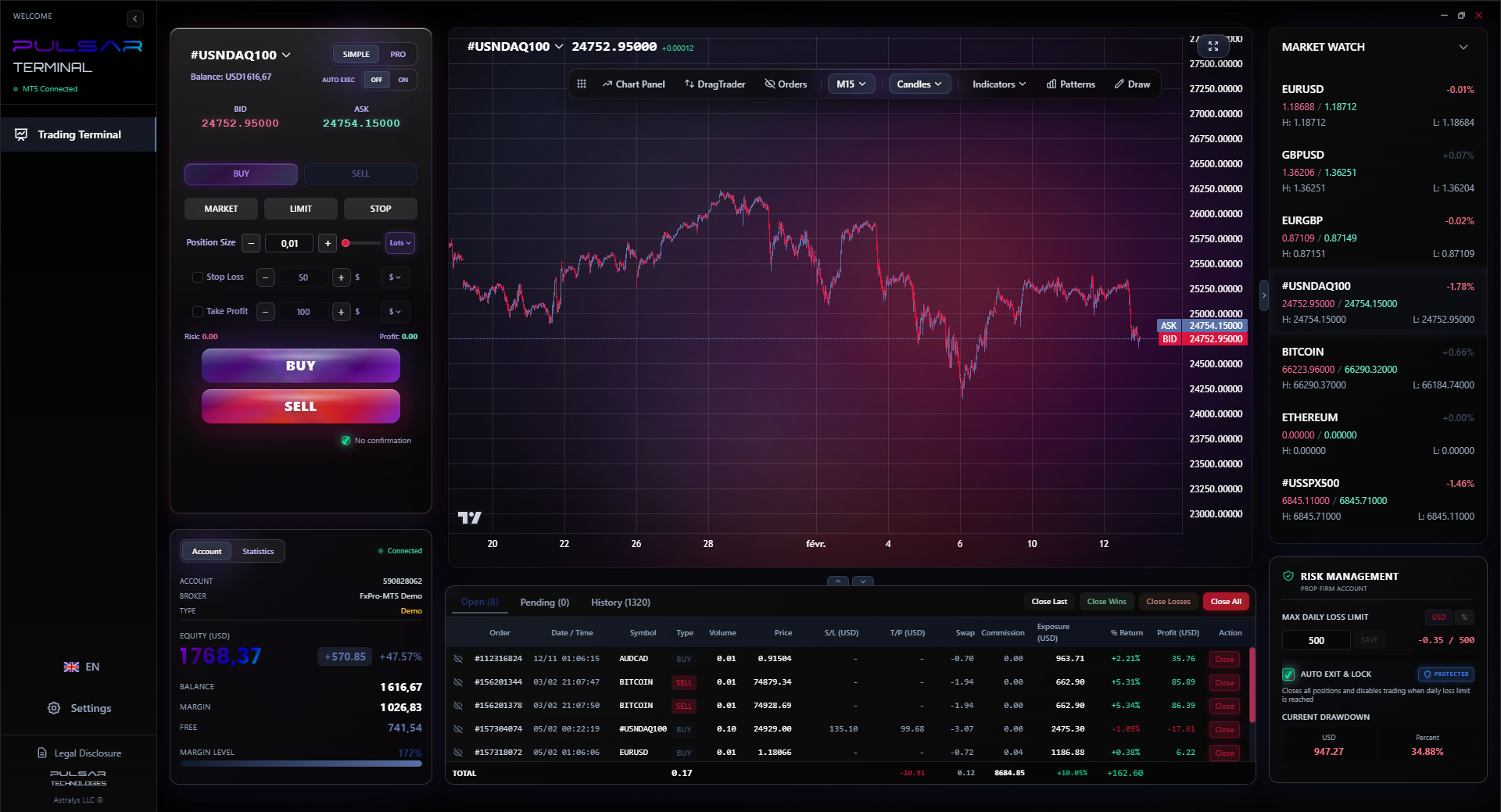
“Passing a trial once is noise. Passing it three times in a row is a signal.”
Not every reputable firm offers a free trial. Some, like many using Exness as a liquidity provider, don't. That's okay. You just have to do your homework differently.
1. The 'Demo Challenge' Purchase: Some firms sell a 'demo challenge' for $10-$20. It's their full challenge rules on a demo account. It's not free, but it's a fraction of the full challenge cost. Treat this like a paid trial. It's often worth the coffee money to test.
2. The Power of the Community: Go to forums, Discord servers, or YouTube reviews. Don't just listen to the success stories. Search for 'fail,' 'problem,' 'issue.' What are people complaining about? Is it platform slippage, slow payout processing, or vague rules? This is real-world trial data.
3. Dissect the Rulebook: Without a trial, you must become a rule detective. Calculate everything. If the max drawdown is 10% and it's calculated from the starting balance and includes open trades, that's stricter than if it's just from the starting balance. How does their trailing drawdown work? Nail this down on paper first.
4. Start with the Smallest Live Account: If you're determined to try a firm with no trial, never start with their $100,000 challenge. Go for the $10,000 or $25,000 option. The risk is lower, and the rules are often identical. It's a live, paid trial with a potential upside.
, a prop firm free trial is the most efficient research tool. But if it's not available, your next best tool is obsessive preparation. Simulate their rules on your own demo account manually. It's more work, but it forces you to understand the mechanics of their limits inside and out, which is never a bad thing.
FAQ
Q1Are prop firm free trials really free?
Yes, the legitimate ones are completely free and require no credit card. They are marketing tools for the prop firm to attract serious traders. Be very suspicious of any 'trial' that asks for payment details upfront.
Q2Can I get funded from a free trial?
Absolutely not. A free trial is a simulation on a demo account. No real money is being traded, and no payouts are possible. Its sole purpose is to let you test the firm's rules and platform before you decide to pay for an evaluation.
Q3How long do prop firm free trials usually last?
They typically mirror the length of the firm's first-stage challenge, commonly ranging from 14 to 30 days. Some might offer a shorter 7-day trial, while others may give you a fixed number of trading days (e.g., 10 trading days).
Q4If I pass a free trial, am I guaranteed to pass the real challenge?
No, and this is critical. Passing a trial is a positive sign, but the psychology of trading with a real fee on the line is different. A trial pass means your strategy is mechanically compatible with the rules. It doesn't guarantee you can execute it under real pressure. That's why passing a trial multiple times is a better indicator.
Q5What's the main thing I should learn from a free trial?
You need to learn if your current trading strategy can operate profitably within the firm's specific risk constraints (daily loss, max drawdown, time limit). The trial answers one question: 'Are their rules a cage I can thrive in, or one that will choke my strategy?'
Q6Do all prop firms offer free trials?
No, many do not. It's a specific marketing strategy. Some top firms don't offer them, while newer firms often use them to attract clients. The absence of a trial doesn't mean a firm isn't reputable, it just means you have to do more manual research.
윈스턴 교수의 수업
핵심 요약:
- ✓Treat free trials as mandatory strategy audits, not lotteries.
- ✓Calculate all rules into exact dollar amounts before your first trade.
- ✓Passing a trial once is luck; passing it three times is competence.
- ✓If you fail a trial, you just saved 100% of your challenge fee.
이 기사가 얼마나 유용했나요?
별을 클릭하여 평가
주간 트레이딩 인사이트
무료 주간 분석 & 전략. 스팸 없음.
저자 소개
James Mitchell
수석 트레이딩 애널리스트
뉴욕 기반으로 9년 이상의 트레이딩 경력 보유. 주요 USD 통화쌍, 프롭 펌 챌린지, 미국 규제 환경에 집중.
댓글
위험 고지
금융 상품 거래에는 상당한 위험이 수반되며 모든 투자자에게 적합하지 않을 수 있습니다. 과거 성과가 미래 수익을 보장하지 않습니다. 이 콘텐츠는 교육 목적으로만 제공되며 투자 조언으로 간주되어서는 안 됩니다. 거래 전에 항상 직접 조사를 수행하십시오.
이 기사도 읽어보세요

Cara Trading Forex Sukses: 7 Prinsip dari Trader Profesional
Cara trading forex sukses dengan 7 prinsip trader pro: manajemen modal, disiplin, journal trading, backtest. Data nyata, bukan janji profit palsu.
Jam Trading Forex Terbaik untuk Trader Indonesia: Panduan Lengkap dengan Tabel Waktu
Panduan jam trading forex untuk trader Indonesia. Tabel 4 sesi dunia, jam emas 20:00-00:00, sesi mana yang harus dihindari. Data akurat + tips dari trader berpengalaman.
Top 5 Sàn Forex Uy Tín Nhất 2026: Review Jujur dari Trader Indonesia
Top 5 sàn forex uy tín 2026 untuk trader Indonesia. Review jujur: spread, deposit, withdraw, dukungan lokal. Exness, XM, IC Markets & lebih.
