


I was staring at a 4.7% daily drawdown on a $50,000 FTMO challenge account back in 2021.

James Mitchell
수석 트레이딩 애널리스트 ·  Canada
☕ 12 분 소요
배울 내용:
- 1The Legal Grey Zone: Are Prop Firms in Canada Even Legal?
- 2The Real Math: Fees, Splits, and What You Actually Keep
- 3Picking Your Firm: Platform, Payouts, and Fine Print
- 4How to Actually Pass the Damn Challenge
- 5You're Funded. Now What? (And What About the CRA?)
- 6Firms Worth a Look (And Ones to Avoid)
- 7Is It Worth It? A Veteran's Take

I was staring at a 4.7% daily drawdown on a $50,000 FTMO challenge account back in 2021. The USD/CAD had spiked on a surprise BoC announcement, and my stop-loss got skipped. The account was dead. That $399 evaluation fee? Gone. That moment taught me more about the real cost of prop firms in Canada than any shiny sales page ever could. It's a wild world out here - less regulated than your bank, full of opportunity, but littered with traps for the unprepared. Let's talk about how to navigate it, make money, and keep the regulators off your back.
Here's the thing everyone whispers about but few brokers will say outright: prop firms in Canada operate in a regulatory grey area. It's not black market stuff, but it's not like walking into a TD branch either.
The core legal trick is that these firms are trading their own capital, not managing client funds for a fee. That's the loophole. They're not acting as traditional investment dealers, so they often sidestep the full registration requirements with the Canadian Investment Regulatory Organization (CIRO, formerly IIROC). Think of it as you paying a fee for the chance to trade their money. You blow up, they keep your fee. You profit, they take a cut. It's a performance-based model, not an asset management one.
But the regulators are waking up. In August 2024, the Ontario Securities Commission (OSC) dropped a clarification that should make any prop firm sweat. They said day-trading firms with direct market access can't hide behind exemptions - they might need to register as investment dealers. There's even a case pending before the Capital Markets Tribunal right now against an unregistered day-trading firm. The winds are shifting.
What does this mean for you, the trader? It means the firm you're giving money to might be operating on shaky ground. It doesn't mean you'll get arrested, but it does mean your consumer protections are thinner. If a firm folds or refuses a payout, you're not calling IIROC. You're likely starting a civil lawsuit. Always, always check where a firm is legally based and who, if anyone, oversees them. An offshore registration with no oversight is a massive red flag.

Warning: Just because a firm accepts Canadian clients doesn't mean it's regulated in Canada. Most aren't. You are dealing with an unregulated entity. Your recourse if something goes wrong is extremely limited.
“Prop firms in Canada operate in a regulatory grey area. It's not black market stuff, but it's not like walking into a TD branch either.”
Forget the "get funded" hype. Let's talk cold, hard cash. Your journey starts with an evaluation fee. This is non-refundable capital you're risking before you even place a trade.
Evaluation Fees: The Price of Admission
These range from the laughably cheap to the seriously steep. You'll see $17 challenges for a $5k account and $2,999 fees for a shot at $400k. My rule? Never pay a fee that would ruin your week if you lost it. That $2,999 fee? That's a decent used car. I'd never risk that on a challenge. I've had more success treating these like a business expense. I budget for two or three attempts at a lower level. In 2023, I spent $287 total on fees across two firms, passed one, and have since withdrawn over $14,000 from that single funded account. The math worked, but only because I kept the initial risk small.
The Profit Split Illusion
They all advertise "up to 90% profit split!" It's marketing. The standard starting split is 80/20 in your favor. Some, like FundedNext, might start at 60%. You can scale up to 90% or even 100% by hitting consistent profit targets. But here's the dirty secret: they calculate that split on net profits. If you make $1,000 but have $50 in commissions, your split is on $950. Read the fine print.
Let's run a real example from my books. On my FTMO account (80% split), I closed a month with $8,200 in gross profits. Commissions and swaps totaled about $420. Net profit: $7,780. My 80% cut was $6,224. FTMO kept $1,556. Not bad, but a far cry from 80% of the headline $8,200.

Example: Gross Profit: $10,000
- Commissions & Fees: -$500 = Net Profit: $9,500 Your 80% Share: $7,600 Firm's 20% Share: $1,900 Your effective split of the gross P&L: 76%
The Hidden Goal: Profit Targets & Drawdowns
To even get that split, you must first pass the challenge. Typical profit targets are 8-10%. On a $100k account, that's $8k-$10k. Seems easy until you hit the drawdown rules. The most common account killer is the maximum daily loss, usually around 5%. Hit that, and your challenge is instantly failed, no questions asked. Your overall drawdown limit might be 10%. These rules force a discipline most retail traders lack, which is the whole point. You need a solid position size calculator and iron-clad risk management to survive.

💡 윈스턴의 팁
Your first funded account goal should be the size of your car payment, not your mortgage. Small, consistent withdrawals build confidence and a track record.
“Never pay an evaluation fee that would ruin your week if you lost it. That $2,999 fee is a decent used car.”
Not all prop firms in Canada are created equal. The flashy funding amount is the last thing you should look at.
Trading Platform: This is your office. If you hate it, you'll fail. Most firms offer MT4/MT5. Some, like BrightFunded, use cTrader or DXTrade. Others, like OANDA Prop Trader, push their own platform. Never, ever pay for a challenge on a platform you haven't demo-traded for at least a week. I made that mistake with a firm using a web-based platform that lagged terribly during news events. Lost a challenge in 3 days. Stick to what you know. If you're an MT5 wizard, only go with firms that offer it.
Payout Reliability & Methods: This is the most important factor. How do you get paid? The best firms pay like clockwork, monthly, via wire transfer or crypto. Ask in their Discord or community forums. If people complain about delayed payments, run. For Canadians, receiving USD is key. Many firms use services like "Plane" for international wires. You'll need a USD account at your Canadian bank (easy to set up at any major bank) to avoid brutal conversion fees. Some firms pay in crypto (USDT), which is often faster and cheaper.
The Rulebook: Read it. Then read it again. Compare key rules across firms:
| Rule | Typical Range | Why It Matters |
|---|---|---|
| Profit Target | 8% - 10% | Your goal. Lower is easier. |
| Max Daily Loss | 4% - 6% | The instant-fail trap. The higher, the better. |
| Total Drawdown | 8% - 12% | Your overall loss buffer. |
| Minimum Trading Days | 5 - 10 days | Prevents lucky one-trade passes. |
| use | 1:30 to 1:100 | Affects your position size and risk. |
use: Canadian prop firms often offer more use than a retail broker would under IIROC rules (which cap use for retail clients). I've seen up to 1:100. This is a double-edged sword. It can amplify gains but will vaporize your account twice as fast if you're sloppy. I never use more than 1:30, even if 1:100 is available.

Pro Tip: Don't chase the highest funding. Start small. A $10k or $25k challenge has a much lower fee. Pass that, prove you can handle the rules and get consistent payouts, then scale up. A firm that won't pay you on a $10k account won't pay you on a $100k account.

“Never pay an evaluation fee that would ruin your week if you lost it. That $2,999 fee is a decent used car.”
This is where dreams go to die. I've failed more than I've passed. Here's what finally worked.
Phase 1: The Grind. Your only job here is survival. The profit target is secondary. I treat the first phase as a risk-management drill. I risk 0.5% per trade, max. My goal is 5-10 high-probability, small wins. I avoid news like the plague. I'm not trying to hit the 8% target in one week. I'm trying to build a 2-3% cushion without ever touching the daily loss limit. This phase is about proving you're not a gambler. A tool that can automate a trailing stop or set a breakeven is useful here to protect open profits.
Phase 2: The Replication. This is usually easier (5% target). But psychologically, it's harder. You're so close. The temptation to over-trade is huge. You must trade exactly as you did in Phase 1. Same strategy, same risk. This is where a journal is critical. I literally re-read my Phase 1 notes before every trading session in Phase 2.
The Mental Game: The rules create a unique pressure. That 5% daily loss limit hangs over you. You have a winning trade, up 2%. Do you take profit early to bank it and avoid a reversal? Often, yes. Prop firm trading isn't about maximizing a single trade; it's about consistent, rule-compliant profitability. It's a different beast than swing trading your own account.
My Personal Blueprint:
- Week 1: Trade only my absolute best set-up. 0.5% risk. Goal: +1-2%. No losses > 1%.
- Week 2-3: With a small profit buffer, I can be slightly more active. Still 0.5% risk. Aim for 2-3 more high-quality trades.
- Week 4: If I'm at 6-7%, I might take one final, calculated trade to cross the 8% line. If not, I extend. Time is usually on your side.
The biggest mistake I see? Traders hit 7% and then take a huge, impulsive trade to "get it over with." They blow through the daily loss and fail. Patience is the ultimate edge.
💡 윈스턴의 팁
Print out the firm's rule sheet and stick it next to your monitor. The 5% daily loss limit isn't a suggestion; it's a cliff edge.
“The biggest mistake I see? Traders hit 7% and then take a huge, impulsive trade to 'get it over with.' Patience is the ultimate edge.”
Congratulations. You passed. Now the real work begins. You're running a small business.
Trading the Live Account: The rules are usually identical, but the psychology changes. It feels like real money (it is, sort of). The first month is nerve-wracking. My advice? Trade half your normal size for the first two weeks. Get used to the rhythm of the account. The goal is your first payout, not getting rich.
The Payout Process: Most firms have a monthly payout cycle. You request a withdrawal, they process it, and it hits your account a few days later. Document everything. Save every statement, every payout confirmation. This is crucial for two reasons: tracking your performance and dealing with taxes.
The Tax Man Cometh (CRA Rules): This is the million-dollar question, and I am not an accountant. This is my understanding from my own experience and consultations.
Your payouts from a prop firm are likely considered business income in Canada, not capital gains. Why? Because you're being paid a share of profits for providing a service (your trading skill). You are a contractor. You will receive a T4A or similar slip if the firm is Canadian, but most aren't, so you'll get nothing.
It is 100% your responsibility to report this income. You must keep careful records of every payout (date, amount in USD, converted CAD amount using the Bank of Canada rate for that day). You can deduct legitimate business expenses: your evaluation fees (yes, even the failed ones), a portion of home office costs, trading software subscriptions, internet, computer equipment, and education. My accountant treats my prop trading as a sole proprietorship. I file a T2125 Statement of Business or Professional Activities with my personal return.
Warning: Ignoring this can lead to serious penalties and interest from the CRA. The paper trail from a prop firm is clean. If you get audited and they see regular USD deposits from "XYZ Funding Ltd," you better have a good explanation. Get a Canadian accountant who understands trading income. It's worth the fee.

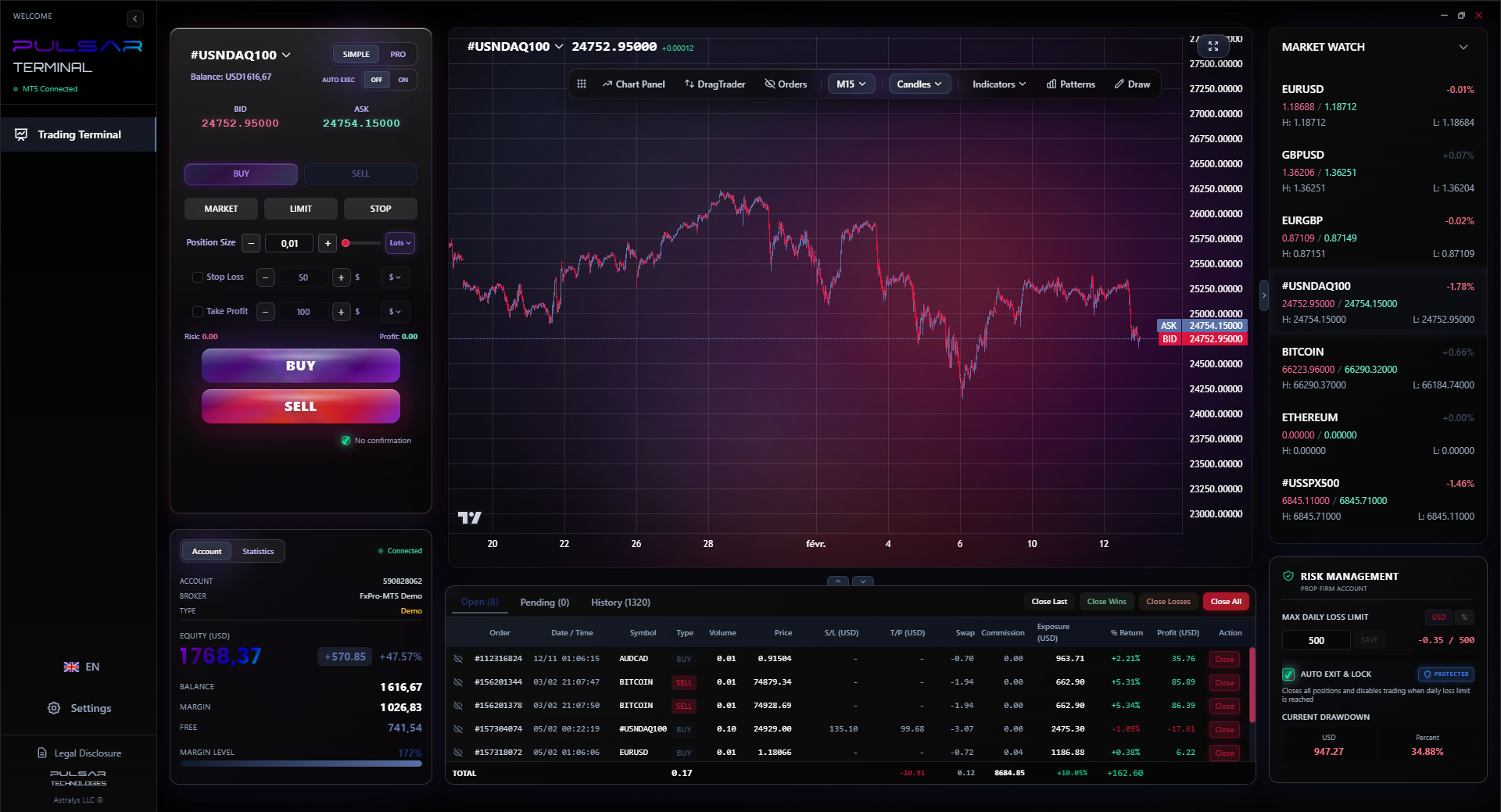
Managing a prop firm's strict daily loss limit is stressful manual work, but Pulsar Terminal automates it by tracking your loss in real-time and alerting you before you breach it.
Pulsar Terminal
MT5 올인원 도구: 드래그앤드롭 주문, 다중 TP/SL, 트레일링 스톱, 그리드 트레이딩, 볼륨 프로파일, 프롭펌 보호. 매일 1,000명 이상의 트레이더가 사용.
“The biggest mistake I see? Traders hit 7% and then take a huge, impulsive trade to 'get it over with.' Patience is the ultimate edge.”
Based on community feedback, payout consistency, and rule fairness, here's my current shortlist. This changes, so do your own homework.
Tier 1 (Proven & Reliable):
- FTMO: The OG. Expensive challenges, but their reputation is solid. Payouts are reliable. Their rules are strict but clear. Great for traders who are already disciplined. They use MT4/MT5/cTrader.
- FundedNext: Very popular with a variety of challenge models (one-step, two-step). Good community, transparent about payouts. They support multiple platforms including TradingView. A strong contender.
Tier 2 (Solid & new):
- BrightFunded: Gaining a great reputation for fair rules and good support. Their two-phase challenge (8% then 5%) is standard. They offer cTrader and DXTrade, which is a plus for some.
- The5%ers: Different model with a focus on slower, long-term growth. Less pressure on huge short-term targets. Good for longer-term swing trading styles.
Firms I'm Cautious About:
- Any firm with overly complex or hidden rules. If you need a lawyer to understand the drawdown calculation, walk away.
- Firms with a history of payout complaints. A quick search on ForexPeaceArmy or Reddit will reveal patterns.
- Firms offering "instant funding" with no evaluation. These often have catastrophic hidden drawdown rules or are outright scams.
Platform Note: If you trade on MT5, using a tool that helps manage the prop firm's specific risk rules can be a lifesaver. Manually calculating your daily loss limit while in a trade is a recipe for a margin call. Automation is key.
💡 윈스턴의 팁
When you get your first payout, put 30% of it aside immediately in a separate savings account. The CRA will want their share, and you don't want to be scrambling at tax time.
“Your payouts are likely business income, not capital gains. The CRA loves a clear paper trail from an offshore company.”
Prop firms in Canada are a tool, not a lottery ticket. For the right trader - one with a proven, disciplined strategy and solid risk management - they provide incredible use. You can control $100k with a few hundred dollars of risk (your evaluation fee). That's powerful.
For the average retail trader blowing up their $2,000 account every few months, it's a expensive way to learn the same lessons. You will fail challenges. I did. Multiple times. Each failure cost me money and ego.
My final advice: Treat it like starting a small business. Budget for it. Start small. Your first goal isn't a $200k account; it's a consistent $500 monthly payout from a $10k account. Build from there. The skills you learn - trading under strict rules, managing psychology, handling business income - are useful, whether you stick with prop firms or eventually trade your own significant capital.
The landscape is evolving. Regulation is coming. Get in, learn the game, make some money, and always have an exit strategy. And for the love of all that's holy, keep the CRA in the loop.
FAQ
Q1Do I need to be a professional trader to join a prop firm in Canada?
No, but you need to be a profitable trader with a clear strategy. They're testing your consistency and risk management, not your credentials. If you can't consistently make money in a demo account over 3-6 months, you're not ready for a prop firm challenge.
Q2How are payouts from prop firms taxed in Canada?
Almost certainly as business income (on a T2125 form), not capital gains. You must report the full CAD-equivalent amount of each payout. You can deduct legitimate business expenses like evaluation fees, software, and home office costs. Consult a Canadian accountant familiar with trading.
Q3What's the biggest mistake traders make when trying a prop firm challenge?
Overtrading and mis-sizing positions. They see a $100k account and trade like they have $100k of their own money, risking 1-2% per trade. With a 5% daily loss limit, 2-3 losing trades in a row can blow the account. You must trade tiny (0.25%-0.5% risk) to survive the variance.
Q4Can I use Expert Advisors (EAs) or automated trading?
It depends entirely on the firm's rules. Most allow it, but some have restrictions (e.g., no high-frequency trading, no arbitrage). You must read their terms of service. Never assume it's allowed. Using an unpermitted EA is a surefire way to get your account terminated and any profits forfeited.
Q5What happens if I break a rule without realizing it?
Your account is typically violated and closed immediately. No warnings, no refunds. The rules are automated. It's your responsibility to know them. Common traps: exceeding the maximum daily loss (which includes floating losses), holding trades over the weekend if it's not allowed, or trading during high-impact news if it's banned.
Q6Is there a minimum credit score or financial check?
Almost never. They don't care about your credit; they care about your trading. You're not borrowing money. You're paying for an evaluation. Your only financial requirement is having enough for the evaluation fee.
Q7Which trading platforms are most common with Canadian prop firms?
MetaTrader 4 (MT4) and MetaTrader 5 (MT5) are the industry standards. Some firms also offer cTrader, DXTrade, TradeLocker, or their own proprietary platforms. Always test the platform on a demo before paying for a challenge.
윈스턴 교수의 수업
핵심 요약:
- ✓Start with the smallest, cheapest challenge you can find.
- ✓Risk 0.5% or less per trade to survive the daily loss limit.
- ✓Treat payouts as business income and save 30% for taxes.
- ✓Choose a firm based on payout reliability, not the biggest funding offer.
- ✓The platform you trade on matters more than the firm's branding.
이 기사가 얼마나 유용했나요?
별을 클릭하여 평가
주간 트레이딩 인사이트
무료 주간 분석 & 전략. 스팸 없음.
저자 소개
James Mitchell
수석 트레이딩 애널리스트
뉴욕 기반으로 9년 이상의 트레이딩 경력 보유. 주요 USD 통화쌍, 프롭 펌 챌린지, 미국 규제 환경에 집중.
댓글
위험 고지
금융 상품 거래에는 상당한 위험이 수반되며 모든 투자자에게 적합하지 않을 수 있습니다. 과거 성과가 미래 수익을 보장하지 않습니다. 이 콘텐츠는 교육 목적으로만 제공되며 투자 조언으로 간주되어서는 안 됩니다. 거래 전에 항상 직접 조사를 수행하십시오.
이 기사도 읽어보세요

Cara Trading Forex Sukses: 7 Prinsip dari Trader Profesional
Cara trading forex sukses dengan 7 prinsip trader pro: manajemen modal, disiplin, journal trading, backtest. Data nyata, bukan janji profit palsu.
Jam Trading Forex Terbaik untuk Trader Indonesia: Panduan Lengkap dengan Tabel Waktu
Panduan jam trading forex untuk trader Indonesia. Tabel 4 sesi dunia, jam emas 20:00-00:00, sesi mana yang harus dihindari. Data akurat + tips dari trader berpengalaman.
Top 5 Sàn Forex Uy Tín Nhất 2026: Review Jujur dari Trader Indonesia
Top 5 sàn forex uy tín 2026 untuk trader Indonesia. Review jujur: spread, deposit, withdraw, dukungan lokal. Exness, XM, IC Markets & lebih.
