


If you're searching for 'Sable Forex' hoping to find your next trading broker, you've already made your first mistake.

David van der Merwe
신흥시장 트레이더 ·  South Africa
☕ 8 분 소요
배울 내용:
- 1What Sable Forex Actually Is (Spoiler: Not a Broker)
- 2Sable vs. Real Forex Brokers: The Critical Difference
- 3The South African Forex Rules You Can't Ignore
- 4Costs, Fees, and The Transparency Trap
- 5How to Actually Set Up for Trading (The Right Way)
- 6The Top 3 Mistakes I See (And Made Myself)
- 7The Rand, Regulations, and Your Future
If you're searching for 'Sable Forex' hoping to find your next trading broker, you've already made your first mistake. You're not alone - I see this confusion weekly from students. Sable International is not a platform to trade EUR/USD or scalp gold. It's something far more critical for your long-term success: your legal gateway to move Rands offshore. This article will gut the hype, show you exactly what Sable Forex does (and doesn't do), and lay out the real trading landscape in South Africa so you stop wasting time and start protecting your capital.
Let's clear this up immediately. Sable International's forex service is a regulated international money transfer and currency exchange business. They are an Authorised Dealer with the South African Reserve Bank (SARB). Their FSCA license (FSP no. 41900) is for providing foreign exchange services, not for operating a leveraged trading platform where you speculate on price movements.
Think of them as the bridge, not the casino. Their core clientele isn't day traders; it's individuals emigrating, businesses paying overseas suppliers, or investors moving funds into offshore brokerage accounts. I've used them myself to fund my international trading account with a broker like IC Markets. The process was straightforward, but it's administrative, not tactical.
If you walk in expecting MT5 charts and a 1:500 use offer, you'll be sorely disappointed. Their value is in compliance, not candlesticks.
This confusion costs traders money and time. You need to know which tool is for which job.
| Feature | Sable International Forex | A Real FSCA-Regulated Trading Broker (e.g., Pepperstone) |
|---|---|---|
| Primary Service | International money transfers & currency exchange. | Providing leveraged speculative trading on currency pairs, indices, commodities. |
| Platform | Online portal for transfer requests. | MT4, MT5, cTrader, proprietary platforms with charts, indicators, order execution. |
| use | None. You exchange physical currency. | Typically 1:30 to 1:500 for retail clients (FSCA capped for majors). |
| Profit Mechanism | Saving on bank fees & getting a competitive exchange rate. | Profiting from bid/ask price movements. |
| Regulatory Focus | SARB exchange controls, FSCA for financial services. | FSCA for market conduct, client money protection. |

Warning: Trying to 'trade' through a money transfer service is like trying to race a forklift. It's the wrong tool. You will lose because the game isn't even being played on the same field.
A real broker's job is to give you access to the interbank market's price feed. Your relationship with them is about execution speed, spreads, and the reliability of their platform. Your relationship with Sable is about getting your ZAR converted to USD and sent to that broker legally.
“Sable Forex is your logistics department. Your broker is your trading floor. Don't let the departments mix.”
This is where Sable's world and your trading world collide. You can't trade seriously without understanding the SARB's rules. They control the pipes your money flows through.
The Two Allowances That Matter
Every South African resident over 18 gets two annual allowances:
- Single Discretionary Allowance (SDA): R2 million. This is the big news as of February 2026 - it doubled from R1 million. You can use this for anything legal offshore: travel, online subscriptions, funding a trading account. No tax clearance needed. Just go.
- Foreign Investment Allowance (FIA): R10 million. This is for formal offshore investments. It requires a Tax Clearance Certificate from SARS (an AIT PIN).
That's R12 million total per year you can move. For 99% of traders starting out, the R2 million SDA is all you'll ever need to worry about.

Pro Tip: Always use your SDA first. It's paperwork-free. I structure my annual funding by moving chunks of my R2m SDA to my international broker early in the year. It simplifies everything.
The recent relaxation on SARS AIT PIN requirements for some transfers over R1 million is a welcome change, but for trading purposes, stick to the SDA path. It's cleaner.
Ignoring these limits isn't bravery; it's stupidity. The SARB doesn't fine you, they can criminalize the transaction. Use a regulated channel like Sable or your bank's forex desk. It's not just advice; it's the law.

💡 윈스턴의 팁
The SARB's R2m allowance is your best friend. Use it first, every year. It turns a regulatory hurdle into a non-issue.
Sable advertises fees around 1%, which beats the pants off traditional banks that might hide 3-5% in a poor exchange rate. But 'around 1%' is a starting point for negotiation, especially on larger amounts. I've gotten better rates by calling and asking, particularly when moving over R500,000.
For trading, your cost structure is completely different and more complex. Here’s what actually eats your profits:
- The Spread: The difference between the buy and sell price. On USD/ZAR, this can be 50-150 pips during volatile sessions. On majors like EUR/USD, a good broker offers under 1 pip. Every time you enter a trade, you start in a hole the size of the spread. Use a position size calculator to see its real impact.
- Commission: ECN brokers charge a fee per lot. $7 per 100,000 units traded is standard.
- Swap Rates: Holding a position overnight costs or earns you interest. Selling USD/ZAR (going short) often has a negative swap that adds up fast.
I once blew a R15,000 account not from bad analysis, but from churning trades on USD/ZAR with a 90-pip spread and a high commission. The costs alone were R210 per round trip. After 20 trades, I was down R4,200 before the market had even moved. Don't be me. Know your numbers.
“Depositing R500 to trade with 1:1000 use isn't a strategy; it's a donation to the market.”
So you've used Sable Forex to move Rands offshore. Now what? Here's the real setup.
Step 1: Choose a Real Broker
Pick an internationally reputable, well-regulated broker that accepts South African clients. Exness and XM are popular here for a reason: they understand our market. Look for FSCA regulation (or equivalent like ASIC) for peace of mind. Deposit the USD you moved via Sable.
Step 2: Start with Enough Capital
Depositing R500 is a guaranteed way to get a margin call. With South African brokers offering high use (sometimes 1:2000), that R500 can control R1,000,000. It sounds cool until a 0.05% move against you wipes you out. Seriously, start with at least R10,000-R20,000. It forces discipline and lets you survive the learning curve.
Step 3: Master Your Platform & Psychology
MT4/MT5 is your cockpit. Learn one instrument first. The EUR/USD guide is a better starting point than the volatile USD/ZAR. Practice on a demo, then a live cent account. Your first goal isn't profit; it's not blowing up.

Example: With R20,000 capital, risking 1% per trade means your max loss per trade is R200. On a USD/ZAR trade with a 100-pip stop loss, that dictates a position size of roughly 2 mini lots. This math is non-negotiable.
The tools you use matter. Basic MT5 is good, but professional add-ons change the game. Managing multiple trades with partial take-profits and automated trailing stops is a nightmare manually.
💡 윈스턴의 팁
Your first R20k in trading isn't for making profit. It's tuition. Its only job is to survive long enough for you to learn.
- Trading USD/ZAR Like It's EUR/USD. It's not. It's less liquid, has a massive spread, and is prone to sudden gaps on local political news. I lost R8,000 in 2017 holding a USD/ZAR short over a weekend when a cabinet reshuffle was announced. The market opened 300 pips against me on Monday. The XAU/USD guide shows a commodity with volatility, but it's global and often more predictable than our Rand.
- Chasing Prop Firm Dreams with R1,000. The 'get funded' fantasy is huge here. People take their last R1,000, buy a challenge, use insane use to try and pass the profit target in a week, and blow up. Passing a challenge requires the same discipline as trading your own money. It's a marathon, not a sprint. Tools that automate daily loss limits are the only reason I passed my last one.
- Ignoring the Total Cost of Trading. They see a '0.0 pip spread' ad and don't check the commission. Or they trade micro lots but take 50 trades a day. The costs compound. A scalping strategy needs razor-thin costs to be viable. Most local traders' strategies are mathematically doomed before they place the first order because they never did the cost math.
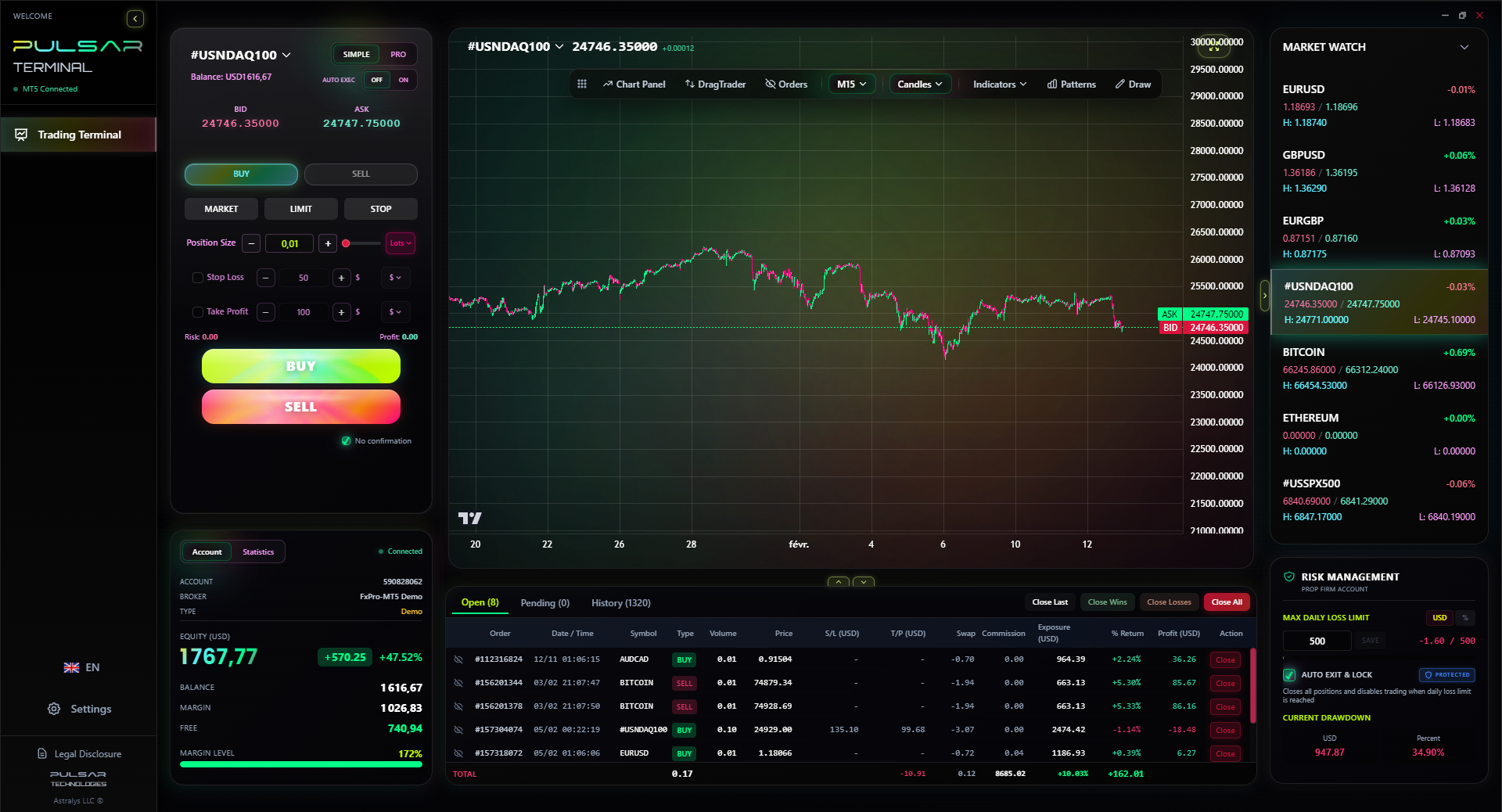
Managing the complex risk of prop firm challenges or multiple trades is a manual nightmare, which is why tools like Pulsar Terminal automate stop-losses, take-profits, and daily loss limits directly on your MT5.
Pulsar Terminal
MT5 올인원 도구: 드래그앤드롭 주문, 다중 TP/SL, 트레일링 스톱, 그리드 트레이딩, 볼륨 프로파일, 프롭펌 보호. 매일 1,000명 이상의 트레이더가 사용.
“The barrier to professional trading from South Africa is no longer access; it's skill and discipline.”
The Rand's 13% surge in 2025 was a reminder: our currency is a wild beast. Trading it requires respect. The long-term trend for South African traders is positive - more access, better technology, and slightly looser controls like the increased SDA.
The market is growing, projected to nearly double by 2033. More young, tech-savvy traders are coming in. This means more competition, but also more innovation in tools and education.
The key takeaway? The infrastructure for being a professional retail trader from South Africa exists. You have legal channels (Sable), reputable international brokers, and powerful software. The barrier is no longer access; it's skill and discipline. The traders who treat it like a business - understanding regulations, controlling costs, managing risk - will be the ones left when the hype-train crowd has blown their accounts and gone home.
Separate the functions in your mind. Sable Forex is your logistics department. Your broker is your trading floor. Your brain and your plan are the CEO. Don't let the departments mix.
FAQ
Q1Can I trade forex directly with Sable International?
No. Absolutely not. Sable International is a money transfer and currency exchange service. They do not provide leveraged trading platforms, charts, or the ability to speculate on forex price movements. You use them to send money to a real broker.
Q2What is the minimum amount I can transfer with Sable Forex?
Their typical minimum transfer amount is R100,000. This highlights their focus on larger, substantive transfers for emigration, investment, or business, not small retail trading top-ups. For smaller amounts, your bank's forex desk or other international payment apps might be more suitable.
Q3Is it legal for South Africans to trade forex with international brokers?
Yes, it is completely legal. You must use your annual exchange control allowances (the R2m Single Discretionary Allowance and the R10m Foreign Investment Allowance) to fund the account through an authorised dealer like a bank or Sable. Trading with an unregulated offshore broker is risky, but using a reputable, regulated international broker is a standard practice.
Q4Why is USD/ZAR so expensive to trade compared to EUR/USD?
Liquidity and the spread. The EUR/USD is the most traded pair globally, with massive liquidity tightening the spread, often below 1 pip. USD/ZAR is an emerging market currency pair with lower liquidity and higher volatility, so banks and brokers widen the spread (often 50-150 pips) to protect themselves. This means you need a much larger price move just to break even.
Q5How much money do I really need to start trading forex in South Africa?
Technically, some brokers let you start with R50. Practically, you need at least R10,000-R20,000 to have a fighting chance. This allows for proper risk management (risking 1% is R100-R200 per trade), withstands the inevitable losses while learning, and isn't immediately wiped out by trading costs. Starting with less teaches bad habits like over-leveraging.
Q6What's more important for a beginner: low spreads or low commission?
For beginners, simplicity and total cost are key. A 'standard' account with a slightly higher spread but no commission is often easier to understand. As your volume increases, an ECN account with a raw spread plus commission becomes cheaper. First, learn to trade profitably on a demo, then analyze your typical trade frequency and size to choose the right account type.
윈스턴 교수의 수업
핵심 요약:
- ✓Sable Forex is a money transfer service, not a trading broker.
- ✓Use your R2m Single Discretionary Allowance (SDA) first for funding.
- ✓Start with at least R10k-R20k capital to learn properly.
- ✓USD/ZAR costs 50-150 pips per trade just to break even.
이 기사가 얼마나 유용했나요?
별을 클릭하여 평가
주간 트레이딩 인사이트
무료 주간 분석 & 전략. 스팸 없음.
저자 소개
David van der Merwe
신흥시장 트레이더
요하네스버그 기반 트레이더로 신흥시장 통화 11년 경력. ZAR 통화쌍, FSCA 규제 거래, 남아공 시장 분석 전문.
댓글
위험 고지
금융 상품 거래에는 상당한 위험이 수반되며 모든 투자자에게 적합하지 않을 수 있습니다. 과거 성과가 미래 수익을 보장하지 않습니다. 이 콘텐츠는 교육 목적으로만 제공되며 투자 조언으로 간주되어서는 안 됩니다. 거래 전에 항상 직접 조사를 수행하십시오.
이 기사도 읽어보세요

Cara Trading Forex Sukses: 7 Prinsip dari Trader Profesional
Cara trading forex sukses dengan 7 prinsip trader pro: manajemen modal, disiplin, journal trading, backtest. Data nyata, bukan janji profit palsu.
Jam Trading Forex Terbaik untuk Trader Indonesia: Panduan Lengkap dengan Tabel Waktu
Panduan jam trading forex untuk trader Indonesia. Tabel 4 sesi dunia, jam emas 20:00-00:00, sesi mana yang harus dihindari. Data akurat + tips dari trader berpengalaman.
Top 5 Sàn Forex Uy Tín Nhất 2026: Review Jujur dari Trader Indonesia
Top 5 sàn forex uy tín 2026 untuk trader Indonesia. Review jujur: spread, deposit, withdraw, dukungan lokal. Exness, XM, IC Markets & lebih.
