


Here's a number that should keep you up at night: 82% of retail forex traders lose money.

Olumide Adeyemi
서아프리카 트레이딩 선구자 ·  Nigeria
☕ 10 분 소요
배울 내용:
Here's a number that should keep you up at night: 82% of retail forex traders lose money. In Nigeria, with our unique economic pressures and the recent regulatory earthquake of the ISA 2025, that failure rate might be even higher for the unprepared. Everyone's looking for a magical indicator or a guru's signal. I'm here to tell you the secret of forex trading success has nothing to do with predicting the market. It's about not letting the market predict your bankruptcy. After 12 years and blowing up my first two accounts, I learned this the hard way. Success isn't found on the chart; it's built in your broker choice, your tax calculations, and the cold, hard math of risk management before you ever place a trade.
If you're trading with an unregistered platform in Nigeria right now, you're not just taking a market risk. You're breaking the law. The Investments and Securities Act (ISA) 2025 changed everything. It's now illegal for any entity to run an online forex platform here without SEC registration. This isn't bureaucracy; it's your first layer of protection. I've seen too many guys get excited about "too good to be true" bonuses, only to find they can't withdraw their profits because the "broker" was a shell company in a cybercafé.
The CBN's new Nigerian FX Code and the consolidated NFEM guidelines are pushing for transparency. For you, the trader, this means the wild west days are over. Your broker choice is your most important trade. You need a platform that not only accepts Nigerians but does so with a clear regulatory framework you can verify. This isn't optional homework. It's the foundation.

Warning: Trading with an unregistered platform post-ISA 2025 means you have zero legal recourse if your funds vanish. The SEC will not help you. That "customer support" number will go dead.
So, who can you use? Many top international brokers operate here under their home regulations. You'll see brokers like Exness (regulated by FSCA, CySEC) and IC Markets (ASIC) commonly used. The key is to go directly to the regulator's website (like the FSCA or CySEC) and verify the license number the broker gives you. Don't just trust the logo on their homepage.

💡 윈스턴의 팁
Your first profit target should always be to recover your spread and commission. Only then does the trade work for you.
You can be wrong about the direction of EUR/USD and still make money over time. How? Position sizing. This is where 90% of Nigerian traders blow up. They see a $100 account, dream of turning it into $10,000, and risk $50 on a single trade. One loss cuts them in half. The psychology is destroyed, and they revenge trade the rest away.
Let me give you a real, painful example from my early days. In 2015, I had a $500 account. I was convinced GBP/USD was going to rally. I used a crappy internet connection, didn't check the economic calendar, and went all in. I didn't have a stop loss because I was "sure." A surprise BoE statement came out, the pair dropped 120 pips in minutes, and I got a margin call. Account balance: $12.74. I lost 97% of my capital in one arrogant trade.
The secret is to risk a tiny, consistent percentage of your account per trade. Not a fixed dollar amount. If your account grows, your risk grows proportionally. If it shrinks, you risk less, preserving capital. Most pros risk between 0.5% and 2% per trade. Let's do the math.
The 1% Rule in Action
If you have a ₦500,000 account ($330 approx.), risking 1% means you can lose ₦5,000 per trade. You use your stop loss to determine your position size. If your stop loss is 20 pips away on USD/NGN, and each pip is worth ₦250 for a standard lot, you'd need to calculate a smaller position so that 20 pips * [pip value] = ₦5,000. This is non-negotiable. Use a position size calculator every single time. It removes emotion.

Example:
- Account: $1,000
- Risk per Trade: 1% = $10
- Trade: Buy EUR/USD at 1.0850
- Stop Loss: 1.0820 (30 pips risk)
- Pip Value Needed: $10 / 30 pips = $0.333 per pip
- To get $0.333 per pip on EUR/USD, you'd trade a micro lot (0.03 lots).
- Your potential loss is capped at $10, no matter what.
“The moment you trade to pay next month's rent, you've lost. Fear and greed become your chart indicators.”
You think the market is your opponent? Often, it's your own trading costs. For Nigerian traders, this comes in three forms: spreads, commissions, and taxes. Ignore them, and they'll eat your profits like termites.
Spreads & Commissions: This is your direct cost of doing business. You buy at the Ask and sell at the Bid. That difference is the spread, and you start the trade in a hole. On major pairs like EUR/USD, competitive brokers offer spreads from 0.6 pips on standard accounts down to 0.0 pips on raw ECN accounts (but then you pay a commission). For a scalping strategy, these tiny differences are everything. A broker with a 3-pip spread on EUR/USD means you need the market to move 3 pips just to break even. That's a huge handicap.
The 10% Tax Reality: This is the one many forget. The FIRS wants 10% of your gross trading profits as Capital Gains Tax. You must factor this into your profit targets. If you aim for a 10% return, remember that 1% of that goes to the government. You need to keep careful records of all your trades - entry, exit, profit/loss. I learned this the hard way after a good quarter; my accountant asked for the records, and I had to spend days reconstructing them from broker statements.
Here’s a comparison of typical costs at brokers popular in Nigeria:
| Broker | Avg. EUR/USD Spread | Min. Deposit | Key Regulation for NG Clients |
|---|---|---|---|
| Exness | 0.1 - 0.2 pips (Raw) | $10 | FSCA, CySEC |
| XM | From 0.8 pips | $5 | CySEC, ASIC |
| OctaFX | From 0.7 pips | $25 (₦30k) | FSCA |
| IC Markets | 0.0 - 0.2 pips + commission | $200 | ASIC |
| Pepperstone | Low spreads + commission | $0 | FCA, ASIC |
Your choice here directly impacts your edge. A tight-spread broker like IC Markets or Pepperstone is crucial for high-frequency styles. For a beginner or swing trader, a commission-free account from XM might be simpler.
💡 윈스턴의 팁
If you can't state your exact entry, stop loss, and take profit before clicking 'buy,' you're not trading. You're gambling.
We face unique pressures. Inflation is high, the Naira is volatile, and there's immense social pressure to "make it fast." This creates a toxic mindset for trading. Trading is not a get-rich-quick scheme; it's a get-slowly-consistent profession. The moment you trade to pay next month's rent, you've lost. Fear and greed become your chart indicators.
I remember trading USD/NGN during a period of intense volatility. I was up ₦150,000 on a swing trade. Greed told me to hold for "just a little more." Fear of missing out on even bigger profits overruled my plan. The CBN intervened, the pair reversed violently, and I watched my profit turn into a ₦40,000 loss before I finally exited. I broke every rule: I moved my stop loss, ignored my profit target, and let emotion drive. That loss wasn't about analysis; it was about psychology.
The secret here is ritual and routine. Have a pre-market checklist. Define your trade before you enter: entry, stop loss, take profit. Write it down. Once the trade is on, you are a robot executing a plan. Your job is not to predict, but to manage. Use tools that enforce discipline. If you struggle with moving stops, use a platform feature that locks it in. The market will test your patience daily. Your system is your anchor.
“Your success secret is built in the boring, careful, daily grind of risk management and self-honesty.”
The secret of forex trading success is that there is no secret setup. There is only a strong, repeatable system. A system has three parts: 1) A clear signal to enter, 2) A defined risk point (stop loss), and 3) A defined profit target. It must work across all market conditions - trending, ranging, volatile.
Most Nigerians jump from YouTube strategy to WhatsApp signal without backtesting. Backtesting is simply checking how your rules would have performed in the past. You don't need fancy software. Take a strategy like using the RSI indicator for overbought/oversold levels with price action confirmation. Go back on your chart for six months. Mark every time your conditions were met. Did you make money? How often did you win (win rate)? How much did you make on winning trades vs. losing trades (risk/reward ratio)?
Let's say you test 100 trades. You win 40 times (40% win rate). But your average winner is ₦8,000, and your average loser is ₦3,000. Your risk/reward is about 1:2.7. That's a profitable system, even with more losses than wins. The math: (40 wins * ₦8,000) - (60 losses * ₦3,000) = ₦320,000 - ₦180,000 = ₦140,000 profit. That's the power of risk/reward.
Your system could be based on the MACD indicator crossover, support/resistance, or news events. It doesn't matter. What matters is that you know its statistical edge and you follow it without deviation. This turns trading from gambling into a probabilistic business.

Pro Tip: Your profit target should be at least 1.5 times your stop loss distance (a 1:1.5 risk/reward ratio) to be sustainable. If you need a 20-pip stop, aim for a 30-pip take profit. This means you can be wrong more often than you're right and still break even or profit.
💡 윈스턴의 팁
Review your trading journal every Sunday. Look for patterns in your losing trades. That's where the real education is.
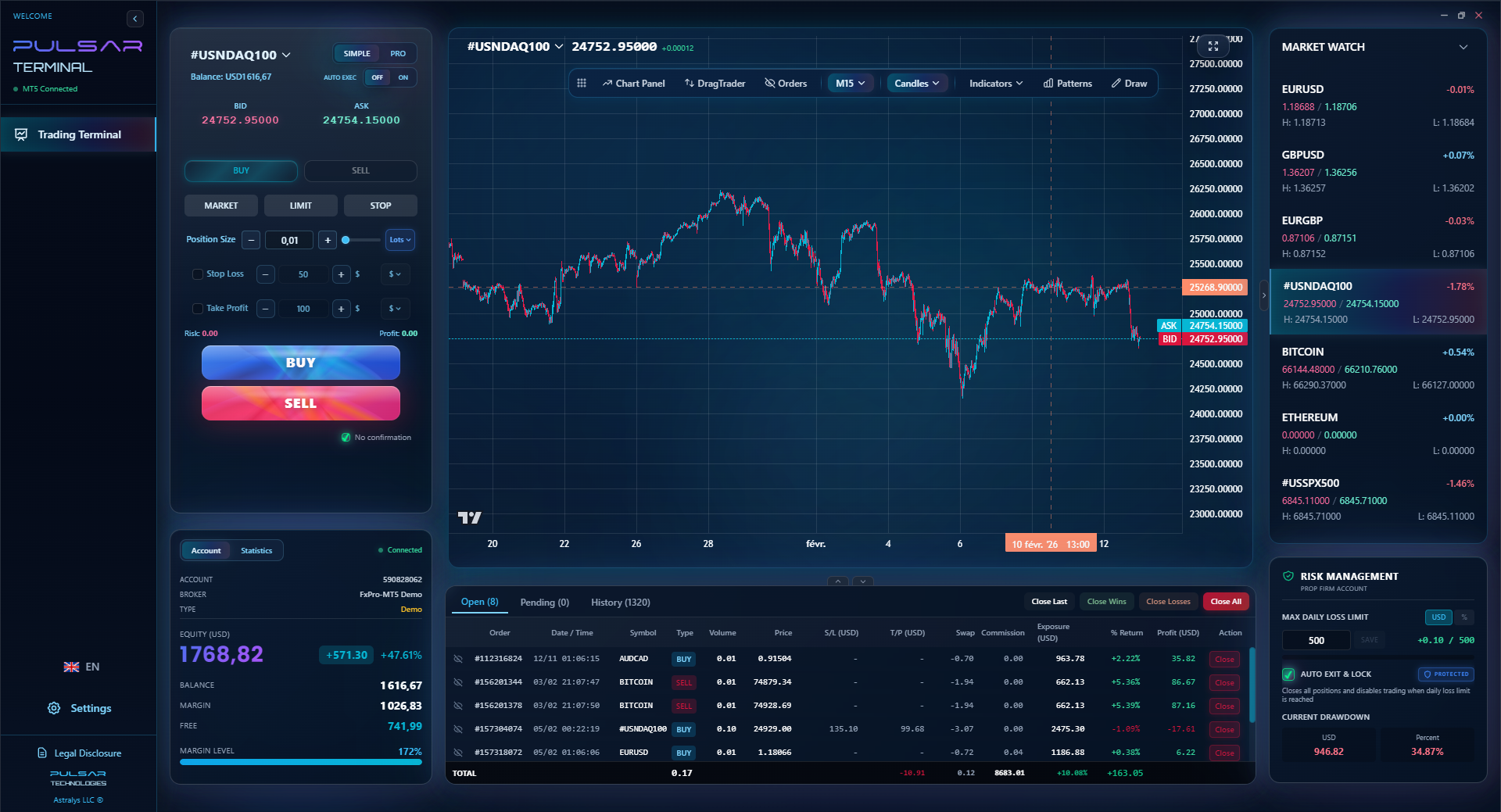
A robust trading system requires precise execution, which is where tools like Pulsar Terminal excel by letting you set multi-level take profits and stop losses with a single drag-and-drop on your MT5 chart.
Pulsar Terminal
MT5 올인원 도구: 드래그앤드롭 주문, 다중 TP/SL, 트레일링 스톱, 그리드 트레이딩, 볼륨 프로파일, 프롭펌 보호. 매일 1,000명 이상의 트레이더가 사용.
So, what's the first step? It's brutally simple and unsexy.
- Get Legal & Secure: Choose a reputable, regulated broker that supports Naira deposits/withdrawals. Verify their license. This is day zero.
- Start Small, Think Big: That recommended $500-$1000 starting capital exists for a reason. With ₦500,000, you can properly implement the 1% risk rule. Starting with ₦50,000 forces you into reckless risk-taking just to see meaningful gains. Fund your account with money you can afford to lose completely.
- Learn to Lose Correctly: Open a demo account. Practice your system. Then, open a live account with the minimum deposit. Your sole goal for the first 50 trades is not profit. It's to execute your plan perfectly - entering, setting stops, taking profits - regardless of outcome. You are training discipline.
- Keep a Journal: Every trade. Entry, exit, reason, emotion, screenshot. Review it weekly. Your journal will tell you more about the secret of forex trading success than any guru ever will. It shows you your own repetitive mistakes.
The market doesn't care about your dreams, your bills, or your analysis. It's a machine that transfers money from the impatient, undisciplined, and unprepared to the patient, disciplined, and systematic. In Nigeria, with our specific challenges and opportunities, that principle is magnified. Your success secret isn't hidden in a chart pattern. It's built in the boring, careful, daily grind of risk management and self-honesty. Start building that today.
FAQ
Q1Is forex trading legal in Nigeria?
Yes, forex trading is legal. However, the new Investments and Securities Act (ISA) 2025 makes it illegal for platforms to operate without SEC registration. As a trader, you must use a registered entity or a reputable international broker regulated abroad (like by the FSCA, CySEC, or ASIC) to stay on the right side of the law and protect your funds.
Q2What is a realistic starting capital for a Nigerian forex trader?
While some brokers allow deposits as low as $1 or ₦5,000, a realistic starting capital for effective risk management is between $500 and $1000 (roughly ₦750,000 - ₦1.5 million). Starting with too little (e.g., ₦50,000) often leads to over-leveraging and blowing the account, as proper position sizing becomes impossible.
Q3How much tax do I pay on forex profits in Nigeria?
You are required to pay a 10% Capital Gains Tax on your gross forex trading profits to the Federal Inland Revenue Service (FIRS). You must keep detailed records of all your trades for accurate tax calculation and filing.
Q4What's more important, a high win rate or good risk/reward?
Good risk/reward is far more important. You can have a 40% win rate and be highly profitable if your average winning trade is 2.5 times larger than your average losing trade. Conversely, a 70% win rate can destroy your account if your losses are much bigger than your wins. Focus on the risk/reward math.
Q5Should I trade USD/NGN or major pairs like EUR/USD?
Major pairs like EUR/USD typically have much tighter spreads, more liquidity, and clearer technical patterns, making them better for beginners. USD/NGN can have unpredictable volatility due to local CBN interventions and wider spreads. Start with majors to learn the global market mechanics first.
Q6How do I choose a safe forex broker in Nigeria?
- Verify it is registered with the SEC (post-ISA 2025) or holds a top-tier international license (FCA, ASIC, CySEC, FSCA). 2) Check for reasonable minimum deposits and spreads. 3) Ensure it supports convenient Naira deposit/withdrawal methods. 4) Read independent reviews from trusted sources. Never trust a broker that promises guaranteed profits.
Q7What is the single biggest mistake Nigerian traders make?
Trading with money they cannot afford to lose, leading to emotional decisions. This combines with a lack of a written trading plan and no understanding of position sizing. They risk far too much per trade trying to turn a small account into life-changing money quickly, which almost always leads to rapid account failure.
윈스턴 교수의 수업
핵심 요약:
- ✓Risk a maximum of 1-2% of your account on any single trade.
- ✓Always verify your broker's license with the regulator directly.
- ✓Factor the 10% Capital Gains Tax into your profit targets.
- ✓A 1:1.5 risk/reward ratio is the minimum for a sustainable edge.
이 기사가 얼마나 유용했나요?
별을 클릭하여 평가
주간 트레이딩 인사이트
무료 주간 분석 & 전략. 스팸 없음.
저자 소개
Olumide Adeyemi
서아프리카 트레이딩 선구자
나이지리아에서 가장 활발한 외환 트레이딩 교육자 중 한 명. 라고스에서 8년간 트레이딩 경험. 아프리카 트레이더를 위한 소자본 전략과 프롭 펌 챌린지 전문.
댓글
위험 고지
금융 상품 거래에는 상당한 위험이 수반되며 모든 투자자에게 적합하지 않을 수 있습니다. 과거 성과가 미래 수익을 보장하지 않습니다. 이 콘텐츠는 교육 목적으로만 제공되며 투자 조언으로 간주되어서는 안 됩니다. 거래 전에 항상 직접 조사를 수행하십시오.
이 기사도 읽어보세요

Cara Trading Forex Sukses: 7 Prinsip dari Trader Profesional
Cara trading forex sukses dengan 7 prinsip trader pro: manajemen modal, disiplin, journal trading, backtest. Data nyata, bukan janji profit palsu.
Jam Trading Forex Terbaik untuk Trader Indonesia: Panduan Lengkap dengan Tabel Waktu
Panduan jam trading forex untuk trader Indonesia. Tabel 4 sesi dunia, jam emas 20:00-00:00, sesi mana yang harus dihindari. Data akurat + tips dari trader berpengalaman.
Top 5 Sàn Forex Uy Tín Nhất 2026: Review Jujur dari Trader Indonesia
Top 5 sàn forex uy tín 2026 untuk trader Indonesia. Review jujur: spread, deposit, withdraw, dukungan lokal. Exness, XM, IC Markets & lebih.
