


I lost R1,200 in a single night back in 2018 trying to trade USD/ZAR at 2 AM SAST.

David van der Merwe
신흥시장 트레이더 ·  South Africa
☕ 10 분 소요
배울 내용:
I lost R1,200 in a single night back in 2018 trying to trade USD/ZAR at 2 AM SAST. The spread was so wide it ate my stop-loss before the market even twitched. That painful lesson taught me that in forex, timing isn't just everything, it's the only thing that matters for us trading from South Africa. Knowing when the big players are awake and moving money is the difference between catching a proper trend and just watching your capital bleed out on a flat chart. Let's break down the real-world clock you need to follow.
You might think a 24-hour market means you can trade whenever you feel like it. I thought that too. The reality is, the forex market has a heartbeat, and if you're trading when it's sleeping, you're fighting a losing battle.
The two things that kill you in quiet times are widening spreads and false breakouts. Your broker's spread on EUR/USD might be 0.8 pips at 3 PM, but I've seen it balloon to 3 or 4 pips at 4 AM SAST. That means the price has to move significantly just for you to break even. It's like starting a 100m race 10 meters behind everyone else.
Then there's liquidity, or the lack of it. When London and New York are closed, there's just not enough money moving around. A single medium-sized order can cause a spike that looks like a breakout, only for the price to snap back instantly once real trading resumes. I've been whipsawed out of more trades in the Asian session than I care to admit.

Warning: Trading major pairs like EUR/USD during the dead Asian session (2 AM - 8 AM SAST) is often a recipe for frustration. The low volatility and wide spreads make consistent profits very difficult for most strategies, especially scalping.
The good news? South Africa's time zone (SAST, GMT+2) is actually brilliant for forex. We get to catch the tail end of Asia, the full London session, and the juicy overlap with New York, all at reasonable local hours. You don't need to be a night owl to trade well.

💡 윈스턴의 팁
The market pays you for being patient, not for being busy. If the chart between 2 AM and 8 AM SAST looks like a flat EKG, that's the market telling you to go back to sleep. Conserve your energy and capital for the London bell.
“South Africa's time zone is a secret weapon for forex traders.”
Forget New York or London time. You need to internalise this schedule in SAST. This is your trading bible.
The Tokyo/Sydney Session (2:00 AM - 8:00 AM SAST)
This is the quiet opener. It's not useless, but it's niche. The action is mostly in the Asian pairs: AUD/USD, NZD/USD, and USD/JPY. Volatility is generally low. I sometimes use this time to analyse charts and plan my day, but I rarely place trades unless I see a very clear setup on the USD/JPY guide. It's a good time for longer-term swing trading analysis.
The London Session Kick-Off (10:00 AM SAST)
This is when the game truly starts. The London session is the largest FX market in the world. Liquidity pours in, spreads tighten, and trends begin. From 10 AM SAST, all the EUR and GBP pairs come alive. If you have a day job, your lunch break suddenly becomes very interesting.
The Golden Overlap: London & New York (3:00 PM - 7:00 PM SAST)
This is the holy grail. For four glorious hours, the two biggest financial centres are open together. This is when you get the highest volume, strongest trends, and cleanest moves. Over 70% of the day's meaningful action can happen here. I've made most of my consistent profits in this window. It's perfect for all strategies.

Pro Tip: Set a phone alert for 2:55 PM SAST. Be at your desk, charts ready, for the 3 PM surge. The first 30 minutes of the overlap can be explosive.
The New York Solo Session (7:00 PM - 11:00 PM SAST)
After London closes, volatility starts to fade, but the New York afternoon can still offer good opportunities, especially around US economic data releases. By 11 PM SAST, it's all over. The market goes into a lull until Asia wakes up. This is your time to close screens, review trades, and sleep.
“Trading the ZAR requires you to follow the JSE's sun, not just the forex market's clock.”
Trading our own currency is a different beast. The rules change because USD/ZAR and EUR/ZAR have their own unique rhythm tied to local and global events.
The most important time for ZAR pairs is 9:00 AM to 5:00 PM SAST. Why? Because that's when the JSE is open and local banks, corporates, and institutional players are actively hedging and moving money. The liquidity is deepest then. I once tried to close a large USD/ZAR position at 8 PM, and the slippage was horrific because the local market had gone home.
Key times to watch:
- 10:00 AM SAST: Often a key turning point as local and European flows merge.
- 3:00 PM SAST: The London/New York overlap hits, and if there's a global risk-on or risk-off move, ZAR will feel it.
- Local Data Releases: Times for SA CPI, SARB interest rate decisions, or budget speeches are non-negotiable. The volatility can be insane. I got stopped out of a trade in 30 seconds during a SARB announcement once. Now I either flat-out avoid these times or use ultra-wide stops.
A crucial local rule: South African residents can't speculate directly against the Rand with an online broker. You trade ZAR pairs as CFDs. For actual currency conversion (using your R1 million discretionary allowance), you need to go through a bank or authorised dealer. Don't get this confused.
ZAR pairs are famously volatile. A 200-pip move in a day is not unusual. This is where proper position size calculator use is critical. A standard lot on USD/ZAR where a pip is worth about R7? One wrong move can ruin your week.
“Trading the ZAR requires you to follow the JSE's sun, not just the forex market's clock.”
Not all weekdays are created equal. Your strategy should adapt.
| Day | Character | Advice for SA Traders |
|---|---|---|
| Monday | Often range-bound, hesitant. The market is waking up from the weekend. | Good for setting up trades, less for execution. I avoid big directional bets early Monday. |
| Tuesday & Wednesday | Peak activity. Volatility and volume ramp up. Economic data flows. | These are your prime trading days. Be fully engaged, especially during the 3-7 PM overlap. |
| Thursday | Still very active, but you might see some profit-taking ahead of Friday. | Another strong day. Often the last clear day for swing trading entries you want to hold. |
| Friday | Can be unpredictable. Volatile early, then dead after 5 PM SAST as NY closes. | Be cautious after 3 PM SAST. I never hold speculative positions over the weekend unless it's a core long-term view. The gap risk on a Sunday open isn't worth it. |
Friday afternoons are a particular trap. I learned this the hard way holding a GBP/USD trade into the Friday close. A geopolitical headline hit over the weekend, and it gapped 80 pips against me on Sunday open. That was an expensive lesson in weekend risk. Now, I'm usually in cash by Friday evening.

Example: If you risk 1% per trade, a 80-pip gap against you could mean an 8% loss on that single position if your stop gets skipped. That's a major blow to your account that no margin call warning can save you from.
💡 윈스턴의 팁
Your first job at 3 PM SAST isn't to trade, it's to watch. Let the initial volatility spike settle. The first 5-minute candle after the overlap is often emotional noise. The real trend reveals itself in the next 15.
“The 3 PM to 7 PM SAST overlap isn't just a good time to trade; it's the only time you need to be great.”
You don't have to stare at a clock. Use tools to see the market's pulse.
First, get a Forex Market Hours indicator on your MT4/MT5. It visually shades the different sessions on your chart. It's a constant reminder of where we are in the day. Many are free.
Second, watch the Average True Range (ATR) indicator. This shows the average pip movement over a set period. When the ATR value is rising during the London session, you know volatility is picking up. When it's flat during the Asian session, it confirms the quiet. I set my stop-loss distances based on the current ATR, not a fixed pip number.
Third, an Economic Calendar is non-negotiable. I use one that filters for high-impact events. You must know when the US Non-Farm Payrolls (3:30 PM SAST) or the SA CPI data is due. Trading blindly into these events is gambling. I got lucky once, but I've been burned more often.
Finally, consider your broker's platform. Some, like IC Markets or Pepperstone, have excellent built-in market analytics tabs that show real-time volatility and volume metrics. This data helps you confirm whether the market is truly 'awake' or just twitching.
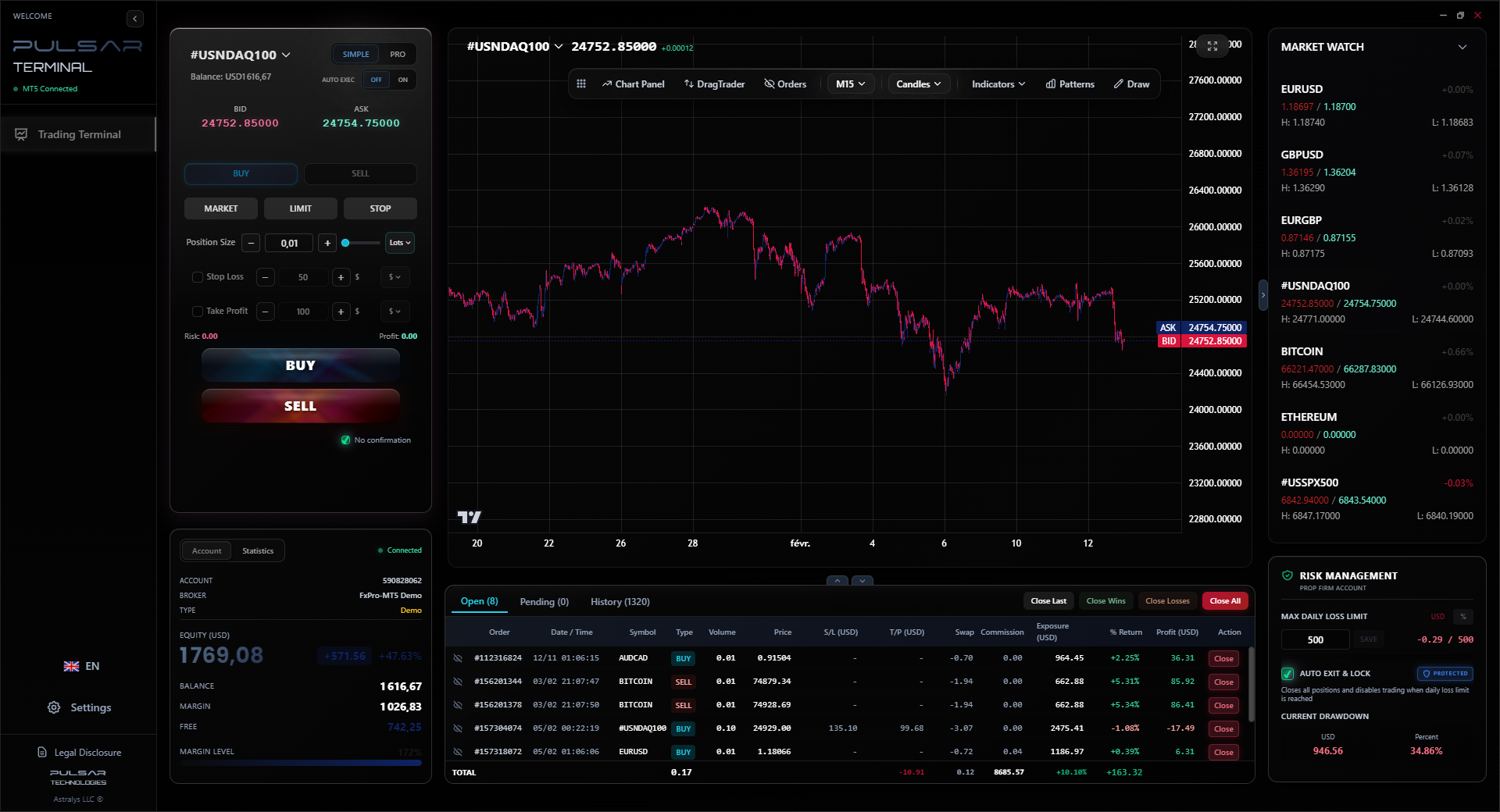
Managing multiple trades across the volatile London/New York overlap is easier with tools that automate order placement and risk management directly on your MT5 charts.
Pulsar Terminal
MT5 올인원 도구: 드래그앤드롭 주문, 다중 TP/SL, 트레일링 스톱, 그리드 트레이딩, 볼륨 프로파일, 프롭펌 보호. 매일 1,000명 이상의 트레이더가 사용.
“The 3 PM to 7 PM SAST overlap isn't just a good time to trade; it's the only time you need to be great.”
Your broker choice directly impacts your ability to trade these optimal times effectively.
The number one thing is FSCA regulation. It's your safety net. Brokers like Exness (FSCA licensed) or XM are required to segregate client funds and adhere to the 30:1 use cap. That cap might feel limiting, but it protects you from yourself. I've seen too many guys blow accounts with 500:1.
Look for ZAR-denominated accounts. This lets you deposit and withdraw in Rands without hidden conversion fees eating into your profits. It simplifies your accounting for SARS, too. Brokers like Khwezi Trade or IFX Brokers offer this locally.
Check their spreads during key times. A broker might advertise '0.1 pip spreads', but that's often during London hours. What does the spread look like on USD/ZAR at 6 AM SAST? Email their support and ask. A wide spread during your preferred trading window is a silent profit killer.
Finally, execution speed and slippage. During the volatile 3 PM overlap, you want a broker with fast execution. I've had orders with slower brokers get filled 2-3 pips away from my requested price in fast markets. That adds up. Read reviews focusing on order execution during news events.
“Wide spreads in the dead of night aren't a broker trick; they're a warning sign to stay away.”
Here's what a structured trading day could look like for a South African part-time trader (like I was for years):
- 6:30 AM - 7:30 AM SAST: Wake up, scan the markets. Check what happened in the US late session and Asia early session. Did any major levels break? I update my swing trading watchlist. No trades yet.
- 9:55 AM SAST: Get ready for London open. Check the economic calendar. Set alerts on key levels.
- 10:00 AM - 12:00 PM SAST: London session is live. Look for initial directional moves. This is when I might take my first trade of the day if a setup is clear.
- 12:00 PM - 2:30 PM SAST: Monitor, manage open positions. Maybe take a lunch break trade if something sets up.
- 2:45 PM SAST: Final prep. Be at your desk. Clear distractions.
- 3:00 PM - 7:00 PM SAST (GOLDEN HOURS): Fully focused trading. This is when I am most active, looking for breakouts, retracements, and news plays. I might use the MACD indicator or RSI indicator here for confluence.
- 7:00 PM SAST: Start winding down. Close any scalp positions. Review the day's trades in a journal. Plan for tomorrow.
This routine aligns your effort with the market's energy. You're not wasting 8 hours staring at a dead chart. You're putting in 3-4 hours of high-focus, high-probability work. That's sustainable and effective.
💡 윈스턴의 팁
Friday afternoon is for closing trades and reviewing your journal, not for heroics. A trade you 'just have to take' at 4 PM on a Friday has a higher probability of ruining your weekend than making it.
FAQ
Q1What is the single best hour to trade forex from South Africa?
Hands down, 3:00 PM to 4:00 PM SAST. This is the first hour of the London/New York overlap. Volume spikes, volatility increases, and you get the clearest directional moves of the day. It's when the big institutional orders hit the market.
Q2Can I trade successfully only in the evenings after work?
Yes, absolutely. The 5:00 PM to 7:00 PM SAST window (still part of the overlap) is still highly active. You'll miss the initial 3 PM surge, but there are plenty of opportunities as New York traders react to the afternoon's moves. It's a great time for shorter-term trades.
Q3Is it safe to leave trades open over the weekend?
I strongly advise against it for speculative trades. The market closes Friday night and reopens Sunday night. Any geopolitical news, economic data, or central bank comments over the weekend can cause a 'gap' – where the price opens significantly higher or lower. This can blow straight through your stop-loss, causing a much larger loss than you planned. I only hold over weekends for long-term, fundamental positions with a very wide risk buffer.
Q4Why does my broker's spread get so wide sometimes?
Spreads widen when liquidity is low (like during the Asian session or Friday evening SAST) or just before/after major news events. Brokers widen spreads to protect themselves from the increased risk of rapid price movement and low liquidity. That's why trading during high-liquidity periods (London session) usually gets you the tightest spreads.
Q5What's the biggest mistake SA traders make with timing?
Trying to trade the Rand pairs (USD/ZAR) outside of South African business hours (9 AM - 5 PM SAST). The liquidity dries up massively, leading to huge spreads and erratic, thin price action. You'll get terrible fills and increased slippage. Trade ZAR when the local market is awake.
Q6Does daylight saving time affect trading times?
Yes, but only for other countries. South Africa doesn't observe daylight saving. When the UK and US switch their clocks, our session times shift by an hour relative to SAST. For example, the London/New York overlap becomes 2:00 PM - 6:00 PM SAST during their summer (our winter). Always double-check a world clock around March and November.
윈스턴 교수의 수업
핵심 요약:
- ✓Trade major pairs from 10 AM SAST, focus on the 3-7 PM golden overlap.
- ✓Only trade USD/ZAR during SA business hours (9 AM-5 PM SAST).
- ✓Avoid holding speculative positions over the weekend.
- ✓Wednesday & Thursday offer the cleanest, highest-volume trends.
- ✓Use the Asian session (2-8 AM SAST) for analysis, not action.
이 기사가 얼마나 유용했나요?
별을 클릭하여 평가
주간 트레이딩 인사이트
무료 주간 분석 & 전략. 스팸 없음.
저자 소개
David van der Merwe
신흥시장 트레이더
요하네스버그 기반 트레이더로 신흥시장 통화 11년 경력. ZAR 통화쌍, FSCA 규제 거래, 남아공 시장 분석 전문.
댓글
위험 고지
금융 상품 거래에는 상당한 위험이 수반되며 모든 투자자에게 적합하지 않을 수 있습니다. 과거 성과가 미래 수익을 보장하지 않습니다. 이 콘텐츠는 교육 목적으로만 제공되며 투자 조언으로 간주되어서는 안 됩니다. 거래 전에 항상 직접 조사를 수행하십시오.
이 기사도 읽어보세요

Cara Trading Forex Sukses: 7 Prinsip dari Trader Profesional
Cara trading forex sukses dengan 7 prinsip trader pro: manajemen modal, disiplin, journal trading, backtest. Data nyata, bukan janji profit palsu.
Jam Trading Forex Terbaik untuk Trader Indonesia: Panduan Lengkap dengan Tabel Waktu
Panduan jam trading forex untuk trader Indonesia. Tabel 4 sesi dunia, jam emas 20:00-00:00, sesi mana yang harus dihindari. Data akurat + tips dari trader berpengalaman.
Top 5 Sàn Forex Uy Tín Nhất 2026: Review Jujur dari Trader Indonesia
Top 5 sàn forex uy tín 2026 untuk trader Indonesia. Review jujur: spread, deposit, withdraw, dukungan lokal. Exness, XM, IC Markets & lebih.
