


I lost $450 in under an hour trading EUR/USD during the Tokyo session.

Olumide Adeyemi
서아프리카 트레이딩 선구자 ·  Nigeria
☕ 11 분 소요
배울 내용:
- 1What Exactly Is the Tokyo Session?
- 2The Best Forex Pairs to Trade (And the Worst)
- 3Proven Setups for the Tokyo Session
- 4Risk Management for the Nigerian Trader
- 5Brokers & Execution: Getting a Fair Deal in Nigeria
- 6The Asian Economic Calendar: Your Secret Weapon
- 7Three Deadly Mistakes to Avoid
- 8Putting It All Together: A Sample Trading Plan

I lost $450 in under an hour trading EUR/USD during the Tokyo session. The chart looked dead, spreads widened to 3 pips out of nowhere, and my 'sure thing' breakout just evaporated into thin air. That was the day I learned you can't trade London or New York pairs when Asia is in charge. The Tokyo session has its own rhythm, its own liquidity providers, and most importantly, its own set of profitable forex pairs. If you're trading from Lagos or Port Harcourt and trying to catch moves before your day job starts, you need to know which instruments actually work when the sun rises over Japan.
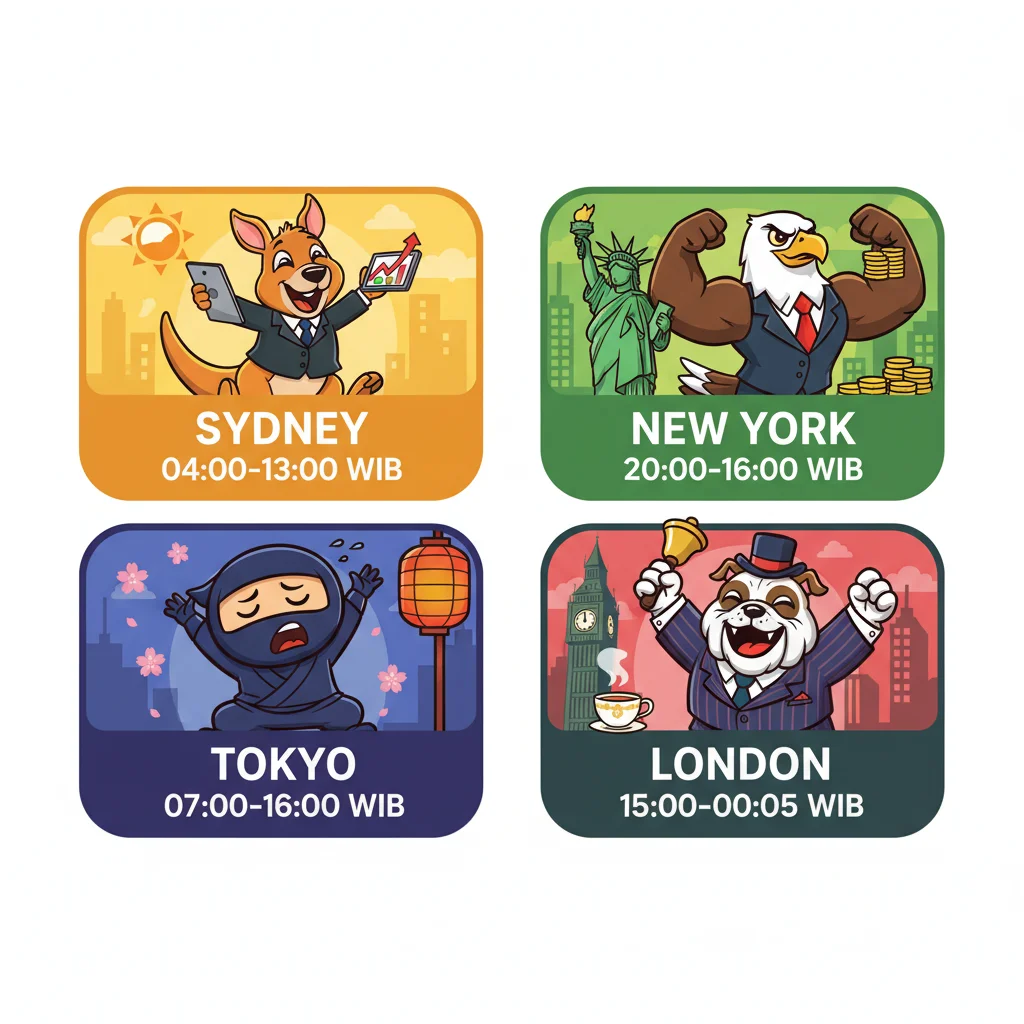
Forget the textbook definition. In practical terms, the Tokyo session is when the major Japanese banks and financial institutions are open for business. It runs from 12:00 AM to 9:00 AM Nigerian time (WAT), which corresponds to 8:00 AM to 5:00 PM in Japan (JST).
This is the Asian liquidity engine. While London and New York are asleep, Tokyo (along with Singapore and Hong Kong) provides the market's pulse. The volume isn't as monstrous as the London-New York overlap, but it's more focused. You get cleaner, more technical moves on specific currency pairs, before the European and American 'noise' comes in.

Warning: Many Nigerian brokers show the session as 'Asian Session' on their platforms. Don't be fooled. The real price action kicks off when Tokyo opens, not Sydney. Sydney opens earlier (around 10 PM WAT), but it's a warm-up act with much thinner liquidity.
The key here is understanding who's trading. It's not hedge funds making billion-dollar bets. It's Japanese institutional money, export companies hedging Yen exposure, and retail traders across Asia. This creates predictable patterns, especially in Yen crosses, which we'll get to.
This is the core of it. Your pair selection will make or break your Tokyo session trading. I group them into three tiers.
Tier 1: The Japanese Yen (JPY) Crosses
These are the stars of the show. When Tokyo is open, you have direct access to the liquidity pools for the Japanese Yen. The spreads are tightest, and the moves are most logical during this window.
- USD/JPY: The king of the session. You'll see consistent 30-50 pip ranges. It reacts sharply to Japanese economic data released at 12:30 AM or 1:30 AM WAT.
- EUR/JPY & GBP/JPY: The volatile cousins. These pairs have wider spreads (2-4 pips is normal) but offer bigger swings. They're fantastic for swing trading setups that develop over the Asian session. A word of caution: they can gap like crazy if London opens with a different sentiment.
- AUD/JPY & NZD/JPY: The 'risk sentiment' gauges. These are heavily influenced by Asian stock markets (like the Nikkei) and Chinese economic news. If Asian equities are up, these pairs tend to rally.
Tier 2: The AUD & NZD Pairs
Australia and New Zealand are in the same time zone. Their data hits during the session.
- AUD/USD: A solid choice. Australian employment or inflation data at 2:30 AM WAT can trigger 40+ pip moves. It has good liquidity from both Asian and early European participants.
- NZD/USD: Similar profile to the Aussie, but slightly less liquid. Can be good for a quieter, more range-bound approach.
Tier 3: What to Avoid
- EUR/USD & GBP/USD: These are European pairs. During the Tokyo session, they often enter a consolidation 'coma' with painfully low volatility and random, whippy 10-pip ranges. It's a great way to get chopped up. Save them for London.
- Exotics: Avoid anything like USD/TRY or USD/ZAR during Tokyo. The spreads will be astronomical, and there's zero liquidity. I learned this the hard way trying to get cute with USD/SEK at 3 AM.

Example: Let's say USD/JPY is trading at 151.50. A good Tokyo session range might be 151.30 to 151.80. Buying at support and selling at resistance within that 50-pip band is a classic play. Trying the same with EUR/USD might give you a pathetic 15-pip range that doesn't even cover the spread.

💡 윈스턴의 팁
The market's personality changes with the clock. Tokyo is a librarian: quiet, precise, and logical. Don't shout at it like it's a New York pit trader.
“The Tokyo session has its own rhythm, its own liquidity providers, and its own set of profitable forex pairs.”
You can't just use your London breakout strategy here. The market mechanics are different. These are the two setups I've had consistent success with.
The Asian Range Fade
This is my bread and butter. Tokyo session often establishes a clear high and low in the first 2-3 hours. The market then tends to oscillate between these levels until London hints at opening.
How I play it: I mark the session high and low on the 1-hour or 30-minute chart after 2 AM WAT. I then look for price to return to these levels with a loss of momentum. A bearish RSI indicator divergence near the session high is a great signal. I'll sell with a stop 15 pips above the high and target the middle of the range or the opposite extreme.
Personal trade: On March 12, AUD/JPY made a session high at 98.45. It rejected, formed a small double top on the 15-minute chart with RSI showing lower highs. I sold at 98.40. Stop at 98.60. Took half profit at 98.15 (25 pips) and let the rest run down to the session low at 97.90 for a 50-pip total gain.
The London Breakout Anticipation
This is more advanced. Between 7:00 AM and 9:00 AM WAT, liquidity starts to build as Europe wakes up. You can often spot a buildup of orders near the Tokyo session range extremes.
I watch for price to coil into a very tight consolidation (like a 10-pip range) right at the session high or low. This is often institutions positioning for the European open. I'll place a buy stop 5 pips above the consolidation if we're at the high, or a sell stop below if at the low. The target is a 20-30 pip momentum burst as London traders jump in.

Pro Tip: Never hold a Tokyo-session-initiated trade through the London open unless it's already in significant profit (like 30+ pips). The change in liquidity can violently reverse your position. Always check the economic calendar for major European or US news scheduled for 8:00 AM or 10:00 AM WAT.
This is where most guys in our position blow up. You're trading late at night or early in the morning, maybe tired, maybe on a small screen. Discipline is everything.
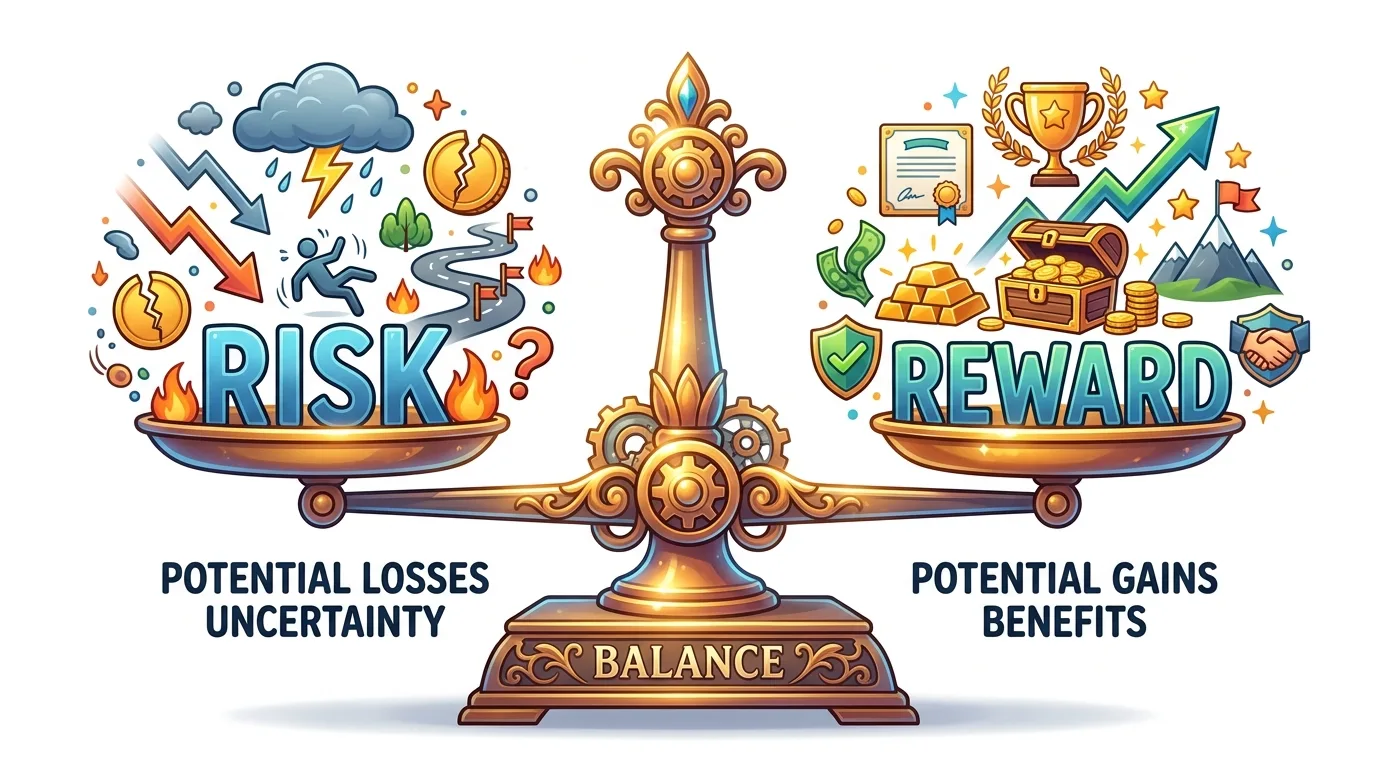
Position Sizing is Non-Negotiable: The volatility in pairs like GBP/JPY can wipe you out fast. I never risk more than 0.5% of my account on a single Tokyo session trade. Why? Because the moves, while logical, can be sharp. Use a position size calculator every single time. Don't eyeball it.
Spread Awareness: Check the spread on your pair right before you enter. At 2 AM, the spread on EUR/JPY might be 2.5 pips. If your stop is only 15 pips away, the spread is eating 16% of your risk budget before you even start. That's a terrible trade. I avoid any trade where the spread is more than 20% of my planned stop-loss distance.
The Overnight Gap Risk: If you're holding a JPY cross from the Tokyo session into the next day, you're exposed to the gap risk when Tokyo re-opens. A piece of unexpected Japanese news can cause a 50-pip gap against you. I either close all trades before the session ends or use a broker with guaranteed stop-losses (which cost extra) if I must hold.
The biggest mistake I see? A trader makes 20 pips on USD/JPY, gets overconfident, and triples their position size on the next trade. Then GBP/JPY spikes 80 pips against them on a random headline, and they get a margin call. It happens in minutes. The session is predictable, but it's not forgiving.
💡 윈스턴의 팁
Your most important tool for the Asian session isn't an indicator. It's the economic calendar. Know when Japan and Australia are speaking.
“A one-second delay on a market order during Tokyo can mean a 5-pip worse fill. That's your profit gone.”
Your broker choice critically impacts Tokyo session trading. You need a broker with strong liquidity during Asian hours and fair pricing for Nigerians.
The Spread Test: Do this. At 1:00 AM WAT, pull up the live spreads on USD/JPY, EUR/JPY, and AUD/USD on your broker's platform. Then, check the same pairs on a major broker like IC Markets or Pepperstone. If your broker's spreads are consistently 1 pip or more wider, you're being taxed for being in Nigeria. It's that simple.
Commission vs. Spread: For active Tokyo session traders, especially scalping, an ECN/RAW account that charges a commission but offers raw spreads is almost always cheaper. Let's say the raw spread on USD/JPY is 0.2 pips, and you pay $3.50 per lot commission. On a standard account, the spread might be 1.2 pips with no commission. On a 1-lot trade, the ECN account cost is 0.2 pips + ~0.35 pips (commission equivalent) = 0.55 pips total. You save 0.65 pips per trade. That adds up fast.
Local Payment Methods: This is the Nigerian reality. You need a broker that allows deposits and withdrawals in Naira via local bank transfer or USSD. The hassle and cost of international wire transfers will eat your profits. Brokers like Exness and XM have strong local payment processing. Always confirm the current deposit/withdrawal channels and any fees before funding.
Platform Stability: Test your trading platform (MT4/MT5) during the Tokyo session. Does it freeze? Are orders slow to execute? This is a silent killer. A one-second delay on a market order can mean a 5-pip worse fill.
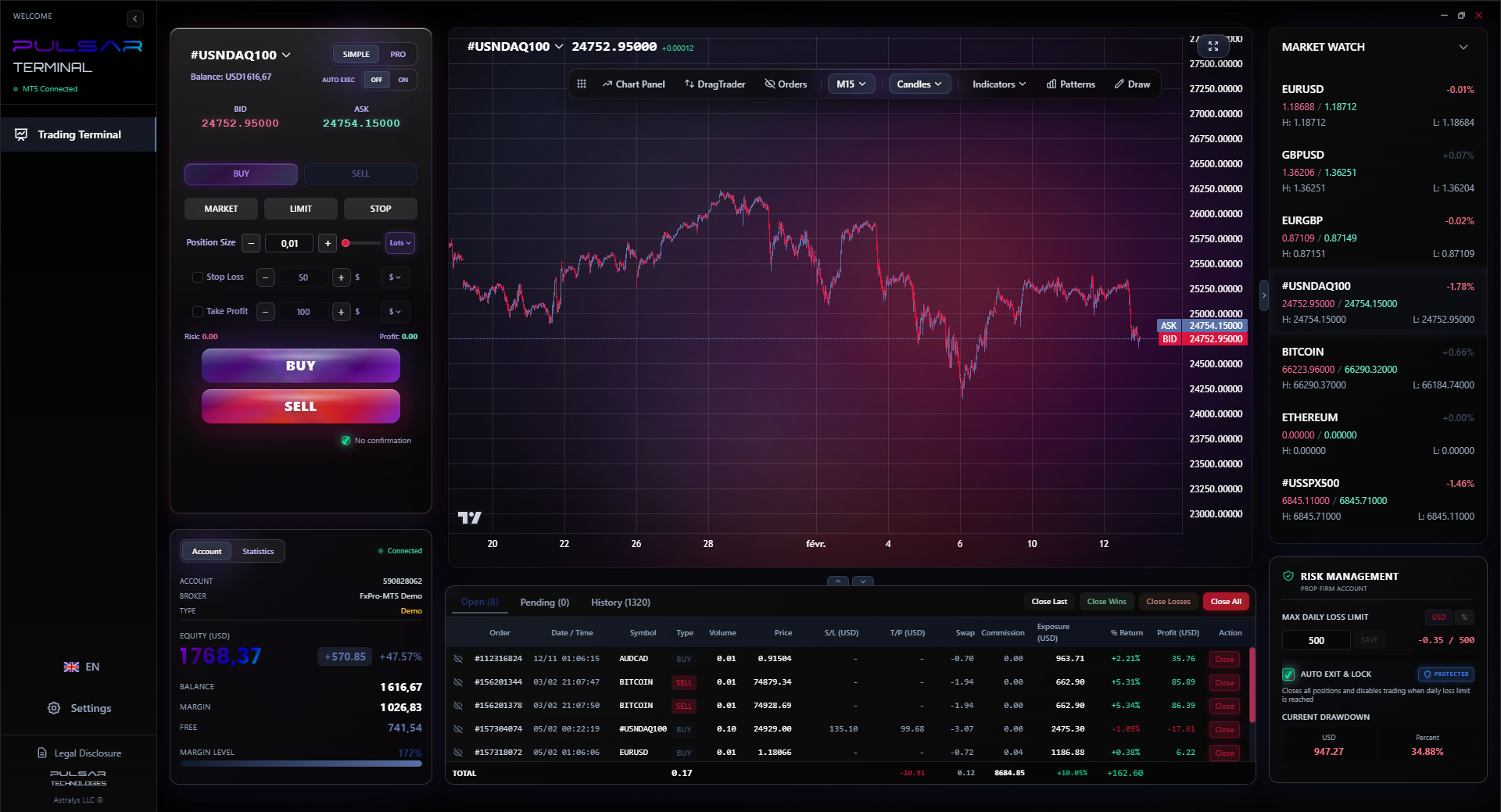
Managing multiple JPY cross trades and moving stops to breakeven during the fast-moving Tokyo session is far easier with a tool like Pulsar Terminal that lets you drag and modify orders directly on your MT5 chart.
Pulsar Terminal
MT5 올인원 도구: 드래그앤드롭 주문, 다중 TP/SL, 트레일링 스톱, 그리드 트레이딩, 볼륨 프로파일, 프롭펌 보호. 매일 1,000명 이상의 트레이더가 사용.
Tokyo session moves are often driven by data. You must know what's scheduled.
Key Japanese Data (Times in WAT):
- Tankan Survey: 12:50 AM. Huge for JPY. Can cause 70+ pip moves in USD/JPY.
- CPI / Inflation Data: 12:30 AM. Guides Bank of Japan policy expectations.
- Bank of Japan Monetary Policy Statement: Variable time, but often around 4:00 AM. This is the big one. Volatility explodes.
Key Australian/Chinese Data:
- Australian Employment Change & CPI: 2:30 AM WAT. Moves the AUD pairs.
- Chinese PMI Data: Around 3:00 AM WAT. This is a massive risk sentiment driver for AUD/JPY, NZD/JPY, and Asian stock markets.
My rule: I do not have any open positions 5 minutes before a high-impact news release (red news on the calendar) for the currency I'm trading. I either close or move my stop to breakeven. The whipsaw can take you out even if you're right on direction. It's not worth the stress.
I keep a separate window open just for the calendar during the session. It's that important. Trading blind during this session is like driving in Lagos without checking your mirrors.
“The goal isn't to be in a trade the whole time. The goal is to be patient, take 1-2 high-quality setups, and then protect the capital.”
I've made all of these. Learn from my losses.
1. Chasing Low-Volume Breakouts: You see EUR/USD finally break out of its 15-pip range with a spike. You FOMO in. Then it reverses and fills the entire spike in 30 seconds. Why? There was no real volume behind it. It was just a single bank's order. In Tokyo, wait for a sustained break with follow-through over 15-20 minutes, not a 5-minute candle.
2. Overleveraging on JPY Pairs: The temptation is high. GBP/JPY moves 100 pips a day, easy. "If I just use 1:100 use, a 50-pip move is 5%!" This is the road to ruin. These pairs also have sharp, unexpected retracements. That 50-pip profit can become a 70-pip loss in the time it takes to blink. Stick to your 0.5% risk rule, no exceptions.
3. Ignoring the 'Quiet Hours': The deadest period is often between 5:00 AM and 7:00 AM WAT (after Tokyo lunch, before Europe). Price action becomes meaningless, spreads can widen. This is when you get fakeouts. My best advice? Step away from the charts. Make a cup of tea. Review your plan for the London open. Trading during this void is a surefire way to give back your earlier profits.
💡 윈스턴의 팁
If your chart looks like a flatlined heart monitor, it's not a trading signal. It's a signal to go to bed. Patience is enforced by the market's rhythm.
Let's walk through what a disciplined Tokyo session looks like for me now, after years of mistakes.
11:45 PM WAT: I'm at my desk. I review the economic calendar for the next 8 hours. I note any Japanese, Australian, or Chinese high-impact news.
12:00 AM - 1:30 AM WAT: Session open. I'm not trading yet. I'm watching. I'm identifying the early range on my preferred pairs: USD/JPY, AUD/JPY, AUD/USD. I mark support and resistance on my charts.
1:30 AM - 5:00 AM WAT: Active trading window. I look for my setups:
- A rejection at a session extreme with momentum divergence.
- A retest of the opening price area with a clear bounce.
- I calculate my position size using my position size calculator. I set my stop-loss immediately. I enter only if the spread is acceptable.
5:00 AM - 7:00 AM WAT: Wind-down. I move stops to breakeven on any profitable trades. I avoid new entries unless there's a crystal-clear, high-probability setup. I usually don't find any.
7:00 AM WAT Onwards: London anticipation. I manage any remaining trades aggressively, ready for a volatility shift. I plan my London session trades.
The goal isn't to be in a trade the whole time. The goal is to be patient, take 1-2 high-quality setups with a solid 1:2 or better risk-reward ratio, and then protect the capital. A successful Tokyo session for me is a clean 40-80 pips of profit across 1-2 trades, with zero drama. That consistency, compounded over time, is how you build an account from Nigeria.
FAQ
Q1What time does the Tokyo session start and end in Nigeria?
It starts at 12:00 AM (midnight) and ends at 9:00 AM Nigerian Time (West Africa Time, WAT). The most active trading period is typically between 1:30 AM and 5:00 AM WAT.
Q2Is EUR/USD good to trade during the Tokyo session?
Generally, no. EUR/USD is a European pair and often experiences very low volatility and choppy, unpredictable price action during the Asian hours. It's one of the worst major pairs to trade in this session. Focus on JPY crosses or AUD pairs instead.
Q3Why are spreads sometimes wider during the Tokyo session?
Spreads can widen because overall market liquidity is lower than during the London or New York sessions. This is especially true for non-Asian currency pairs. For JPY pairs, spreads are usually tightest during Tokyo hours, but for something like GBP/USD, the lack of European liquidity providers can cause spreads to expand.
Q4Can I use scalping strategies during the Tokyo session?
Yes, but only on the right pairs. Scalping USD/JPY or AUD/JPY on lower timeframes (like 1 or 5-minute charts) can work due to sufficient liquidity and movement. However, you must use an ECN broker with tight spreads, as standard account spreads will destroy a scalping strategy's profitability. Avoid scalping EUR/USD or GBP/USD during this time.
Q5What is the biggest risk for a Nigerian trader in the Tokyo session?
Overleveraging on volatile pairs like GBP/JPY. The combination of high use, large pip movements, and potentially trading while tired can lead to rapid account blow-ups. Strict position sizing (never risk more than 0.5-1% per trade) is the essential defense.
Q6Do I need to stay up all night to trade the Tokyo session from Nigeria?
Not necessarily. You can trade the first half (12 AM - 3 AM) or set alerts and orders for key Asian news releases (like Japanese CPI at 12:30 AM). Many traders also focus on the tail end of the session (7 AM - 9 AM) to catch the early European momentum, which fits a more normal morning schedule.
윈스턴 교수의 수업
핵심 요약:
- ✓Trade the JPY crosses (USD/JPY, EUR/JPY) during Tokyo hours.
- ✓Avoid EUR/USD and GBP/USD; they are dormant and choppy.
- ✓Never risk more than 0.5% per trade on volatile pairs like GBP/JPY.
- ✓Always check spreads before entering; avoid if >20% of your stop-loss.
- ✓Close trades or move to breakeven before high-impact Asian news.
이 기사가 얼마나 유용했나요?
별을 클릭하여 평가
주간 트레이딩 인사이트
무료 주간 분석 & 전략. 스팸 없음.
저자 소개
Olumide Adeyemi
서아프리카 트레이딩 선구자
나이지리아에서 가장 활발한 외환 트레이딩 교육자 중 한 명. 라고스에서 8년간 트레이딩 경험. 아프리카 트레이더를 위한 소자본 전략과 프롭 펌 챌린지 전문.
댓글
위험 고지
금융 상품 거래에는 상당한 위험이 수반되며 모든 투자자에게 적합하지 않을 수 있습니다. 과거 성과가 미래 수익을 보장하지 않습니다. 이 콘텐츠는 교육 목적으로만 제공되며 투자 조언으로 간주되어서는 안 됩니다. 거래 전에 항상 직접 조사를 수행하십시오.
이 기사도 읽어보세요

Cara Trading Forex Sukses: 7 Prinsip dari Trader Profesional
Cara trading forex sukses dengan 7 prinsip trader pro: manajemen modal, disiplin, journal trading, backtest. Data nyata, bukan janji profit palsu.
Jam Trading Forex Terbaik untuk Trader Indonesia: Panduan Lengkap dengan Tabel Waktu
Panduan jam trading forex untuk trader Indonesia. Tabel 4 sesi dunia, jam emas 20:00-00:00, sesi mana yang harus dihindari. Data akurat + tips dari trader berpengalaman.
Top 5 Sàn Forex Uy Tín Nhất 2026: Review Jujur dari Trader Indonesia
Top 5 sàn forex uy tín 2026 untuk trader Indonesia. Review jujur: spread, deposit, withdraw, dukungan lokal. Exness, XM, IC Markets & lebih.
