


I downloaded over 47 trading strategies books in PDF format during my first two years.

Rajesh Sharma
수석 외환 애널리스트 ·  India
India
☕ 13 분 소요
배울 내용:
- 1The PDF Trap: Why Most Free Books Fail Indian Traders
- 2Must-Read Books That Actually Translate to Indian Markets
- 3Adapting Global Strategies to NSE and BSE Realities
- 4SEBI Rules & What You Can't Learn from a Book
- 5Building Your Own System From Books
- 6The Honest Review of Popular PDF Strategy Types
- 7From Knowledge to Execution: Brokers and Tools
- 8Final Words: Your Trading Bibliography
I downloaded over 47 trading strategies books in PDF format during my first two years. I spent more time collecting them than actually trading. The hard truth? 90% were useless for the Indian markets, and following some nearly blew up my account. The right book, applied correctly with our taxes and rules, can change everything. Let's cut through the noise.
We've all been there. A flashy ad promises a 'proven trading strategies book PDF' for free. You download it, skim the fancy charts, and feel smarter. I built a digital library before I made a single profitable trade. It's a distraction.
The biggest issue with these free PDFs is context. They're almost always written for US or European markets. The examples use the S&P 500, the EUR/USD, or Apple stock. When you try to apply that to a Nifty 50 stock or the Bank Nifty futures, the dynamics are completely different. Liquidity, volatility patterns, and even the market open behave uniquely here.
Then there's the cost structure. A strategy might show 100 trades with a 5-pip stop loss. Sounds tight. But they never factor in the Securities Transaction Tax (STT) or the Goods and Services Tax (GST) on brokerage. On a short-term trade, these can turn a theoretical winner into a real-world loser. I learned this the hard way trying to scalp USD/INR. My strategy was positive on paper, but after STT (0.025% on sale) and GST, my edge vanished.

Warning: Be extremely wary of any 'strategies book' that promises fixed monthly returns or a 'secret indicator.' Under the new SEBI (Stock Brokers) Regulations, 2026, brokers themselves are prohibited from offering schemes with indicative or guaranteed returns. If a book is selling that dream, it's a red flag.
The best use for a free PDF? As a framework for understanding concepts - like support and resistance or momentum. Never as a plug-and-play system. Treat them like a cookbook from a different country; you need to adapt the recipes to local ingredients.
Forget the 500-page obscure PDFs. These are the real ones. They teach principles, not just rules, and those principles work on the NSE chart just as well as on the NYSE.
1. 'Trading in the Zone' by Mark Douglas This isn't a strategies book with entries and exits. It's about the psychology of probability. This was the single most important book I ever read. Indian markets are emotional. FOMO during a Reliance breakout or panic selling during a VIX spike will destroy any strategy. Douglas teaches you to manage yourself. After reading this, my consistency improved because I stopped overriding my own swing trading rules.
2. 'Market Wizards' Series by Jack D. Schwager Interviews with legendary traders. You won't get a PDF strategy, but you'll see a common thread: risk management. Every wizard has a different method, but they all have strict rules for losing. This directly applies to managing a margin call scenario during a volatile expiry day.
3. 'The New Trading for a Living' by Alexander Elder This is the closest to a complete textbook. Elder covers psychology, technicals, and risk management as three pillars. His emphasis on the '2% risk rule' is gospel. On a ₹500,000 account, that's ₹10,000 max risk per trade. This simple rule saved me in 2020. I took three losing trades in a row on Bank Nifty, but because I used a position size calculator based on that 2%, I was down less than 3% overall and could recover easily.
Where to get them? Please, buy them. A physical copy or a legit ebook. The act of paying for knowledge commits you to actually reading it. Scribd or Amazon Kindle often has them. The ₹500 spent is better than losing ₹5000 testing a faulty free strategy.

💡 윈스턴의 팁
If a strategy in a book seems too complicated to explain in two sentences, it's probably too complicated to trade. The market is complex; your rules should be simple.
“The best use for a free PDF is as a framework for understanding concepts - never as a plug-and-play system.”
So you read a great chapter on moving average crossovers. The book uses the 50 and 200-day EMA on the S&P 500. Time to load up TATA Motors? Not so fast.
Factor in Indian Market Hours & Gaps
Our market has a pre-open, a continuous session, and a closing session. A lot of action happens at the open (9:15 AM). Many Western strategies assume smoother opens. I tried a gap-fading strategy from a US book on Nifty. It worked in the US, but here, the gaps often just keep running, especially on news. I had to add a filter: only fade gaps smaller than 0.5% and wait for the first 15-minute candle to close.
Liquidity is King (and Queen)
A strategy calling for 1000 shares on a $10 US stock is easy. Trying that on a mid-cap or small-cap stock here? The slippage will kill you. Always check the average daily volume and the order book depth. I stick to the top 100 Nifty stocks or major indices like Bank Nifty for any strategy requiring quick entry and exit. For less liquid instruments, you must widen your stops, which changes your entire risk profile.
The Tax Overhead
This is the silent killer of imported strategies. Let's do the math on a futures trade, a common instrument in strategies books.

Example: You buy 1 lot of Nifty Futures at 22,000 and sell at 22,100.
- Profit: 100 points * ₹50 (lot size) = ₹5,000
- STT on Futures: 0.01% on sell side = ₹11.05
- Brokerage (₹20 per side): ₹40
- GST on Brokerage (18%): ₹7.20
- Exchange Charges, SEBI Turnover Fee: ~₹5
- Net Profit: ₹5,000 - ₹63.25 = ₹4,936.75
That's a 1.3% haircut on your gross profit. On a 100-point target, you effectively start 1.3 points in the hole. Your strategy must have an edge wide enough to absorb this. A scalping strategy aiming for 10-point profits in Bank Nifty is mathematically doomed before it starts.
This is the most critical section for any Indian trader. A strategies book won't teach you this, but ignoring it can get you in trouble.
The Finfluencer Rule: As of last year, SEBI cracked down hard. Anyone providing stock market education cannot use live prices - they must use data lagged by at least three months. Why does this matter for you? It means any YouTube video, Telegram channel, or blog post selling a course with 'live calls' is potentially operating in a grey area if they're not registered. The book or PDF they give you might be fine, but the accompanying 'live mentorship' could be problematic. Stick to the principles in the book, not the promoter's latest hot tip.
No Guarantees, Ever: The new 2026 broker regulations make it crystal clear. No registered entity can promise returns. If a 'strategies book' is being sold with a guarantee of 10% per month, it's a scam. Full stop. Real trading involves losses. Any material that doesn't spend at least a third of its time on risk management isn't worth the file it's saved on.
Prop Firm Challenges: These have become popular. A strategies book might teach you a trend-following method, but passing a prop firm challenge like FTMO or The5%ers requires specific, aggressive risk parameters. You often have a daily loss limit. This is where tools matter. Managing a max daily loss manually is stressful. I've found using a trading journal and tools that can automate stop-losses to be essential, not optional, for this environment.
Your first stop for education should actually be SEBI's own website and the NSE's learning center. They offer free, legitimate PDFs and modules on the basics of derivatives, technical analysis, and fundamental analysis. It's dry, but it's factually correct and designed for our market.
💡 윈스턴의 팁
Always calculate your 'all-in cost per trade' - brokerage, STT, GST, everything. If your average winning trade isn't at least 3x this cost, you have no edge. It's just noise.
“Your stop-loss must be placed where, if hit, it invalidates your trade idea. Not at an arbitrary number you're comfortable losing.”
This is where the magic happens. You don't adopt a strategy, you build one.
Step 1: Find Your Timeframe Are you a full-time trader or doing this after work? Books will cover everything from scalping strategy (seconds/minutes) to position trading (months). Be honest. I started trying to scalp because a book made it look exciting. I failed. I'm not wired for that pressure. I found my edge in 4-hour and daily charts for swing trading. A book gave me the tools, but I had to choose which ones fit my life.
Step 2: The Core Signal Pick ONE concept from one book to be your primary entry signal. Maybe it's a MACD indicator crossover on the hourly chart. Maybe it's a breakout of a 20-day high on the daily chart. Just one. Don't combine five indicators from five different PDFs. I used to have a chart with RSI, MACD, Stochastic, and Bollinger Bands. It was a mess. I now use pure price action and volume. Simplicity wins.
Step 3: Define Your Risk Before Your Reward This is non-negotiable. For every trade, know where you're wrong before you know where you're right. Use the ATR (Average True Range) indicator to set a logical stop-loss based on market noise, not an arbitrary number. If the daily ATR of a stock is ₹20, a ₹5 stop loss will get hit constantly. Your stop must be placed where, if hit, it invalidates your trade idea. Then, use your position size calculator so that loss equals 1% of your capital.
Step 4: Backtest & Forward Test Don't use real money yet. Take your simple system (Step 2 signal + Step 3 risk) and look at historical charts. Use TradingView's replay mode. How would it have done on Infosys over the last year? Then, do a forward test. Paper trade it for a month. Log every trade. The goal isn't to be profitable in the test, it's to see if you can follow the rules you wrote down. This process alone will teach you more than 100 trading strategies books PDFs.
Let's break down common strategies you'll find in PDFs and their Indian applicability.
| Strategy Type (Common in PDFs) | Does it work in India? | The Major Caveat |
|---|---|---|
| Forex Scalping (5-min charts) | Very Difficult. | The USD/INR pair is less liquid than majors like EUR/USD. Spreads can widen, and the STT on derivatives makes tiny profits unsustainable. |
| Gold (XAU/USD) Trend Following | Yes, but with care. | You can trade Gold futures on MCX. The principles from an XAU/USD guide apply, but our contracts have specific lot sizes and expiry. You're also trading in INR, so currency fluctuations add a layer. |
| Moving Average Crossover Systems | Yes, a classic. | On indices like Nifty, the 50/200-day 'death cross' still gets attention. But on individual stocks, beware of whipsaws. Works better on higher timeframes (daily/weekly). |
| 'Risk-Free' Arbitrage | Mostly theoretical. | By the time you read about it in a public PDF, the institutional algos have already exploited the tiny window of opportunity. Don't waste time. |
| Options Selling 'Premium Collection' | Popular, but high risk. | Selling options (like writing covered calls) is popular here. The PDFs often undersell the risk. One gap move against you can wipe out months of small premiums. Margin requirements are high. |
My biggest personal mistake was with a 'Fibonacci Grid Trading' PDF. It laid out a beautiful mechanical system to place buy orders at Fibonacci retracement levels. I set it up on Crude Oil mini contracts. It worked... until a major news event caused a sustained trend with no retracement. My grid of buy orders kept getting hit, and I had no stop-loss for the overall system. I lost over 8% of my account in a day. The book never mentioned that risk. Now, if I were to use a grid, I'd want a tool that could manage the overall exposure and set a hard stop for the entire basket, not just individual orders.
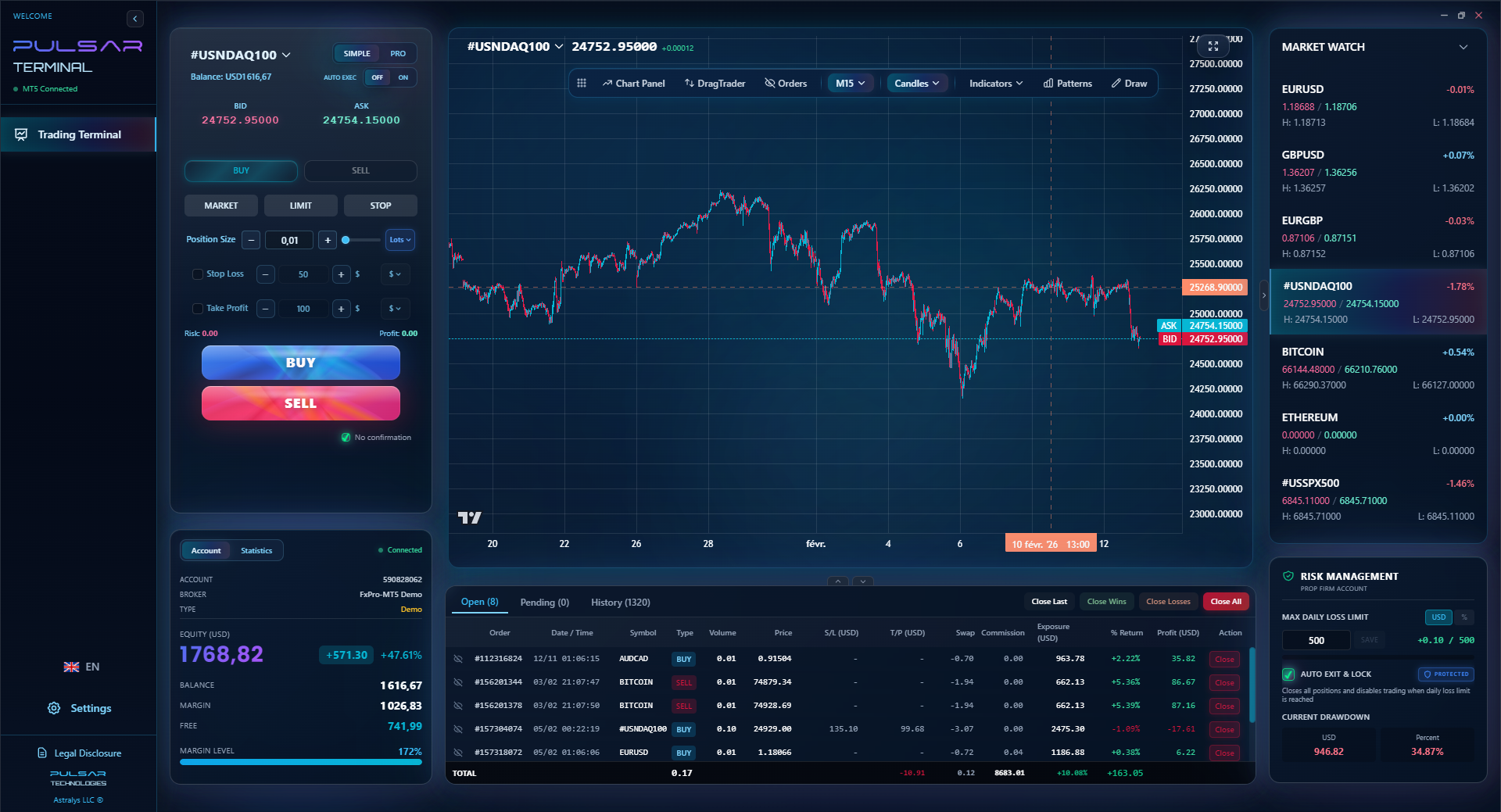
Managing complex strategies like grid trading requires precise order management, which is where a tool like Pulsar Terminal, with its automated basket orders and stop-loss controls for MT5, becomes essential for risk control.
Pulsar Terminal
MT5 올인원 도구: 드래그앤드롭 주문, 다중 TP/SL, 트레일링 스톱, 그리드 트레이딩, 볼륨 프로파일, 프롭펌 보호. 매일 1,000명 이상의 트레이더가 사용.
“My most profitable year started when I stopped looking for new strategies and traded one simple method with ruthless consistency.”
You have a solid strategy from a good book. Now you need to execute it without friction. Your broker and tools are critical.
Choosing a Broker: For retail traders in India, low-cost, reliable technology is key. I've used several.
- Zerodha: The pioneer. Their Kite platform is excellent for most traders. Low costs, great for equities and futures. Their backend sometimes struggles during extreme volatility.
- Upstox/Groww: Similar discount models. Good for beginners.
- For Advanced Trading & Forex: If you're looking beyond Indian markets at international forex or CFDs (complex and high-risk), you'd need an international broker. I've used Exness for forex metals and IC Markets for raw spreads. Remember, trading with international brokers carries its own set of regulatory and tax implications in India. Do your homework.
Essential Tools No Book Mentions:
- A Trading Journal: This is your real 'strategies book' - the one you write. Log every trade: entry, exit, reason, emotion, screenshot. I use TraderSync. Reviewing this weekly is more valuable than reading another PDF.
- A Reliable Charting Platform: TradingView is the industry standard for a reason. The social ideas are noise, but the charting tools are superb.
- Order Management Tools: This was my game-changer. Manually moving stop-losses to breakeven or setting a trailing stop while watching the chart is distracting and emotional. I started using a terminal that plugs into MT5 (which some international brokers use) to automate this. Setting a rule like 'move stop to breakeven when trade is up 1.5x the risk' lets the trade run without me babysitting it. It executes the discipline the books preach.
💡 윈스턴의 팁
Your first trade after reading a new strategy should be 1/10th your normal size. You're not testing for profit, you're testing your own understanding and execution.
So, should you search for 'trading strategies books pdf'? Yes, but with a purpose. Be a curator, not a collector.
Start with this shortlist:
- For Psychology: 'Trading in the Zone' (Mark Douglas).
- For a Complete Method: 'The New Trading for a Living' (Alexander Elder).
- For Inspiration & Risk Mindset: 'Market Wizards' (Jack Schwager).
Read one. Finish it. Apply its single biggest lesson to your trading for one month. Journal the results. Then, and only then, consider the next one.
The ultimate strategy isn't in a PDF. It's the process you build: Education (from good books) + Adaptation (for India's costs & rules) + Discipline (via journals & tools) + Patience.
I'll leave you with this. My most profitable year didn't start with a new strategy. It started when I stopped looking for new strategies. I took the simplest method from the first good book I ever read - a trend pullback system - and traded it with ruthless consistency for 12 months. The strategy was simple. The execution was everything. That's the secret no PDF will ever give you. You have to build that part yourself.

Pro Tip: Create a 'Trading Rules' document for yourself. One page. List your entry criteria, your exact risk per trade (e.g., 1%), your position sizing method, and your exit rules. Print it. Stick it next to your screen. This is the only 'strategies book' you need to look at during market hours.
FAQ
Q1Are free trading strategy PDFs from the internet illegal in India?
No, possessing or reading a free PDF on trading strategies is not illegal. However, you must be cautious. If the PDF is being used to promote an unregistered advisory service or makes guaranteed return claims, the person distributing it may be violating SEBI's finfluencer and investment advisor regulations. The content itself isn't illegal, but the commercial activity around it might be.
Q2How do I adjust a forex strategy from a PDF for trading USD/INR?
You must account for three major differences: 1) Costs: Factor in STT (0.025% on sale for intraday) and GST on brokerage, which many international forex strategies ignore. 2) Liquidity & Hours: USD/INR is most liquid during Indian market hours (9 AM to 5 PM). Strategies based on 24-hour forex market volatility may not align. 3) Spread: Check the typical spread on your broker; it can be wider than majors like EUR/USD, affecting scalping strategies. Always test with smaller position sizes first.
Q3What is the single biggest mistake when using a strategies book?
The biggest mistake is implementing a strategy without forward-testing it on Indian market data first. The second is ignoring the impact of taxes and fees. A strategy showing a 5% return in a US-based book might only yield 3-4% net in India after STT, brokerage, and GST. Always 'Indianize' the strategy by subtracting transaction costs in your backtesting.
Q4Can books really teach you how to trade?
Books can teach you the concepts, the vocabulary, and the frameworks - like how to read a chart, what risk management is, or the psychology of markets. But they cannot teach you execution or discipline. That's like a football coaching book teaching you tactics; you still have to get on the field, make passes, and handle the pressure. Books provide the map, but you have to make the journey.
Q5Where can I find legitimate educational materials approved by SEBI?
The best free and legitimate sources are the official websites of SEBI (sebi.gov.in - look for 'Investor Education' section) and the National Stock Exchange (nseindia.com - look for 'NSE Academy' or 'Knowledge Center'). They offer presentations, booklets, and even full courses on market basics, derivatives, and analysis, all tailored for the Indian regulatory environment.
Q6Is it better to buy a physical book or use a PDF?
For core, foundational books, I strongly recommend buying a physical copy or a legitimate ebook. The act of paying commits you to reading it thoroughly. You'll make notes in the margins, highlight sections, and revisit it. A free PDF on your computer often gets lost in a folder and forgotten. For a quick reference on a specific indicator, a PDF is fine. For learning, go physical.
윈스턴 교수의 수업
핵심 요약:
- ✓Adapt every strategy for STT & GST; they kill scalping edges.
- ✓Test any PDF strategy on Indian data for 3 months first.
- ✓Risk 1% per trade max, no exceptions from any book.
- ✓Psychology books matter more than indicator books long-term.
이 기사가 얼마나 유용했나요?
별을 클릭하여 평가
주간 트레이딩 인사이트
무료 주간 분석 & 전략. 스팸 없음.
저자 소개
Rajesh Sharma
수석 외환 애널리스트
인도 및 남아시아 시장에서 10년 이상의 트레이딩 경력. NSE 통화 파생상품으로 시작해 국제 외환시장으로 전향. USD/INR 및 신흥시장 통화쌍 전문.
댓글
위험 고지
금융 상품 거래에는 상당한 위험이 수반되며 모든 투자자에게 적합하지 않을 수 있습니다. 과거 성과가 미래 수익을 보장하지 않습니다. 이 콘텐츠는 교육 목적으로만 제공되며 투자 조언으로 간주되어서는 안 됩니다. 거래 전에 항상 직접 조사를 수행하십시오.
이 기사도 읽어보세요

Cara Trading Forex Sukses: 7 Prinsip dari Trader Profesional
Cara trading forex sukses dengan 7 prinsip trader pro: manajemen modal, disiplin, journal trading, backtest. Data nyata, bukan janji profit palsu.
Jam Trading Forex Terbaik untuk Trader Indonesia: Panduan Lengkap dengan Tabel Waktu
Panduan jam trading forex untuk trader Indonesia. Tabel 4 sesi dunia, jam emas 20:00-00:00, sesi mana yang harus dihindari. Data akurat + tips dari trader berpengalaman.
Top 5 Sàn Forex Uy Tín Nhất 2026: Review Jujur dari Trader Indonesia
Top 5 sàn forex uy tín 2026 untuk trader Indonesia. Review jujur: spread, deposit, withdraw, dukungan lokal. Exness, XM, IC Markets & lebih.
