


Most traders get triangle patterns completely wrong.

Olumide Adeyemi
서아프리카 트레이딩 선구자 ·  Nigeria
☕ 10 분 소요
배울 내용:
- 1What Exactly Is a Triangle Pattern? (It's Not What You Think)
- 2The Three Main Types: Symmetrical, Ascending, and Descending
- 3Spotting Real Setups in the Nigerian Market
- 4Trading the Breakout & Avoiding the Deadly Fakeout
- 5Common Mistakes Nigerian Traders Make (I Made Them All)
- 6Brokers, Platforms & Tools for Nigerian Triangle Traders
- 7Putting It All Together: A Real Trade Example
Most traders get triangle patterns completely wrong. They see a few converging lines and jump in, only to get stopped out when the market chops them up. In Nigeria's volatile forex market, where the Naira can swing hundreds of pips on CBN news, misreading a triangle is a sure way to burn capital. I've made that mistake myself, losing over $800 on a single EUR/USD fakeout before I learned the rules. This guide isn't about drawing pretty lines; it's about identifying high-probability setups that actually work with Nigerian brokers, local spreads, and our unique market psychology.
A triangle pattern in forex is a consolidation chart formation where price action gets squeezed between converging trendlines. It represents a battle between bulls and bears where neither side can gain decisive ground, creating lower highs and higher lows (or variations thereof). The key word here is consolidation – it's a pause, not a trend.
Most Nigerian traders I mentor initially see triangles as a magic crystal ball. They're not. They're a pressure cooker. As the space between the lines narrows, volatility compresses. Energy builds. The eventual breakout is that pressure being released. The pattern's real value is in defining a clear risk point (the opposite side of the triangle) and providing a measured move target.

Warning: A triangle on its own means nothing. It needs context. A triangle after a strong uptrend has a different implication than one in the middle of a ranging market. Always ask: 'What was the price doing BEFORE this pattern formed?'
Symmetrical Triangle
This is the classic, neutral pattern. You've got a descending resistance line (lower highs) and an ascending support line (higher lows) meeting at an apex. It shows balance. Neither buyers nor sellers are in control. In my experience, the breakout direction from a symmetrical triangle is the least predictable. You need to wait for the close outside the trendline. I got chopped up early in my career trying to anticipate the break. Now, I don't enter until the candle closes beyond the line, especially with Nigerian brokers where slippage on news can be nasty.
Ascending Triangle
This is a bullish continuation pattern. You have a flat, horizontal resistance line and a rising support line (higher lows). The story here is that buyers are getting increasingly aggressive, pushing up the dips, but they keep meeting the same selling wall at the top. Each test of resistance weakens it. The breakout above that horizontal line is the signal. I've had great success with these on GBP/USD during the London session.
Descending Triangle
The bearish counterpart. A flat, horizontal support line with a descending resistance line (lower highs). Sellers are becoming more aggressive, capping rallies at lower levels, while buyers defend the same price floor. The breakdown below support is the trigger. These can be brutal in a downtrend.
Here’s a quick comparison of what each pattern typically signals:
| Pattern Type | Structure | Typical Bias | Key Level to Watch |
|---|---|---|---|
| Symmetrical | Converging support & resistance | Neutral / Continuation | Break of either trendline |
| Ascending | Horizontal resistance, rising support | Bullish | Break above horizontal resistance |
| Descending | Horizontal support, falling resistance | Bearish | Break below horizontal support |

💡 윈스턴의 팁
A triangle pattern is just a map of indecision. The real trade starts when the indecision ends with a decisive breakout. Don't buy the map; buy the territory it reveals.
“A triangle on its own means nothing. It needs context.”
Trading triangle patterns from Nigeria adds specific layers. Our internet can be flaky, spreads on exotic pairs involving NGN can widen dramatically, and CBN policy announcements can override any technical pattern in seconds. Here’s how to adapt.
First, stick to the majors and minors on your main charts. EUR/USD, GBP/USD, XAU/USD (Gold) are your friends. The liquidity is massive, spreads are tight (think 0.6-0.9 pips on a good ECN account from a broker like IC Markets or Pepperstone), and the patterns are cleaner. Trying to trade a triangle on NGN/USD on a retail platform is asking for trouble due to the wide spreads and potential for gap risk.
Second, time your analysis. The cleanest patterns form during the overlap of the London and New York sessions (2pm - 5pm Nigerian time). That’s when volume is highest, and breakouts are more likely to follow through. A triangle that forms during the dead Tokyo session might just fizzle out.

Pro Tip: Use the ATR (Average True Range) indicator. If the ATR value is collapsing while the triangle forms, it confirms the volatility squeeze. A rising ATR on the breakout confirms strength. I pair this with basic trend analysis for a better swing trading edge.
Third, manage your size. A breakout can fail. In 2023, I took a beautiful ascending triangle setup on EUR/USD. Entered at 1.0950 on the breakout, target at 1.1080. A surprise Fed comment reversed it entirely. I was saved because I used a sane position size calculator and my stop was at 1.0890, just below the triangle's support. I lost 60 pips, but only 1% of my account. The pattern failed, but my risk management didn't.
This is where the money is made or lost. A breakout is a clean, decisive candle closing outside the triangle's boundary. A fakeout (or false breakout) is a quick spike beyond the line that then reverses and smashes through the other side. They are designed to trap retail traders.
My Entry Rules:
- Wait for the Close: I do not enter on the spike. I wait for the 1-hour or 4-hour candle to close firmly outside the trendline. This one rule saved me thousands.
- Volume Check: On MT4/MT5, use the volume indicator. A genuine breakout should see a noticeable spike in volume. A low-volume breakout is suspect.
- Retest Entry: Often, price will break out, then pull back to retest the broken trendline (now acting as support/resistance). This is a lower-risk entry. My buy order sits just above the retested support line.
Avoiding Fakeouts: Fakeouts love to happen around major news. Check an economic calendar. If the breakout happens 5 minutes before US Non-Farm Payrolls, ignore it. Also, if the breakout occurs right at the triangle's apex (the very tip), it's often weaker. The best breakouts happen between the halfway and three-quarters point of the pattern's development.
Your stop-loss must go on the opposite side of the triangle. If you're long on a breakout, your stop goes below the triangle's support trendline. This defines your risk clearly. For take-profit, a common method is to measure the height of the triangle's back (the widest part) and project that distance from the breakout point. Don't get greedy; take partial profits at that target.
💡 윈스턴의 팁
If you're proud of how perfectly you've drawn your triangle, you've probably drawn it wrong. The best patterns are obvious, not artistic.
“Wait for the close. This one rule saved me thousands.”
Let me save you some money and frustration by listing the errors I've paid to learn.
- Drawing the Lines Incorrectly: You can't just connect random wicks. The trendlines should connect at least two swing highs and two swing lows. The price should react off these lines multiple times. If you're forcing the line to fit, the pattern is invalid.
- Trading Too Small Timeframes: On a 1-minute or 5-minute chart, you'll see triangles everywhere. Most are noise. I started on these timeframes and got shredded. Move to 1-hour or 4-hour charts for more reliable patterns. Save the scalping strategy for when you have more experience.
- Ignoring the Overall Trend: A descending triangle in a strong uptrend is not a high-probability short signal. It's more likely a continuation pattern that will break upwards. Always trade in the direction of the higher timeframe trend.
- Not Accounting for Spreads: If your broker's spread on EUR/USD is 2 pips, and your profit target from the triangle is only 15 pips away, your risk/reward is ruined. Factor in the spread before you enter. This is why I prefer raw spread accounts with commissions.
- Letting Hope Override the Stop: You see your breakout failing and price heading back to your stop. You move your stop-loss further away, 'giving it room.' This is how a 1% loss turns into a 5% loss or a margin call. The pattern is invalidated when price closes back inside the triangle. Get out.
Your broker and platform are your tools of the trade. You need reliability, good execution, and the right charting software.
Brokers: For trading these patterns, you need a broker with tight spreads and fast execution. Slow execution can mean you enter a breakout trade 5 pips above the intended price. Based on my testing and community feedback:
- IC Markets and Pepperstone are excellent for raw spreads (from 0.0 pips) and fast execution on their ECN accounts. Their minimum deposit ($200-ish) is reasonable.
- Exness is hugely popular here for its local Naira support and variety of account types, though always verify their current regulatory status for Nigerian clients.
- XM offers a very low minimum deposit ($5) which is great for beginners wanting to practice with real money without much risk.
Platforms: MT4 and MT5 are the standards. The drawing tools are all you need. However, managing multiple trades with different take-profit levels on a complex pattern can be clunky on vanilla MT5.

Example: You enter a triangle breakout and want to take 50% off at the measured move target, move your stop to breakeven, and let the rest run with a trailing stop. Doing this manually while watching other charts is stressful and error-prone.
💡 윈스턴의 팁
In Nigeria, your biggest edge isn't a secret pattern. It's discipline. A poorly executed plan on a great pattern will lose to a well-executed plan on a decent pattern every single time.
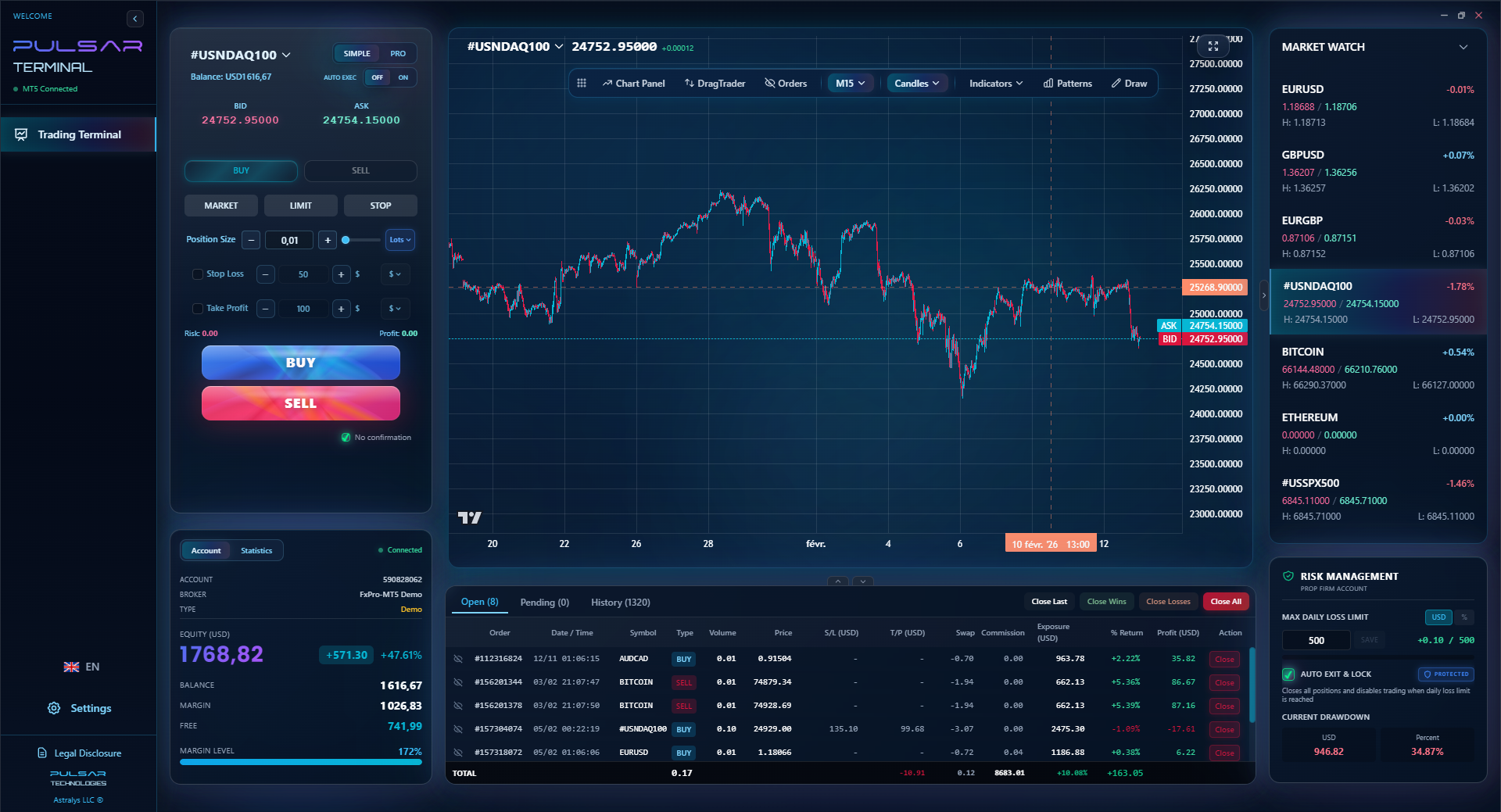
Managing partial profits, breakeven stops, and trailing stops on a triangle breakout is complex, but tools like Pulsar Terminal automate these multi-stage trade plans directly on your MT5 chart.
Pulsar Terminal
MT5 올인원 도구: 드래그앤드롭 주문, 다중 TP/SL, 트레일링 스톱, 그리드 트레이딩, 볼륨 프로파일, 프롭펌 보호. 매일 1,000명 이상의 트레이더가 사용.
“The profit wasn't magical. It was mechanical.”
Let's walk through a recent trade I took on Gold (XAU/USD), a market loved by Nigerian traders for its volatility.
- Context (Early March 2026): Gold was in a clear weekly uptrend. On the 4-hour chart, it entered a consolidation after a push to $2150.
- Pattern Identification: A symmetrical triangle formed over 7 days. I drew the descending resistance line connecting lower highs at $2148 and $2142. I drew the ascending support line connecting higher lows at $2120 and $2125.
- The Setup: The ATR was declining, showing the squeeze. I waited. No early entries.
- The Breakout: A strong 4-hour bullish candle closed at $2145, clearly above the resistance line. Volume was higher than average. This was my signal.
- The Trade:
- Entry: $2145.50 (buy limit on the retest of the broken line).
- Stop-Loss: $2129 (below the triangle support and a recent swing low). Risk: 16.5 points.
- Take-Profit 1: $2170 (measured move target: triangle height was ~$28, added to breakout point ~$2142).
- Take-Profit 2: Let remainder run with a trailing stop.
- Result: Price hit TP1 at $2170 within two days. I banked 24.5 points on half my position. I moved my stop to breakeven. The trend continued, and my trailing stop was hit a few days later at $2188 for additional profit. A clean, rules-based trade inspired by my XAU/USD guide principles.
The profit wasn't magical. It was mechanical. I followed my plan, managed my risk, and let the pattern do its work. That's the only sustainable way to trade triangles, or anything else, from Nigeria or anywhere else in the world.
FAQ
Q1Which triangle pattern is the most reliable for forex trading?
Ascending and descending triangles are generally more reliable than symmetrical ones because they have a built-in bias. The flat line in an ascending (resistance) or descending (support) triangle acts as a clear level that, when broken, signals a likely directional move. Symmetrical triangles are truly neutral, so you must wait for the breakout confirmation.
Q2What timeframe is best for trading triangle patterns?
For most Nigerian traders, the 1-hour and 4-hour charts offer the best balance. Patterns on these timeframes are significant enough to filter out market noise but don't require you to wait weeks for a result. Avoid the 1-minute and 5-minute charts as a beginner - the patterns are often false and spreads eat your profits.
Q3How do I know if a triangle breakout is real or a fakeout?
Wait for the candle to CLOSE outside the trendline. Check for an increase in trading volume on the breakout candle. Also, see if the breakout happens at a logical point in the pattern (not right at the thin apex) and isn't coinciding with a major news event that could cause a sudden reversal.
Q4Can I use triangle patterns to trade the Naira (NGN) pairs?
I strongly advise against it on standard retail platforms. The spreads are usually very wide, liquidity can be poor outside local hours, and sudden CBN interventions can cause massive gaps that ignore all technical patterns. Stick to major pairs like EUR/USD for cleaner technical analysis.
Q5Where should I place my stop-loss on a triangle trade?
Your stop-loss must be placed on the opposite side of the triangle from your entry. If you go long on a breakout above resistance, your stop goes below the triangle's support trendline. This placement means the trade idea is invalidated if the price moves back inside the pattern.
Q6What other indicators work well with triangle patterns?
I use the ATR (Average True Range) to confirm the volatility squeeze. The RSI indicator can be useful to see if momentum is building in the direction of the breakout (e.g., RSI holding above 50 during an ascending triangle). However, keep it simple - the pattern itself is your primary tool.
Q7Do triangle patterns work for crypto trading as well?
Yes, the principles are the same, but crypto markets are even more volatile. Expect more fakeouts and wider swings. Use larger stop-loss margins and smaller position sizes compared to forex. The same rule applies: wait for the close beyond the trendline.
윈스턴 교수의 수업
핵심 요약:
- ✓Wait for the candle close outside the trendline. No exceptions.
- ✓Place your stop-loss on the opposite side of the triangle.
- ✓The best breakouts occur between 50-75% of the pattern's width.
- ✓Always trade triangles in the direction of the higher timeframe trend.
- ✓Factor in your broker's spread before calculating risk/reward.
이 기사가 얼마나 유용했나요?
별을 클릭하여 평가
주간 트레이딩 인사이트
무료 주간 분석 & 전략. 스팸 없음.
저자 소개
Olumide Adeyemi
서아프리카 트레이딩 선구자
나이지리아에서 가장 활발한 외환 트레이딩 교육자 중 한 명. 라고스에서 8년간 트레이딩 경험. 아프리카 트레이더를 위한 소자본 전략과 프롭 펌 챌린지 전문.
댓글
위험 고지
금융 상품 거래에는 상당한 위험이 수반되며 모든 투자자에게 적합하지 않을 수 있습니다. 과거 성과가 미래 수익을 보장하지 않습니다. 이 콘텐츠는 교육 목적으로만 제공되며 투자 조언으로 간주되어서는 안 됩니다. 거래 전에 항상 직접 조사를 수행하십시오.
이 기사도 읽어보세요

Cara Trading Forex Sukses: 7 Prinsip dari Trader Profesional
Cara trading forex sukses dengan 7 prinsip trader pro: manajemen modal, disiplin, journal trading, backtest. Data nyata, bukan janji profit palsu.
Jam Trading Forex Terbaik untuk Trader Indonesia: Panduan Lengkap dengan Tabel Waktu
Panduan jam trading forex untuk trader Indonesia. Tabel 4 sesi dunia, jam emas 20:00-00:00, sesi mana yang harus dihindari. Data akurat + tips dari trader berpengalaman.
Top 5 Sàn Forex Uy Tín Nhất 2026: Review Jujur dari Trader Indonesia
Top 5 sàn forex uy tín 2026 untuk trader Indonesia. Review jujur: spread, deposit, withdraw, dukungan lokal. Exness, XM, IC Markets & lebih.
